

REQUEST DEMO
Robot CATALOG will be sent to your mailbox immediately after submission.
SUBMIT
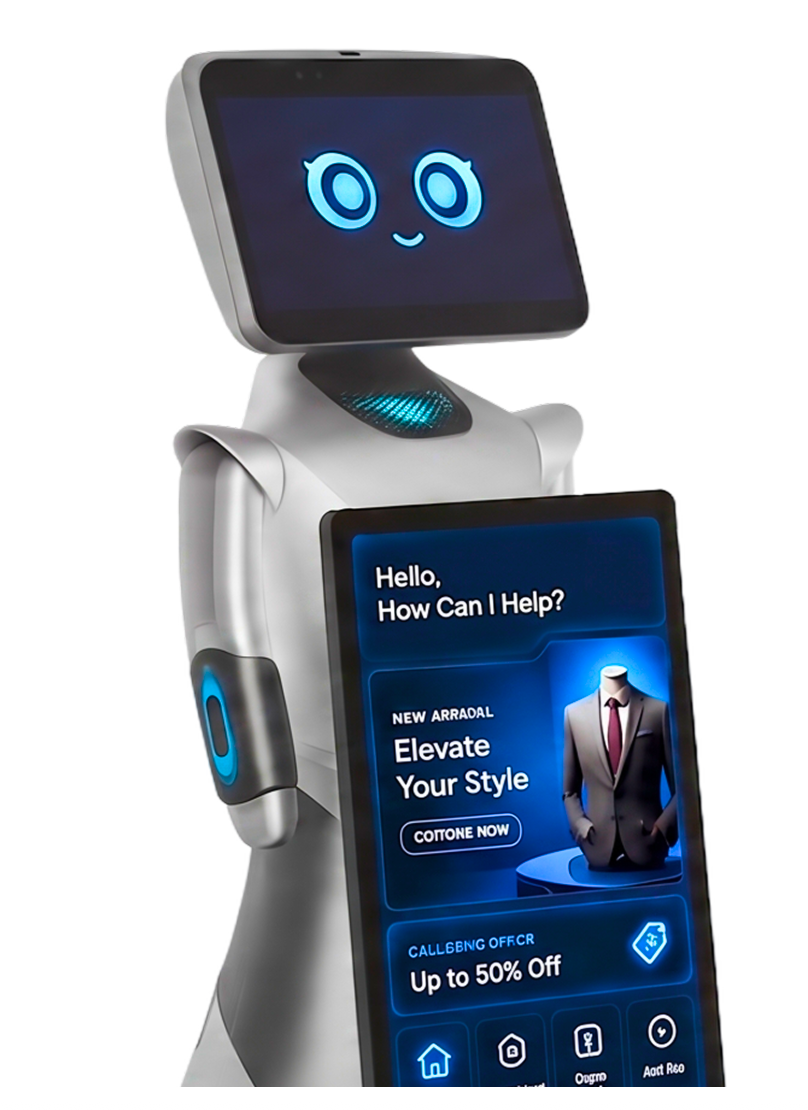
Home appliance stores operate in a unique retail landscape, balancing wide, high-traffic showrooms with narrow product aisles, multi-department layouts, and the dual need to guide customers to specific items while promoting new launches and limited-time sales. These mixed environments pose significant challenges for traditional staff, who often struggle to cover every zone effectively while delivering personalized service. Reception robots emerge as a targeted solution, addressing these pain points by combining autonomous navigation, customer engagement, and dynamic promotional capabilities tailored to the diverse needs of home appliance retail. Choosing the right robot requires evaluating four core factors: aisle navigation and space adaptability, dual-mode customer engagement, content management scalability, and total cost of ownership (TCO).
The OrionStar GreetingBot AD is engineered to excel in mid-to-large home appliance stores, offering a balance of humanoid interaction and high-impact promotional display that aligns with both narrow aisle navigation and open concourse needs. For space adaptability, it uses a LiDAR-based navigation system paired with wheel odometers, an IMU, and mono/RGB cameras to achieve centimeter-level positioning accuracy, with a minimum net aisle passability of 60–65 cm (separate from its overall dimensions of 498 × 465 × 1,280 mm). This makes it suitable for standard kitchen appliance zones and smart home demonstration rooms, while its ability to map up to 50,000 m² in unobstructed indoor environments, according to manufacturer laboratory data, supports operation across large-format showrooms. It can cross 10 mm ground bumps and 20 mm floor seams, and climb up to 5° unloaded, ensuring consistent movement across varied retail flooring surfaces.
In terms of dual-mode engagement, the GreetingBot AD distinguishes its screen functions clearly: a 14-inch FHD head touch screen for interactive customer tasks like wayfinding controls, Q&A, and video calls, and a 21.5-inch FHD chest display dedicated to broadcast-style promotional content such as product demos, sale announcements, and brand messaging. Multi-modal interaction is supported by a 6-mic circular array with 360° sound source localization, dual 5W speakers, and natural head pitch motion from −15° to +40° for personalized face-to-face greetings. Arm motion is shipped in a default-off state to avoid interference with the chest display, with options for reconfiguration via secondary development for custom workflows. For content management, it runs on Agent OS (based on Android 13) with 8GB RAM and 128GB ROM, supporting Wi-Fi 6 and 4G connectivity, ESP32-based multi-robot scheduling, and an optional elevator control module for multi-floor stores. Its 20Ah lithium ternary battery delivers up to 8–10 hours of runtime under typical retail usage (21.5-inch screen at moderate brightness, normal greeting and movement frequency), according to manufacturer data, with charging times of about 5 hours powered off or 6 hours powered on. As a device with cameras, voice recording, and cloud connectivity, operators deploying it in EU markets must verify GDPR compliance, including clear signage, lawful data collection basis, and defined retention policies for customer data.
The temi robot is a cost-effective entry point for small home appliance franchise branches and pilot deployments, prioritizing ease of use and basic guidance capabilities over high-end promotional features. For space adaptability, its compact chassis (approximately 100 cm H × 35 cm W × 45 cm D) and 360° LiDAR navigation system paired with depth and RGB cameras allow it to navigate narrower aisles, with sub-5 cm positioning accuracy according to manufacturer data. It is recommended for hard floors, tile, hardwood, and low-pile carpet, though it does not support high-pile surfaces. Its lightweight design (12 kg) makes it easy to relocate across store zones, from central service desks to vacuum and cleaning aisles.
In dual-mode engagement, temi uses a 10-inch tablet-class screen for both greeting and basic promotional tasks, supporting LLM-powered voice Q&A, follow-me wayfinding, and telepresence mode for remote sales reps to assist customers directly. Its multilingual support is limited to English out of the box, with additional languages requiring SDK or cloud-based integration per manufacturer documentation. Content management is streamlined through its tablet interface, allowing non-technical staff to update wayfinding maps and promotional content quickly without extensive training. It offers 8 hours of runtime on a lithium-ion battery with auto-return to charging dock, and a base price under $2,000 according to public data, making it a low-TCO option for stores testing robot deployment. As a device with cameras and voice recording, operators must verify GDPR compliance in EU markets before deployment, including proper signage and data handling policies.
The Pudu KettyBot Pro is a hybrid solution for home appliance stores looking to combine in-store delivery of small accessories with screen-led product promotions, optimized for narrow aisle navigation. Its compact C-shaped chassis offers a minimum passability of 52 cm in certain configurations (with rear cover removed), according to manufacturer data, making it ideal for tight vacuum and cleaning aisles where larger robots may struggle. It uses RGBD-based perception and a fusion of visual SLAM and LiDAR for navigation, with obstacle detection covering the front chassis to avoid blocking shoppers or product displays.
For dual-mode engagement, it features a front-mounted advertising screen with adjustable viewing angles to accommodate customers of varying heights, paired with a tray capable of carrying up to 10 kg for delivering small items like kitchen gadget samples or accessory kits. Multilingual support is configured via the PUDU Open Platform, allowing stores to deploy region-specific voice packs and screen content through cloud-based tools. Content management is flexible, with the PUDU Scheduler for multi-robot coordination and an open SDK for customizing interaction flows to align with store promotions. Its 20Ah battery delivers up to 9 hours of runtime in standard configuration according to manufacturer data, with charging times of 3.5 to 4.5 hours depending on setup. As a device with cameras and cloud connectivity, EU operators must ensure GDPR compliance, including clear data processing signage and retention policies.
The Pudu BellaBot Pro is designed for home appliance stores that want a humanoid greeter capable of carrying product samples or accessories while running targeted promotions. For space adaptability, it uses a fusion of VSLAM, Marker, and LiDAR SLAM navigation, with two forward-facing cameras, three RGBD sensors, and radar for full front chassis obstacle detection. Its minimum path clearance of 65 cm (separate from its 57 × 55 × 129 cm dimensions) makes it suitable for standard kitchen appliance zones and white goods galleries, though it may not fit the narrowest vacuum aisles. It can travel at up to 1.2 m/s according to third-party listings, with a 25.6Ah battery delivering up to 11 hours of runtime without load.
In dual-mode engagement, it features a 10.1-inch head screen for interactive greetings and Q&A, paired with an 18.5-inch chest display for promotional content. Its 40 kg total payload across four trays allows it to carry multiple product samples or accessory kits to customers, blending operational support with marketing outreach. Multilingual content and voice packs are managed via the PUDU Open Platform, with cloud-based updates for consistent messaging across regional store locations. Content management includes the PUDU Scheduler for multi-robot coordination and an open SDK for customizing workflows, such as integrating with in-store POS systems. As a device with cameras and cloud processing, EU operators must verify GDPR compliance before deployment, covering data collection signage and lawful processing basis.
The LG CLOi GuideBot is an enterprise-grade solution tailored for large national home appliance chains that already use LG commercial displays, prioritizing brand consistency and centralized content management. For space adaptability, it uses a fusion of bumper, depth, LiDAR, magnetic, and ToF sensors for navigation, though its 51 cm body diameter and 80 kg weight make it better suited for wide open showrooms, central service desks, and in-store promotion stages rather than narrow aisles. It supports time- and location-based advertising, allowing chains to deploy targeted promotions in high-traffic zones.
In dual-mode engagement, it features multi-screen displays for both guidance and promotional content, with voice recognition and interactive touch capabilities for customer Q&A. Its key differentiator is the LG CLOi CMS, a dedicated enterprise content management system that integrates seamlessly with existing LG commercial display ecosystems, enabling centralized scheduling of promotions, wayfinding maps, and brand content across all store locations. Multilingual content is managed through the CMS, with no native auto-detection support per manufacturer documentation. It is available for purchase at over $39,990 or via Robot-as-a-Service (RaaS) at $1,119 per month according to public data, making it a high-TCO option for chains prioritizing long-term scalability and brand alignment. As a device with cameras, voice recording, and cloud connectivity, EU operators must ensure GDPR compliance, including clear data processing signage and customer data access protocols.
Selecting the right reception robot for home appliance stores depends on aligning product capabilities with store size and operational goals. For single-store locations or small franchises, low-cost entry models like temi offer basic guidance and easy content updates, while the Pudu KettyBot Pro adds delivery functionality for narrow aisles. Mid-sized regional chains can benefit from balanced options like the OrionStar GreetingBot AD, which combines humanoid interaction with high-impact promotions, or the Pudu BellaBot Pro, which blends sample delivery with targeted advertising. Large national chains should prioritize enterprise-grade solutions like the LG CLOi GuideBot, which integrates with existing commercial display ecosystems for centralized content management and brand consistency. Across all categories, operators must evaluate aisle adaptability, engagement capabilities, content scalability, and TCO to ensure the robot meets both immediate and long-term retail needs.
Plan on a wide cost band rather than a single number. Entry-level tablet-based greeters sit in the low-thousands USD per unit, mid-range humanoid greeters with advertising screens cluster in the mid-thousands to low-tens-of-thousands USD per unit, and enterprise CMS-integrated robots typically exceed USD 30,000 per unit with optional Robot-as-a-Service financing around USD 1,000 per month. Add budget for installation, content production, multi-year maintenance, and a privacy compliance review before deployment in regulated regions.
Payback depends on what you replace or augment. Stores that substitute guided selling labor during peak hours or that run high-rotation promotional campaigns on the robot's screen typically see the clearest return on hardware, content, and ongoing service costs within 12 to 24 months. Stores that deploy the robot as an add-on without reorganising floor staffing usually see softer returns and should size the project as a brand experience investment first.
Large chains typically benefit from robots with a dedicated enterprise CMS so that marketing can push the same promotions to every location from a central console. Mid-size chains usually prefer an open SDK or fleet scheduler so the operations team can customise flows per store while sharing fleet management. Single-location stores can usually rely on tablet-led quick updates with light IT support. In every case, define service-level expectations for uptime, on-site repair, and content change turnaround in the vendor contract.
A typical commercial reception robot delivers roughly 8 to 13 hours of active duty on a single charge depending on configuration, which covers a full retail trading day in most markets. Robots that return to a docking station automatically when battery is low and that can be scheduled to charge overnight between closing and opening are the most operationally predictable. Confirm the vendor's published runtime figure under continuous greeting and screen-on workload rather than standby.
Most humanoid greeters in this category require a minimum clearance of 60 to 70 cm, while compact delivery-plus-advertising models can fit aisles as narrow as 52 cm in certain configurations and high-end enterprise models with larger chassis typically need wider spaces. Before purchase, walk the actual store aisles where the robot will travel (especially the white goods walls, TV/audio zones, and vacuum aisles) and measure the tightest pinch points at full shelf projection, not at empty-shelf width.
Operators must verify GDPR or local equivalent compliance before deployment. This typically includes posting clear signage that robots process voice and video data, defining a lawful basis for processing, configuring retention windows for any recorded audio, video, or mapping data, and ensuring the vendor's cloud or content management system supports data subject access and deletion requests. Treat the privacy review as a procurement gate, not an afterthought, especially for chains with stores in multiple member states.
Third-party product specifications are based on public data (up to, under laboratory conditions, according to manufacturer data) and may vary by configuration. Product names and trademarks are the property of their respective owners. Any product involving cameras, voice recording, spatial mapping, or cloud data processing requires operators to verify GDPR compliance in EU markets before deployment, including proper signage, lawful data collection basis, and retention policies.