

REQUEST DEMO
Robot CATALOG will be sent to your mailbox immediately after submission.
SUBMIT
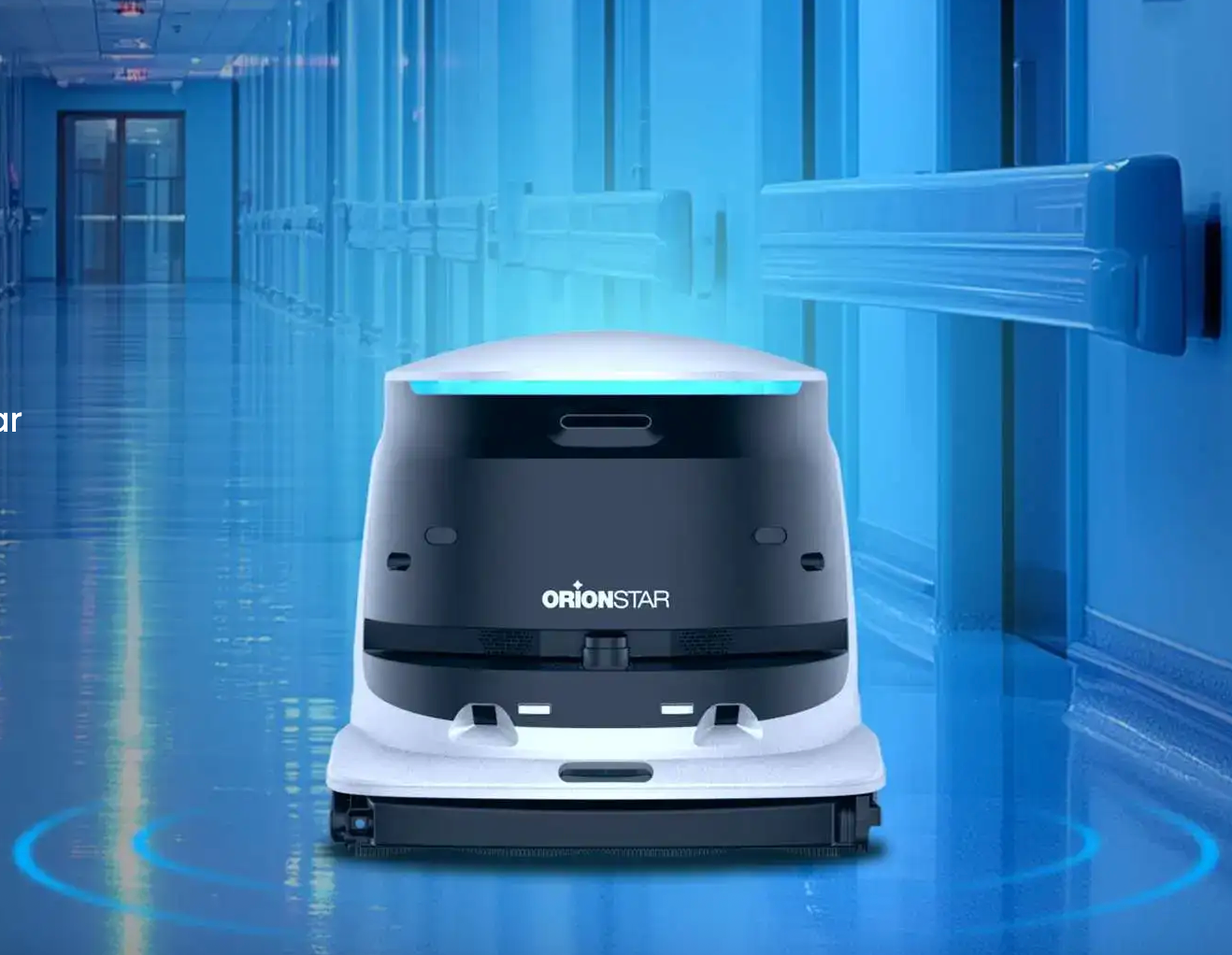
Hospital service hallways are the unseen backbone of clinical operations, supporting patient transport, equipment logistics, supply replenishment, and staff movement around the clock. Unlike public-facing areas, these corridors can never be closed for cleaning, creating persistent challenges for facility teams: constant traffic disrupts manual cleaning efforts, floors accumulate contaminants that increase healthcare-associated infection (HAI) risks, chronic understaffing leaves overnight shifts under-served, and narrow widths require compact cleaning solutions that can navigate tight spaces effectively. Autonomous floor scrubbers offer a data-driven, efficient solution to these pain points, enabling consistent, non-disruptive cleaning while addressing compliance and staffing gaps.
The OrionStar CleaniBot S55 Pro embodies these autonomous cleaning capabilities to address hospital service hallway challenges. Its LiDAR-based navigation system supports map construction up to 10,000 m² under standard test conditions; performance may vary in highly cluttered environments, allowing it to accurately navigate narrow corridors with a minimum passing width of 700 mm, making it suitable for tight turns and small alcoves. The robot’s 15-sensor suite provides 360° obstacle detection, ensuring safe interaction with staff, stretchers, and equipment during both peak and off-peak hours. With a scrubbing efficiency of up to 1,197 m²/h and a runtime of 4.5 hours in scrubbing mode (values measured under standard test conditions; performance may vary based on floor soil level and environment), it can cover large stretches of service hallways in a single cycle before auto-charging, reducing the need for manual oversight.
Patient transport corridors see constant flow of stretchers, wheelchairs, and staff, making manual cleaning nearly impossible during peak hours. The autonomous scrubber can be scheduled for off-peak cleaning, ensuring floors are free of tracked-in contaminants and body fluids that pose HAI risks. Its multi-sensor obstacle avoidance system safely navigates around moving stretchers and staff even if deployed during low-traffic daytime windows.
These corridors are high-risk zones, as floors accumulate contaminants from patients with infectious diseases. Supports infection prevention team protocols by delivering consistent cleaning cycles designed to remove surface contaminants (pathogen reduction efficacy tested per ISO 14644-1). The robot’s self-cleaning system prevents cross-contamination between cleaning cycles, ensuring safe operation across different areas of the hospital.
Equipment logistics routes are used to transport heavy medical devices like IV pumps and ventilators, often resulting in tracked-in dirt and debris. The scrubber’s sweep, vacuum, and mop modes efficiently remove debris and sanitize floors, while its high cleaning efficiency (up to 1,368 m²/h in combined modes) covers large stretches of corridor quickly. Its compact design navigates around parked equipment carts and tight corners without disrupting logistics operations.
Autonomous floor scrubbers integrate seamlessly with existing hospital smart systems to enhance operational efficiency. They can connect to Computerized Maintenance Management Systems (CMMS) to feed cleaning session data into compliance dashboards, linking every task to Joint Commission PE codes and CMS standards for instant survey traceability. For facilities with automated logistics fleets, scrubbers can share defined routes and right-of-way rules with medication delivery robots and AGV linen carts to avoid corridor congestion. Building Management Systems (BMS) can align cleaning schedules with real-time occupancy data, adjusting scrubber routes to avoid peak transport windows or temporary layout changes like mobile furniture. Cloud-based remote monitoring allows facility managers to check cleaning status, adjust routes, and receive alerts from anywhere, reducing on-site oversight needs.
Overall, autonomous floor scrubbers deliver measurable, data-backed sustainability benefits that align with hospital ESG objectives and green building certifications.
Autonomous floor scrubbers offer a data-driven solution to longstanding challenges in hospital service hallway maintenance, improving operational efficiency and cleaning consistency, addressing longstanding challenges of traffic disruption, infection risk, staffing shortages, and compliance. By combining precision navigation, automated scheduling, and data-driven reporting, these robots enable consistent, non-disruptive cleaning that supports both operational efficiency and patient safety. The OrionStar CleaniBot series offers multiple models suited to different hospital scenarios, from narrow service corridors to large public areas, providing facility teams with flexible solutions tailored to their specific needs.