

REQUEST DEMO
Robot CATALOG will be sent to your mailbox immediately after submission.
SUBMIT
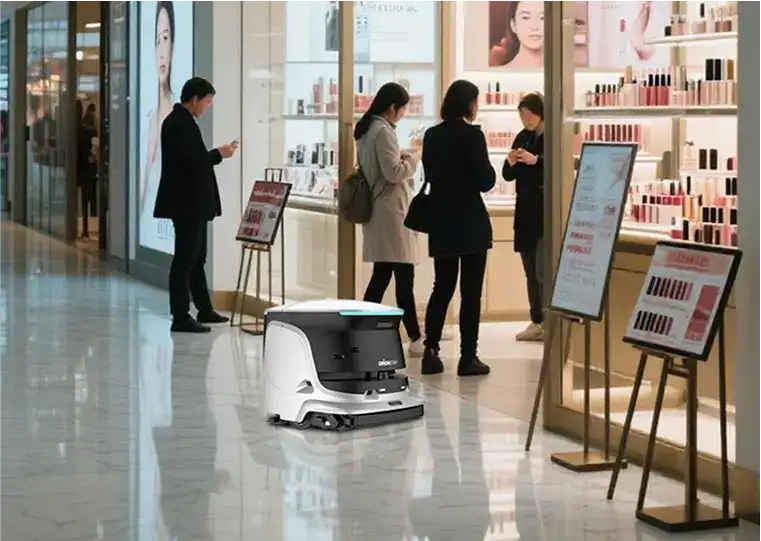
Big-box retail operations face persistent challenges maintaining clean, safe main aisles amid tight profit margins, chronic labor shortages, and non-stop foot traffic from opening to closing. These high-traffic zones accumulate debris, spills, and packaging waste throughout the day, yet cleaning crews are often scheduled overnight, leaving long windows where visible contamination harms customer perception and increases slip-and-fall liability. Additionally, strict compliance standards like GDPR for data handling add complexity to adopting smart cleaning tools. Commercial cleaning robots emerge as a scalable solution to address these pain points, offering consistent, automated cleaning that aligns with operational and regulatory needs.
The OrionStar CleaniBot S55 Pro embodies these commercial cleaning robot capabilities through its integrated design tailored for large retail spaces. Equipped with LiDAR navigation that supports map construction up to 10,000 m² according to manufacturer data, it can autonomously navigate complex main aisle layouts, updating maps in real-time to adapt to changing obstacles like promotional displays. Its multi-mode cleaning system offers sweeping, scrubbing, vacuuming, and mopping functions, with cleaning efficiency reaching up to 1,368 m²/h in sweep and vacuum modes, enabling it to cover expansive main aisles quickly. Additionally, it features auto-charging with a charging time of less than 4 hours, ensuring it can resume tasks without manual intervention to maintain consistent cleaning coverage throughout operating or overnight hours.
Center aisles see constant foot traffic, accumulating dry debris and product spills that can go unnoticed during peak hours. The OrionStar CleaniBot S55 Pro uses its LiDAR navigation to navigate narrow gaps between shelves, with a minimum passing width of 700 mm, and switches between sweep/vacuum and mopping modes to address both loose debris and liquid spills efficiently. Its multi-sensor obstacle avoidance ensures it safely maneuvers around shoppers and restocking carts without interrupting store operations.
Perimeter aisles often collect dust and dirt in hard-to-reach corners and along baseboards, which manual cleaning may miss. The CleaniBot S55 Pro’s line lasers enable it to clean within 5 cm of walls, maximizing coverage of these overlooked areas. Its long runtime of up to 28 hours in dust mopping mode allows it to cover extensive perimeter zones in a single session, reducing the need for frequent recharging.
Cross-aisles near fresh and frozen departments are prone to sticky spills and tracked-in ice or water, creating high slip-and-fall risks. The robot’s power scrubbing mode delivers deep cleaning to remove stubborn residues, while its stereo camera cliff detection prevents it from entering wet floor areas near freezers that could cause slips or damage the robot. Its real-time monitoring also alerts supervisors to frequent spill zones, allowing for proactive cleaning adjustments.
End-cap display zones are high-traffic areas where promotional products often lead to packaging waste and spills, impacting the visual appeal of key marketing spaces. The CleaniBot S55 Pro’s multi-mode cleaning system adapts quickly to these dynamic zones, switching from sweep/vacuum to scrubbing mode as needed, and its compact 650 × 580 × 550 mm dimensions allow it to navigate around temporary displays without disrupting promotional setups. Its auto-charging capability ensures it can return to these zones regularly to maintain clean, attractive displays throughout the day.
Commercial cleaning robots like the OrionStar CleaniBot S55 Pro can integrate seamlessly with big-box retailers’ existing digital ecosystems to enhance operational efficiency. Their connectivity features support integration with facility management reporting layers, enabling multi-site operators to track cleaning utilization and performance benchmarks across stores. IoT and RFID signals can be leveraged to align cleaning schedules with restocking activities and customer flow analytics, ensuring robots clean during low-traffic windows to minimize disruption. Additionally, real-time data on water, energy, and chemical consumption can feed into sustainability reporting platforms like Salesforce Net Zero Cloud, simplifying compliance with CSRD and SEC climate disclosure requirements. Fleet management dashboards also allow remote monitoring of cleaning routes, converting floor cleaning into a transparent, plannable activity that aligns with broader retail operational goals.
By automating floor cleaning with eco-friendly commercial robots, big-box retailers can achieve measurable ESG improvements, generate auditable data for regulatory disclosures, and align their operations with global sustainability frameworks like GRI and CSRD.
Commercial cleaning robots are transforming how big-box retail operations maintain clean, safe main aisles, addressing longstanding labor, cost, and compliance challenges with automated, consistent solutions. The OrionStar CleaniBot series offers a range of models tailored to different retail environments, from compact spaces to expansive main aisles, providing flexible options for retailers seeking to optimize their cleaning operations. As the industry continues to embrace automation, these robots will play an increasingly critical role in enhancing customer experience, reducing operational risks, and supporting sustainable retail practices.