

REQUEST DEMO
Robot CATALOG will be sent to your mailbox immediately after submission.
SUBMIT
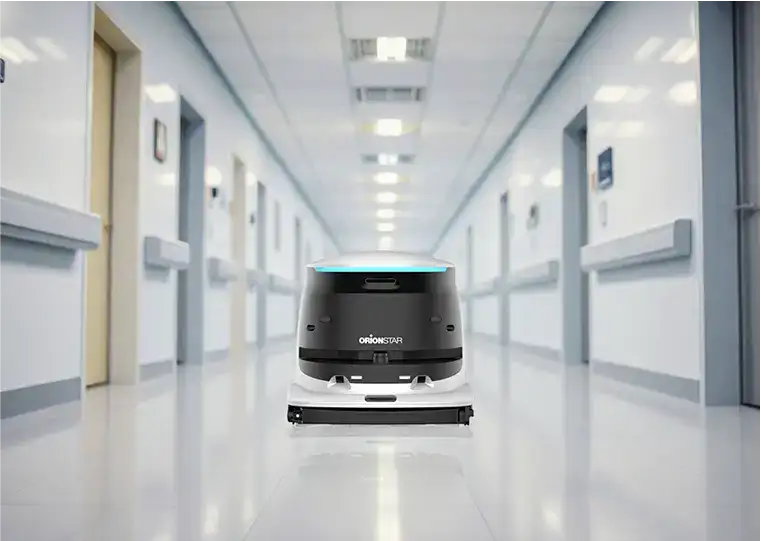
Healthcare facilities face unique and pressing cleaning challenges that demand precision, consistency, and adaptability. From high-traffic lobbies and waiting areas to quiet patient corridors and acute-care wards, maintaining rigorous infection control is non-negotiable to reduce pathogen transmission. At the same time, cleaning operations must avoid disrupting patient rest, navigate around medical equipment and constant foot traffic, and accommodate mixed floor types ranging from hard tile to low-pile carpet. Automatic floor scrubbers have emerged as a critical solution to these challenges, offering autonomous, efficient, and customizable cleaning workflows that align with healthcare’s strict hygiene and operational requirements.
The OrionStar CleaniBot S55 Pro is positioned as a compact, multi-mode autonomous floor scrubber ideal for routine cleaning across diverse healthcare zones, including lobbies, corridors, waiting areas, and patient floors. Its integrated InstantClean Floor Care System supports sweeping, scrubbing, vacuuming, mopping, and disinfection-related cleaning workflows, making it adaptable to mixed floor types commonly found in healthcare buildings. For hard floors like tile and linoleum, it offers scrubbing and power scrubbing modes with up to 1,197 m²/h cleaning efficiency, while sweep and vacuum modes handle low-pile carpet with up to 1,368 m²/h efficiency. The robot supports hospital-grade disinfectants, and its removable, washable wastewater tank with a strainer design helps reduce cross-contamination risks, aligning with strict infection control protocols.
In terms of noise profile, the CleaniBot S55 Pro excels in patient-centric environments, operating at 45 dB in dust mopping mode and 55 dB in scrubbing mode – levels quiet enough to avoid disrupting patient rest even during daytime or overnight cleaning. Its compact dimensions (650 × 580 × 550 mm) and 700 mm minimum passing width make it highly maneuverable, allowing it to navigate narrow patient corridors and around furniture and medical equipment without blocking access to care. The robot’s multi-sensor navigation system, including LiDAR, stereo cameras, and ultrasonic sensors, ensures safe operation in high-traffic areas, detecting and avoiding people and obstacles in real time.
For operational continuity, the CleaniBot S55 Pro offers extended runtime depending on the cleaning mode: up to 4.5 hours for scrubbing, and up to 28 hours for dust mopping, with automatic recharging supported via its charging dock. It also includes cloud-based management capabilities, with Wi-Fi and 4G connectivity enabling remote deployment, maintenance, and performance reporting. EU operators should verify GDPR compliance for its cloud-based mapping and telemetry features, as data is processed and stored outside the EU.
Avidbots explicitly markets the Neo 2W to healthcare facilities, with documented deployments in hospitals, ICUs, and acute-care wards, positioning it as a solution that addresses both floor cleaning and infection control needs. Its core capabilities include fully autonomous floor scrubbing with twin cylindrical or disc heads, and an optional 3D surface disinfection add-on (UV-C or electrostatic, region-dependent) that complements floor care to support broader pathogen reduction. The robot is compatible with hospital-grade disinfectants and features large solution (109 L) and recovery (135 L) tanks, making it suitable for extended cleaning sessions across large healthcare areas.
While its noise level is not publicly specified, operators should validate it before deploying in quiet patient zones to ensure alignment with hospital noise policies. The Neo 2W’s dimensions (152 cm length, 76–94 cm width) make it a medium-sized system that balances maneuverability and coverage, capable of navigating most healthcare corridors and waiting areas while avoiding obstacles via its proprietary Avidbots Autonomy software with a 360° sensor suite. It is designed to operate safely in high-traffic environments, dynamically rerouting around people and medical equipment to maintain consistent cleaning workflows.
For operational continuity, the Neo 2W supports battery-swap functionality, allowing for 24/7 multi-shift operation critical for healthcare facilities needing round-the-clock cleaning coverage. Its Avidbots Command Center cloud platform provides remote fleet management, route programming, and performance reporting, with real-time monitoring and assistance available. EU operators must verify GDPR compliance, as the platform collects cleaning maps and operational telemetry stored in non-EU servers; a formal Data Protection Impact Assessment (DPIA) is recommended for patient-area deployments.
The Nilfisk Liberty SC60 is a ride-on autonomous floor scrubber positioned for healthcare-adjacent environments, widely deployed in hospitals and clinical facilities via global distributor networks. It aligns with infection control protocols through its 28-inch scrub deck for efficient wet cleaning and disinfection, and EcoFlex features that reduce water and detergent usage, supporting sustainability goals while maintaining hygiene standards. The robot holds CSI/ANSI 336 third-party safety certification, ensuring safe operation near patients and staff, and its BrainOS-powered autonomy enables continuous cleaning under constant foot traffic.
A key strength of the Liberty SC60 is its low noise profile, operating at 57 dB(A) per IEC 60335-2-72 – among the quieter options in the ride-on scrubber class, making it well suited for nighttime cleaning in noise-sensitive patient areas. Its dimensions (169.5 cm length, 81.1 cm width) require a minimum turnaround aisle width of 1.88 m, making it better suited for larger corridors and open areas rather than narrow patient rooms. Its 360° sensor suite supports proactive obstacle detection, allowing it to navigate around waiting-area furniture and medical equipment safely.
Operational continuity is supported by a battery runtime of 4.5–5.5 hours (application dependent), with automatic recharging capabilities. The BrainOS Connect cloud platform offers fleet management, route programming, and OTA updates, enabling remote monitoring and workflow adjustments. EU operators should verify GDPR compliance, as the platform collects route maps and telemetry hosted on US-based servers, requiring checks on cross-border data transfer rules and processor-controller agreements.
The Tennant T16AMR is an industrial-positioned ride-on scrubber that is sold to healthcare facilities as part of a broader portfolio, though it is not explicitly validated for acute-care use. It aligns with infection control needs through its ec-H2O NanoClean system, which uses electrolyzed water to minimize chemical disinfectant carryover, and Duramer Hygienic Tanks designed for easy sanitization. Its large scrub paths (36–46 inches) offer high productivity, making it suitable for large non-patient healthcare areas like concourses, loading bays, and central supply corridors.
However, the T16AMR’s noise level of 71 dBA at the operator’s ear (cylindrical mode) may not align with typical hospital noise policies for sensitive patient areas, making it better suited to non-patient zones where noise constraints are less strict. Its large dimensions (203 cm length, 107 cm width) and 1.45 m pass-through clearance mean it fits larger non-patient areas better than narrow patient corridors and crowded emergency departments. While it features a BrainOS-powered navigation system with safety certifications (UL/CSA 60335-2-72 and CSA/ANSI C22.2 No. 336), its size and noise profile restrict its healthcare deployment to specific non-patient zones.
For operational continuity, the T16AMR offers up to 5.5 hours of Li-ion runtime, with cloud-based fleet management via BrainOS Connect. EU operators must verify GDPR compliance for its cloud-stored operational data. It is important to note that the ec-H2O system may not support all EPA-registered hospital-grade disinfectants, so operators should confirm chemistry compatibility with Tennant before deployment.
The Kärcher KIRA CV 60 is an autonomous dry vacuum sweeper explicitly listed for use in healthcare facilities, positioned as a supplementary tool for dust and debris control in high-traffic areas like lobbies and waiting rooms. Its HEPA-rated vacuum bag improves indoor air quality by capturing fine particles, supporting infection control by reducing dust-borne pathogens. However, it cannot perform wet scrubbing or dispense disinfectant solution, so it cannot meet core healthcare infection control requirements on its own, requiring pairing with a wet scrubber for comprehensive floor care.
Its noise level is not publicly specified, so operators should request measured dBA figures before deploying in quiet patient areas. The KIRA CV 60’s dimensions (127 cm length, 76 cm width) make it maneuverable in most healthcare corridors, though its heavy weight (386 kg) may require floor load rating checks for patient floors. Its BrainOS-powered navigation system includes smart obstacle detection, enabling safe operation alongside foot traffic and furniture.
Operational continuity is supported by an area performance of up to 1,672 m²/hr, with cloud-based fleet management via BrainOS Connect. EU operators must verify GDPR compliance for its mapping and operational data stored on US servers. As a dry-only system, it is best used for nighttime dust control between wet disinfection cycles, rather than as a primary floor cleaning solution for healthcare facilities.
When evaluating automatic floor scrubbers for healthcare buildings, four core factors drive the selection process: hygiene and infection control alignment, noise profile, space maneuverability, and operational continuity. For acute-care patient zones and quiet areas, compact, low-noise models like the OrionStar CleaniBot S55 Pro and Nilfisk Liberty SC60 stand out, offering quiet operation, maneuverability, and integrated disinfection workflows. Facilities needing round-the-clock coverage across mixed zones may prioritize the Avidbots Neo 2W, with its battery-swap capability and documented acute-care deployments. For large non-patient areas like concourses and loading bays, the Tennant T16AMR delivers high productivity, though its noise and size restrict it to non-patient zones. The Kärcher KIRA CV 60 serves as a valuable supplementary tool for dust control, but requires pairing with a wet scrubber for full infection control compliance. EU operators must prioritize GDPR verification for all cloud-enabled models to ensure data privacy compliance.
Autonomous floor scrubbers like the CleaniBot S55 Pro reduce repetitive manual cleaning tasks by handling routine floor care across large areas, freeing EVS staff to focus on high-touch surfaces and specialized infection control tasks. With cleaning efficiencies up to 1,368 m²/h, these robots cover more ground in less time, reducing the workload on stretched teams. They also operate autonomously on scheduled shifts, including overnight or low-staff periods, to maintain consistent cleaning standards without additional labor.
Healthcare facilities should prioritize models with third-party safety certifications like CSI/ANSI 336 (e.g., Nilfisk Liberty SC60) to ensure safe operation near patients and staff. For infection control, choose robots compatible with hospital-grade disinfectants and featuring hygienic design elements like removable, washable tanks (CleaniBot S55 Pro). EU facilities must verify GDPR compliance for cloud-based fleet management systems, including data transfer mechanisms and retention policies, as all major platforms use non-EU servers.
Industry benchmarks show that autonomous floor scrubbers in healthcare typically deliver ROI within 12 to 24 months, driven by labor savings from reduced manual floor cleaning hours. This timeline varies based on facility size, traffic volume, and existing staffing costs, with larger high-traffic facilities seeing faster returns. Robots with high cleaning efficiency (like CleaniBot S55 Pro’s 1,368 m²/h in sweep/vacuum modes) maximize coverage per hour, accelerating labor cost recoupment.
Yes, models like CleaniBot S55 Pro, Nilfisk Liberty SC60, and Avidbots Neo 2W are designed to operate safely in high-traffic healthcare areas with continuous foot traffic. They use multi-sensor navigation systems to detect and avoid people, furniture, and medical equipment, maintaining consistent cleaning paths without interruptions. Many include integrated disinfection workflows and support hospital-grade detergents, helping facilities meet strict infection control requirements while minimizing disruption to patient care.
Noise levels vary by model and cleaning mode: CleaniBot S55 Pro operates at 45 dB in dust mopping mode and 55 dB in scrubbing mode, while Nilfisk Liberty SC60 has a 57 dB(A) sound level, both suitable for quiet patient areas. Tennant T16AMR’s 71 dBA level exceeds typical nighttime noise targets for patient care areas, making it better suited to non-patient zones like concourses. Always verify noise specifications for the specific cleaning mode needed, as quieter modes (like ECO Vacuum or Dust Mop) are ideal for sensitive areas.
Autonomous floor scrubbers offer configurable cleaning modes to handle mixed floor types: CleaniBot S55 Pro switches between scrubbing for hard floors (tile, linoleum) and sweep & vacuum for low-pile carpet, with no-tool mode switching for efficiency. Avidbots Neo 2W supports all common hospital floor surfaces, while Nilfisk Liberty SC60’s EcoFlex features adjust water and detergent usage for different materials. This flexibility allows facilities to use one robot for multiple zones, reducing the need for specialized cleaning equipment.
Third-party product specifications are based on public data (up to, under laboratory conditions, according to manufacturer data) and may vary. Product names and trademarks are the property of their respective owners. For any product involving cameras, voice recording, mapping, or cloud data processing, operators must verify GDPR compliance prior to deployment.