

REQUEST DEMO
Robot CATALOG will be sent to your mailbox immediately after submission.
SUBMIT
Convention centers are dynamic, high-traffic venues that host a constant stream of events, from large exhibitions to intimate meetings, requiring rigorous cleaning to maintain a professional appearance while maximizing booking capacity. Core challenges include tight post-event turnaround windows where floors must be prepared quickly for the next gathering, mixed hard and carpeted floor layouts that demand specialized cleaning methods, cleaning during occupied hours without disrupting attendees, and tackling stubborn stains like food and beverage spills or adhesive tape residue from booth setups. Selecting the right automatic floor scrubber is critical to addressing these pain points, as it can streamline operations, reduce labor costs, and ensure consistent cleaning results across diverse spaces. This article evaluates representative models based on key procurement factors, tailored to the global market including Europe, the US, and Asia.
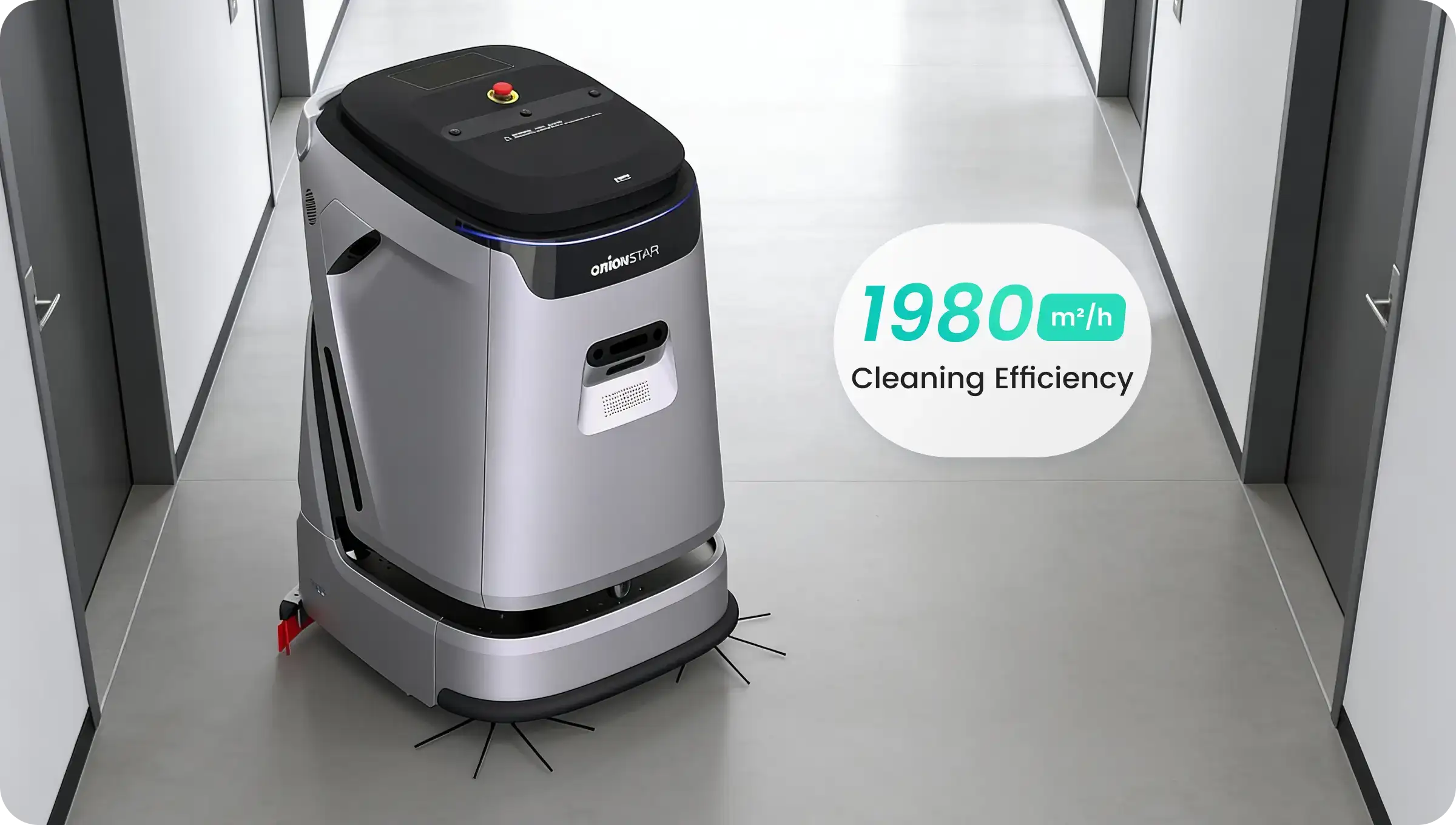
The OrionStar CleaniBot C5 is a heavy-duty wet scrubbing robot designed to meet the demands of large convention center spaces like exhibition halls and concourses. According to manufacturer data, it features a dual-rolling brush system with up to 25 kg of downward scrub pressure, capable of removing up to 95% of heavy grime, food spills, and tape residue in a single pass—ideal for post-event cleaning where time is limited. With a maximum cleaning capacity of up to 1,980 m² per hour, it can cover vast hard-floor areas efficiently, cutting down on turnaround time between events. Its combined 90 L clean and waste water tank minimizes the need for frequent refills and emptying, further reducing downtime during critical cleaning cycles.
Beyond productivity, the CleaniBot C5 operates at a noise level of less than 68 dB(A), making it suitable for use during occupied hours in concourses or pre-function areas without disturbing attendees or staff. Its fully autonomous system can map spaces up to 10,000 m², plan optimal cleaning paths, and automatically dock at a workstation for refueling, drainage, and self-cleaning. The workstation’s high-pressure internal tank rinsing prevents odor and blockages, supporting multi-shift operation for busy venues. Compatible exclusively with hard surfaces like concrete, tile, and vinyl, it pairs effectively with dry vacuum robots to cover carpeted areas within the convention center.
The Avidbots Neo 2W is a large-format autonomous wet scrubber built for vast open hall floors and loading bays in convention centers, where heavy debris and frequent layout changes are common. Its industrial-grade design includes a Debris Diverter to reduce clogs from large debris found in loading bays and a Bulk Navigator that adapts to shifting environments—critical for post-exhibition teardowns where booths and equipment are moved regularly. According to manufacturer data, it offers 4–6 hours of runtime per charge, extendable via swappable batteries, and features large 109 L solution and 135 L recovery tanks, minimizing stops for refills or emptying during long cleaning sessions.
Powered by the Avidbots Autonomy AI platform, the Neo 2W uses a 360° sensor suite for real-time obstacle detection, operating safely around pallets, equipment, and staff in busy loading bays. It supports both cylindrical and disc cleaning heads, allowing customized cleaning for different levels of grime on hard floors. Available across Europe, the US, and Asia via a global distributor network, it is a reliable choice for venues needing high-throughput cleaning of large hard-floor zones. Note that it is not suitable for carpeted areas, so it should be integrated into a fleet that includes dry vacuum robots for complete venue coverage.
The Nilfisk Liberty SC60 is an established-brand autonomous wet scrubber ideal for consistent route-based cleaning of concourses and back-of-house areas in convention centers. Powered by BrainOS, a widely adopted autonomous operating system in commercial cleaning robotics, it offers reliable obstacle detection and cloud-based software updates to maintain performance over time. Its largest scrub deck among comparable BrainOS-enabled models maximizes productivity in large open hard-floor spaces, supporting efficient post-event turnaround by covering more area per pass.
Deployed globally in large commercial spaces like airports—an environment analogous to convention centers—it has a strong distribution network across Europe, the US, and Asia. Compatible only with hard floors, it excels at handling heavy foot traffic and occasional spills common in concourses and back-of-house areas. Since it uses BrainOS for mapping and cloud data processing, operators must verify GDPR compliance before deployment in European venues to ensure adherence to data privacy regulations. Its predictable route planning ensures consistent cleaning results, making it a trusted option for back-of-house operations where reliability is a top priority.
The ICE Co-Botics Cobi 18 is a compact autonomous wet scrubber tailored for tight, occupied spaces like registration lobbies, pre-function areas, and narrow service corridors in convention centers. Its ultra-compact size (48 cm x 48 cm) allows it to navigate around furniture, signage, and attendees without disruption, and its noise level of 66–70 dB(A) makes it suitable for use during events or registration periods. Teach-once route mapping ensures consistent cleaning in small, frequently used areas, while Fill-in Mode provides autonomous area coverage after perimeter mapping, reducing manual input for staff.
According to manufacturer data, the Cobi 18 offers 90 minutes of runtime per charge and a cleaning productivity of 800 sq. m. per hour, making it ideal for targeted cleaning tasks in occupied zones. Its constant fresh cleaning solution flow ensures streak-free, dry floors—critical for maintaining a professional appearance in registration lobbies where first impressions matter. Available across Europe, the US, and Asia, it complements larger scrubbers by handling tight spaces that are hard to reach with industrial-grade models. Note that it is only compatible with hard floors and requires frequent recharging for large-area cleaning.
The SoftBank Robotics Whiz is an autonomous dry vacuum sweeper specialized for carpeted meeting rooms and ballrooms in convention centers, where wet scrubbing is not feasible. It fills a critical gap in convention center cleaning, addressing carpeted spaces where hard-floor scrubbers cannot operate without damaging the surface. Powered by BrainOS, it offers adaptive route planning and real-time performance tracking, ensuring thorough cleaning of embedded dirt from carpets.
Deployed in conference spaces and hotels globally, it frees staff to focus on high-value cleaning tasks like restroom maintenance or attendee assistance during events. Since it uses BrainOS for mapping and cloud data processing, operators must verify GDPR compliance before deployment in European venues. While some operational specs are not publicly available, its specialized dry vacuum capability makes it a valuable complement to wet scrubbers in a comprehensive convention center cleaning fleet, pairing with wet scrubbers to cover all floor types and ensure complete venue cleanliness.
Selecting the right automatic floor scrubber for convention centers requires a tailored approach that aligns with the venue’s specific space types, cleaning needs, and operational constraints. For large open hard-floor zones like exhibition halls and loading bays, heavy-duty wide-coverage models such as the OrionStar CleaniBot C5 or Avidbots Neo 2W are recommended for their high productivity and debris-handling capabilities, which support fast post-event turnaround. For tight, occupied spaces like registration lobbies and pre-function areas, compact low-noise units like the ICE Co-Botics Cobi 18 are ideal for cleaning without disrupting attendees. For carpeted areas like meeting rooms and ballrooms, dedicated dry vacuum robots like the SoftBank Robotics Whiz are necessary to avoid surface damage and ensure thorough cleaning. For venues with mixed surfaces, combining specialized models is the most effective strategy to ensure comprehensive coverage, while also verifying GDPR compliance for any robot with mapping or cloud data processing capabilities to meet regional data privacy requirements.
Automatic floor scrubbers reduce labor costs by eliminating manual cleaning for large, repetitive tasks, freeing staff to focus on high-touch areas critical for attendee experience. Faster cleaning speeds (up to 1,980 m² per hour for models like the OrionStar CleaniBot C5) cut post-event turnaround times, enabling convention centers to host more events annually and boost revenue. Predictable cleaning schedules and autonomous operation minimize downtime between events, while durable designs reduce long-term maintenance costs compared to frequent manual equipment replacement. Industry estimates suggest a positive ROI is typically achieved within 12–24 months, depending on facility size and event frequency.
First, verify that the robot’s navigation and data processing systems (such as BrainOS used by Nilfisk Liberty SC60 and SoftBank Whiz) adhere to GDPR requirements, including data minimization and secure storage of mapping or sensor data. Collaborate with the manufacturer to obtain documentation on data handling practices, including how location data is collected, stored, and deleted. Ensure staff training covers GDPR protocols for robot operation, such as restricting data access to authorized personnel only. Conduct regular audits of cloud-based features (if applicable) to maintain compliance with evolving GDPR regulations.
According to industry reports, the TCO for automatic floor scrubbers suitable for convention centers ranges from $20,000 to $60,000 over a 5-year period, including purchase price, maintenance, battery replacement, and software subscriptions. In comparison, manual cleaning for the same facility size typically costs 2–3 times more annually due to ongoing labor expenses. Models like the OrionStar CleaniBot C5 offer lower long-term costs with durable components (e.g., a fan rated for 10,000+ hours) and minimal downtime from automatic self-cleaning stations. For high-traffic convention centers, TCO savings often offset the initial investment within two years of deployment.
Yes, combining specialized models allows full coverage of convention center environments: wet scrubbers like the OrionStar CleaniBot C5 or Nilfisk Liberty SC60 clean hard floors (exhibition halls, concourses, loading bays), while dry vacuum robots like SoftBank Whiz target carpeted spaces (ballrooms, meeting rooms, pre-function areas). The recommended route strategy is to first deploy dry vacuum robots on carpeted areas to remove loose debris, then use wet scrubbers on hard floors to tackle spills and stains. For mixed zones, program robots to switch modes or use dedicated units to avoid cross-contamination and ensure optimal cleaning results.
Most industrial-grade automatic floor scrubbers operate at noise levels between 66–70 dB(A), comparable to normal conversation. The OrionStar CleaniBot C5 has a noise level of less than 68 dB(A), while the ICE Co-Botics Cobi 18 operates at 66–70 dB(A)—both are suitable for use in occupied spaces like registration lobbies or pre-function areas without disturbing attendees. Higher-capacity units may be reserved for post-event teardowns when spaces are unoccupied. Always refer to manufacturer data for exact noise specifications.
Automatic floor scrubbers with high scrubbing pressure (like the OrionStar CleaniBot C5’s 25 kg downward pressure) and dual-rolling brush systems can remove up to 95% of heavy stains, including food spills and tape residue, in a single pass. Fast cleaning speeds (up to 1,980 m² per hour for the CleaniBot C5) and large tank capacities (90 L combined clean/waste water for CleaniBot C5) minimize downtime from refills and emptying, supporting quick post-event turnaround. Autonomous route planning and self-docking stations further streamline operations, allowing robots to clean continuously without manual intervention between events.
The OrionStar CleaniBot C5 is a high‑performance, industrial‑grade autonomous floor‑scrubbing cleaning robot designed for medium‑to‑large commercial and industrial environments such as warehouses, factories, shopping malls, hospitals, campuses, and transportation hubs.
Core specifications Dimensions: about 820 × 680 × 1,130 mm, with a net weight of 170 kg.
Cleaning width: 550 mm main brush, giving it a maximum cleaning area capacity of up to 1,980 m² per hour.
Water‑tank system: combined 90 L capacity (45 L clean water + 45 L waste water), which reduces refills and downtime.
Battery: 24 V, 80 Ah, with a scrubbing runtime of about 3 hours and a mopping runtime of up to 8 hours; supports around 1.5 hours of fast charging.
Cleaning performance and design Scrubbing pressure: 25 kg of downward scrubbing pressure using a dual‑rolling‑brush system, enabling a “one‑pass” removal of heavy oil, grime, and stubborn stains with a reported dirt‑cleaning rate of about 95%.
Cleaning modes: scrubbing, dust‑mopping, and water absorption, allowing the machine to sweep, scrub, and vacuum or mop in a single cycle.
Debris and waste handling: can pick up debris up to about 3 cm in height and includes a 1.8 L dust bin for dry waste.
Automation and docking station Fully autonomous operation: the robot can map an area of up to 10,000 m², plan optimal cleaning paths (“Cloud Learning”‑style optimization), and automatically dock at a station for refueling, drainage, and self‑cleaning.
Workstation features: automatic clean‑water refilling, waste‑water discharge, and high‑pressure internal tank rinsing; the waste‑water tank can self‑clean in roughly 4 minutes, helping to prevent odor and blockages.
Auto‑charging: supports automatic recharging when the battery is low, enabling continuous multi‑shift operation in large venues.
Mobility, safety, and adaptability Mobility: max operating speed about 1.2 m/s, with the ability to climb obstacles up to 15 mm and manage slopes (up to 5° loaded, 8° unloaded).
Minimal passing width: approximately 880 mm, so it can move through typical corridors and doorways.
Noise level: less than 68 dB(A), making it suitable for use in busy public spaces without causing excessive disturbance.
Safety and environment: uses multiple sensors and a smart obstacle‑avoidance system to ensure safe operation around people and equipment.
Typical use cases and advantages Target environments: factories, logistics warehouses, office buildings, shopping malls, hospitals, transportation hubs, and large hospitality venues.
Key advantages:
High‑efficiency, heavy‑duty scrubbing for oil‑stained or high‑traffic industrial floors.
Reduced labor workload and predictable cleaning schedules due to full autonomy and a durable, long‑life design (e.g., a fan rated for 10,000+ hours).
Flexible deployment with optional mobile water tanks that do not require building plumbing modifications.