

REQUEST DEMO
Robot CATALOG will be sent to your mailbox immediately after submission.
SUBMIT
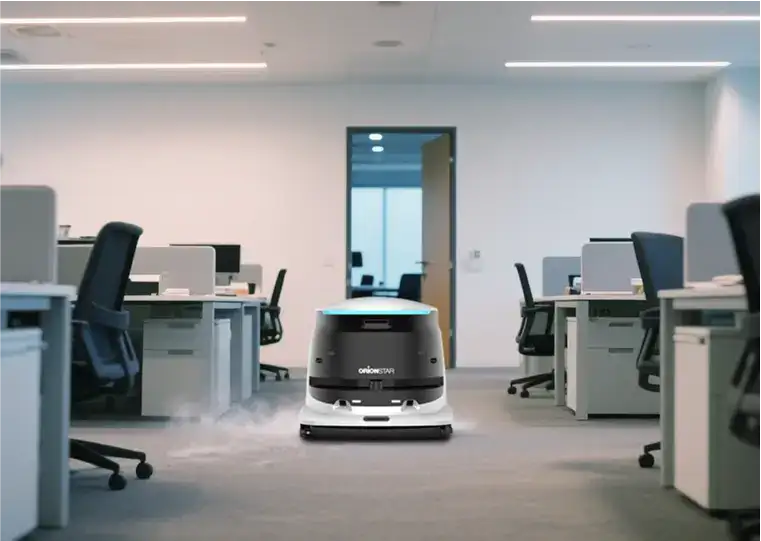
Maintaining a pristine environment across business campuses, mixed-use commercial real estate, and modern office buildings requires strategic equipment selection. Facility managers face unique spatial and operational challenges that cannot be solved by traditional industrial sweepers. Deploying commercial cleaning robots for corporate offices has become an essential strategy to ensure consistent cleanliness while optimizing human labor for high-touch tasks. Selecting the appropriate autonomous machine demands a careful evaluation of the facility's specific layout, flooring types, and acoustic requirements.
Quiet operation is a critical factor for any equipment deployed during standard working hours. Facility managers must recognize that low decibel output is vital for offices, and it is a misconception to generalize that all commercial robots are loud. Furthermore, multi-mode flexibility matters immensely because corporate environments frequently mix hard floors in lobbies with carpeted areas in boardrooms and corridors. A compact body and narrow passing width are equally important, as the robot must navigate standard office doorways, tight cubicle aisles, and busy pedestrian paths safely and unobtrusively.
The OrionStar CleaniBot S55 Pro represents a highly versatile approach to automated maintenance, offering multi-mode scrubbing, vacuuming, and dust mopping within a single unit. This design directly addresses the reality that corporate offices mix hard floors and carpets throughout their floor plans. By integrating both wet and dry cleaning capabilities, this robot navigates diverse surfaces seamlessly, ensuring that facility managers do not have to deploy multiple single-purpose machines across different zones of a business campus.
Beyond its multi-surface functionality, the CleaniBot S55 Pro features a compact body with a narrow 700 mm passing width. This specific dimension allows the robot to easily pass through standard office doorways and maneuver within constrained cubicle corridors. Additionally, the system is engineered for quiet operation, ensuring that it can function effectively during busy daytime shifts without disrupting employee focus or meetings, making it a highly suitable option for mixed-use commercial real estate across global markets.
The SoftBank Robotics Whiz functions as a commercial autonomous vacuum specifically tailored for office carpets. Its primary engineering focus centers on dry vacuuming rather than wet scrubbing, which serves particular zones within a corporate building extremely well. By targeting dust and debris embedded in carpet fibers, this robot helps maintain air quality and floor aesthetics in boardrooms, private offices, and carpeted hallway stretches.
Facility managers must keep in mind that multi-mode flexibility matters because offices mix hard floors and carpet, meaning facilities with mixed surfaces typically require supplementing vacuum-only units with additional scrubbing equipment. While the Whiz handles carpeted environments proficiently, it will need to be paired with dedicated scrubbing equipment for the hard-surfaced lobbies, cafeterias, and restrooms found within the same facility. Nevertheless, its relatively compact design allows it to navigate tight office layouts effectively as part of a broader, multi-machine cleaning strategy.
The Avidbots Neo is established as a heavy-duty autonomous floor scrubber intended primarily for large industrial-grade floors with full coverage path planning. Its robust construction allows it to tackle expansive, open hard floors efficiently, utilizing advanced navigation to ensure no section of a wide-open area is missed. This makes it a compelling choice for massive corporate headquarters that feature sprawling entry atriums, attached warehouse spaces, or extensive indoor parking facilities.
Despite its impressive area coverage, the Neo's larger footprint requires careful consideration before deployment in standard office areas. A compact body and narrow passing width matter for standard office doorways and corridors, and a heavy-duty industrial unit may struggle to navigate the tight confines of traditional cubicle layouts. Therefore, while it excels in the wide-open spaces of a mixed-use commercial campus, its footprint is optimized for wide-open industrial spaces rather than the intricate pathways of administrative floors.
Designed for large facilities and high-traffic environments, the Nilfisk Liberty SC60 serves as an industrial autonomous scrubber built to manage substantial square footage. Its high-capacity tanks and wide cleaning path allow it to process vast stretches of hard flooring rapidly, which is beneficial for the sprawling communal spaces often found in massive business campuses. The system relies on proven navigation technology to safely avoid obstacles in heavily traversed corridors.
Because this unit is exclusively focused on scrubbing hard floors, facility operators must evaluate the overall composition of their real estate. Do not present scrub-only solutions as universally sufficient for corporate offices, as they cannot address the significant volume of carpeted space typical of modern work environments. Deploying the Liberty SC60 successfully in a corporate setting requires acknowledging its specialized industrial nature and pairing it with appropriate dry-vacuuming counterparts for mixed-surface buildings.
The Kärcher KIRA CV 50 operates as an autonomous scrubber built upon a German-engineered platform with a strong B2B service orientation. This machine leverages decades of traditional floor care expertise translated into an autonomous format, prioritizing consistent mechanical cleaning performance and reliable daily operation. The robust service network associated with the brand provides peace of mind for multinational corporations seeking standardized equipment maintenance across their global campuses.
When applying this machine to corporate offices, the evaluation must center on maneuverability and acoustic presence. While it delivers excellent scrubbing results on hard surfaces, facility managers must verify its operational noise levels meet their specific daytime requirements, remembering that quiet operation is critical for administrative spaces. Additionally, its primary function as a scrubber necessitates supplementary vacuuming equipment to ensure full coverage of the varied flooring types inherent to office buildings.
Selecting the appropriate autonomous cleaning equipment requires matching the machine's specific capabilities to the architectural and operational realities of the workspace. Heavy-duty, single-mode scrubbers provide immense value in the expansive, hard-floored sections of mixed-use commercial real estate, while dedicated vacuums handle extensive carpeted tracts. However, machines offering a compact footprint, quiet operational noise levels, and the flexibility to switch between wet and dry cleaning modes generally provide the most comprehensive solution for the intricate, mixed-surface environments typical of modern corporate headquarters.
Most corporate environments feature a combination of hard floors, tiles, and varying pile carpets that demand versatile cleaning approaches. Advanced multi-mode robots can transition between scrubbing hard floors and vacuuming carpets dynamically. However, some models are specialized exclusively for dry vacuuming or wet scrubbing. Facility managers must evaluate their specific floor composition to select a unit that adequately addresses all surface types.
Quiet operation is a critical design element for modern cleaning equipment intended for corporate environments. Many units are engineered to operate at low decibel levels to ensure they do not interrupt meetings or focused work. It is entirely incorrect to generalize that all commercial robots are loud, as manufacturers specifically tailor acoustic profiles for administrative use. Strategic scheduling and selecting appropriately quiet models effectively mitigate any potential workplace disruptions.
A compact body and narrow passing width matter significantly for navigating standard office doorways and tight corridors. Large industrial machines often struggle to maneuver through narrow cubicle rows or access confined private offices. Selecting a suitably sized robot ensures comprehensive cleaning coverage without causing physical damage to office furniture or becoming stuck in bottlenecks. Compact designs ultimately offer greater versatility across complex, mixed-use commercial real estate.
Third-party product specifications are based on publicly available data, which may represent performance up to certain limits, under laboratory conditions, or according to manufacturer data, and may vary in real-world applications. All product names and trademarks are the property of their respective owners. If any product involves cameras, voice recording, mapping, or cloud data processing, the operating entity must verify GDPR compliance prior to deployment.
