

REQUEST DEMO
Robot CATALOG will be sent to your mailbox immediately after submission.
SUBMIT
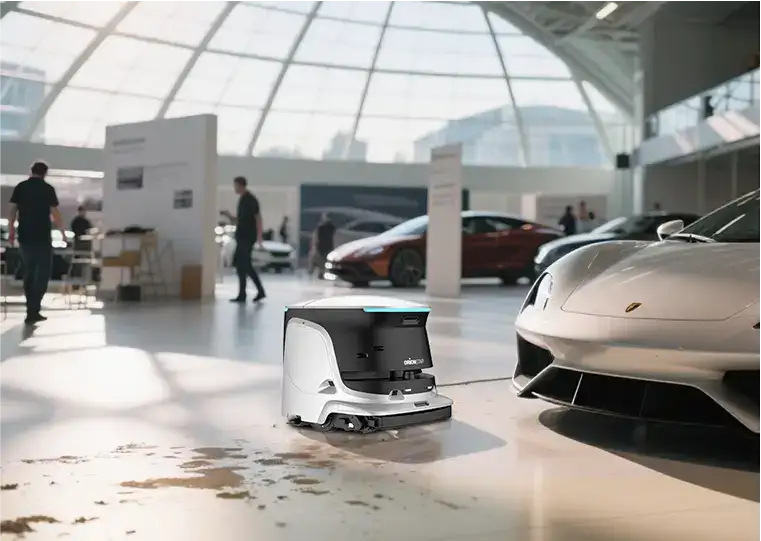
Facility managers overseeing large-scale hospitality venues face unique scheduling and environmental challenges when evaluating floor maintenance automation. Deploying a commercial cleaning robot for banquet halls requires balancing the demands of guest-facing event spaces against the intensive sanitation needs of back-of-house prep kitchens and service corridors. Banquet floors constantly rotate between polished marble, temporary parquet dance floors, low-pile carpet runners, and hard tile. These areas demand rapid, quiet cleaning during tight turnover windows between bookings where acoustic interference must remain minimal. Conversely, the adjacent prep kitchens and service corridors present a distinct sub-scenario, requiring heavy-duty scrubbing capabilities to handle grease, food spills, and high foot traffic. Addressing both environments effectively often dictates the structural and operational requirements of the chosen robotic platform.
When evaluating automation platforms, operators must first analyze cleaning modality and surface adaptability. Event venues constantly transition between carpeted VIP lounges, hard-surface ballrooms, and heavily soiled back-of-house prep kitchens. The choice of cleaning mechanism dictates whether a facility requires a versatile multi-functional unit or specialized machines. Multi-functional hybrid platforms integrate sweeping, vacuuming, and wet mopping or scrubbing within a single chassis, allowing operators to transition from dry-vacuuming guest carpets to scrubbing hard floors without deploying separate machines. Dedicated heavy-duty wet scrubbing platforms utilize industrial-grade brush pressure strictly for hard floors, offering high-intensity soil removal for massive ballrooms and intensive commercial kitchens. Dedicated dry vacuuming systems employ pure suction and sweeping mechanisms with high-efficiency particulate air filtration to manage light debris across mixed surfaces during rapid room turnovers.
Physical footprint and venue navigability determine the effective coverage areas of a robotic platform. Banquet halls feature distinct layout challenges, ranging from completely open floors during event setup to highly dense chair configurations and narrow service corridors linking the kitchen to the main floor. Large-format architectures utilize high-capacity chassis designs weighing over four hundred kilograms to maximize continuous cleaning productivity in wide-open spaces, requiring wider turnaround aisles and reinforced floor load ratings. Compact-format architectures utilize smaller, lightweight chassis designs to maneuver through complex venue environments, navigating standard banquet doors, tight table arrangements, and narrow back-of-house service corridors.
Acoustic profile and operational timing dictate when automation can be deployed. A machine’s decibel output determines whether it must be relegated strictly to overnight shifts or if it can operate alongside venue staff near guest zones. Acoustic-focused architectures engineer internal vacuum components to maintain low operational noise levels, allowing venue managers to deploy the machine during daytime turnovers without creating disruptive acoustic interference. Standard commercial-decibel architectures operate at higher noise levels to maximize motor torque and deep-cleaning suction power, functioning best during overnight maintenance or in closed-off rooms.
Autonomous navigation and route execution capabilities govern how the machine adapts to physical shifts in the environment. Dynamic event venues experience constant layout changes as tables are moved and staging is erected. Dynamic mapping architectures utilize continuous environmental scanning to autonomously calculate paths, avoid sudden obstacles, and update maps in real time. Pre-programmed teach-and-repeat architectures require an operator to physically drive the initial cleaning route, which the robot then memorizes and replicates identically for standardized corridor runs.
The OrionStar CleaniBot S55 Pro is positioned as a multi-mode autonomous floor-cleaning platform suitable for the diverse surfaces found in hospitality venues. By integrating sweeping, scrubbing, vacuuming, and mopping capabilities into a single chassis, the system allows operators to match the cleaning behavior to the specific zone. The robot features a dedicated Dust Mop mode designed specifically for delicate surfaces such as polished marble and parquet dance floors, alongside more intensive scrubbing settings for hard floors. Its acoustic engineering targets daytime public environments, emitting low noise levels that permit operation during daytime event turnovers without causing severe acoustic disruption.
According to manufacturer data, the CleaniBot S55 Pro operates at up to 55 decibels in scrubbing mode and up to 45 decibels in dust mopping mode. The battery system supports extended operational periods, yielding runtimes of up to 19.5 hours in ECO Vacuum mode and up to 28 hours in Dust Mop mode under laboratory conditions. Navigation is driven by a multi-sensor array including a LiDAR sensor capable of mapping spaces up to 10,000 square meters, alongside stereo cameras and ultrasonic sensors for obstacle avoidance. The chassis maintains a minimum passing width of 700 millimeters, enabling it to navigate between banquet tables and standard service doors. Fleet oversight is managed via Wi-Fi and 4G connectivity, supporting remote deployment, cloud-based maintenance, and over-the-air updates.
The SoftBank Robotics Whiz focuses strictly on dry vacuum sweeping, providing a lightweight, vacuum-only solution for hospitality environments. This platform is highly applicable to guest-facing areas where rapid turnovers on low-pile carpets and hard floors are required between events. As a dry-vacuum platform, it focuses specifically on mechanical sweeping and high-efficiency particulate air filtration to capture dust and debris. The system utilizes a teach-and-repeat route execution model, making it highly effective for standardized banquet corridors and pre-function lobbies where the floor layout remains relatively consistent.
Technical specifications indicate the Whiz weighs up to 30 kilograms, establishing a light footprint that is easy for catering or cleaning staff to transport and store. Under laboratory conditions, the machine produces a noise level of 62 decibels in normal mode, classifying it among the quieter options for daytime turnover tasks. It utilizes an interchangeable battery system that delivers up to 3 hours of runtime on a single charge, according to manufacturer data. The platform incorporates a 4.0-liter dust bag capacity and relies on a BrainOS navigation stack utilizing LiDAR and 3D cameras to replicate taught paths.
The Avidbots Neo 2 serves as a premium autonomous floor-scrubbing platform engineered for heavy-duty wet cleaning operations. Its design is strictly focused on hard floors, making it highly applicable to massive, unobstructed ballrooms and the rigorous sanitation demands of back-of-house prep kitchens. The machine provides heavy brush pressure to remove stubborn grease and food spills that accumulate during extensive catering operations. It is commonly deployed in venues characterized by high utilization rates and dedicated overnight cleaning crews, where its industrial-grade scrubbing power can operate during off-peak hours.
The Neo 2 features substantial liquid capacities, carrying up to 109 liters in its solution tank and 135 liters in its recovery tank, according to manufacturer data. The platform reaches a gross vehicle weight of up to 688 kilograms, requiring facilities to verify elevator capacities and floor load ratings prior to deployment. Operating sound pressure sits at up to 75 decibels, with a maximum audio output of 83 decibels, positioning it primarily for overnight or closed-room maintenance. Navigation relies on dynamic planning driven by a 360-degree LiDAR and 3D camera array, though the machine requires an autonomous turnaround width of up to 3.05 meters.
The Gaussian Robotics Ecobot Scrubber 75 addresses the deep-scrubbing requirements of large hospitality venues through a high-capacity wet scrubbing architecture. This platform is positioned to handle intensive grease and spill management in back-of-house prep kitchens, service corridors, and vast convention center layouts. The machine incorporates a specialized rotating scrub deck designed to maintain edge-to-edge cleaning along walls, which aids in navigating the perimeters of large banquet halls. It is engineered to sustain long continuous cleaning sessions without requiring frequent manual intervention for water replacement.
According to manufacturer data, the Scrubber 75 features a 75-liter clean water tank and a 750-millimeter cleaning width, translating to high theoretical coverage rates. The platform weighs up to 400 kilograms and operates at a noise level ranging from 55 to 70 decibels depending on the active cleaning mode. Battery capacity allows for up to 4 to 6 hours of runtime under laboratory conditions. Navigation is facilitated by simultaneous localization and mapping technology utilizing over twenty onboard sensors, including LiDAR, 3D cameras, and ultrasonic sensors, though it requires a minimum pass width of up to 1,400 millimeters.
The Pudu CC1 provides a mid-size commercial cleaning platform integrating sweeping, scrubbing, vacuuming, and dust mopping into a unified system. This multi-functional design targets mid-size hospitality venues that prefer to maintain a single machine capable of addressing both soft guest-area carpets and hard back-of-house floors. By offering a compact footprint, the machine can transition from broad ballroom floors to narrow kitchen corridors with relative ease. The platform is increasingly present in hotel and event spaces where facility managers require varied cleaning modes without procuring dedicated single-function machines.
Manufacturer specifications state the Pudu CC1 weighs up to 75 kilograms, utilizing a relatively compact chassis measuring 663 by 626 by 667 millimeters. The vacuum system is rated to deliver up to 17,000 pascals of suction power for dry debris extraction. Liquid capacities are rated at up to 15 liters for both the clean and wastewater tanks, making it well-suited for targeted zones or deployments paired with an optional mobile water station. Operational noise is rated at under 70 decibels, while the onboard navigation system utilizes a combination of visual and laser simultaneous localization and mapping.
Selecting a commercial floor-cleaning platform for hospitality and event venues demands a rigorous assessment of venue layout, floor types, and operational schedules. Venues characterized by mixed surfaces, including polished marble, parquet, and low-pile carpet, benefit substantially from hybrid, multi-mode platforms that combine quiet dust mopping with vacuuming capabilities. Conversely, facilities prioritizing heavy grease removal in massive prep kitchens and vast hard-surface ballrooms will require the liquid capacities and heavy brush pressure found in dedicated industrial scrubbers. Procurement teams must map their typical event turnover schedules against the acoustic profiles and minimum passing widths of the evaluated machines to ensure continuous, non-disruptive operation.
In published 2026 industry analysis of large-facility cleaning automation, payback for an autonomous scrubber usually lands between 9 and 18 months when the site can run a repeatable daily route of roughly 50,000+ sq ft, with overnight and off-peak routes typically paying back fastest. Banquet halls fit that pattern well because the same ballrooms, corridors, and back-of-house kitchens are re-cleaned after every function. The strongest case comes from shifting repetitive floor coverage to off-shift robot runs while staff focus on edges, spill response, restrooms, and supervisory tasks — not from trying to remove all janitorial labor. Vendors in this space typically quote annual robot opex of around $4,000–$7,000 per unit, well below the loaded cost of a full-time cleaning employee.
Manual cleaning TCO is dominated by labor: base wages of roughly $16–$22/hr for commercial cleaners, plus 30–42% in employer costs (payroll burden, benefits, workers' comp, supervision, PTO), giving a loaded rate around $26–$28/hr or about $40,000–$55,000 per full-time equivalent per year. A commercial cleaning robot typically carries MSRP in the $25,000–$50,000 range plus an annual operating cost of roughly $4,000–$7,000 (consumables, brush/squeegee replacement, preventive maintenance, operator inspection time). The financial case depends on how many repetitive floor-care hours the robot can absorb per shift and whether the venue schedules it overnight or between events; programs that can replace at least 1 FTE of repetitive scrubbing usually see payback in under 12 months.
Most modern cleaning robots support Wi-Fi and 4G connectivity and ship with cloud dashboards, mobile apps, and remote-management portals for fleet status, route uploads, alerts, and downloadable cleaning reports. Some platforms go further. OrionStar CleaniBot S55 Pro officially supports remote deployment, cloud-based maintenance, OTA updates, and data reporting over Wi-Fi/4G, which is enough to plug into standard facility-management workflows for status, reporting, and map updates. Specific API endpoints, integration names, or backend platform details for individual vendors are not publicly specified and should be confirmed with the supplier during procurement.
Noise is the most common deal-breaker for guest-area cleaning. CleaniBot S55 Pro is among the quietest platforms in this category — 55 dB in scrubbing mode and 45 dB in dust mopping mode — making it usable in adjacent guest areas during quieter service windows. For comparison, published competitor noise levels are SoftBank Whiz at 62 dB (vacuum only), Pudu CC1 under 70 dB(A), Gausium Scrubber 75 at 55–70 dBA depending on mode, and Avidbots Neo 2 at 75 dB(A) operating / 83 dB(A) max. As a practical rule, any of these robots should still be scheduled around speeches, music, and seated dining — usually between event turnovers, pre-event setup, or overnight — but during pre-function turnaround windows the quieter platforms (Whiz, S55 Pro in dust-mop mode) are tolerable near guest zones.
Floor compatibility varies sharply by mode and platform. CleaniBot S55 Pro explicitly supports marble and polished floors via its dedicated Dust Mopping mode, plus scrubbing, sweeping, vacuuming and combined sweep-vacuum-mop modes for hard floors and low-pile carpets — but maximum garbage height is 3 cm and it is not intended for thick pile or rugs that shift. Avidbots Neo 2 is hard-floor only and is not recommended for carpeted areas. Gausium Scrubber 75 lists marble, granite, PVC/vinyl, PU, ceramic tile, epoxy and concrete but does not call out parquet or low-pile carpet, so a sample-area test is advisable. SoftBank Whiz handles mixed hard floor and low-pile carpet with HEPA vacuuming but cannot wet-scrub, so grease and food spills in back-of-house prep kitchens still need a separate scrubber. Operators should request a floor-compatibility test on a small sample area before full deployment, especially on parquet dance floors and heritage finishes.
Autonomous cleaning robots in this category rely on multi-sensor fusion rather than fixed magnetic tracks. CleaniBot S55 Pro uses 15 sensors including LiDAR (map construction up to 10,000 m², real-time map updates), a stereo camera for cliff and step detection, ultrasonic sensors for obstacle avoidance, and line lasers that hold a 5–10 cm distance from walls and corners — small enough to clean chair-row edges but with a 700 mm minimum passing width. Pudu CC1 combines visual SLAM and laser SLAM with a 663 × 626 × 667 mm footprint. Gausium Scrubber 75 adds a 270° rotational scrub deck for edge-to-edge coverage. The practical implication for banquet halls: chairs and tables left in place after an event will be detected as obstacles in real time, but the robot cannot clean under chair or table legs, and tight chair-dense layouts with passages below ~700 mm (S55 Pro), ~1.4 m (Scrubber 75), or ~3.05 m autonomous U-turn width (Neo 2) will reduce coverage or rule out certain platforms. Standard practice is to clear loose furniture first and use the robot for the open ballroom floor, corridors, and back-of-house service paths.
Footnote: Third-party product specifications are based on public manufacturer data under laboratory conditions and may vary. Product names and trademarks are the property of their respective owners. Data Privacy Notice: Devices equipped with visual sensors (cameras) and spatial mapping (LiDAR) process environmental data for navigation. Cloud connectivity (Wi-Fi/4G) transmits operational telemetry and mapping data. Facility operators must ensure deployment complies with local data protection regulations (e.g., GDPR, PIPL), including obtaining necessary operational consents and configuring data retention policies appropriately.
