REQUEST DEMO
Resources > Blogs > Elevating Facility Standards: Commercial Cleaning Robots For Workplace Management In Airports

Elevating Facility Standards: Commercial Cleaning Robots For Workplace Management In Airports

2026-09-17 23:29 OrionStar

Elevating Facility Standards: Commercial Cleaning Robots For Workplace Management In Airports

Introduction

Workplace Management in airports faces structural pressures that manual cleaning operations can no longer absorb, particularly as global passenger traffic continues to surge and facility teams struggle with severe janitorial labor shortages, rising operational costs, and strict hygiene compliance standards. To address the gap between increasing passenger expectations and a shrinking, aging workforce, facility operators are turning to commercial cleaning robots as a strategic solution to deliver consistent, verifiable, and cost-effective floor care across massive terminal footprints.

The Growing Need For Smarter Cleaning In Airports

  • Workplace experience managers, facility operations managers, and workplace services providers must maintain millions of square feet of terminal space continuously while passengers actively move through every zone, compounded by a projected 10% year-over-year increase in global passenger traffic.
  • Facility operations managers face a severe janitorial labor shortage, with the workforce averaging nearly 51 years old, annual turnover running at roughly 200%, and projected employment growth at only 2% through 2034.
  • Workplace services providers struggle with inconsistent cleaning coverage caused by fatigue and shift transitions, making it difficult to provide regulators and airlines with verifiable evidence that cleaning meets required standards.
  • Workplace experience managers carry significant revenue and liability exposure, as an 80% increase in consumer expectations for public hygiene directly impacts airport quality scores, while workplace slip-and-fall incidents average up to USD 40,000 in compensation costs.

How Commercial Cleaning Robots Can Help

  • LiDAR navigation allows these machines to map complex indoor environments and autonomously plan efficient cleaning routes across large open areas.
  • Multi-sensor obstacle avoidance systems ensure safe, uninterrupted operation around moving crowds, luggage carts, and structural barriers.
  • Multi-mode floor care systems provide the flexibility to switch between scrubbing, vacuuming, and mopping based on the specific surface and soil level.
  • Auto-recharge capabilities enable continuous overnight or multi-shift operations without requiring constant human supervision.
  • Wi-Fi and 4G connectivity support real-time fleet tracking and automated reporting, utilizing on-device edge processing and data anonymization to ensure compliance with global data protection frameworks like GDPR.

A Closer Look: OrionStar CleaniBot S55 Pro In Action

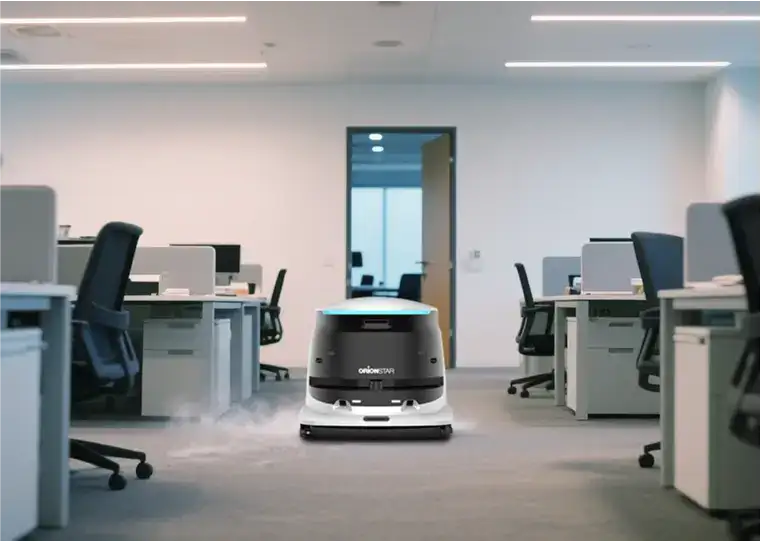
The OrionStar CleaniBot S55 Pro demonstrates how these autonomous capabilities function in a real-world commercial floor-care platform. According to manufacturer data, the unit utilizes a multi-sensor system incorporating LiDAR, a stereo camera, and ultrasonic sensors to navigate safely while performing tasks like scrubbing, sweeping, and vacuuming. It is designed to cover large areas efficiently, achieving a maximum cleaning efficiency of up to 1,368 square meters per hour in sweep and vacuum modes. To support extended facility maintenance without constant manual intervention, the robot provides a runtime of up to 28 hours in dust mop mode and automatically returns to its charging dock when battery levels run low.

Benefits For Workplace Experience Managers, Facility Operations Managers, And Workplace Services Providers

  • Labor redeployment: Autonomous floor scrubbers allow facility teams to reduce floor-cleaning labor costs by 30–50%, freeing up housekeeping staff to focus on high-touch surface disinfection rather than eliminating jobs.
  • Predictable ROI: Documented airport deployments consistently achieve payback periods within a 12 to 24-month range, making automated cleaning a financially viable strategy for large aviation hubs.
  • Verifiable quality: Digital reporting provides 100% cleaning cycle documentation, ensuring compliance and audit readiness for programs like the ACI Public Health and Safety Readiness Accreditation.
  • Resource efficiency: By utilizing calibrated chemical dosing and precise application, autonomous systems can reduce water usage by up to 60% and chemical usage by up to 50% compared to manual over-application.
  • Enhanced passenger experience: Maintaining consistent hygiene standards directly influences facility ratings, with clean environments contributing to a correlation where a 1% increase in passenger satisfaction drives 1.5% growth in airport revenue.
  • Predictive maintenance savings: Integrating robotic endpoints with facility management systems has been shown to reduce unplanned repairs by 89% and increase fleet uptime from 68% to 94%.

Real-World Applications

Terminals and check-in halls

These expansive zones experience constant foot traffic, luggage movement, and spills, making it difficult for manual crews to maintain pristine hard floors during peak hours. Autonomous robots navigate these dynamic environments using multi-sensor obstacle avoidance, scrubbing large square footage systematically while safely bypassing passengers and check-in kiosks.

Gate areas and departure lounges

Waiting areas are dense with seating, charging stations, and lingering travelers, requiring a cleaning approach that minimizes disruption and noise. Robots can deploy quiet dust-mopping or eco-vacuuming modes to maintain cleanliness around seating blocks without disturbing passengers waiting for their flights.

Baggage claim

Baggage claim areas face heavy wear and tear from wheeled luggage, dirt tracked in from the tarmac, and sudden bursts of crowd density as flights arrive. Multi-mode cleaning systems can quickly sweep debris and perform deep scrubbing between flight arrivals, ensuring the area remains safe and presentable before the next wave of passengers.

Security checkpoints

Security zones require strict operational compliance and cannot be obstructed by bulky cleaning equipment or long manual cleaning processes. Compact commercial cleaning robots can clean close to walls and security stanchions during off-peak hours, ensuring high-traffic bottlenecks are thoroughly cleaned and maintained without impacting passenger flow.

Integration With Other Smart Systems

Commercial cleaning robots maximize their value when treated as mobile IoT nodes integrated directly into an airport's existing smart building stack. By connecting with Building Management Systems (BMS), facility managers can coordinate cleaning schedules with HVAC and lighting setbacks to capture energy savings during off-peak hours. Furthermore, integration with Computerized Maintenance Management Systems (CMMS) allows real-time sensor data to trigger predictive maintenance, track work-order completion, and significantly reduce fleet downtime, proving that integration scoped at the procurement stage yields the strongest return on investment.

Supporting ESG And Sustainability Goals

  • Automated scrubbing systems utilize precise calibration to minimize environmental impact, typically reducing water consumption by up to 60% and chemical usage by up to 50%.
  • Onboard data logging automatically captures specific metrics—such as water volume consumed and chemical dosing records—required for green building certifications and corporate sustainability reports.
  • Modern compliance strategies ensure that robots operating in public spaces process sensor data securely through edge processing and on-device anonymization, aligning with data privacy frameworks.
  • By replacing manual estimations with verifiable data, autonomous cleaning systems transform facility maintenance into a measurable, compliant pillar of an airport's broader ESG strategy.

Closing

Commercial cleaning robots are fundamentally changing how Workplace Management approaches the daily maintenance of airports, shifting the focus from labor-intensive reactive tasks to data-driven, autonomous operations. By stabilizing costs, ensuring verifiable hygiene compliance, and supporting sustainability targets, these systems provide a resilient foundation for managing massive terminal spaces. As facility demands continue to evolve, the OrionStar CleaniBot series offers multiple configurations to accommodate different floor types and environmental constraints, providing operators with scalable options to meet specific operational requirements.