Introduction
Ecommerce fulfillment centers are facing unprecedented material handling challenges in returns processing areas, driven by severe labor shortages, surging return volumes of up to 30%, spiraling operational costs, and strict compliance demands. Handling this complex reverse logistics flow manually is physically straining for workers and often leads to costly inaccuracies that compound throughout the supply chain. To navigate these pressures, operators are increasingly deploying warehouse AMRs as a flexible, automated solution to streamline material transport, reduce human error, and keep fast-paced reverse operations running smoothly.
The Growing Need for Smarter Material Handling in Returns Processing Areas
- Severe labor shortages and annual turnover rates of approximately 36% leave fulfillment center operators struggling to staff physically demanding material handling roles.
- High ecommerce return rates of 20% to 30% create unpredictable reverse logistics flows that overwhelm traditional intake systems and slow down processing speed.
- Manual receiving and putaway inefficiencies during peak return surges frequently lead to human errors, contributing to phantom inventory and inaccuracy rates that cost roughly 1.4% of annual revenue.
- Rising commercial real estate prices make expanding warehouse footprints cost-prohibitive, forcing ecommerce operations managers to process growing return volumes within heavily constrained floor spaces.
How Warehouse AMRs Can Help
- VSLAM+ navigation and autonomous path planning allow robots to adapt to constantly changing warehouse layouts without requiring pre-set markers or physical facility modifications.
- Multi-robot cooperation systems dynamically route fleets to prevent traffic jams in narrow aisles, prioritizing tasks based on real-time operational demands.
- Multi-layer obstacle avoidance technologies use continuous sensor scanning to detect people and objects, ensuring safe navigation around sudden blockages in crowded staging zones.
- Auto-charging and docking capabilities ensure robots independently manage their power levels, enabling continuous operation across multiple warehouse shifts.
- Real-time monitoring platforms connect the fleet to central management dashboards, providing full visibility into transport workflows and equipment utilization.
- By utilizing edge computing, the AMRs process navigational data locally, ensuring personally identifiable information (PII) on return labels is not transmitted or stored, ensuring strict adherence to GDPR frameworks.
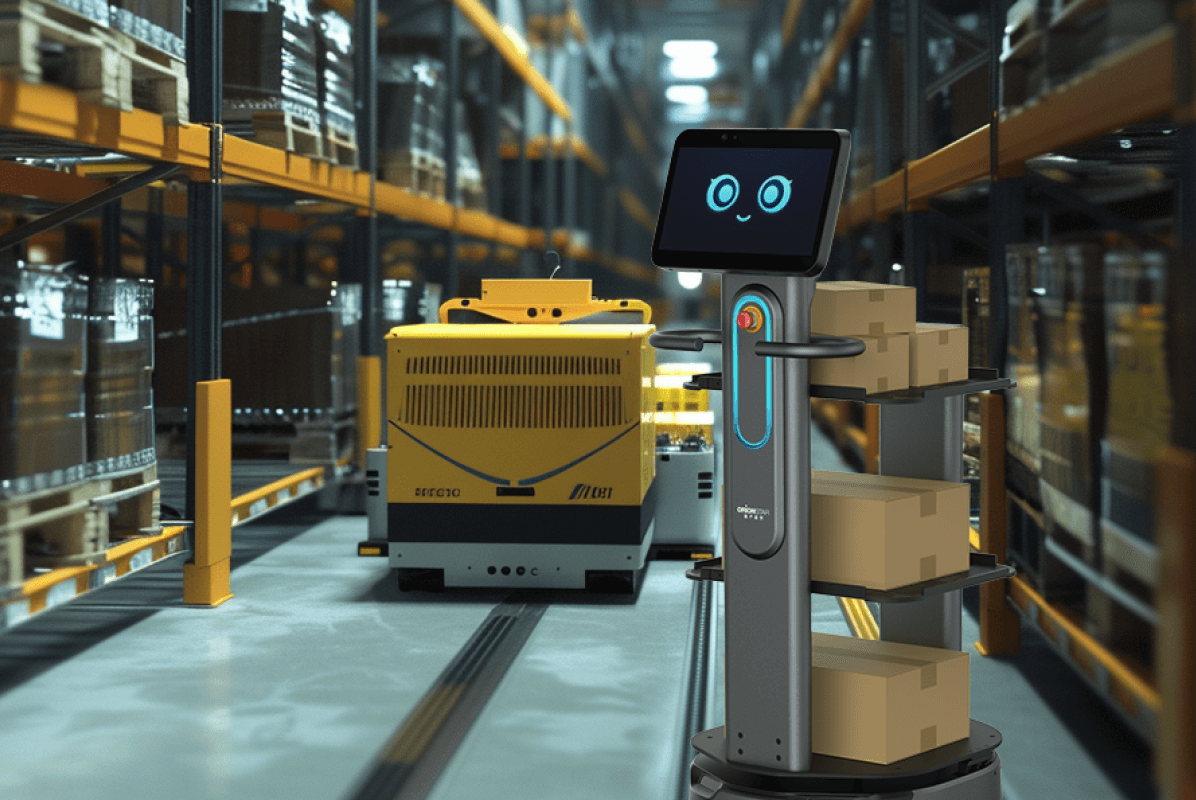
The OrionStar CarryBot D150 illustrates how these autonomous material handling capabilities function in demanding micro-fulfillment and warehouse environments. According to manufacturer data, this specific model features a net payload capacity of up to 150 kg and utilizes VSLAM 2.0 technology combined with LiDAR and depth cameras to navigate spaces with a minimum passage clearance of 65 cm. Powered by a high-capacity battery that delivers up to 12 hours of runtime per charge, the robot automatically returns to its docking station when low on power, while its five-layer safety protection system safely guides the unit through dynamic reverse logistics environments.
Benefits for Fulfillment Center Operators, Ecommerce Operations Managers, and Returns Processing Leads
- Reduced labor costs: Automating the transport of heavy return loads helps facilities achieve significant savings, with some operations reporting labor cost reductions of up to 50%.
- Accelerated throughput: Deploying mobile robots to handle massive seasonal returns alongside forward picking operations can increase overall transport efficiency by three to six times.
- Enhanced inventory accuracy: By integrating directly with warehouse systems, robotic material transport removes manual handling steps, helping operations push precision and on-time delivery rates up to 99.99%.
- Improved space utilization: Replacing traditional forklifts and manual carts with compact, agile robots allows managers to optimize narrow aisles and increase storage capacity utilization by up to 25%.
- Reduced worker strain: Taking over repetitive walking and heavy lifting significantly lowers the physical burden on employees, directly addressing the fatigue and injury risks that drive high turnover.
- Scalable flexibility: Utilizing flexible leasing or service models enables returns processing leads to dynamically scale their fleets to absorb post-holiday return volume surges that often exceed steady-state levels by up to 400%.
Real-World Applications
Intake and Inspection Zones
The initial receiving area for returned parcels is highly unpredictable and often congested with disorganized pallets and bins. Warehouse AMRs continuously shuttle heavy loads of unverified returns from the unloading docks directly to inspection stations. This autonomous movement keeps the intake floor clear and eliminates the need for workers to push manual carts back and forth.
Triage and Grading Areas
Once items are inspected, they must be rapidly sorted into distinct categories such as restock, refurbishment, or liquidation. Robots equipped with specialized shelving or tray configurations wait at grading stations to collect sorted merchandise. They autonomously navigate to the correct downstream processing zone as soon as they reach their load capacity.
Restocking Zones
Returning viable merchandise to active inventory is traditionally one of the most labor-intensive and error-prone warehouse tasks. Integrated fleets receive instructions directly from the facility's management software to transport verified goods right to the designated storage aisles. This integration seamlessly blends reverse logistics items back into forward-picking workflows without human disruption.
Integration With Other Smart Systems
To function effectively in dynamic environments, warehouse AMRs rely on deep integration with a facility's existing digital infrastructure. A Returns Management System (RMS) or Return Merchandise Authorization (RMA) platform typically generates the digital ticket that feeds directly into the primary Warehouse Management System (WMS) or Warehouse Execution System (WES). The WMS then translates these return data points into automated routing tasks, orchestrating the AMR fleet alongside IoT scanners, RFID systems, and computer vision checkpoints to track inventory accurately in real time and eliminate the critical visibility gaps often caused by disconnected legacy systems.
Supporting ESG and Sustainability Goals
- Automated material transport facilitates rapid densification and optimized vertical storage, reducing the physical footprint and lowering the per-order embodied-carbon footprint of the warehouse building.
- Delegating repetitive lifting and crowded-aisle navigation to robots directly improves occupational health and safety, supporting the social governance pillar by reducing worker injuries and physical fatigue.
- Advanced software coordination minimizes unnecessary transport trips and idle equipment time, improving overall facility energy efficiency in line with supply-chain decarbonization frameworks.
- By simultaneously cutting energy waste and creating safer working conditions, automated logistics equipment provides measurable progress toward a facility's comprehensive environmental and social governance objectives.
Closing
Warehouse AMRs are fundamentally changing the way ecommerce fulfillment centers manage and execute material transport within returns processing areas. By alleviating physical labor, mitigating inaccuracies, and connecting isolated software platforms, this technology allows operators to transform chaotic reverse logistics flows into predictable, data-driven processes. For facilities evaluating these automation strategies, the OrionStar CarryBot series provides a variety of robotic models and top-module configurations designed to adapt to specific logistical requirements and operational layouts.