

REQUEST DEMO
Robot CATALOG will be sent to your mailbox immediately after submission.
SUBMIT
Deploying automated cleaning solutions within corporate-owned office buildings, headquarters campuses, and mixed-use corporate properties presents distinct architectural and operational challenges for facility teams. Operators navigate severe spatial bottlenecks, ranging from narrow executive corridors and standard passenger elevators to intricate, glass-partitioned lobbies requiring high maneuverability. Simultaneously, facility managers enforce strict acoustic limits to support daytime continuous cleaning without disrupting active workspaces, meetings, and reception duties. Furthermore, enterprise IT departments require stringent oversight of fleet management platforms processing spatial mapping and visual telemetry. Operations teams must verify applicable data protection and privacy regulations, such as GDPR, regarding lawful basis, mapping data, and telemetry before deploying any robotic assets across corporate real estate portfolios.
Corporate real estate environments dictate equipment selection heavily through spatial adaptability and navigation clearances. A robot’s physical footprint, minimum passing width, and autonomous turning requirements establish precisely where it can operate within a headquarters campus. Ultra-compact platforms navigate minimal clearance widths under one meter and execute tight turns, making them applicable for small lobbies, single-occupancy office approaches, and narrow restroom corridors. Conversely, massive ride-on chassis require substantial aisle entrance and turnaround spaces frequently extending up to three meters, restricting their deployment to sprawling corporate cafeterias, subterranean parking decks, and expansive common concourses.
Facility teams must balance continuous daytime cleaning schedules with the acoustic discretion and operating hours demanded by corporate executives and campus visitors. Systems operating in the sub-70 decibel range generate lower ambient noise, allowing for flexible daytime deployments near active workspaces and populated breakout areas. Platforms operating at or above 70 decibels prioritize aggressive motor power and downward scrubbing pressure over noise reduction, forcing facility teams to schedule these larger machines exclusively during unoccupied night shifts or within isolated back-of-house logistics zones.
The choice of cleaning modality determines how effectively the equipment addresses the specific soil targets found across varying corporate floor plans. Configurations functioning strictly as autonomous dry vacuums utilize onboard filtration and roller brushes to extract dust and maintain the daily visual appearance of low-pile carpets without introducing water management logistics. Configurations dispensing liquid solution and applying mechanical downward pressure target hard-surface spill response, tile grout maintenance, and single-pass removal of heavy foot-traffic grime in heavily utilized entryways and cafeteria settings.
Enterprise facility teams rely on remote oversight, making fleet management and cloud data architecture a critical selection factor. Architectures processing telemetry directly through the hardware manufacturer's proprietary cloud environments offer end-to-end integration and centralized web dashboards to monitor cleaning productivity. Alternatively, architectures leveraging standardized third-party robotic operating systems mediate cloud connectivity through external platforms, providing standardized data flows that often align with other similarly equipped automated assets across the organization's broader equipment fleet.
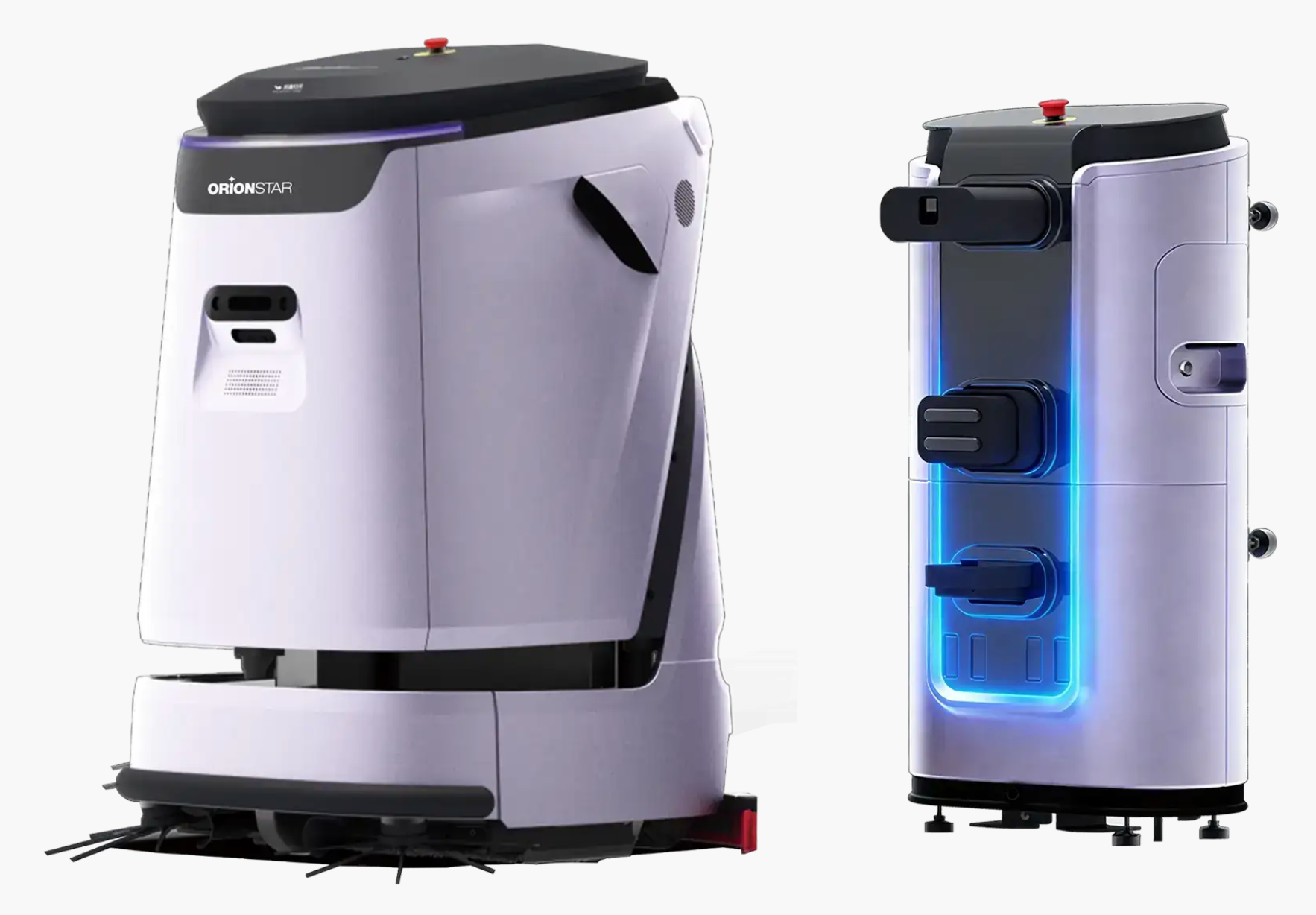
The OrionStar CleaniBot C5 operates as a mid-to-large autonomous scrubber for corporate lobbies, multi-floor corridors, headquarters campuses, and parking structures. The platform executes full-shift wet scrubbing duties while managing liquid logistics through an integrated auto-refill and auto-drain workstation architecture. This docking ecosystem enables corporate facility teams to maintain continuous daily cleaning cycles across expansive hard floors without demanding manual intervention for constant water reservoir management. The system balances aggressive hard-floor remediation with physical proportions designed to navigate common corporate architectural layouts.
Addressing the spatial constraints of office environments, the CleaniBot C5 requires an 880-millimeter passing width, permitting reliable navigation through standard facility corridors and controlled property access doorways. The platform scrubs hard surfaces utilizing a 550-millimeter main brush, achieving a maximum cleaning area capacity of up to 1,980 square meters per hour, according to manufacturer data. The architecture houses a combined 90-liter tank capacity and applies up to 25 kilograms of downward scrubbing pressure to lift stubborn entryway grime. To support daytime deployment near populated corporate spaces, the machine maintains a noise level under 68 decibels under laboratory conditions.
The Avidbots Neo 2W functions as a large autonomous scrubber with dynamic path planning, primarily oriented toward heavy back-of-house zones and expansive parking structures within large corporate campuses. This heavy-duty architecture targets enormous, dynamic floor plans where maximum liquid capacity and aggressive surface remediation override the need for maneuverability in confined architectural spaces. The platform utilizes Advanced Dynamic Planning software to interpret continuously shifting environments, supporting reliable autonomous navigation across central corporate loading bays or internal transit concourses experiencing high pedestrian and equipment traffic.
The substantial physical footprint of the Neo 2W dictates its deployment solely in wide-open campus zones, featuring a width ranging from 76 to 94 centimeters and a total weight spanning 581 to 688 kilograms. These dimensions necessitate a 3.05-meter aisle turn-around clearance, effectively excluding the unit from narrow office corridors and standard passenger elevators. Compensating for its limited spatial agility, the system delivers industrial-grade endurance with up to six hours of run time utilizing swappable industrial batteries, according to manufacturer data.
The Kärcher KIRA CV 1 represents a compact autonomous scrubber from a German original equipment manufacturer, expressly positioned for European office buildings requiring quiet operation and a modest physical footprint. While referenced in selection literature as the CV 1 series, the underlying commercial hardware in this specific segment is the KIRA CV 50. The machine operates strictly as an autonomous vacuum rather than a wet scrubber, emphasizing the daily aesthetic maintenance of low-pile carpets and hard-floor office corridors. This dry-cleaning modality removes the logistical burden of managing water tanks, aligning with facility managers focused on unobtrusive daytime upkeep across multi-story executive levels.
The platform achieves superior corporate real estate compatibility through extreme spatial adaptability, navigating complex facility layouts via a 26-inch minimum clearance width. This compact geometry enables the unit to access glass-partitioned meeting rooms, single-occupancy office approaches, and restricted building elevators. Operating quietly during active business hours, the system maintains a 57-decibel sound pressure level, establishing a highly discreet acoustic profile for front-of-house deployments. The unit generates an autonomous coverage rate of up to 5,651 square feet per hour while providing up to 140 to 210 minutes of run time, according to manufacturer data.
The Tennant T7AMR serves as a mid-size ride-on scrubber pairing proven scrub-deck engineering with BrainOS navigation, holding an established footprint in United States corporate accounts. The machine is engineered for wide-aisle, high-coverage environments rather than constrained corporate hallways, targeting large-format headquarters atriums, executive dining halls, and multi-floor common areas serviced by a single high-capacity unit. Facility teams utilize this ride-on architecture to execute vast autonomous fill routines, allowing human operators to manually drive the unit across massive campus zones before initiating the automated scrubbing sequence.
The substantial physical requirements of the T7AMR restrict its deployment to expansive architectural spaces, as the 33-by-65-inch footprint necessitates a 10-foot U-turn radius. The system dispenses cleaning solution from large 29-gallon solution and recovery tanks, achieving an estimated coverage of up to 45,760 square feet per fill, according to manufacturer data. The platform supports extended campus routes with an estimated run time of up to 6.5 hours when equipped with high-capacity lithium batteries. Due to a standard sound level measuring around 70 decibels, facility teams generally restrict its automated deployment to unoccupied night shifts or acoustically isolated corporate concourses.
The ICE Co-Botics Cobi 18 operates as a compact scrubber-dryer aimed at narrower office corridors and smaller floor plates unable to accommodate full-size scrubbing machines. The platform functions under a collaborative robotics positioning, designed to operate closely alongside corporate facility staff during active business hours. This approach addresses the daily wet-cleaning requirements of constrained architectural spaces such as restroom approaches, executive breakrooms, and small-format reception areas. The system leverages straightforward Teach-and-Repeat navigation, allowing onsite janitorial teams to manually record and execute custom cleaning paths for highly specific layouts.
The machine navigates narrow corporate real estate via an 18.8-by-18.8-inch near-cube footprint, trading outright cleaning throughput for exceptional spatial agility. Operators manage smaller liquid volumes through a 10-liter solution tank and an 11-liter recovery tank, necessitating more frequent manual drainage interventions. The platform delivers a run time of up to 60 to 90 minutes per charge, according to manufacturer data. To maintain corporate environmental comfort, the unit operates at an acoustic profile of 66 to 68 decibels while running in its specialized ECO mode.
Procuring the appropriate automated cleaning asset for a corporate headquarters requires closely aligning the machine's spatial geometry and acoustic specifications with the physical realities of the building footprint. Facility directors managing expansive subterranean parking decks or multi-story central atriums require heavy-duty scrubbing platforms capable of dispensing large liquid volumes and executing multi-hour autonomous routes. Conversely, teams responsible for the daily aesthetic upkeep of narrow executive corridors and glass-partitioned lobbies demand ultra-compact architectures that navigate tight clearances and maintain discreet acoustic profiles. By carefully assessing minimum clearance widths, daytime noise thresholds, and cloud data architectures, corporate real estate operators can confidently integrate robotic floor maintenance platforms into their facility management workflows.
Most published case studies from autonomous scrubber vendors (Avidbots citing DHL, ICE Co-Botics citing Winona Health) report labor-hour reductions of roughly 50–80% on repetitive floor-cleaning routes, which typically translates into a 12–24 month payback for a single unit once offset against janitorial labor costs. The exact figure depends on local labor rates, shift coverage, and whether the building runs one or more units. Corporate real estate directors should request a vendor-supplied TCO model that includes lease vs. purchase, financing terms, consumables (pads, brushes, detergent), and maintenance contracts before contracting.
Owner-occupied corporate headquarters typically treat robotic scrubbers as capitalized fixed assets depreciated over 5–7 years, while leased multi-tenant office buildings more often use operating-expense leases or a Robotics-as-a-Service (RaaS) subscription offered by most vendors to preserve balance-sheet flexibility. For mixed-use corporate properties with a combination of owner- and tenant-occupied areas, a hybrid model is common: the landlord procures the unit and bills cleaning allocations back to tenants via the service-charge mechanism. Confirm treatment with your finance and tax teams before procurement.
Standard corporate procurement contracts should specify uptime guarantees (commonly 95% during contracted cleaning windows), response-time SLAs for service calls (typically 24–48 hours on-site), software/firmware update commitments, data-processing clauses (especially GDPR Article 28 controller-processor terms for EU/EEA/UK deployments), and clear end-of-life data return or destruction. Because most autonomous scrubbers rely on cloud-mediated fleet management (Avidbots Command Center, Kärcher KIRA Robots + BrainOS, Tennant + BrainOS, ICE i-SYNERGY), corporate facility teams should require documented data residency, sub-processor lists, and breach-notification timelines.
For lobbies and executive corridors with daytime traffic, an autonomous scrubber operating above approximately 65 dB(A) will generally be disruptive to phone calls, meetings, and front-of-house conversations. The Kärcher KIRA CV 50 is documented at 57 dB(A), the ICE Co-Botics Cobi 18 in ECO mode at 66–68 dB, the OrionStar CleaniBot C5 at under 68 dB(A), and the Tennant T7AMR at around 70 dB(A). For mixed-use corporate properties that run cleaning during business hours, selecting a quieter unit or scheduling heavy scrubbing outside peak hours is the standard mitigation.
Footprint and turning requirements vary dramatically by class of machine. The Kärcher KIRA CV 50 fits through a 26 in (660 mm) clearance and is the narrowest unit in the comparison set, the ICE Co-Botics Cobi 18 occupies an 18.8 × 18.8 in cube, the OrionStar CleaniBot C5 needs roughly 880 mm of passing width, and the Avidbots Neo 2W requires a 3.05 m aisle turn-around — which excludes it from most corporate corridors. Tennant's T7AMR requires a 10 ft U-turn. Corporate real estate teams should map elevator cab dimensions, glass-partition corridors, and executive-suite doorways against these figures before pilot deployment.
Most autonomous scrubbers in this comparison expose fleet data through a cloud platform (Avidbots Command Center, Kärcher KIRA Robots app, Tennant fleet reporting on BrainOS, ICE i-SYNERGY), and several vendors publish REST APIs or webhook integrations that allow data to flow into a corporate CMMS such as IBM Maximo, ServiceNow, or Archibus for work-order reconciliation. Direct BMS integration (BACnet, Modbus, Niagara) is less common and typically requires a middleware layer. Corporate real estate directors planning a single-pane-of-glass dashboard should request an API reference from the vendor and validate it against existing security review before procurement.
Note: Third-party product specifications are based on public data (up to, under laboratory conditions, according to manufacturer data) and may vary. Product names and trademarks are the property of their respective owners. Where automated equipment utilizes visual telemetry, spatial mapping, or environmental audio sensors, the corporate facility acting as the Data Controller is solely responsible for ensuring compliance with applicable privacy regulations (e.g., EU GDPR, CCPA), including establishing lawful basis and implementing employee notification protocols prior to deployment.