

REQUEST DEMO
Robot CATALOG will be sent to your mailbox immediately after submission.
SUBMIT
Hospitals currently face an unprecedented structural labor squeeze, rising operational costs, and stringent infection-control compliance pressures, particularly within high-throughput outpatient departments where patient turnover is constant. Maintaining optimal hygiene standards in these fast-paced clinical environments is becoming increasingly difficult and resource-intensive using traditional manual methods. To bridge this critical gap, commercial cleaning robots have emerged as a highly effective technological solution, offering reliable, autonomous floor care that allows human staff to redirect their focus toward high-touch surface disinfection and complex sanitation tasks.
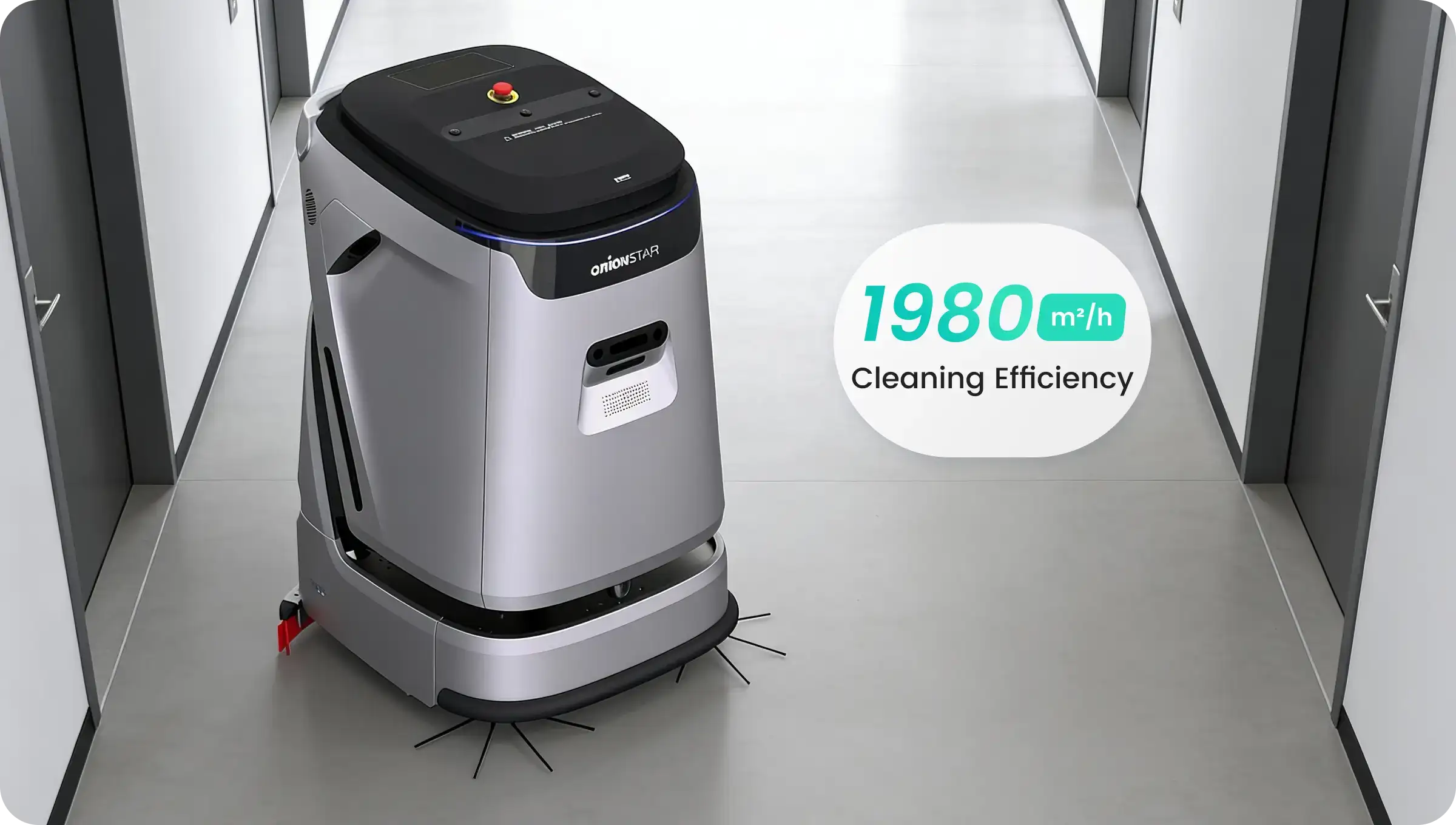
The OrionStar CleaniBot C5 illustrates how these autonomous capabilities are deployed in heavy-duty, fast-paced environments. According to manufacturer data, this model utilizes a dual-rolling-brush system delivering up to 25 kg of downward scrubbing pressure, achieving an estimated dirt-cleaning rate of about 95% in a single pass. Designed to navigate expansive areas without human intervention, the system can autonomously map spaces up to 10,000 square meters and process a maximum cleaning capacity of up to 1,980 square meters per hour. Operating at noise levels below 68 dB(A), the unit is capable of sweeping, scrubbing, and mopping concurrently, demonstrating a practical application of high-efficiency autonomous floor care while minimizing disruptions to patient care.
These high-traffic zones experience continuous footfall and rapid patient turnover, acting as primary vectors for dirt and pathogens. Commercial cleaning robots dynamically adjust their schedules using smart-building data to perform intensive scrubbing during off-peak hours or focus on perimeter cleaning when the seating space is heavily occupied.
Hospital corridors require constant maintenance to prevent slip-and-fall hazards and ensure the smooth transport of medical beds and critical equipment. Autonomous scrubbers utilize wide cleaning paths and obstacle avoidance technology to safely navigate these vital arteries without disrupting clinical workflows.
The transition between patient consultations demands rapid and thorough sanitation within incredibly strict time constraints. While staff concentrate on disinfecting high-touch examination tables and devices, automated robotic systems can perform terminal floor cleaning as soon as the scheduling system flags the room as available.
Reception and registration desks represent the first point of contact and suffer from the highest volume of tracked-in debris from the outdoors. Utilizing heavy-duty scrubbing pressure and integrated vacuuming, cleaning robots maintain a pristine and safe entryway, establishing a highly visible standard of hygiene for arriving patients.
Commercial cleaning robots function as connected nodes within a hospital's broader facility technology stack. By pushing validated data packets over facility Wi-Fi directly to Building Management Systems (BMS), operations teams can monitor robot status and coverage alongside HVAC and access-control data. Furthermore, integration with Computerized Maintenance Management Systems (CMMS) via APIs enables the immediate generation of auditable cleaning records and automated maintenance work orders—such as flagging brush replacements or battery load drops—ensuring the robotic fleet remains operational with minimal administrative oversight. Through IoT platforms and occupancy sensors, cleaning intensity can even be dynamically adjusted to track real-time patient arrival patterns in the outpatient tracking systems.
Commercial cleaning robots are fundamentally transforming the way hospitals maintain their outpatient departments, shifting the paradigm from reactive manual labor to proactive, data-driven facility management. By adopting these autonomous solutions, healthcare facilities can effectively combat EVS understaffing, lower operational costs, and elevate baseline infection control standards across all their public-facing spaces. Because facility layouts and specific clinical demands vary widely, the OrionStar CleaniBot series provides multiple models designed to adapt to different environmental requirements and integration needs. This ongoing integration of smart robotics ensures that healthcare operations can sustain optimal levels of safety and efficiency well into the future.