

REQUEST DEMO
Robot CATALOG will be sent to your mailbox immediately after submission.
SUBMIT
Commercial properties span a complex mix of spaces, from narrow office corridors and carpeted meeting rooms to high-traffic lobbies, concrete parking decks, and rugged back-of-house service zones. Each area demands tailored cleaning solutions, and facility managers face the challenge of balancing efficiency, maneuverability, compliance, and sustainability across these diverse environments. Choosing the right commercial cleaning robot requires aligning a unit’s capabilities with the specific needs of each zone, rather than relying on a one-size-fits-all approach. This guide evaluates leading options against key procurement factors to help property operators make informed decisions.
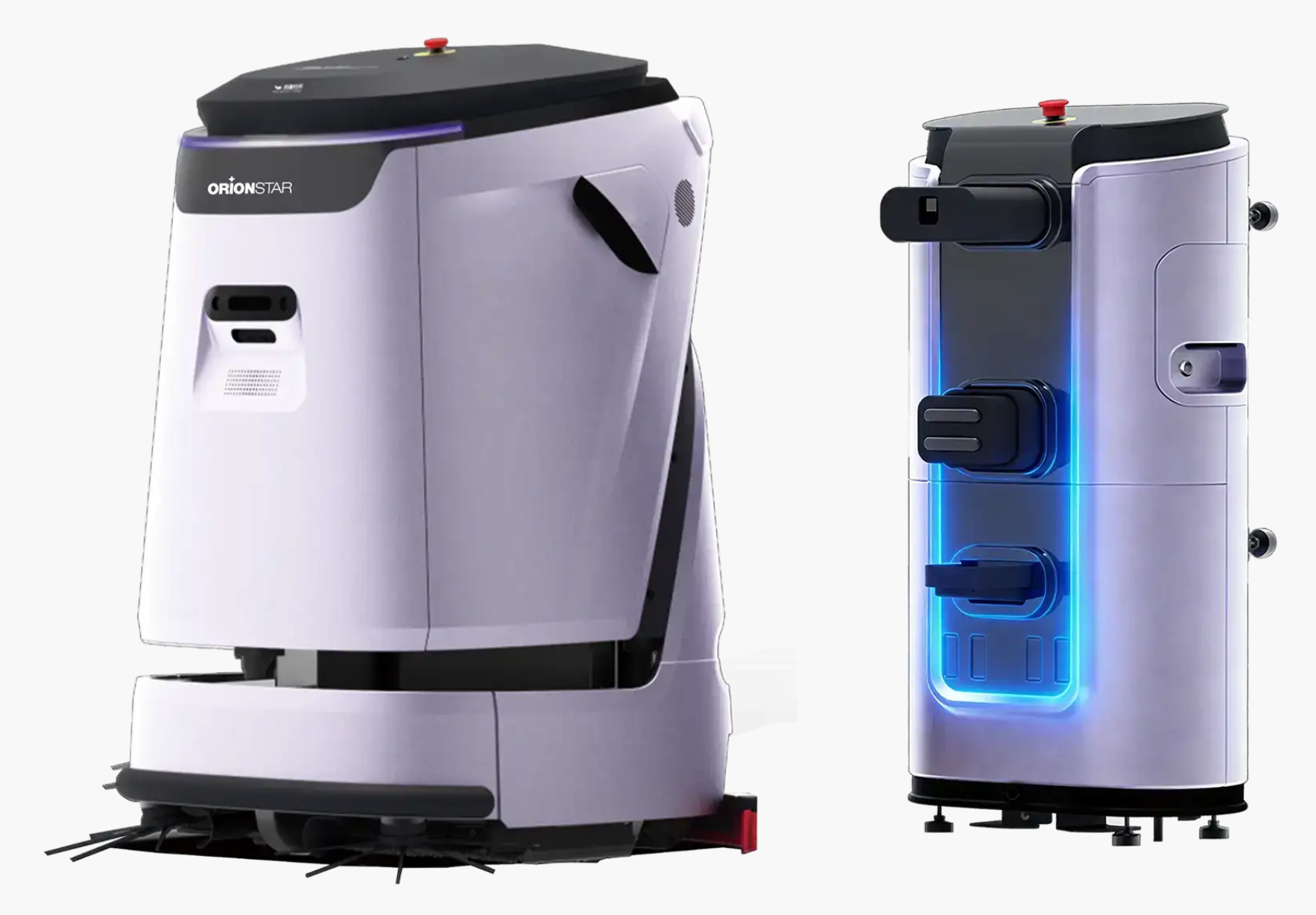
The OrionStar CleaniBot C5 is engineered for large commercial properties, parking levels, and mixed-use estates, where heavy-duty cleaning and continuous operation are priorities. Its multi-zone cleaning capability shines across polished lobby tiles, corridor vinyl, and concrete parking decks, offering scrubbing, dust-mopping, and water-absorption modes in a single cycle. According to manufacturer data, it delivers up to 25 kg of downward scrubbing pressure via a dual-rolling-brush system, which is designed to tackle heavy oil, grime, and stubborn stains. Under standard laboratory testing conditions, the dirt-cleaning rate reaches approximately 95% (data sourced from OrionStar official technical documentation). It can also pick up debris up to 3 cm in height, making it suitable for back-of-house zones with loose waste.
In terms of maneuverability, the CleaniBot C5 has a minimum passing width of approximately 880 mm, allowing it to navigate typical corridors and doorways, and it can climb obstacles up to 15 mm and manage slopes up to 5° when loaded. Operational efficiency is supported by a combined 90 L water tank system (45 L clean, 45 L waste), reducing the need for frequent refills and downtime. It offers up to 3 hours of scrubbing runtime or up to 8 hours of mopping runtime, with fast charging in around 1.5 hours. The robot’s fully autonomous operation includes mapping up to 10,000 m², planning optimal cleaning paths, and automatically docking for refueling, drainage, and self-cleaning. For GDPR compliance, operators should verify that any data captured by its obstacle-avoidance sensors aligns with regional regulations, especially when deploying in the EU or UK.
The Kärcher KIRA CV 50 serves as a dry-maintenance complement to wet-scrubbing machines, designed specifically for narrow corridors, under-desk coverage, and daily dry-debris maintenance in commercial-property offices and lobbies. It is not a direct substitute for wet-scrubbing units, as it focuses solely on vacuuming carpets and hard floors, but it fills a critical gap in cleaning hard-to-reach areas where larger scrubbers cannot operate. Its compact 22.8-inch footprint and 12.6-inch clearance height let it navigate under office desks, lobby furniture, and reception counters, seamlessly transitioning between carpeted and hard-floor surfaces with specialized settings per area.
Operational efficiency is supported by two exchangeable 36 V Kärcher Battery Power+ packs, enabling near-continuous runtime in multi-shift environments, though charging time per pair ranges from 58 to 81 minutes with a slow charger. The robot uses a multi-sensor system centered on LiDAR with a stated 20 m sensing range, supplemented by optical and acoustic sensors for collision avoidance, wall tracking, and cliff detection, ensuring safe operation around people and furniture. For GDPR compliance, since it does not use an RGB camera for mapping, mapping data is stored locally, and Kärcher’s German headquarters with EU data-processing infrastructure simplifies alignment, though operators should still confirm full compliance before deployment in EU/UK properties.
The Gaussian Robotics Scrubber 50 is a mid-size option ideal for offices, retail concourses, and corridor-heavy floors, offering multi-modal sweeping, scrubbing, mopping, and optional workstation-supported water/charging cycles. Its 3-in-1 cleaning capability allows it to handle mixed floor types in a single pass, with quick-release squeegee and filter components that swap without tools to adapt to polished tile, vinyl, or concrete surfaces. A standout feature is its Auto Spot Cleaning, driven by an RGB camera, which detects stains and wastes to focus cleaning on targeted areas. Under controlled testing conditions, this feature can reduce cleaning time by up to 75% compared to full-area cleaning runs (data sourced from Gaussian Robotics official documentation).
Maneuverability is balanced for moderate spaces, with a minimum passable width of 800 mm and a minimum U-turn width of 1,100 mm, fitting through standard doorways and corridors. Operational efficiency includes a 30 L clean water tank and 24 L recovery tank, with up to 3 hours of scrubbing runtime or 6–8 hours of dust mopping. The optional WS-01 Workstation enables self-docking, automatic charging, and water refill/drain, reducing human intervention in 24/7 properties. Sustainability is a key strength, with a 5-stage water-recycling system that reduces freshwater consumption by approximately 80%, supporting ESG reporting for office and mixed-use estates. For GDPR compliance, operators must verify that Gausium’s cloud-based data processing, mapping storage, and cross-border transfers align with regulations, as the robot uses RGB cameras and routes data through global cloud services.
The Tennant T7AMR is a ride-on autonomous scrubber framed as overkill for typical office floors but well-suited to wide concourses, parking decks, and large commercial-property atria. Its large 650 mm scrubbing path and up to 86 kg of main down pressure make it ideal for heavy-soil areas like concrete parking decks and high-traffic lobbies, where it can cover up to 4,250 m² per battery run with high-capacity lithium-ion batteries. Optional ec-H2O NanoClean technology converts water into an effective cleaning solution without chemicals, reducing environmental impact and reducing the need for chemical cleaning solutions, which can contribute to a more favorable indoor environment when used as directed.
Maneuverability is limited to expansive spaces, as it requires a 4 ft navigation aisle width, 5 ft entrance width, and 10 ft U-turn radius, making it unsuitable for narrow office corridors or tight indoor areas. Operational efficiency is supported by 110 L solution and recovery tanks, reducing refill frequency, and up to 6 hours of runtime with lithium-ion batteries. The robot runs on BrainOS®, which offers teach-and-repeat and area-fill learning modes, with cloud-based fleet management, route analytics, and reporting dashboards. For GDPR compliance, operators should verify that Brain Corp’s cloud platform, which handles mapping and telemetry data, meets regional data privacy requirements before deployment in EU/UK properties.
The Avidbots Neo 2W is the right pick for back-of-house service zones, loading bays, and large parking or storage areas within mixed-use commercial properties, but it is not suited for customer-facing lobbies or narrow office spaces. Its industrial-grade build is tuned to handle warehouse hazards like pallets, forklift tines, and floor-level obstacles, with advanced obstacle detection optimized for logistics and warehouse environments. It offers up to 6 hours of cleaning per charge, with swappable batteries to eliminate charging wait times for 24/7 operations.
Maneuverability is restricted to wide spaces, with a minimum autonomous aisle turn-around width of 3.05 m, making it too large for typical office corridors. Operational efficiency includes a 109 L solution tank and 135 L recovery tank, reducing the need for frequent emptying, and a Debris Diverter to push aside debris between pre-sweeps, reducing clog risk. The Avidbots Command Center, a web-based platform, provides 24/7 fleet management, real-time monitoring, and detailed cleaning reports. For GDPR compliance, operators must confirm that data residency, mapping storage, and cross-border processing via the Command Center align with regulations, as the robot uses RGB cameras and cloud-based telemetry.
For facility managers navigating diverse commercial property zones, selecting the right cleaning robot requires matching capabilities to specific area needs. Mixed-use estates with a mix of parking decks, back-of-house zones, and office spaces can pair the OrionStar CleaniBot C5 (for heavy-duty wet cleaning) with the Kärcher KIRA CV 50 (for dry under-desk maintenance), or opt for the Gausium Scrubber 50 for mid-size areas where sustainability and spot cleaning are priorities. Wide concourses and parking decks benefit from the Tennant T7AMR’s large coverage and heavy-duty scrubbing, while back-of-house loading bays and storage zones are best served by the Avidbots Neo 2W’s industrial-grade obstacle detection. When evaluating options, prioritize multi-zone flexibility, space maneuverability, operational efficiency, GDPR compliance, and sustainability to align with long-term property management goals.
Documented deployments in commercial-property-adjacent sites show payback periods in the 12–24 month range. Gausium reports a 64% ROI at London Heathrow Airport with £124,174.99 in savings, and roughly 145,945 labor hours plus 1.1 million liters of water saved annually across Network Rail's UK stations. Avidbots cites an 80% labor-hour reduction for DHL in a warehousing environment. Buyers should expect payback to depend on local labor rates, shift coverage, and whether the existing cleaning SLA is being met by manual crews at premium overtime cost.
TCO varies significantly by commercial model. Capital purchase pricing for mid-size units such as the Gausium Scrubber 50 is reported at approximately USD 53,600 per robot with the optional WS-01 Workstation sold separately, while the Kärcher KIRA CV 50 vacuum is listed at MSRP USD 12,999 (vacuum, charger, battery) in the US. Heavy-duty ride-on units like the Tennant T7AMR and Avidbots Neo 2W are typically procured through dealer channels and command higher upfront costs. Avidbots additionally offers a Gold Service Plan that bundles preventive maintenance every 480 hours with break-fix and parts, raising annual TCO but reducing operational risk. Facility managers should model TCO over a 5-year horizon including batteries, water, consumables, and integration labor.
A standard procurement package should include: defined coverage rate (m²/h) under site conditions, uptime SLA (typically 90–95% during contracted operating hours), mean-time-to-repair commitments (often 24–48 hours), response-time guarantees, and consumables replacement terms. Vendors that operate as managed service — including Avidbots through its Gold Service Plan — bundle preventive maintenance and parts. Buyers should also confirm where mapping data and fleet telemetry are stored, especially when deploying in the EU, where GDPR governs cross-border processing of any sensor-captured data. Reporting cadence (cleaning records, fleet dashboards) and software-update policies should be written into the contract as well.
Mid-size autonomous scrubbers such as the OrionStar CleaniBot C5 and Gausium Scrubber 50 are explicitly designed for mixed floor types: the C5 combines scrubbing, dust-mopping, and water-absorption modes for polished lobby tile, corridor vinyl, and back-of-house service zones in a single cycle, while the Scrubber 50 offers 3-in-1 scrub/sweep/dust-mop with quick-release squeegee and filter components. The Tennant T7AMR adds Insta-Fit tool-free brush/pad changes for switching between floor types. For parking-deck concrete with heavy oil staining, heavier ride-on units like the Avidbots Neo 2W (109 L solution tank, 26/32-inch cleaning width) or the C5 with 25 kg of downward pressure and a 550 mm main brush are better suited. A dedicated vacuum such as the Kärcher KIRA CV 50 complements scrubbers for carpeted boardrooms and meeting rooms.
Most autonomous cleaning robots use a combination of 2D LiDAR, 3D depth cameras, and/or RGB cameras for navigation and obstacle detection — the Gausium Scrubber 50, Tennant T7AMR (via BrainOS), and Avidbots Neo 2W all rely on sensor fusion that may capture data beyond simple geometry. Kärcher's KIRA CV 50 uses LiDAR plus optical and acoustic sensors without a published RGB camera for mapping. Because these platforms route mapping, route learning, and fleet telemetry through vendor clouds (Gausium Shanghai with global subsidiaries, Brain Corp for Tennant, Avidbots Command Center), EU operators should confirm data residency, processing agreements, and any cross-border transfers with the vendor before deployment. Vendors operating under GDPR-aligned frameworks — for example Kärcher as a German-headquartered company with EU data infrastructure — typically publish relevant compliance statements on request.
The minimum infrastructure requirements cluster around three areas. First, physical access: the OrionStar CleaniBot C5 needs about 880 mm of passing width and handles slopes up to 5° loaded or 8° unloaded; the Tennant T7AMR requires 4 ft navigation aisle width, 5 ft entrance width, and a 10 ft U-turn radius. Second, charging and water: the C5 supports an optional mobile water tank to avoid building plumbing modifications, while the Gausium Scrubber 50 requires the optional WS-01 Workstation for self-docking, automatic refilling, and water discharge. Third, connectivity: Kärcher's KIRA Robots app and Avidbots Command Center depend on Wi-Fi coverage across the mapped floors for fleet reporting, remote start/stop, and no-go-zone management. Most vendors also recommend LiDAR-friendly environments — avoiding mirrored glass and highly reflective surfaces at mapping time — to ensure reliable localization.
Third-party product specifications are based on up to, under laboratory conditions, according to manufacturer data, and may vary in real-world use. Product names and trademarks are the property of their respective owners. If any product involves cameras, voice recording, mapping or cloud data processing, operators must verify GDPR compliance before deployment in EU/UK commercial properties.