

REQUEST DEMO
Robot CATALOG will be sent to your mailbox immediately after submission.
SUBMIT
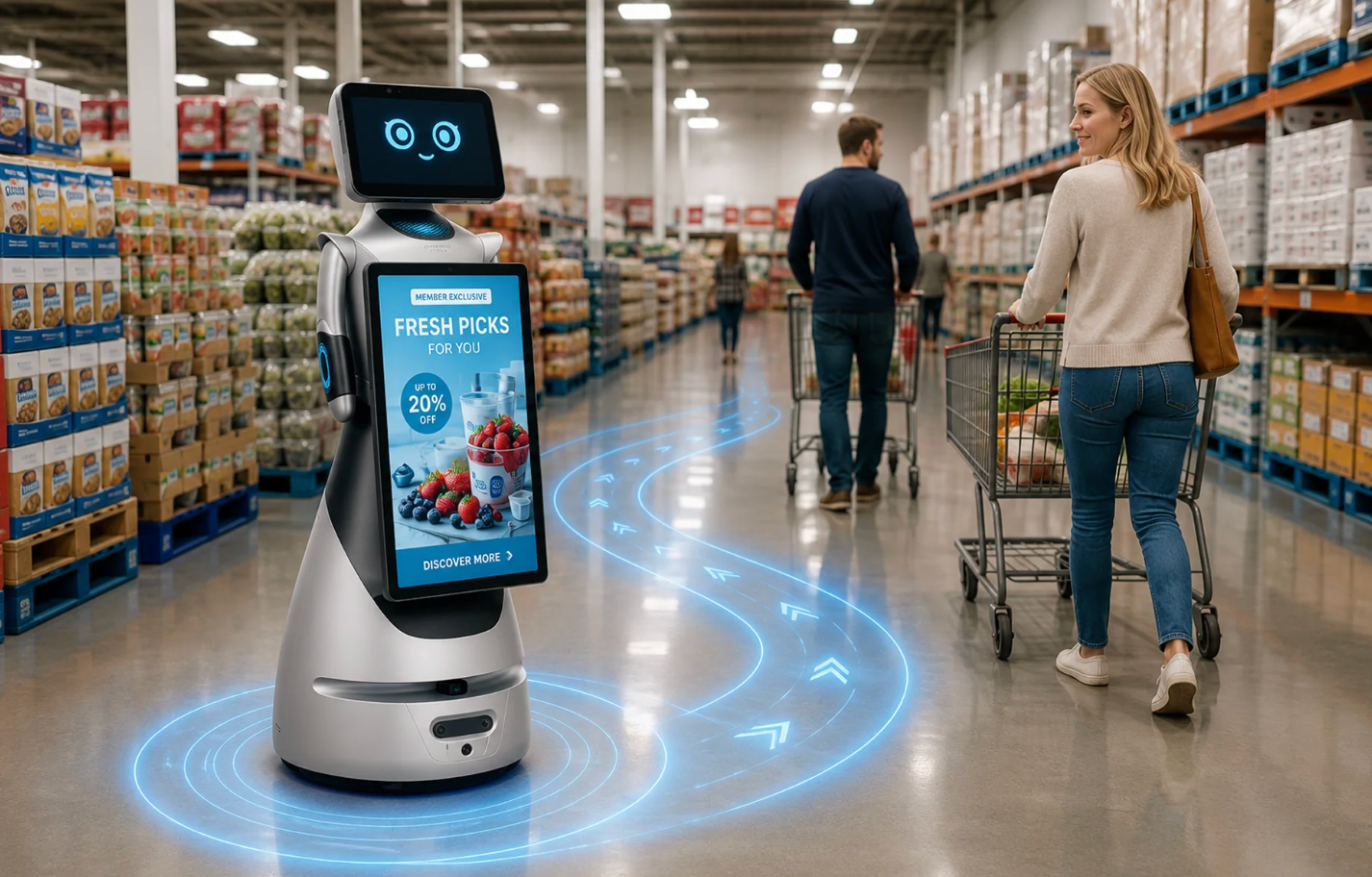
Retail operators across shopping malls, brand flagship stores, supermarkets, car dealerships, and electronics showrooms face unique challenges that demand tailored technology solutions. Diverse space layouts, from narrow supermarket aisles to sprawling car showrooms, require robots that can adapt without disrupting customer flow. Balancing customer engagement with marketing versatility is key to driving foot traffic conversion, while extended operational hours demand resilient systems that minimize downtime. Additionally, data privacy regulations like GDPR add a critical layer of compliance that cannot be overlooked when deploying customer-facing robots. This guide evaluates leading retail assistant robots against these core selection factors to help operators make informed decisions for their specific venue needs.
Designed for narrow retail aisles and customer-facing engagement, the OrionStar GreetingBot Mini excels in space adaptability thanks to its compact chassis, with a minimum passable width up to 55 cm according to manufacturer data. Its markerless navigation system, combining LiDAR and depth camera fusion, delivers centimeter-level positioning accuracy and supports mapping areas up to 5,000 m², making it suitable for quick deployment across multi-floor venues like shopping malls without the need for physical floor markers. This agility allows it to maneuver through crowded supermarket aisles and compact electronics store walkways without disrupting customer flow.
For customer engagement, the GreetingBot Mini prioritizes voice-first interaction, featuring a 6-mic circular array with 360° sound source positioning and speech recognition accuracy greater than 97% in noisy environments up to 75 dB according to manufacturer data. Its 14-inch FHD display offers a high-end visual experience for displaying promotions, product information, or guiding customers to target locations. Unlike many competitors, it provides native multilingual support with 30+ languages, real-time switching, and automatic language detection, making it ideal for tourist-heavy venues or international flagship stores. The open development platform, with 73 API interfaces, allows retailers to customize workflows for specific retail needs, from gift card sales to specialty recommendations, at a claimed development cost up to 1/10 of industry standards.
Operational resilience is a strong suit, with a cruising time up to 12 hours in typical scenarios and automatic return to charger when power drops below 10%, enabling 24/7 non-stop cycle service with scheduled overnight charging. Multi-robot cooperation capabilities allow fleets to avoid collisions and coordinate tasks across large venues, reducing operational overhead. When deploying in the EU or UK, operators must verify GDPR compliance, as the robot uses head and wide-angle cameras, plus cloud-connected AI tools like the ChatMAX Platform. This includes confirming lawful basis for data processing, clear customer-facing privacy notices, and defined data retention windows.
Positioned as a 3-in-1 solution combining delivery, greeting, and in-venue advertising, the Pudu KettyBot Pro is ideal for crowded retail aisles where visible marketing surfaces matter as much as customer engagement. Its compact C-shaped body offers a minimum passable clearance up to 52 cm according to reseller data, allowing it to navigate tight supermarket aisles and showroom layouts where larger delivery robots cannot access. Dual SLAM navigation and RGBD-based obstacle avoidance, paired with multiple redundant safety sensors and 360° PTZ cameras, ensure reliable movement in high-traffic areas, with support for multi-floor deployment and auto-recharge functionality.
The KettyBot Pro stands out for its integrated 18.5-inch advertising display, which doubles as a marketing surface while the robot patrols, greets customers, or completes delivery tasks. It supports tray-based delivery with up to 10 kg per tray, making it suitable for supermarket café hybrids or retail stores offering in-store pickup. Multi-robot cooperation via the PUDU Scheduler allows fleets to hand off tasks across venue networks, optimizing coverage during peak hours. Multilingual support is not publicly specified on manufacturer sheets; operators should verify language pack availability with local distributors, which typically involve cloud-based uploads or regional firmware configurations tailored to specific markets.
Operational runtime is up to 9 hours in typical scenarios according to reseller data, with a charging time up to 3.5 hours. Remote management features include compatibility with RobotLAB Smart Pass for elevator and door-opener integrations, though detailed cloud platform controls require confirmation from regional distributors. For GDPR compliance in the EU/UK, operators must address the robot’s use of RGBD and 360° PTZ cameras, plus cloud-connected fleet management. This involves securing lawful basis for video processing, implementing clear privacy signage, and establishing data retention policies aligned with regional regulations.
The Pudu BellaBot is tailored for wider-aisle retail environments and family-oriented commercial venues, leveraging its expressive cat-ear interface to attract customer attention while handling high-capacity delivery tasks. Its larger footprint requires a minimum navigable space up to 65 cm according to manufacturer data, making it better suited for open mall concourses, brand flagship stores, or spacious supermarkets than narrow aisles. Equipped with LIDAR and RGBD sensors, the BellaBot Pro adds VSLAM navigation for enhanced 360° perception, ensuring smooth maneuvering through busy open spaces.
Customer engagement is driven by expressive multi-modal interaction, combining touch, voice, and light cues to create approachable interactions. The BellaBot Pro features an 18.5-inch HD ad screen for displaying promotions, while the base model focuses on delivery with up to 40 kg total payload across four trays according to reseller data. Multi-robot coordination via the PUDU Scheduler allows fleets to manage delivery and greeting tasks across large venues, though its delivery-focused design means reception and wayfinding functionality is secondary to its core role. Multilingual support varies by regional firmware, so operators must confirm specific language packs with local distributors, which may involve cloud-based updates to voice prompts and UI elements.
Operational resilience includes a battery life of 10–12 hours according to reseller data, with a charging time up to 5 hours and auto-return to dock functionality. Like other Pudu models, it supports multi-floor deployment and integration with elevator systems via RobotLAB Smart Pass. For GDPR compliance in the EU/UK, operators must verify data processing practices related to the robot’s LIDAR, RGBD sensors, and potential camera integration. This includes obtaining appropriate consent for data collection, establishing retention windows, and signing processor agreements with vendors and cloud sub-processors.
Hyundai’s DAL-e is purpose-built for brand flagship stores, car dealerships, and retail showrooms, designed to enhance brand-customer interaction through immersive, human-like engagement. Its four-wheel independent steering (4WIS) drive base enables 360° rotation and agile movement, making it suitable for open showroom layouts where space is not a constraint. Equipped with two LiDAR sensors and cameras, it offers real-time obstacle avoidance and free indoor roaming, with auto-docking for charging to support extended operational hours.
Customer engagement is centered around personalized brand interactions, including real-time natural language conversation, face tracking and recognition (with mask detection), and synchronized content with showroom media walls. It can capture customer photos and share them directly to smartphones, adding a memorable touch to the showroom experience. Multilingual support is built into the software architecture, but requires per-market scenario and gesture work with Hyundai’s Robotics Lab to adapt to local customer preferences, making it a customizable solution rather than an out-of-the-box multi-language tool.
According to manufacturer positioning, DAL-e is designed for 24-hour active service, with auto-charging functionality to minimize downtime. The DAL-e Delivery variant, launched in 2024, extends capabilities to indoor delivery with a top speed up to 1.2 m/s and cargo capacity up to 10 kg. Remote management details are not publicly specified, though the robot integrates with showroom media systems for synchronized content. For GDPR compliance in the EU/UK, operators must address the robot’s use of facial recognition and cameras, including verifying lawful basis for biometric processing, obtaining explicit consent where required, and conducting data protection impact assessments.
The temi robot is an ultra-slim, budget-friendly solution tailored for retailers needing flexible navigation in very tight aisles, such as electronics stores or compact retail showrooms. Its 35 cm body width makes it the most space-efficient option evaluated, with a ROBOX navigation system delivering 5 cm positioning accuracy according to manufacturer data. Equipped with 360° LIDAR, depth cameras, and time-of-flight sensors, it offers fully autonomous navigation, human-follow mode, and real-time obstacle avoidance, making it easy to maneuver through crowded, narrow spaces.
Customer engagement features include a 13.3-inch 1080p multi-touch display for multimedia presentations, telepresence/video calls, and self-service product demos. Its open Android SDK and app marketplace allow retailers to build custom retail-specific applications, from interactive product catalogs to lead capture forms, making it a versatile tool for brand experience scenarios. However, multilingual support is currently limited to English, with more languages planned for future updates, which is a material limitation for non-English-speaking markets.
Operational resilience includes a battery life up to 8 hours per charge according to manufacturer data, with auto-return to dock functionality. Cloud-based remote management via the temi center allows operators to control fleets and customize workflows in real time, though its smaller tray load (up to 3 kg) and shorter runtime make it less suitable for high-capacity delivery tasks. For GDPR compliance in the EU/UK, operators must verify data processing practices related to the robot’s cameras, microphones, and cloud storage, including ensuring end-to-end encryption, data minimization, and compliance with subject-access requests.
When selecting a retail assistant robot, operators should align their choice with their venue’s specific needs and constraints. For narrow aisles in supermarkets or electronics stores, the OrionStar GreetingBot Mini offers native multi-language support and agile navigation, while temi is a budget-friendly option (note its current English-only limitation). For crowded aisles where advertising and delivery are priorities, the Pudu KettyBot Pro’s integrated ad display and 3-in-1 functionality make it a strong choice. Wider-aisle venues or family-oriented spaces can benefit from the Pudu BellaBot’s high-capacity delivery and expressive interaction. For brand-focused showrooms and car dealerships, Hyundai’s DAL-e provides immersive, personalized brand engagement tailored to high-end retail experiences. Across all deployments, operators must prioritize compliance with regional data privacy regulations like GDPR, verifying data processing practices and vendor agreements before going live.
Industry data consistently places payback in the 12 to 24 month range for well-selected commercial robots, with high-utilization scenarios reaching as low as 6 to 15 months (sources: AMD Machines installation data, IDTechEx 2025). The wide spread reflects three variables: hours of daily operation, local labor cost, and how much the robot offsets front-of-house staff time versus purely promotional use. For a retail-assistant robot running 10–12 hours per day greeting, wayfinding, and screen-driven promotion, operators typically model direct labor savings plus secondary uplift from increased dwell time and conversion. OrionStar does not publish a specific payback figure for the GreetingBot Mini; operators should request a vendor-supplied ROI worksheet that compares current staffing hours against projected deployment hours.
Every retail-assistant robot on the market — including the OrionStar GreetingBot Mini — uses cameras, microphones, and cloud-connected fleet management, which places them inside GDPR scope. BDO's 2024 retail-robotics guidance highlights six guardrails: clear customer-facing privacy notices, lawful basis (consent versus documented Legitimate Interest Assessment for any biometric processing), purpose limitation, data minimization, defined retention windows with deletion-on-request, and signed processor agreements with the robot vendor and any cloud sub-processors. Facial recognition, where supported, requires explicit consent or a strong LIA in most EU jurisdictions. Operators in Germany, France, and the Netherlands should also expect to appoint or contract a Data Protection Officer before go-live. Plan a 4–8 week privacy readiness sprint between contract signature and first in-store activation.
Both models are common across the category. Pudu's KettyBot Pro and BellaBot / BellaBot Pro are sold as direct purchase through distributors such as RobotLAB (KettyBot Pro USD 14,000; BellaBot USD 14,500; BellaBot Pro USD 16,000) and are also offered as Robot-as-a-Service at roughly USD 395–479 per month per unit. temi is sold outright via authorised resellers (starting around USD 4,499, region-dependent). The OrionStar GreetingBot Mini is sold through regional partners and the procurement model — purchase, lease, or RaaS — varies by market; operators should request both options in any vendor RFQ so that capex and opex budgets can be compared side by side over a 3-year horizon.
Passability is the deciding metric. temi is the narrowest at roughly 35 cm body width, making it the easiest fit for electronics-store gondolas and tight showroom aisles. The OrionStar GreetingBot Mini clears a minimum 55 cm passable width with a 41 cm chassis diameter, fitting comfortably inside most supermarket and brand-flagship layouts. Pudu's KettyBot Pro is rated for around 52 cm clearance, while the BellaBot / BellaBot Pro footprint of 565 × 537 mm is materially wider and better suited to open concourses than narrow aisles. For car dealerships and retail showrooms with wider bays, footprint is rarely the constraint; for supermarkets and electronics stores, request a live aisle test with the proposed unit before signing.
This is where the category splits sharply. The OrionStar GreetingBot Mini ships with 30+ languages, real-time switching, and automatic language detection, which makes it a strong fit for tourist-facing venues, airport-adjacent malls, and cross-border flagship stores. Pudu's KettyBot and BellaBot lines indicate multilingual capability but require confirmation of the specific language pack with the local distributor before commitment. Hyundai's DAL-e is structurally built for localisation but needs per-market scenario and gesture work with the Robotics Lab team. temi is currently English-only on the voice stack — a material limitation for non-English retail environments and a frequent deal-breaker in EU, LATAM, and APAC deployments. Always validate the language list against the specific firmware version the vendor will ship, not the marketing brochure.
Yes, but the screen size, runtime, and charging model vary. The OrionStar GreetingBot Mini pairs a 14-inch FHD display with a 12-hour typical cruising time and auto-return-to-dock when battery drops below 10%, enabling 24/7 cycle service with scheduled overnight charging between 23:00 and 07:00. Pudu's KettyBot Pro and BellaBot Pro carry larger 18.5-inch HD advertising displays, useful for venues that want a dominant marketing surface. temi uses a 13.3-inch 1080p multi-touch display with roughly 8 hours per charge. For continuous in-store operation, the two operational questions to confirm with any vendor are: (1) whether the robot supports scheduled charging windows that align with store trading hours, and (2) whether the CMS allows remote content updates so promotions can change without on-site visits.
Third-party product specifications are based on up to, under laboratory conditions, according to manufacturer data, and may vary. Product names and trademarks are the property of their respective owners. For any product involving cameras, voice recording, mapping, or cloud data processing, operators must verify compliance with GDPR and other applicable regional data protection regulations before deployment.