

REQUEST DEMO
Robot CATALOG will be sent to your mailbox immediately after submission.
SUBMIT
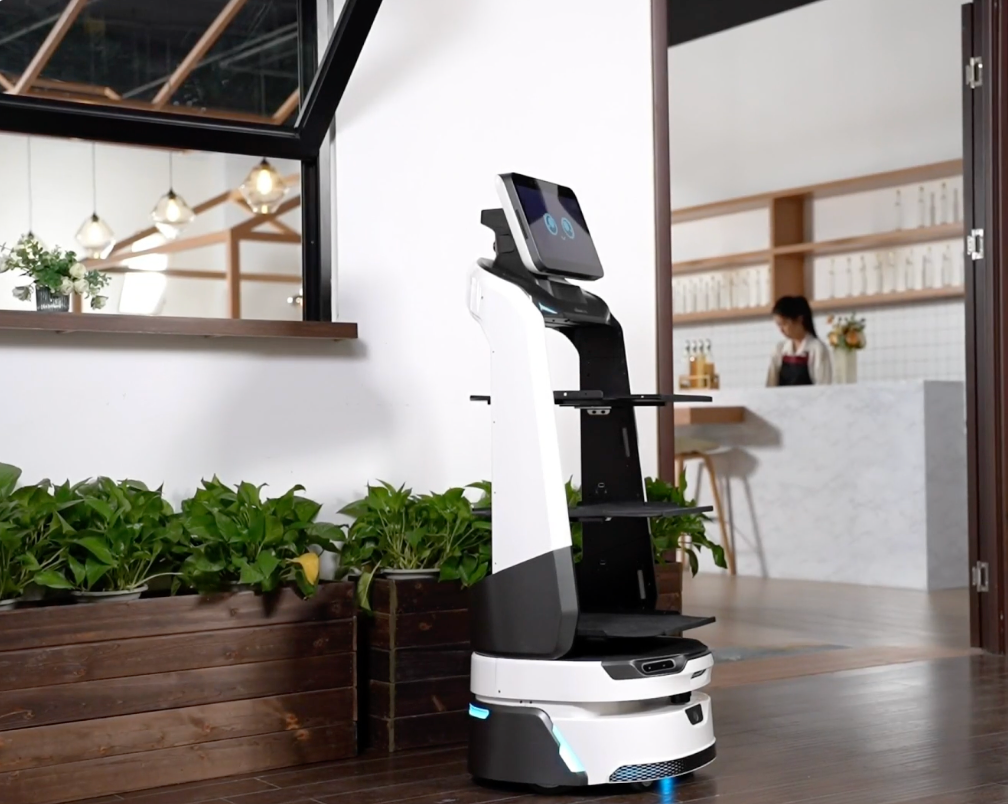
For small to mid-sized full-service eateries—from cozy diners and neighborhood bistros to independent restaurants—daily operations are defined by tight constraints: narrow between-table aisles that leave little room for error, frequent transport of hot food and liquid beverages that demand spill-free stability, mixed front-of-house workflows that blend food delivery, tableware collection, and guest greeting, and ongoing labor challenges that stretch staff thin. Choosing the right food delivery robot for these venues requires balancing maneuverability, transport reliability, workflow flexibility, operational efficiency, and regulatory compliance, especially for global operators navigating data privacy rules like GDPR.
Designed as a flagship open-tray delivery robot for high-demand service environments, the OrionStar LuckiBot Pro is well-suited for eateries handling peak-hour rushes, mixed menu items, and diverse front-of-house tasks. Its quasi-circular chassis and 240° 3D all-around obstacle recognition—powered by LiDAR and triple RGBD depth cameras—support smooth navigation through narrow aisles, with rapid response to small obstacles like dropped items or children under tables, reducing disruptions to staff and guest traffic. For food and beverage stability, the robot features a Torsion Bar Suspension that adapts to uneven flooring, plus a dedicated Soup Delivery Mode optimized for low-vibration transport of liquids, minimizing spill risk and food waste.
When it comes to workflow flexibility, the LuckiBot Pro offers multiple pre-configured modes including Fast Delivery for peak service, Collection for tableware pickup, Promotion Mode for dynamic guest engagement via its 14-inch 1080P FHD display, and Guidance Mode for leading guests to tables. Its modular design allows for up to 4 adjustable trays, with a total payload of up to 60 kg and up to 15 kg per tray, making it capable of carrying large orders or mixed items like plates, bowls, and tall drinkware. On the operational side, it boasts up to 12 hours of runtime per charge, with an auto-charge dock that minimizes staff intervention, and its open RobotOS SDK supports custom integration for eateries looking to align the robot with existing systems. Since the LuckiBot Pro uses cameras and cloud-connected tools for mapping and integration, operators in EU/UK markets must verify GDPR compliance, including confirmation of data types (venue map, visual sensor data, interaction logs), usage purposes (navigation, obstacle avoidance, feature optimization), retention periods, and required user consent mechanisms, per OrionStar’s official privacy policy.
With the largest global installed base in full-service and counter-service venues, the Pudu BellaBot is a widely adopted option for eateries seeking a robot optimized for hospitality workflows. Its dual SLAM navigation system—switchable between LiDAR and visual SLAM—addresses common eatery challenges like mirrors, glass partitions, or dim lighting that can disrupt single-mode navigation, ensuring reliable movement through varied dining room layouts. The robot’s automotive-grade adaptive variable suspension adapts to surface changes, including thresholds and uneven flooring, providing stable transport for hot food and beverages to reduce spills.
BellaBot supports multi-task flexibility with modes for serving, bussing, and guest greeting, enhanced by its bionic cat-style design and multimodal interaction features like haptic feedback and smart expressions that engage guests. It offers four fixed trays with a total payload of up to 40 kg and 10 kg per tray, suitable for standard eatery orders. For operational efficiency, it uses a battery-swap system that enables 24/7 service when spare batteries are available, with a no-load runtime of up to 13 hours per charge. Its cloud-connected PUDU Link platform allows for remote management, route configuration, and fleet coordination. Given its use of visual SLAM, RGBD cameras, and cloud-based tools, operators in EU/UK regions should confirm GDPR compliance for data handling related to venue mapping and telemetry.
The Keenon DINERBOT T9 is engineered for throughput and stability in repetitive counter-to-table runs, making it ideal for eateries with high-volume service needs. Its enclosed multi-tray design features four trays with adjustable heights—ranging from 16.9 cm to 25.3 cm—allowing staff to load mixed items like bowls, tall drinks, or bussing tubs on the same robot across a single shift, enhancing workflow flexibility. With a total payload of up to 40 kg and 10 kg per tray, it can handle multiple orders in one trip, reducing the number of trips between kitchen and dining room.
For aisle passability, the DINERBOT T9 requires a minimum 70 cm clearance, making it better suited for eateries with slightly wider aisles rather than tightly packed diners. Its LiDAR SLAM navigation system supports reliable movement, while its up to 18 hours of runtime per charge ensures it can cover long shifts without frequent downtime, with auto-return-to-charging functionality for minimal staff intervention. The robot’s built-in voice prompts and touch display help coordinate tasks with staff, supporting core delivery and bussing workflows. Since it uses LiDAR and mapping technology, operators in EU/UK markets must verify GDPR compliance related to floor-plan data retention and processing.
Bear Robotics Servi is purpose-built for restaurant dining rooms, with strong deployments in US full-service venues and presence in Korea and Japan, making it a solid choice for eateries in those regions. Its compact design requires a minimum 65 cm aisle pass width, optimized for narrow between-table spaces common in diners and small bistros, and its active suspension system—paired with calibrated speed and parking presets—ensures stable transport of soups and drinks, minimizing spill risk during tight turns or uneven flooring.
Servi offers multi-task flexibility with modes for serving, bussing, hosting, and greeting, plus an integrated LED display and sound system for branded guest engagement. It features up to four customizable trays with a total payload of up to 40 kg and 10 kg per tray, suitable for mixed eatery orders. On the operational side, it has a runtime of up to 12 hours per charge, with auto-charge dock or wired charging options, and its Bear Universe centralized control system supports multi-robot orchestration, preventing congestion in busy dining rooms. Given its cloud-connected fleet management and sensor stack for obstacle detection, operators in EU/UK regions should confirm GDPR compliance for data flows related to robot monitoring and mapping.
Richtech Matradee L (part of the Matradee family, with the current commercial model being Matradee Plus) is a US-supported platform with deployments in North American restaurants, offering multi-tray delivery and additional marketing functionality. It features four fixed trays for serving, bussing, and front-of-house tasks, with a total payload up to 39.9 kg (per publicly available vendor data; for exact specifications, please consult Richtech’s official documentation or sales team directly). Its 15.6-inch advertising display allows it to double as a front-of-house marketing surface, promoting menus or events while handling delivery tasks, adding extra value for eateries looking to enhance guest engagement.
For aisle passability, the minimum clearance is not publicly specified, so eateries should request an on-site audit to confirm compatibility with narrow layouts. The robot uses SLAM navigation with LiDAR and 3D cameras for reliable movement, with a runtime of up to 10 hours per charge and auto-charge dock functionality. Its touchscreen control supports basic task configuration, though remote fleet management details are less granular than some competitors. Since it uses cameras and cloud-connected tools for mapping and updates, operators in EU/UK markets must verify GDPR compliance related to data handling and residency.
Choosing the right food delivery robot for eateries depends on aligning features with specific venue needs. For eateries with extremely narrow aisles, Bear Robotics Servi and OrionStar LuckiBot Pro are among the models with compact chassis design and agile navigation systems suitable for tight spaces; please consult vendor specifications for exact minimum aisle clearance. For venues prioritizing spill-free transport of soups and drinks, LuckiBot Pro’s dedicated Soup Delivery Mode or Servi’s active suspension are strong options. Eateries with long shifts or high-volume service will benefit from Keenon DINERBOT T9’s extended up to 18-hour runtime (in typical no-load cruising scenarios), while those looking for global support and flexible navigation should consider Pudu BellaBot’s dual SLAM system. For North American eateries wanting marketing functionality, Richtech Matradee L’s integrated display adds a unique layer of guest engagement. Regardless of the model, operators in EU/UK regions must prioritize verifying GDPR compliance for any robot using cameras, mapping, or cloud-based tools to avoid regulatory risks.
Industry data points to an 18–24 month payback window at current U.S. labor rates, with estimates ranging up to 36 months in lower-wage markets and compressing to under 18 months where wages run higher (e.g., California or New York). The arithmetic is straightforward: full-service labor sits at roughly 36% of sales, and operators using delivery robots report serving 30–50% more tables per shift by removing the kitchen-to-table walk from the server's loop. The exact figure for any single eatery depends on local wages, shift coverage, and how many roles the fleet absorbs, so request a site-specific ROI model rather than relying on industry averages.
Industry-published prices for current restaurant delivery and serving robots cluster around $15,000–$25,000 outright, or roughly $1,000–$2,500 per month on a lease or Robots-as-a-Service (RaaS) contract. RaaS removes the upfront capital outlay and typically bundles software updates and remote support, which suits an operator without a capital budget line for automation. Direct purchase makes sense for multi-unit groups that can amortize the asset across several locations; subscription makes sense for independents who want predictable monthly operating expense. Confirm what is and is not included (training, spare parts, software, map updates, after-hours support) before comparing headline numbers.
Industry baseline is 1–2 days of on-site mapping and table-destination configuration, after which a phased rollout (one shift, then one section, then the full dining room) usually runs another 2–4 weeks. Most vendors include operator training in the first year; LuckiBot Pro, for example, ships with one year of free operation training and technical support plus 24/7 online service. A single-location buyer should specifically require written training scope (floor staff + kitchen pass + closing crew), a maintenance-response SLA, and a defined escalation path for after-hours breakdowns before signing.
Most restaurant delivery robots in this comparison require 65–70 cm (25.6–27.6 in) of clear aisle width; select compact models from specific vendors may pass through narrower spaces (please consult vendor specifications for exact figures). In the comparison set, Servi Plus specifies a 65 cm minimum pass width and active suspension for uneven floors; DINERBOT T9 and BellaBot both list 70 cm minimum clearance; LuckiBot Pro combines a quasi-circular chassis with 240-degree 3D obstacle recognition (LiDAR plus triple RGBD depth cameras) and a Torsion Bar Suspension that helps with thresholds and small obstacles. For an eatery with tightly packed tables or booths under 60 cm, request an on-site aisle audit before purchase rather than relying on published minimums.
Liquid stability is the single biggest variable between models in this category and the most common cause of front-of-house complaints. LuckiBot Pro offers an explicit Soup Delivery Mode for low-vibration transport plus Torsion Bar Suspension; Servi Plus ships active suspension and parking presets calibrated for soup and drinks; BellaBot uses an automotive-grade adaptive variable suspension. For mixed hot-food + tall-drinkware service, also confirm per-tray payload (10–15 kg across the comparison set), tray dimensions, and whether the vendor offers a sealed food protector or cup-holder accessory — LuckiBot Pro lists both as first-party accessories.
Published cruising times across this category range from about 10 hours (Richtech Matradee Plus) to 18 hours (Keenon DINERBOT T9); LuckiBot Pro and Servi Plus both advertise up to 10–12 hours per charge. Auto-return-to-dock is standard across Bear Robotics, Keenon, and OrionStar LuckiBot Pro, with cable charging as a fallback; Pudu BellaBot uses a battery-swap workflow instead, which requires spare batteries on site. For a typical dinner service the battery is not the limiting factor, but operators should confirm peak-shift charging behavior (does the robot autonomously dock between orders without interrupting service?) and whether the vendor will commit to a swap-unit SLA during the first 90 days.
Third-party product specifications are based on publicly available data and may vary from actual product performance. All product names and trademarks are the property of their respective owners. If any product involves cameras, voice recording, venue mapping, or cloud data processing, operational personnel must verify GDPR compliance before deployment in EU/UK regions.