

REQUEST DEMO
Robot CATALOG will be sent to your mailbox immediately after submission.
SUBMIT
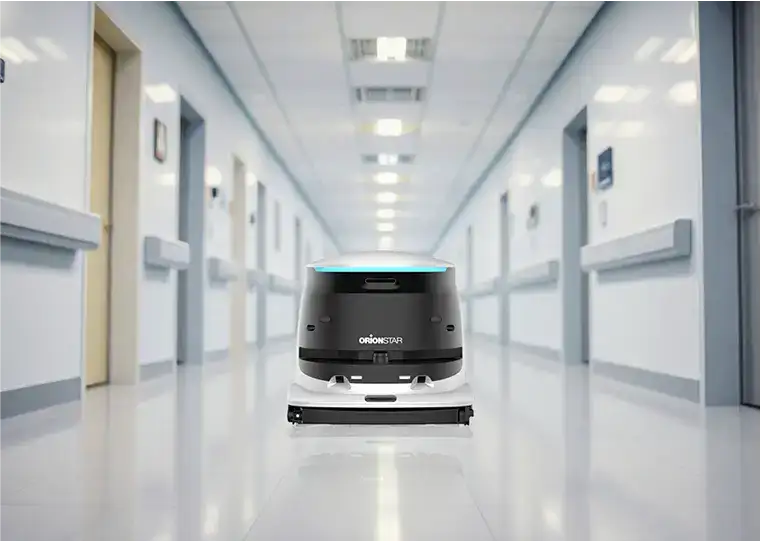
Facilities services teams in hospitals face mounting compound challenges: persistent labor shortages with average annual janitorial staff turnover rates reaching 200%, rising wage inflation (up 5.8% in the U.S. between 2022 and 2023), and the critical need to maintain consistent, documented cleaning standards to support infection control and HCAHPS scores that directly impact reimbursement. Traditional staffing models can no longer absorb these pressures, often forcing teams to choose between cleaning quantity and quality, while 24/7 facility operation leaves no off-peak window to defer routine cleaning of high-traffic areas. Commercial cleaning robots have emerged as a viable solution to address these gaps, combining autonomous operation, consistent performance, and data-driven reporting to augment human teams and elevate cleaning standards in healthcare settings.
The OrionStar CleaniBot S55 Pro embodies these commercial cleaning robot capabilities through its integrated design and advanced features tailored for hospital environments. According to manufacturer data, its LiDAR sensor supports map construction up to 10,000 m², enabling autonomous path planning across large hospital lobbies, corridors, and waiting areas without manual guidance. It offers multiple cleaning modes—including scrubbing, sweep & vacuum, and dust mopping—with cleaning efficiencies reaching up to 1,368 m²/h in sweep modes, allowing it to adapt to different floor surfaces and cleaning priorities. Additionally, its auto-charging functionality supports up to 28 hours of runtime in dust mopping mode, ensuring it can cover extended areas without human intervention, while its multi-sensor system (including ultrasonic sensors and stereo cameras) provides 360° obstacle avoidance to operate safely around patients and staff.
Hospital lobbies are high-traffic areas with constant foot flow, making routine cleaning difficult to schedule without disrupting visitors and patients. Spills, debris, and tracked-in dirt require frequent cleaning to maintain hygiene and positive patient perceptions. The CleaniBot S55 Pro’s quiet dust mopping mode (45 dB) allows it to operate during peak hours, while its high cleaning efficiency (up to 1,368 m²/h) ensures quick coverage of large lobby spaces, keeping floors clean and safe.
Public corridors in hospitals are busy thoroughfares for patients, staff, and equipment, with limited windows for deep cleaning due to 24/7 operation. Inconsistent cleaning can lead to slip hazards and compromised infection control. The robot’s LiDAR navigation enables it to navigate around carts, wheelchairs, and people safely, while its auto-charging capability ensures continuous cleaning coverage throughout the day and night, reducing gaps in floor maintenance.
Patient waiting areas require consistent cleaning to reduce the spread of germs, as visitors and patients spend extended periods in these spaces. Traditional cleaning often misses high-touch floor areas due to staff shortages or scheduling constraints. The CleaniBot S55 Pro’s multi-mode cleaning allows it to switch between scrubbing (for deep dirt) and dust mopping (for routine maintenance), while its digital reporting provides proof of cleaning completion, ensuring compliance with infection control standards.
Public restrooms in hospitals are high-risk areas for cross-contamination, requiring frequent and thorough cleaning. Manual cleaning can be time-consuming and may not always meet consistent standards. The robot’s scrubbing mode (with 1,197 m²/h efficiency) delivers deep cleaning of hard floor surfaces, while its modular maintenance design allows for easy cleaning of its own components, preventing the spread of contaminants between spaces.
Modern commercial cleaning robots act as IoT endpoints that integrate seamlessly with hospital Building Management Systems (BMS) and Computerized Maintenance Management Systems (CMMS). For example, robots can communicate with automated doors and elevators via IoT connectivity to navigate multi-floor facilities without human intervention, while cleaning data APIs feed into CMMS platforms to trigger tasks based on foot-traffic sensor data instead of rigid schedules. LiDAR-based coverage maps, battery status, and maintenance alerts are pushed to CMMS systems, which auto-generate preventive maintenance work orders (such as brush replacement every 50–100 hours) and compliance entries, streamlining facility operations. Additionally, some robots can integrate with smart-hospital platforms to create closed-loop cleaning systems, where air-quality or occupancy sensors trigger automatic cleaning missions to address hygiene gaps in real time.
In summary, commercial cleaning robots directly support facilities services teams in advancing hospital ESG goals by reducing environmental impact, enhancing worker well-being, and ensuring transparent compliance with regulatory standards.
Commercial cleaning robots are transforming how facilities services teams maintain hospital environments, addressing longstanding labor, cost, and compliance challenges while elevating cleaning quality and consistency. By combining autonomous operation, data-driven reporting, and adaptive cleaning capabilities, these robots augment human teams to deliver reliable, 24/7 coverage of high-traffic areas without disrupting hospital operations. The OrionStar CleaniBot series offers multiple models, including the S55 Pro, designed to adapt to different hospital spaces and cleaning needs, providing facilities teams with flexible solutions to meet their unique hygiene and operational requirements.