

REQUEST DEMO
Robot CATALOG will be sent to your mailbox immediately after submission.
SUBMIT
Large department stores face a unique set of cleaning challenges that demand more than traditional manual or one-size-fits-all automated solutions. Spanning multi-floor sales floors, from high-traffic concourses and polished hard-floor food halls to narrow beauty counters, carpeted fitting rooms, and back-of-house stockrooms, these spaces require consistent visible cleanliness during open hours while also supporting overnight deep-cleaning cycles. The need to navigate customer traffic without disruption, handle mixed floor types, and maintain flexible multi-shift operations means procurement teams must prioritize autonomous floor scrubbers tailored to their specific layout and operational needs. By evaluating solutions against key factors including adaptability to space and floor types, noise levels, fleet management capabilities, and safety compliance, department store operators can select tools that enhance cleanliness, reduce labor overhead, and align with regulatory requirements.
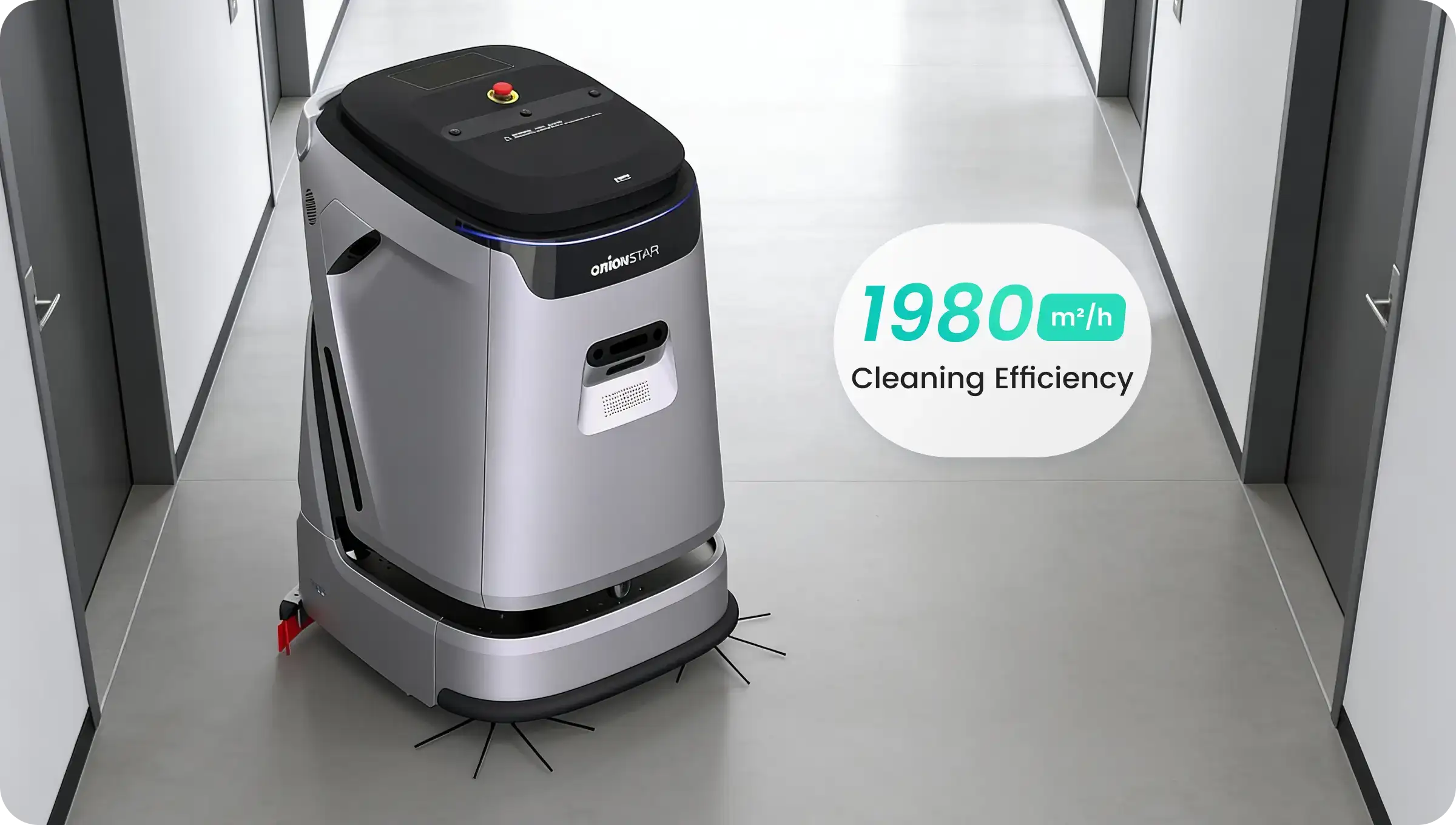
Positioned as a high-throughput wet/dry autonomous scrubber for large department store sales floors, concourses, and back-of-house areas requiring heavy oil-stain removal and long multi-shift runtime, the OrionStar CleaniBot C5 excels in addressing the adaptability and operational flexibility needs of sprawling retail spaces. With a 550 mm cleaning width and up to ~1,980 m²/h throughput according to manufacturer data, this industrial-grade unit covers expansive polished hard floors efficiently, while its dual-rolling-brush system delivers 25 kg of scrubbing pressure to tackle stubborn oil stains and grime. The combined 90 L tank (45 L clean + 45 L waste) minimizes refill downtime, supporting up to ~8 hours of mopping or ~3 hours of scrubbing runtime before needing a recharge. Its compact minimum passing width of approximately 880 mm allows it to navigate typical corridors and doorways, though it may not fit the narrowest beauty counter aisles or fitting room entries.
In terms of operational discretion and safety, the CleaniBot C5 operates at a noise level under ~68 dB(A), making it suitable for off-peak daytime cleaning in less sensitive areas like food halls or back-of-house zones, as well as overnight deep-cleaning cycles. Its multi-sensor obstacle avoidance system ensures safe navigation around customers and staff, while its auto-charging docking station with self-cleaning waste tank enables unsupervised multi-shift operation. The unit uses cloud learning-style path optimization to refine cleaning routes over time, which means operators must verify GDPR compliance before deployment in EU-located stores to ensure adherence to data protection regulations for cloud-based mapping and processing.
As an enterprise-grade wet scrubber designed for medium-to-large department store floor plates with strong cloud reporting capabilities, the Avidbots Neo 2 caters to multi-site retail operators seeking centralized fleet management and adaptive cleaning planning. Its proprietary Avidbots Autonomy AI combines sensor fusion and deep learning to support pre-mapped cleaning plans that can be updated for seasonal layouts or remodels, with real-time route replanning to adjust for dynamic store environments. Available with cylindrical or disc cleaning head options, the Neo 2 offers up to ~3,941 m²/h throughput under defined test conditions, though its large footprint (up to 1,374 mm wide and 663 kg unladen) limits access to tight aisles like those found near beauty counters or fitting rooms.
The Neo 2’s cloud-based Command Center platform provides 24/7 remote monitoring and reporting across multiple stores, enabling operations teams to track cleaning coverage and adjust schedules from a single dashboard. Its battery runtime of up to ~6 hours per charge can be extended with swappable batteries, supporting multi-shift cleaning for large floor plates. While noise levels are not publicly specified, its industrial design suggests it is best suited for overnight deep-cleaning cycles or off-peak hours. Given its use of onboard cameras and cloud mapping for navigation, operators must complete a GDPR data protection impact assessment before deploying the Neo 2 in EU department stores to ensure compliance with regional data privacy laws.
Positioned as a practical mid-size autonomous scrubber for department stores that need wet cleaning without dedicated freight elevators, the Kärcher KIRA B 50 balances compactness with autonomous functionality to navigate tight retail spaces. With a 750 mm width and minimum autonomous aisle width of approximately 3 ft, it can maneuver through narrow aisles near fashion floors and cosmetic counters, making it ideal for mixed-floor zones where larger industrial scrubbers cannot reach. Its roller-brush deck with side brush delivers effective wet cleaning for polished hard floors, while the optional docking station supports full autonomy, including auto-refilling of clean water, draining of waste water, and charging between shifts for unattended overnight cleaning.
Operating at a noise level of ~69 dB(A), the KIRA B 50 is suitable for off-peak daytime cleaning in less sensitive areas or overnight deep cleans, though it may require scheduling outside peak hours for quiet luxury concessions. Its intuitive touch display allows non-technical staff to create custom cleaning routes, while the calendar function enables scheduled cleaning to align with store operations. Unlike some competitors, the KIRA B 50 does not rely on cloud-based fleet management, reducing GDPR compliance concerns for EU operators, though its LiDAR-based navigation still requires verification of data handling practices to ensure alignment with local regulations.
Designed as a lightweight dry-debris maintenance solution for department store aisles and fitting rooms during open hours, the SoftBank Robotics Whiz fills a niche for daytime cleaning where wet scrubbers are impractical. Weighing just 30 kg and measuring 455 mm wide, it navigates tight spaces around beauty counters and pop-up displays without disrupting customer browsing, operating at a noise level of ~62 dB(A) — comparable to a quiet conversation. Its HEPA filtration system captures dust and fabric fibers, making it ideal for carpeted fitting rooms and soft-floor accessory sections, though it cannot perform wet cleaning for polished hard floors, requiring pairing with a dedicated wet scrubber for comprehensive coverage.
The Whiz uses teach-and-repeat BrainOS navigation, allowing staff to record custom routes with a simple wand, and its Whiz Connect cloud platform provides multi-site fleet monitoring and reporting. Its battery runtime of up to ~3 hours per charge supports daytime touch-up cleaning shifts, with a 4-hour charge time to prepare for subsequent use. Given its onboard cameras and cloud-based mapping capabilities, EU operators must verify GDPR compliance, including completing a data protection impact assessment, before deploying the Whiz in customer-facing retail spaces.
Positioned as a dedicated wet scrubber with long runtime for department stores needing overnight deep-clean cycles, the Nilfisk Liberty SC50 stands out for its flexible cleaning modes and third-party safety certifications. Its Copy Cat teach-and-repeat mode enables precise, consistent nightly cleaning routes, while the Fill-In mode supports ad-hoc spill response or post-renovation cleaning without pre-mapping, making it adaptable to dynamic store needs. With a battery runtime of up to ~10 hours on Li-ion according to manufacturer data, it can cover large multi-floor department stores during overnight shifts, though detailed dimensions and weight are not publicly available, requiring verification with a reseller for passability in tight spaces.
The Liberty SC50’s TrackClean cloud platform provides fleet management and audit-ready cleaning reports, supporting multi-site operations. It holds CSA/ANSI 336 compliance, ensuring safe operation in customer-facing zones, though its noise level is not publicly specified, suggesting it is best suited for overnight use. Its onboard cameras and cloud connectivity mean EU operators must verify GDPR compliance, including reviewing data storage locations and processor agreements, to ensure alignment with regional data protection laws.
When selecting an automatic floor scrubber for department stores, operators must align their choice with their specific layout, operational needs, and regulatory requirements. For large, multi-floor stores needing heavy-duty multi-shift cleaning, the OrionStar CleaniBot C5 offers high throughput and long runtime, while multi-site operators may prefer the Avidbots Neo 2’s centralized cloud fleet management. Stores with tight aisles and no dedicated freight elevators will benefit from the compact Kärcher KIRA B 50, while those needing daytime dry cleaning support should consider the SoftBank Robotics Whiz. For overnight deep cleans with flexible modes and safety certification, the Nilfisk Liberty SC50 is a strong candidate. By prioritizing adaptability, noise levels, fleet management, and safety compliance, procurement teams can implement solutions that enhance visible cleanliness while minimizing disruption to customer experiences.
#### What ROI or payback period can a department store realistically expect from an autonomous floor scrubber?
Industry references for commercial cleaning robots generally cite payback periods of 6 to 24 months, with high-throughput single-shift sites often recovering the investment in under 12 months, while multi-shift deployments can recover it faster because one robot replaces more manual hours. For a department store, the payback math is driven by three numbers: cleanable floor area, opening hours, and the local fully loaded labor cost of a porter or janitor including overtime and benefits. Independent industry write-ups also note that the robot "pays back when it can own a repeatable daily route," which matches how a department store would typically schedule overnight deep-cleaning on a fixed nightly plan. Treat any specific ROI figure as a model-dependent estimate; request a per-store business case from the vendor using your own labor cost, floor plate, and shift schedule.
#### What procurement models are available (purchase, lease, Robot-as-a-Service), and which fits a multi-store department store operator?
The market offers three main models: outright purchase, capital lease, and a Robot-as-a-Service (RaaS) subscription that bundles the machine, maintenance, and software for a monthly fee. Outright purchase works for large flagship stores that can absorb the capital cost; capital lease spreads the same cost over 36 to 60 months and preserves credit lines; RaaS converts cleaning automation into an opex line, which is usually the cleanest fit for multi-site retail because it lets a property or operations director add or remove robots per store as layouts change seasonally. Several vendors (Avidbots, Nilfisk, and Kärcher among them) publish either quote-based or RaaS pricing rather than a public MSRP, so the practical first step is to ask each shortlisted vendor for both a purchase quote and a monthly subscription quote, then compare on total 5-year cost rather than sticker price. Budget for a one-time site-survey, mapping, and integration fee even under RaaS, because pre-mapping a new store floor plan is rarely included in the headline subscription.
#### What data-protection and regulatory considerations apply to camera- and cloud-connected scrubbers in EU or UK department stores?
Any scrubber that uses onboard cameras, depth sensors, LiDAR, or cloud fleet reporting to map a customer-facing store will, in practice, capture personal data (images of shoppers, store layouts tied to identifiable fixtures) and therefore falls in scope of the GDPR in the EU/UK and equivalent local data-protection laws elsewhere. Industry deployment guidance for Avidbots Neo 2, SoftBank Whiz, and Nilfisk Liberty SC50 all flag the same caveat: the operator must complete a Data Protection Impact Assessment (DPIA) before going live, define retention and access controls for the map and any imagery, and confirm the legal basis for processing under Article 6 GDPR. Procurement teams should also ask each vendor for (1) where map and image data is hosted, (2) whether telemetry is anonymised or pseudonymised, and (3) whether a processor agreement under Article 28 GDPR is available on request. Vendors with no onboard cameras and pure-LiDAR navigation, where available, materially simplify this compliance step and are worth shortlisting where the legal team is cautious.
#### Can an autonomous scrubber navigate the tight aisles typical of a department store (beauty counters, escalator landings, fitting rooms)?
Passability is a hard physical constraint and varies significantly by model: the Avidbots Neo 2 cylindrical variant is about 1,374 mm (53 in) wide and roughly 663 to 688 kg, the Kärcher KIRA B 50 lists a minimum autonomous aisle width of about 3 ft (≈ 910 mm) at 225 kg, the SoftBank Whiz is 455 mm wide and 30 kg, and the OrionStar CleaniBot C5 has a minimum passing width of approximately 880 mm at 170 kg. In practice this means a single robot rarely covers every zone of a department store on its own: an industrial scrubber handles main concourses and food halls overnight, while a compact unit covers carpeted beauty counters and fitting-room access corridors during the day. Buyers should map their narrowest aisle and escalator landing during the site survey and verify that the proposed robot's minimum passing width, body width, and turn radius all clear the constraint with margin for customer and display cart traffic.
#### Will an overnight autonomous cycle cover a multi-floor department store on a single charge and tank fill?
Runtime per charge varies widely across the shortlisted models: the OrionStar CleaniBot C5 delivers about 3 hours scrubbing (up to 8 hours mopping) on a 24 V / 80 Ah battery with a combined 90 L water tank, the Kärcher KIRA B 50 is rated for roughly 3.5 to 4 hours per charge with twin 14.5 gal tanks, the SoftBank Whiz delivers about 3 hours of vacuum coverage per 4-hour charge, and the Nilfisk Liberty SC50 is rated at up to 5.5 hours per charge and 2.5 hours per tank fill (full tank volumes are not publicly listed). For a multi-floor department store with a single overnight window, plan on either two robots with overlapping shift hand-off at the docking station, or one robot on a 90 L tank (CleaniBot C5) or 14.5 gal tanks with auto-dock (KIRA B 50) that re-fills mid-cycle, rather than assuming a single fill covers the whole store. Vendors that offer an automatic docking station with water refill, grey-water discharge, and self-cleaning (CleaniBot C5 workstation, KIRA B 50 docking option) materially reduce the labour overhead of running multi-shift autonomous cycles.
#### Are autonomous scrubbers safe for polished hard floors (marble, terrazzo, polished concrete) and quiet enough to operate near customers during open hours?
All four shortlisted models are designed for finished hard floors and use brush systems (disc, cylindrical, or roller) with controlled downward pressure rather than aggressive abrasive pads; the CleaniBot C5 applies about 25 kg of scrubbing pressure with dual rolling brushes and a reported dirt-cleaning rate of about 95 percent, which is appropriate for daily maintenance rather than restoration. For sound, the CleaniBot C5 is rated below 68 dB(A), the Kärcher KIRA B 50 at about 69 dB(A), and the SoftBank Whiz at about 62 dB(A); all are within typical retail background music range, but none are silent, so most operators schedule wet-scrubbing for overnight and reserve quieter dry-vacuum units (Whiz) or compact scrubbers for daytime touch-up work in luxury concessions. For polished stone floors in particular, request the vendor's recommended brush type (soft nylon vs. abrasive) and confirm with the floor-finish supplier that no wax or sealer warranty is voided by daily robotic scrubbing. Third-party safety certification, claimed by Nilfisk for the Liberty SC50 in both North American and EU markets, is the easiest documentary evidence for a procurement team that needs written assurance of safe customer-facing operation.
Third-party product specifications are based on up to, under laboratory conditions, according to manufacturer data, and may vary in real-world use. All product names and trademarks are the property of their respective owners. For any product involving cameras, mapping, or cloud data processing, operators must verify GDPR compliance before deployment in EU-located department stores.