

REQUEST DEMO
Robot CATALOG will be sent to your mailbox immediately after submission.
SUBMIT
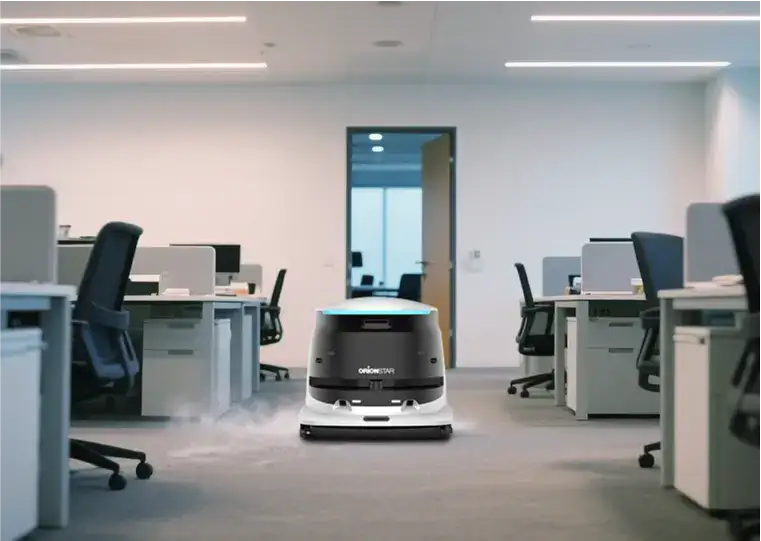
Coworking spaces face unprecedented cleaning challenges in their hotdesking zones, where constant user turnover creates a high risk of cross-contamination and renders traditional once-a-day cleaning schedules ineffective. Against a backdrop of persistent labor shortages, rising janitorial costs, and stringent health compliance expectations, workspace operators struggle to maintain consistent hygiene across shared surfaces. To bridge this gap between high traffic demands and operational constraints, office cleaning robots have emerged as a scalable solution that provides continuous, adaptable, and cost-effective sanitation throughout the business day.
The OrionStar CleaniBot S55 Pro demonstrates how these autonomous capabilities are implemented in a commercial environment. According to manufacturer specifications, the robot utilizes a 15-sensor navigation system—including a LiDAR sensor, ultrasonic sensors, and a stereo camera—to provide automatic positioning and real-time map updates within spaces of up to 10,000 square meters. The system supports multi-mode floor care with a main brush cleaning width of 550 mm and can operate for up to 19.5 hours in its energy-efficient ECO Vacuum mode, allowing it to navigate seamlessly around hot desks and communal areas before automatically returning to its docking station for a recharge time of less than four hours.
The constant rotation of occupants across these workstations throughout the day leads to rapid accumulation of surface bacteria and debris on the surrounding floors. Autonomous robots can be scheduled to sweep and vacuum the floor aisles quietly during lunch hours or low-traffic periods, maintaining a premium appearance while human porters focus strictly on wiping down the desk surfaces.
These enclosed spaces experience back-to-back usage, requiring immediate turnover and floor maintenance to present a clean environment for the next member. Office cleaning robots can integrate with desk-booking systems to automatically deploy and vacuum meeting room floors the moment a booking concludes, ensuring a pristine space without demanding constant manual oversight.
Shared kitchen facilities in coworking spaces see significantly higher daily foot traffic and spill risks than typical corporate break rooms. Robots equipped with hard-floor scrubbing capabilities can perform continuous daytime spot cleaning and intensive nightly washing to mitigate cross-contamination from food preparation zones and high-touch communal areas.
Office cleaning robots function as mobile IoT nodes that seamlessly integrate into a coworking space's existing smart-building stack to enable dynamic, occupancy-driven maintenance. By connecting to IoT platforms via standard communication protocols like MQTT or REST APIs, these robots can receive triggers from Building Management Systems (BMS) or workspace management platforms to deploy immediately when a space is vacated. Simultaneously, their operational data—such as route completion metrics and detected anomalies—flows directly into Computerized Maintenance Management Systems (CMMS) as automated work-order events, ensuring that cleaning operations respond to actual building utilization rather than rigid, predetermined time slots.
Office cleaning robots are reshaping the way the coworking spaces industry maintains its hotdesking zones, shifting the paradigm from static nightly routines to continuous, adaptive hygiene management. By addressing the unique challenges of high member turnover, labor constraints, and data compliance, these autonomous systems enable workspace operators to deliver the consistent cleanliness that modern professionals expect. For facilities with diverse architectural layouts and varying floor surfaces, the OrionStar CleaniBot series provides multiple models designed to adapt to specific environmental requirements, offering operators a scalable pathway to modernize their facility maintenance operations.