REQUEST DEMO
Resources > Blogs > Elevating Workspace Standards: How Facilities Services Utilize Commercial Cleaning Robots in Corporate Offices

Elevating Workspace Standards: How Facilities Services Utilize Commercial Cleaning Robots in Corporate Offices

2026-09-14 23:55 OrionStar

Elevating Workspace Standards: How Facilities Services Utilize Commercial Cleaning Robots in Corporate Offices

Introduction

Operating corporate offices presents an increasingly complex challenge for the Facilities Services industry, where structural labor shortages, rising operational costs, and stringent compliance requirements strain traditional maintenance models. To overcome these compounding pressures, forward-thinking facility managers are adopting commercial cleaning robots as a reliable, scalable solution to ensure high-quality sanitation while optimizing human workforce deployment.

The Growing Need for Smarter Cleaning in Corporate Offices

  • Facilities services teams and contract cleaning supervisors are grappling with a structural labor shortage, where finding and retaining qualified staff has become the primary obstacle to operational growth.
  • Rising wage pressures are compounding budget constraints, with median wages for janitors increasing steadily and field labor often exceeding half of a contractor's total revenue.
  • High turnover rates generate hidden costs and service gaps, leading to issues like "ghost cleaning" where stretched facility coordinators lose up to 40 minutes per shift managing incomplete tasks.
  • Navigating the highly complex ecosystem of a corporate office requires coordinating variable working hours, mixed floor surfaces, and strict data security policies alongside third-party cleaning contracts.

How Commercial Cleaning Robots Can Help

  • LiDAR navigation enables precise environmental mapping, allowing machines to seamlessly traverse complex office layouts without human intervention.
  • Autonomous path planning ensures complete and efficient floor coverage by dynamically adjusting routes based on real-time spatial data.
  • Obstacle avoidance technologies utilize multi-sensor fusion to safely maneuver around temporary barriers, office furniture, and moving pedestrians.
  • Auto-charging and docking capabilities allow these units to independently manage their own power levels, ensuring readiness for scheduled off-hours shifts.
  • Real-time monitoring via cloud dashboards gives managers instant visibility into cleaning performance, task completion, and consumable status.
  • Because mapping and navigation often involve cameras and cloud data processing, operating parties must strictly verify GDPR compliance and data privacy policies with their IT and legal departments prior to deployment.

A Closer Look: OrionStar CleaniBot C5 in Action

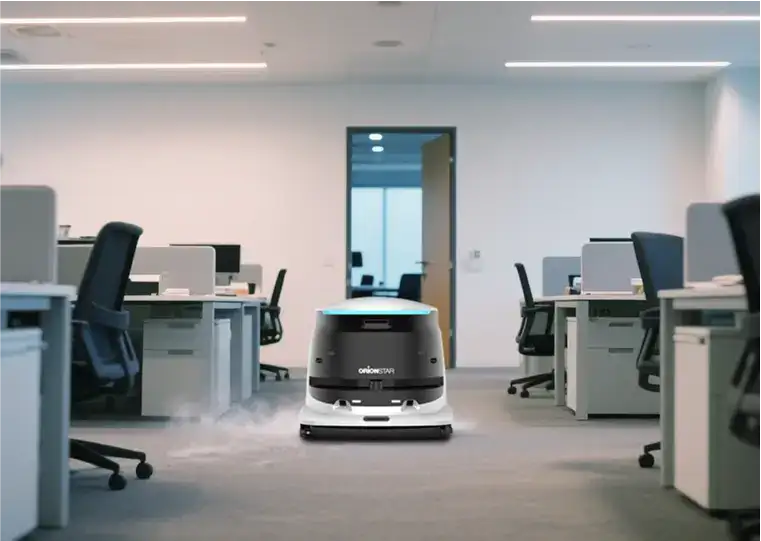
The OrionStar CleaniBot C5 operationalizes these automated capabilities within a compact form factor designed specifically for dynamic environments. Utilizing advanced sensor arrays for obstacle avoidance and path planning, the unit can deliver a maximum cleaning capacity of up to 1,980 square meters per hour according to manufacturer data, depending on the environment. By integrating autonomous charging with real-time cloud reporting, the device allows facilities teams to manage extensive floor plans efficiently, typically completing coverage of a 10,000-square-meter space over an off-hours shift through its autonomous auto-charging and docking capabilities.

Benefits for Facilities Services Teams, Facility Coordinators, Contract Cleaning Supervisors

  • Significant cost reduction: Shifting repetitive floor-care tasks to automated systems can significantly reduce operational costs per productive hour compared to traditional manual labor, according to industry studies.
  • Optimized labor allocation: Utilizing autonomous units allows supervisors to reassign human staff to high-value, detailed tasks like restroom sanitation and high-touch surface disinfection.
  • Accelerated return on investment: Facilities deploying these solutions often achieve a rapid return on investment, particularly in expansive hard-floor spaces, depending on deployment scale.
  • Consistent service quality: Automated routines eliminate the risk of manual tracking errors and missed shifts, helping ensure that daily floor care consistently meets strict landlord-tenant service level agreements.
  • Data-driven dispatching: Cloud-based tracking provides facility coordinators with precise productivity metrics and coverage maps, transforming an unpredictable labor shortage into a manageable, transparent operation.

Real-World Applications

Lobbies and Elevator Banks

These high-traffic entry points demand continuous cleanliness to maintain a premium building reputation while managing heavy footfall. Robots equipped with dynamic obstacle avoidance can safely navigate around moving pedestrians and stanchions to keep hard floors pristine during peak or off-peak hours.

Corridors

Long, narrow office hallways require repetitive, time-consuming floor care that drains manual labor resources. Autonomous units easily navigate standard doorways and tight corridors, delivering consistent dust-mopping and scrubbing across extended stretches of the facility.

Conference Rooms

These spaces feature tight desk clusters, mixed floor surfaces, and frequent layout changes that complicate traditional cleaning routines. Utilizing precision spatial mapping, commercial cleaning robots adapt seamlessly to shifted chairs and temporary barriers, ensuring comprehensive coverage without disrupting the workspace ecosystem.

Pantries and Restrooms

Corporate pantries and areas adjacent to restrooms frequently experience spills and require immediate, reliable sanitation to prevent slip hazards and maintain hygiene. Automated systems provide targeted, chemical-efficient scrubbing that restores hard flooring quickly, leaving the area safe and ready for the next shift of employees.

Integration with Other Smart Systems

Commercial cleaning robots function as continuously reporting sensor assets that integrate seamlessly into the three-layer smart building technology stack. Through an IoT platform functioning as a bridge, standard robotic data protocols are translated and enriched to communicate with both the Building Management System (BMS) and the Computerized Maintenance Management System (CMMS). This integration automatically routes key operational events—such as task completions, coverage verification, or low consumable alerts—directly into connected workplace platforms, enabling data-driven workloading and proactive facility maintenance.

Supporting ESG and Sustainability Goals

  • Automated floor cleaning systems significantly lower resource consumption, optimizing chemical usage while maintaining high sanitation standards.
  • Precise water and energy management during autonomous operations directly supports waste reduction targets essential for green building frameworks.
  • Cloud dashboards generate verifiable ESG reporting metrics, including water consumption, energy use, and runtime, to satisfy corporate sustainability disclosure requirements.

By providing transparent, data-backed operational efficiencies, automated cleaning programs actively help facility owners secure and maintain building-level sustainability certifications.

Closing

Commercial cleaning robots are fundamentally changing the way the Facilities Services industry maintains corporate offices by resolving persistent labor shortages, standardizing cleanliness, and integrating into modern smart building ecosystems. As the industry moves toward data-driven operations, the OrionStar CleaniBot series offers a range of models designed to adapt to diverse spatial requirements and operational complexities. By strategically deploying these autonomous systems, facility leaders can optimize workforce allocation, ensure rigorous data compliance, and elevate the overall standard of the corporate workspace.