

REQUEST DEMO
Robot CATALOG will be sent to your mailbox immediately after submission.
SUBMIT
Facility management teams in modern corporate environments face distinct challenges when standardizing floor-care routines across sprawling architectural layouts. Office complexes encompass a demanding variety of zones, ranging from expansive hard-floor lobbies and high-traffic corridors to densely furnished conference rooms, narrow pantries, and tight restroom entrances. The diversity of surface materials further complicates autonomous deployment, requiring machines to seamlessly handle both polished hard floors and low-pile carpets within a single operational environment. Additionally, the execution of floor care requires strategic alignment with occupant schedules, forcing procurement teams to balance low-noise requirements for daytime cleaning with the need for high-capacity execution during overnight operations. Meeting these dynamic environmental demands requires a careful evaluation of how different automation platforms adapt to mixed spaces without disrupting daily corporate workflows.
When evaluating equipment for corporate facilities, buyers must analyze surface versatility and cleaning functionality to align with their specific floor materials. Procurement teams can deploy integrated multi-function platforms equipped with sweeping, scrubbing, vacuuming, and dust-mopping modules to transition seamlessly from polished corridors to carpeted office zones using a unified chassis. Alternatively, teams may deploy dedicated heavy-duty scrubbers focusing primarily on wet scrubbing and multi-stage water recycling to maintain massive hard-floor lobbies. For spaces heavily reliant on carpeting, managers can deploy dedicated dry vacuum platforms featuring HEPA filtration to handle deep cleaning while relying on separate solutions for wet areas.
Chassis footprint and spatial clearance dictate which specific zones of an office complex can be automated effectively. Buyers can select compact agile architectures featuring machine widths under 650 millimeters to route machines seamlessly through standard doorframes, narrow aisles between workstations, and confined restroom entrances. Conversely, operators may select high-capacity wide architectures featuring machine widths exceeding 700 millimeters to maximize water tank capacities and expand the cleaning path for open-plan atriums.
Operational schedules require facility teams to match robotic capabilities against daytime versus overnight operational profiles. Managers can implement daytime-optimized low-noise configurations that prioritize acoustic dampening between approximately 45 and 65 decibels, utilizing simplified start mechanisms to avoid disrupting meetings or tenant activities. On the other hand, facilities can implement overnight-optimized autonomous ecosystems that prioritize lights-out independence through automatic battery charging and water refilling workstations for unsupervised night shifts.
Because robotic navigation relies on mapping, cameras, or cloud data processing, facility operators must verify compliance with GDPR or local data protection laws before deployment. Facilities can adopt dynamic SLAM-based digital mapping utilizing multi-sensor arrays such as LiDAR and depth cameras to construct real-time digital maps and dynamically reroute around relocated desks or temporary lobby displays. Alternatively, teams can adopt teach-and-repeat route playback utilizing manual guided runs to record fixed, predictable cleaning routes, establishing consistent daily execution in highly predictable physical environments.
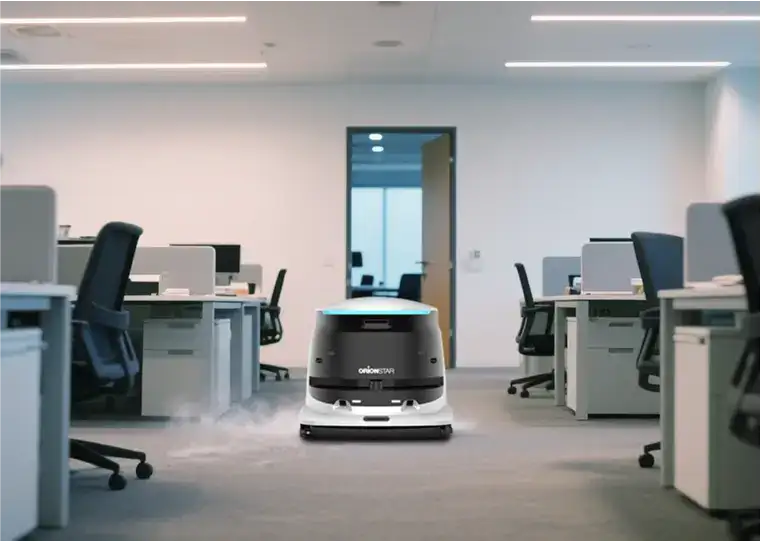
The OrionStar CleaniBot S55 Pro operates as an autonomous commercial floor-cleaning robot designed specifically for large indoor environments including corporate office buildings. This model provides multi-mode floor care to address the varied surfaces typical of modern offices, integrating scrubbing, sweeping, vacuuming, mopping, and dust-mopping into a single consolidated system. By supporting multiple floor-care functions, the robot accommodates routine facility cleaning across open lobbies, narrow corridors, and low-pile carpeted zones without requiring separate machines. Its design focuses on repeatable, low-intervention cleaning over broad floor areas, featuring Wi-Fi and 4G connectivity to facilitate remote deployment, OTA updates, and data reporting for facility managers.
To support complex corporate layouts, the S55 Pro utilizes a multi-sensor navigation system combining a LiDAR sensor, stereo cameras, ultrasonic sensors, and line lasers. According to manufacturer data, this configuration supports map construction of up to 10,000 square meters in standard indoor environments while enabling automatic positioning and real-time obstacle avoidance. The robot maintains a minimum passing width of 700 millimeters, allowing it to navigate common office bottlenecks. For operations during working hours, the machine delivers a quiet acoustic profile, generating noise levels down to 45 decibels in dust mopping mode and 55 decibels in scrubbing mode. Depending on the selected cleaning mode, operators can achieve maximum theoretical cleaning efficiencies up to 1,368 square meters per hour, and runtimes reaching up to 19.5 hours in ECO vacuum mode under defined testing conditions. Due to its cloud connectivity and mapping features, operators must verify GDPR compliance prior to active deployment.
The Gausium Scrubber 50 Pro serves as an AI-driven mid-size all-rounder structured for high-traffic hard floors in office lobbies, cafeterias, and wide corridors. It consolidates scrubbing, sweeping, and dust mopping within a single chassis, utilizing an optional workstation to automate battery charging and water refilling for continuous overnight cleaning cycles. The platform incorporates a multi-stage water-recycling filtration system aimed at reducing freshwater consumption, which supports longer unsupervised autonomous runs during extended night shifts.
A key operational feature of this machine is its AI-powered Auto Spot Cleaning capability, which utilizes an RGB camera and deep-learning navigation to detect waste and stains, directing the robot to re-clean only the affected areas. According to manufacturer data, the unit delivers a practical cleaning efficiency of up to 1,300 square meters per hour while navigating spaces with a minimum passable width of 800 millimeters. Because the navigation relies on 2D LiDAR, 3D depth cameras, and cloud-supported fleet management, facility managers must verify GDPR compliance regarding data residency and image processing prior to implementation.
Pudu Robotics positions the PUDU CC1 as a versatile compact 4-in-1 solution suitable for mixed office environments and narrow aisles. The architecture supports sweeping, scrubbing, vacuuming, and dust-mopping within a footprint measuring under 630 millimeters in width, allowing it to maneuver through confined spaces such as pantries and conference rooms. Furthermore, the platform can integrate with optional e-gate and elevator modules, enabling the machine to autonomously navigate multi-floor office towers and hand off routine nightly cleaning tasks across different levels.
The CC1 relies on a navigation framework termed LiDAR and visual fusion positioning to manage path planning and obstacle avoidance in dynamic corporate environments. According to manufacturer data, the system achieves a sweeping and vacuuming runtime of up to five hours while operating at noise levels below 70 decibels. The integration of dry vacuuming and wet scrubbing functionalities allows facility teams to maintain polished hard floors and low-pile carpets with one unified hardware platform. Due to the inclusion of RGB-style visual positioning and cloud connectivity, operators must verify GDPR compliance regarding spatial mapping and image data storage before use.
The SoftBank Robotics Whiz functions as a widely adopted autonomous commercial vacuum specifically aimed at carpet-heavy corporate office complexes. As a dedicated dry-vacuum solution, this platform provides HEPA-filtered vacuuming, making it highly applicable for extensive carpeted meeting rooms, executive suites, and cubicle zones where wet processes are not utilized. It utilizes a swappable battery design that supports continuous multi-shift operation, allowing janitorial staff to swap power sources and maintain autonomous vacuuming coverage throughout the facility without lengthy charging delays.
Navigation is driven by the BrainOS system, which employs a teach-and-repeat methodology where operators manually guide the machine along a designated route that the robot subsequently memorizes and replays autonomously. According to manufacturer data, the unit achieves a cleaning productivity of up to 700 square meters per hour and produces a noise level of approximately 62 decibels, accommodating daytime operation without heavily disrupting corporate workflows. Because the robot captures environmental data using LiDAR and 2D/3D cameras while utilizing cloud-based fleet reporting, buyers must verify GDPR compliance before active deployment.
The LionsBot R3 Scrub operates as an ultra-quiet hard-floor scrubber optimized for daytime office operation and tight spatial clearances. Measuring 570 millimeters in width without its side brushes, the compact chassis allows the machine to traverse standard doorframes, narrow restroom entrances, and confined pantry corridors that larger high-capacity models cannot access. The system focuses heavily on hard-surface care through single-pass squeegee scrubbing, ensuring polished lobby floors are left dry and safe for immediate foot traffic during active business hours.
To accommodate cleaning crews with varying levels of technical expertise, the platform features a zero-click start mechanism called MagicTag, enabling immediate deployment without complex touchscreen navigation. According to manufacturer data, the robot generates an average sound level of 71 decibels and delivers practical cleaning efficiencies up to 1,200 square meters per hour. The baseline navigation relies on 2D LiDAR with optional 3D LiDAR for expanded spatial adaptation; consequently, facility managers must verify GDPR compliance regarding mapping data retention and cloud connectivity prior to installation.
Procuring autonomous floor-care equipment for corporate real estate requires careful alignment of robotic capabilities with existing facility architecture and tenant schedules. Buyers must assess surface versatility by choosing between integrated multi-function platforms and dedicated dry vacuum solutions depending on the ratio of hard floors to low-pile carpets. Facility managers should evaluate the chassis footprint to ensure the chosen platform can pass through narrow pantries and workstation aisles while maintaining adequate tank capacity for large lobbies. Finally, organizations must balance their daytime versus overnight operational profiles, weighing low-noise acoustic configurations against autonomous docking ecosystems that support continuous unattended shifts. By rigorously comparing these operational dimensions, procurement teams can build a sustainable fleet strategy utilizing advanced solutions like the OrionStar CleaniBot series.
Most published payback estimates for autonomous floor-cleaning robots in commercial buildings cluster between 10 and 24 months, depending on labor cost, shift utilization, and the robot’s cleaning efficiency. Facility managers regularly cite 12–24 months as the realistic range when one robot replaces roughly one full-time cleaner across an overnight shift, while higher-utilization sites (24/7 lobbies, multi-tenant cleaning contracts) can shorten payback into the 1–3 month range by displacing overtime and subcontractor hours. Example calculations published by automation vendors show a single robot producing $40,000–$50,000 in recurring annual savings against $30,000–$60,000 in upfront cost, putting simple payback inside the second year of deployment.
Both models are widely available for the same hardware: outright purchase typically ranges from roughly $30,000 to $55,000 per unit depending on model and accessories (e.g., docking station, elevator module), while RaaS converts that capex into a per-month or per-shift operating expense, often quoted in the $800–$2,500/month band and frequently including mapping, maintenance, and software updates. Purchase suits multi-site facility owners who can amortize the asset and run the robot on multiple shifts; RaaS suits single office towers, outsourced cleaning contractors, or sites that want predictable monthly costs and bundled service. The broader RaaS market for commercial robots is expanding fast — from about $2.5B in 2024 toward a projected $25.6B by 2034 — so most major brands (Pudu, Gausium, LionsBot, SoftBank Robotics Whiz, OrionStar) now offer both routes and the choice is usually a finance decision, not a capability decision.
At minimum, the site needs a flat, accessible area for the charging dock with power and (where supported) a water-refill station; stable Wi-Fi or 4G coverage throughout the cleaning zones for cloud-based mapping and reporting; and a floor plan that meets the robot’s minimum passing width — typically 700–800 mm for the models in this comparison class. Multi-floor office towers usually require an elevator or e-gate integration module so the robot can move between floors autonomously, and at least one initial "mapping run" performed by the vendor or integrator to record zones, no-go areas, and cleaning modes per zone. Vendors such as Gausium, Pudu, and OrionStar frame deployment as a one-time site survey plus mapping onboarding, typically completed within a few working days once power and network are ready.
Yes, but only if you select a low-noise mode or a robot whose dust-mopping / ECO vacuum modes sit in the 45–55 dB range, which is comparable to a quiet office ambient level. The OrionStar CleaniBot S55 Pro is rated at 45 dB in dust mopping and 55 dB in scrubbing, while scrubbing-class competitors such as the Gausium Phantas stay under about 65 dB and the PUDU CC1 runs under 70 dB with a dedicated silent-mopping mode for daytime use. For occupied floors during work hours, facility managers typically schedule robots in dust-mopping or ECO vacuum mode along corridors and conference rooms, then reserve louder scrubbing passes for after-hours in lobbies, pantries, and restrooms.
The four shortlisted products split across two approaches: multi-function scrubbers (OrionStar CleaniBot S55 Pro, Gausium Scrubber 50 Pro, PUDU CC1, LionsBot R3 Scrub Pro) handle hard floors and can sweep or vacuum low-pile carpet to varying degrees, while the SoftBank Robotics Whiz is a vacuum-only unit focused on carpets and hard-floor dust control. The S55 Pro exposes a dedicated "Sweep & Vacuum" mode plus an ECO Vacuum mode (rated 1,368 m²/h and up to 19.5 hours of runtime) that targets low-pile carpet and dust control without wet processes, and the PUDU CC1 family markets sweeping, scrubbing, vacuuming, and dust-mopping in a single chassis. Facilities with substantial carpeted meeting rooms and executive offices often pair a scrubber (for lobbies, pantries, restrooms) with a separate vacuum robot (for carpet), rather than expecting one unit to do both at production quality.
The main approaches are SLAM-based dynamic re-routing versus "teach-and-repeat" route replay. Robots that use LiDAR SLAM with real-time map updates — such as the OrionStar CleaniBot S55 Pro (LiDAR + stereo camera + ultrasonic sensors, mapping up to 10,000 m²), the Gausium Scrubber 50 Pro, and the PUDU CC1 with LiDAR + visual fusion — can re-localize, detect newly placed furniture or partitions, and re-plan coverage paths without a full re-mapping session. Robots based on teach-and-repeat navigation (the SoftBank Whiz records routes via a guided teach run and replays them) are less tolerant to layout change and typically need a new teach run when walls or furniture move materially. For activity-based or agile offices, vendors recommend reserving a short remap slot every few months or after major floor changes, and using virtual no-go zones in the fleet app to cordon off new meeting rooms or collaboration areas until they are added to the map.
All competitor product specifications mentioned are based on publicly available data at the time of publication and are for informational purposes only. Actual performance may vary based on environmental conditions. For features involving environmental mapping and optical sensors, customers are responsible for ensuring operation complies with local data privacy regulations (e.g., GDPR) within their facilities.