

REQUEST DEMO
Robot CATALOG will be sent to your mailbox immediately after submission.
SUBMIT
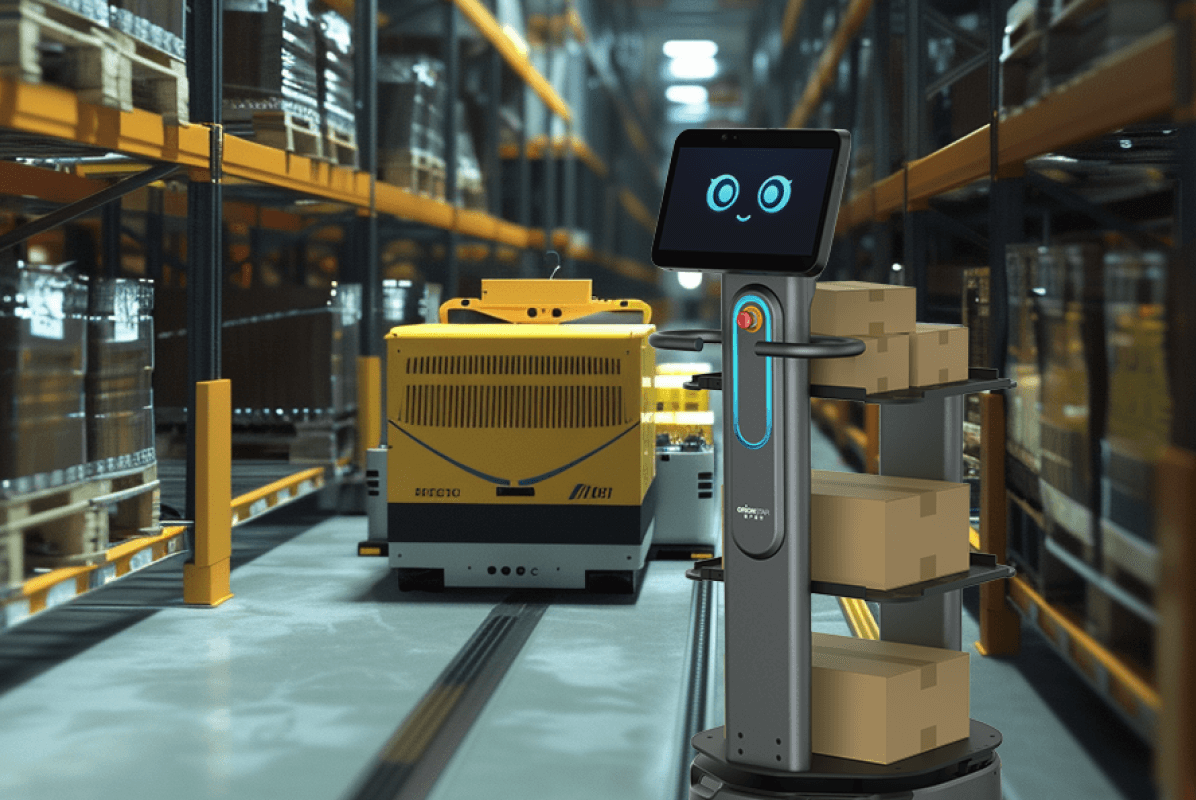
In the high-pressure environment of automotive parts manufacturing, maintaining clean, uncluttered, and compliant machining workshops has become a critical challenge due to severe skilled labor shortages, rising operational costs, and strict safety regulations. The constant movement of manual carts, raw blanks, and scrap bins not only clutters the floor space and creates workplace hazards but also pulls valuable operators away from precision CNC tasks. To clean up these chaotic workflows, clear physical floor space, and ensure synchronized just-in-time delivery without compromising safety, automotive facilities are increasingly turning to autonomous mobile robots as a transformative intralogistics solution.
The OrionStar CarryBot D150 exemplifies these industry-standard capabilities by integrating advanced visual simultaneous localization and mapping (VSLAM) with a multi-layer safety system to handle heavy-duty intralogistics tasks. Capable of transporting a maximum net payload of up to 150 kg according to manufacturer specifications, the robot utilizes a sensor suite that includes LiDAR, depth cameras, and collision sensors to navigate safely with a minimum passage clearance of 65 cm. Furthermore, manufacturer data indicates it can operate for up to 12 hours on a single charge while supporting autonomous multi-robot coordination, allowing it to seamlessly distribute parts or remove heavy scrap across a busy shop floor without disrupting existing workflows.
In these high-volume areas, large raw blanks must be constantly fed into machines, creating heavy lifting and continuous transport demands. Autonomous mobile robots can deliver heavy pallets of raw materials directly to the machine side, ensuring operators never have to wait for forklift availability while keeping transit aisles clear.
Machining generates significant amounts of metal chips and waste that can quickly clutter aisles and pose slipping hazards if not regularly cleared. Mobile robots equipped with heavy-duty carrying attachments can autonomously transport scrap bins to recycling stations, keeping the workspace clean and compliant with safety standards.
Precision components in finish machining require careful handling and strict just-in-time sequencing to prevent damage or downstream assembly delays. Mobile robots configured with multi-tray modules provide organized, vibration-minimized delivery of finished parts directly to the next production stage or quality check.
Quality control requires a steady, prioritized flow of sample parts to avoid bottlenecks that could stall the entire production line. Robots can be programmed for multi-point delivery, automatically routing selected samples from various CNC cells straight to the inspection station for immediate measurement.
For autonomous mobile robots to function as a measurable operational advantage rather than an isolated pilot, they must be deeply integrated with the machining workshop's broader IT stack. A modern Manufacturing Execution System (MES) acts as the central orchestration layer, sending transport orders to the AMR fleet manager and receiving completion events to ensure closed-loop traceability across the facility. Furthermore, integrating the robots via industrial IoT protocols directly with PLCs and SCADA systems allows CNC machine controllers to autonomously dispatch robots for unloading the moment a machining cycle ends, a synchronization process that has been documented to reduce transport delays by 30%.
By establishing an auditable, digitized, and highly efficient operational footprint, automation plays a foundational role in meeting the automotive sector's stringent ESG mandates.
Autonomous mobile robots are fundamentally transforming how the automotive parts manufacturing industry designs and maintains its machining workshops, shifting them from cluttered, manually driven environments into highly synchronized, data-driven hubs. By addressing critical labor shortages and optimizing floor space, these technologies provide a resilient foundation for modern production demands. For facilities evaluating their intralogistics strategies, the OrionStar CarryBot series offers multiple hardware configurations to accommodate various payload and structural requirements, serving as a versatile option for ongoing operational improvement.