

REQUEST DEMO
Robot CATALOG will be sent to your mailbox immediately after submission.
SUBMIT
Integrated facility management in commercial buildings faces a structural labor shortage that directly affects floor cleaning operations. According to CBRE’s 2022 Facilities Management Cost Trends report, soft services such as janitorial work are experiencing low barriers to entry, high turnover, and intense competition for labor. As total job openings vastly outpace the unemployed labor pool, facility managers face intense wage pressures. Despite rising labor costs, productivity has largely flattened. Attempting to boost cleaning output without additional staff risks worker burnout and compromises hygiene standards.
Commercial cleaning is a significant operational expense, typically ranging from USD 0.12 to USD 0.35 per square foot per month depending on the facility. Moreover, inconsistent cleaning carries hidden costs; industry estimates suggest that falling hygiene standards can lead to lost productivity and medical costs of approximately USD 1,685 per employee annually.
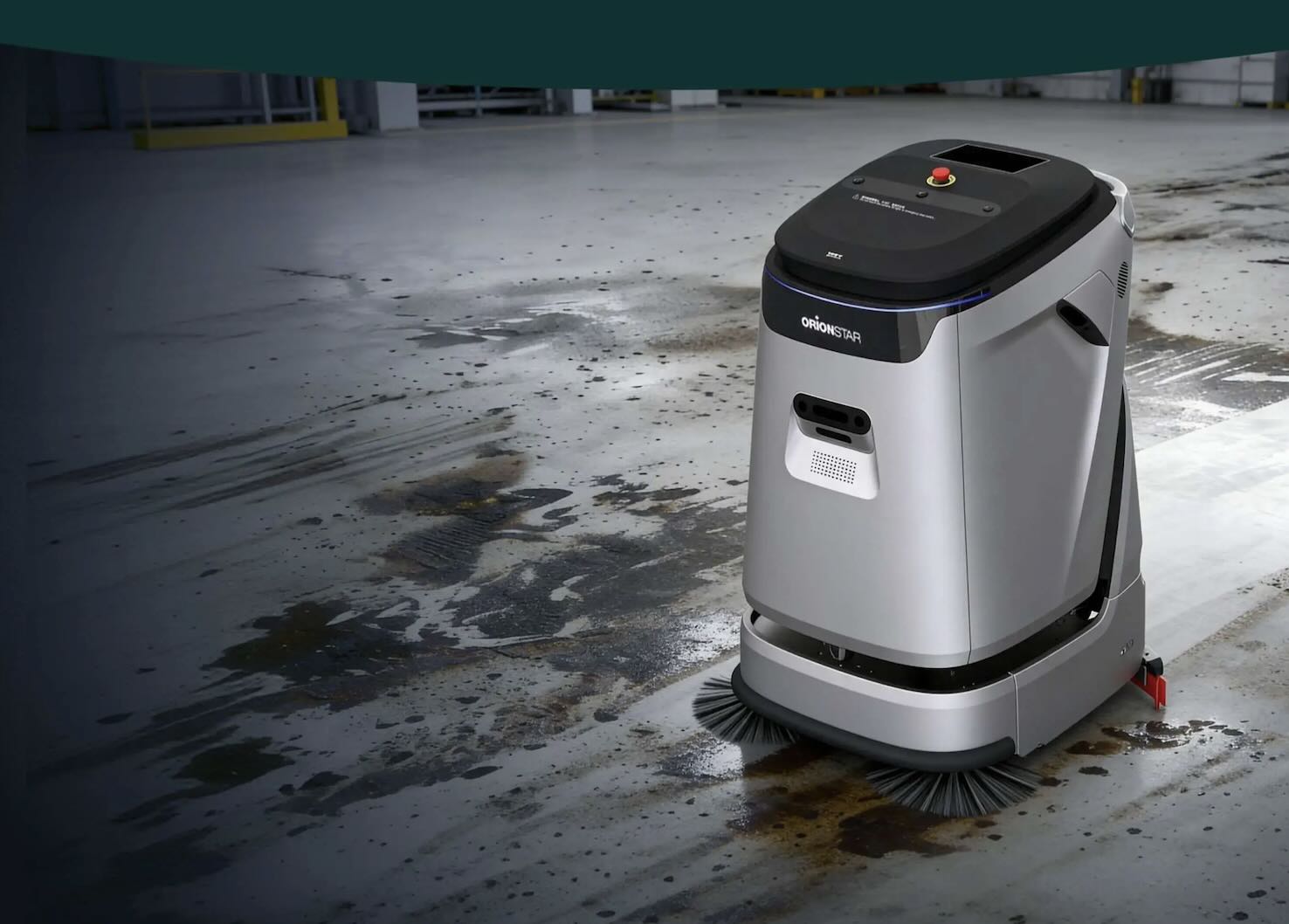
Deploying an autonomous industrial cleaning robot helps decouple consistent floor care from headcount limitations. By automating repetitive floor scrubbing and sweeping, facility managers can reallocate their available workforce to higher-value maintenance tasks. This guide evaluates how the OrionStar CleaniBot C5 fits into the operational demands of commercial buildings.
Commercial buildings present diverse environments, from narrow transit zones to expansive, high-soil areas. The OrionStar CleaniBot C5 is designed to address these varying conditions through specific hardware configurations.
Corridors and Doorways Navigating interior architecture requires a compact footprint. The CleaniBot C5 features a minimal passing width of approximately 880 mm, according to manufacturer data, allowing it to move through standard commercial corridors. Relying on multiple sensors and a smart obstacle-avoidance system, the unit can safely bypass pedestrians and temporary obstructions. Furthermore, it can climb obstacles up to 15 mm and manage slopes up to 8 degrees unloaded (or up to 5 degrees loaded), maintaining mobility across different floor levels.
Parking Areas and Heavy-Traffic Zones Underground parking facilities and delivery loading zones often accumulate stubborn heavy oil, grime, and debris. To address this, the CleaniBot C5 applies up to 25 kg of downward scrubbing pressure via a dual-rolling-brush system. Under defined test conditions, this configuration achieves a reported dirt-cleaning rate of about 95%. It can also pick up solid debris up to about 3 cm in height into a 1.8 L dust bin, reducing the need for manual pre-sweeping in industrial-grade zones.
Lobbies and Common Spaces In ground-floor lobbies and shared tenant spaces, cleaning equipment must operate without disrupting occupant activities. The CleaniBot C5 operates at a noise level of less than 68 dB(A), making it suitable for deployment in busy public areas during standard operational hours. Its 550 mm main brush width supports a maximum cleaning capacity of up to 1,980 square meters per hour, efficiently covering expansive common spaces.
To achieve a meaningful return on investment, robotic floor-cleaning programs require high utilization rates. In a managed deployment by facility services provider KBS, optimizing robotic workflows and minimizing human intervention increased utilization by 49% within nine weeks and reduced overall cleaning and maintenance costs by 21%.
The OrionStar CleaniBot C5 supports high autonomy through a combined 90 L water-tank system (45 L clean water and 45 L waste water), which extends operational time between refills. Based on a typical configuration, the 24 V, 80 Ah battery provides a scrubbing runtime of about 3 hours and a mopping runtime of up to 8 hours, followed by a fast-charging cycle of around 1.5 hours.
When mapping an area (up to 10,000 square meters per map) and executing its scheduled routes, the unit can automatically return to its docking station. This workstation facilitates automatic clean-water refilling, waste-water discharge, and low-battery recharging. Additionally, it features a high-pressure internal tank rinsing system that completes a self-cleaning cycle in roughly 4 minutes, helping to prevent odors and blockages without requiring manual scrubbing of the tanks by the janitorial staff.
Connected facility equipment introduces digital management expectations. The CleaniBot C5 utilizes "Cloud Learning"-style optimization to plan optimal cleaning paths based on its mapped environment.
Because the system relies on sensors, cameras, and cloud-based data processing to map spaces and navigate autonomously, facility managers and building service contractors must exercise diligence regarding data privacy. Operators must verify that the deployment, data transmission, and any over-the-air (OTA) updates comply with GDPR and applicable local data protection regulations. Industry standard practices for autonomous cleaning equipment typically involve data encryption, role-based access control, and ensuring that environmental sensors are strictly limited to navigational safety rather than personnel surveillance. The CleaniBot C5 processes visual data at the edge for navigation only. No personally identifiable information (PII) is stored or uploaded to the cloud. Map data is encrypted and subject to role-based access control.
Implementing an autonomous industrial cleaning robot can significantly alter facility maintenance budgets. Published operator case studies in the facility management sector indicate that well-integrated autonomous scrubbers can generate annual savings ranging from USD 30,000 to USD 150,000 per deployed unit. These savings are driven by labor-hour reductions, eliminated rental costs for manual equipment, and decreased repair expenses. Many operators report achieving full ROI within 12 to 24 months.
Because floor care requirements scale with the size and complexity of the property portfolio, operators can also explore the broader OrionStar CleaniBot series. The series offers multiple models engineered to accommodate different facility layouts, ensuring that building service contractors can match specific machine capabilities to their exact spatial and budget requirements.
Does the workstation require permanent plumbing modifications in the commercial building? The system supports flexible deployment. While direct plumbing integration allows for fully autonomous refilling and draining, the robot can be paired with optional mobile water tanks that do not require modifications to the building's permanent plumbing infrastructure.
Can the machine handle multiple cleaning steps simultaneously? Yes. According to the product specifications, the robot features integrated scrubbing, dust-mopping, and water-absorption modes. This enables the machine to sweep, scrub, and vacuum or mop in a single cycle, reducing the time required to treat multi-surface floors.