

REQUEST DEMO
Robot CATALOG will be sent to your mailbox immediately after submission.
SUBMIT
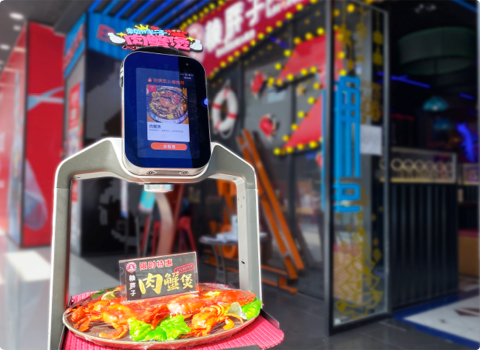
In casual dining restaurants, waiting areas are a high-stakes operational zone where staff shortages, significant guest walk-away rates, dropped conversions from long waitlists, and stringent data compliance protocols frequently collide. With up to 25% of diners abandoning lines and front-of-house teams struggling to dynamically balance advance reservations with walk-in traffic, securing a seamless first impression is increasingly difficult. To combat these front-door bottlenecks, robot waiters have emerged as a practical solution to streamline host stand operations, entertain waiting guests, and alleviate service friction before diners even reach their tables.
The OrionStar LuckiBot translates these category capabilities into a highly functional front-of-house assistant through its integrated hardware and software design. Operating on a customized Robot OS with a 6-microphone ring array, it handles complex voice interactions with up to 97% recognition accuracy in noisy environments, according to manufacturer data. The unit navigates using a dual SLAM solution backed by 3D depth detection, boasting an obstacle response time as short as 0.5 seconds to safely maneuver through crowded guest queues. Additionally, with an adjustable tray setup supporting a total payload of up to 40 kg and a battery life extending up to 10 hours, the robot is built to sustain greeting, guidance, and delivery tasks throughout a full casual dining service shift.
The host stand is often the most chaotic point in a casual dining venue, burdened by long waitlists and impatient arrivals. Robot waiters alleviate this pressure by proactively greeting walk-ins, distributing pagers, and escorting seated parties to their tables so the human host never has to abandon the front door.
Diners waiting in the bar lounge expect fast beverage service, but bartenders frequently struggle to manage both seated patrons and the standing queue. Robots can operate in cruise mode to distribute welcome drinks or collect empty glassware across the lounge, keeping the area tidy and customers satisfied while they wait for their table.
Managing overflow crowds on outdoor patios requires constant back-and-forth travel that exhausts hospitality staff. By utilizing robust self-leveling suspensions and advanced obstacle avoidance, robots can safely navigate transition thresholds to deliver menus or snacks to patio queues, bridging the gap between the indoor kitchen and the outdoor waitlist.
To maximize efficiency, robot waiters operate within an edge-cloud hybrid architecture that connects directly to the venue's existing technology stack. By integrating with Property Management Systems (PMS) and Point-of-Sale (POS) systems via REST APIs and webhooks, digital waitlist data can flow directly into the robot's dispatch logic. This allows the system to autonomously trigger table-ready notifications, route the robot to carry menus to waiting areas, and close the operational loop between the reservation queue and the table turn with minimal latency.
The integration of robot waiters is fundamentally changing how casual dining restaurants manage their waiting areas, turning a traditional point of friction into a streamlined, engaging start to the guest experience. By bridging the gap between digital waitlists and physical floor execution, these automated systems allow human staff to step away from repetitive running and focus on genuine, high-touch hospitality. For operators looking to modernize their front-of-house workflows, the OrionStar LuckiBot series provides multiple models tailored to varying spatial and operational needs, offering a practical pathway to enhanced service and efficiency.