

REQUEST DEMO
Robot CATALOG will be sent to your mailbox immediately after submission.
SUBMIT
Commercial real estate portfolios, encompassing multi-tenant commercial buildings, office towers, and expansive business parks, present uniquely demanding operational environments. Facility managers must balance the aesthetic expectations of mixed-use lobbies with the heavy soil challenges found in parking decks and back-of-house corridors. Labor availability continues to fluctuate, pushing stakeholders toward automation to maintain consistent cleanliness across sprawling multi-floor layouts. Selecting a reliable autonomous floor scrubber for commercial real estate requires carefully matching machine capabilities to specific environmental demands rather than relying on a singular approach. A primary consideration is evaluating whether equipment will operate during daytime tenant-facing hours or handle after-hours tasks, a choice that dictates the necessary noise profiles and safety features.
Building amenities and conference floors further complicate selection due to diverse flooring types and strict data protection requirements in global markets. It is crucial to distinguish between various navigation technologies, as the choice between teach-and-repeat, full SLAM, and AI route-learning drastically impacts deployment flexibility. Furthermore, assessing sensor-only stacks against camera-based systems is critical for European facilities navigating stringent privacy regulations. Evaluating the top units based on their operational footprint, navigation frameworks, and sensory arrays will help operations teams deploy effective and legally compliant cleaning strategies.
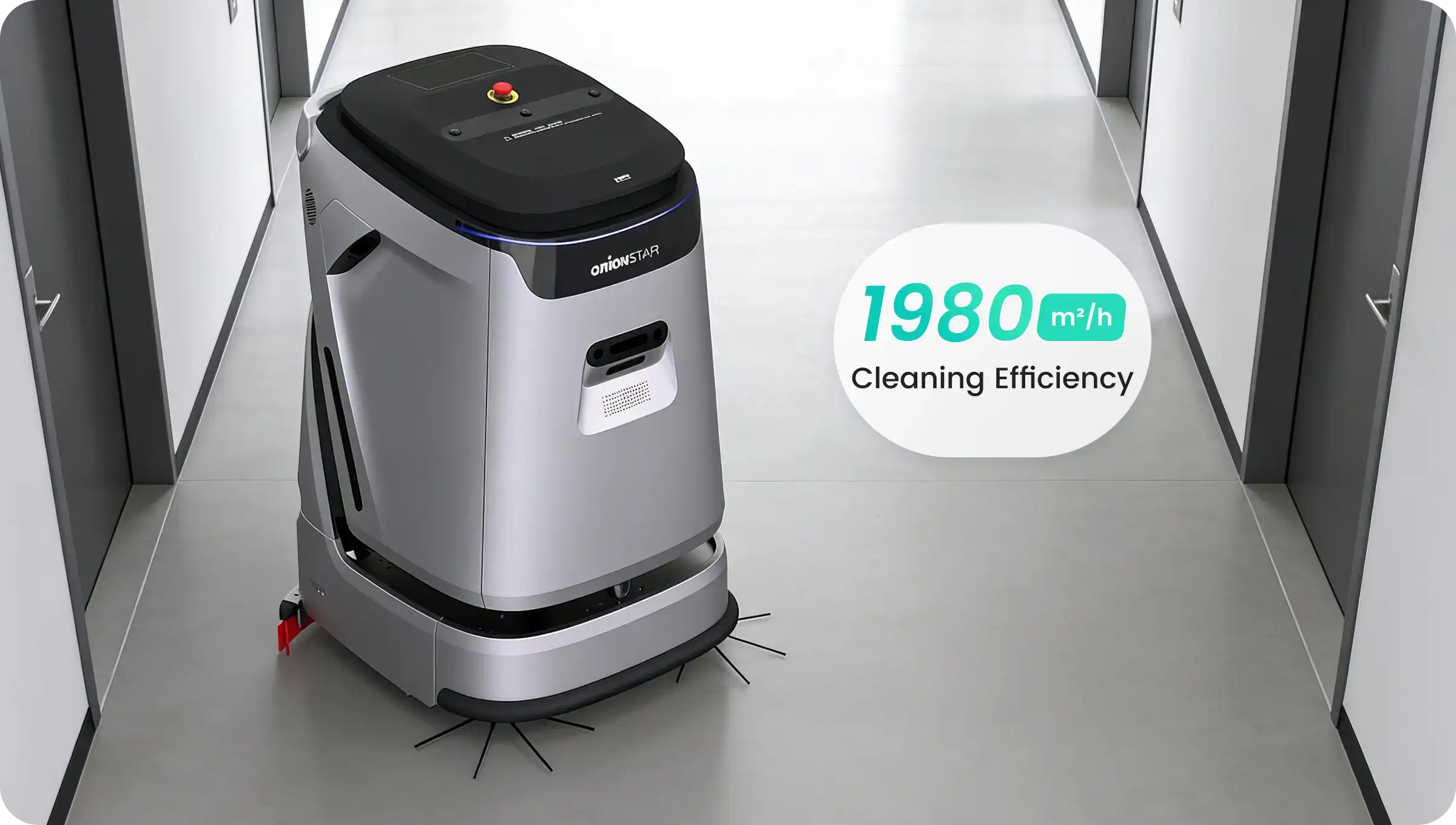
The OrionStar CleaniBot C5 serves as an industrial-grade dual-rolling-brush scrubber designed for multi-shift commercial real estate floor plans needing heavy soil handling. Featuring a 550 mm cleaning width and 90 L combined water tanks, this unit applies 25 kg of scrubbing pressure to effectively manage ingrained dirt in parking decks and high-traffic back-of-house corridors. According to manufacturer data, the machine provides up to 1,980 m²/h coverage under laboratory conditions. By utilizing an autonomous fill, dump, and recharge dock, the system requires minimal daily water handling by onsite custodial staff. This mid-class walk-behind-class autonomous unit offers a distinct advantage in multi-floor portfolios, as its manageable footprint ensures better elevator compatibility and passability through standard doorways compared to much larger ride-on-style platforms.
The CleaniBot C5 utilizes an advanced multi-sensor navigation stack to adapt to dynamic environments like retail common areas and large lobbies. The sophisticated mapping allows the machine to recalculate paths around temporary obstacles efficiently. Combined with 'Cloud Learning' route optimization, managers should align deployment with standard IoT data policies. The robust scrubbing power and automated docking make the CleaniBot C5 highly effective for multi-shift deployments. With an operating noise level under 68 dB(A), it efficiently removes heavy soil during after-hours or safely operates in busy public spaces during the day.
The Avidbots Neo 2W is engineered specifically for large, expansive commercial spaces that benefit from robust digital fleet reporting. This heavy-duty system employs a dual-camera 3D SLAM mapping approach coupled with full-coverage path planning, ensuring thorough cleaning across wide-open mixed-use lobbies and business park concourses. The unit generates audit-grade cleaning reports, providing facility managers with actionable metrics to verify performance across diverse commercial real estate portfolios. When assessing this system for multi-floor operations, teams must account for its ride-on-style heavy platform footprint, which can present passability challenges in older buildings with narrow back-of-house corridors or restrictive elevator weight limits.
Operating with a vision-SLAM navigation stack, the Neo 2W relies heavily on camera inputs to understand its surroundings and navigate safely around physical structures. This extensive visual data processing means that European commercial real estate properties must implement strict privacy safeguards to ensure GDPR compliance before deployment. While its comprehensive mapping capabilities are highly beneficial for after-hours tasks, the machine's operational footprint and data collection methods require careful integration into existing facility management frameworks. According to manufacturer data, the system performs exceptionally well in wide-area applications where digital accountability and sweeping coverage are prioritized over tight-space maneuverability.
Addressing the specific needs of daytime tenant-facing operations, the ICE Co-Botics Cobi 18 is a compact 48 cm teach-and-repeat cobot designed for shared commercial spaces. Its design prioritizes minimal disruption in occupied lobbies and tight office corridors, operating efficiently in an Eco mode that produces sub-70 dB noise levels. This specific acoustic profile allows the machine to function alongside office workers and retail patrons without causing auditory fatigue, a critical factor for daytime deployment where not all machines can simply be assumed to be quiet. Its smaller walk-behind-class stature also ensures seamless elevator compatibility, facilitating easy transport across multi-tenant commercial buildings.
A distinguishing feature of the Cobi 18 is its sensor-only navigation stack, which relies entirely on non-visual sensors without utilizing cameras or voice recording technologies. This hardware configuration significantly simplifies the data-protection posture for European properties navigating stringent GDPR requirements, as no personally identifiable visual data is captured or stored. The teach-and-repeat navigation approach requires an operator to manually guide the machine along the desired route once, after which it autonomously replicates the exact path. This straightforward methodology is highly effective for routine maintenance in static daytime environments, though it relies on predictable layouts to maintain peak efficiency.
The Kärcher KIRA CV 1 functions as a large-tank scrubber-drier tailored for high-coverage commercial real estate floor plans where sustained autonomous operation is required. Equipped with an auto fill and dump dock, the machine significantly reduces the time staff must spend managing fluids, enabling seamless transitions between extensive cleaning zones. This configuration is highly advantageous in sprawling business parks and massive mixed-use retail common areas where manual water changes would otherwise interrupt daily productivity. According to manufacturer data, the generous tank capacity allows the unit to clean continuously for extended periods under laboratory conditions, maximizing operational uptime.
Designed to handle broad expanses reliably, this unit streamlines the maintenance of large commercial footprints with minimal daily water handling. Operations teams must carefully coordinate deployment schedules to align with facility traffic, as operating a large-tank system often entails prioritizing after-hours or nighttime shifts to avoid congesting pedestrian pathways in busy building amenities. Deploying the KIRA CV 1 effectively centralizes the heavy lifting of hard floor maintenance, freeing human personnel to focus on higher-value detailing and spot-cleaning tasks across the commercial property.
Diverging from traditional hard floor scrubbers, the SoftBank Robotics Whiz is a vacuum-focused autonomous sweeper dedicated to extensive carpet care. Many office towers and conference floors feature large carpeted expanses that require daily upkeep to maintain brand recognition and a clean professional appearance. The Whiz utilizes an AI route-learning navigation system to memorize and continuously optimize cleaning paths across these soft flooring environments. Its compact mid-class profile allows it to navigate easily through cubicle aisles and building amenities, ensuring consistent dust and debris removal in spaces where traditional hard-floor scrubbers cannot operate.
The AI route-learning approach enables the Whiz to adapt dynamically to minor environmental changes while focusing heavily on comprehensive carpet coverage. Because this machine is often deployed in daytime settings to maintain aesthetics, it operates at an unobtrusive volume, though operations teams must verify acceptable noise thresholds for specialized quiet zones. When evaluating the Whiz for European properties, managers must review its specific sensor array to confirm GDPR compliance regarding any spatial data processing capabilities. Ultimately, it serves as a specialized autonomous tool for commercial real estate portfolios prioritizing automated soft floor maintenance alongside their hard floor scrubbing fleets.
Integrating an autonomous floor scrubber for commercial real estate requires evaluating a complex matrix of building characteristics, compliance needs, and operational timing. Heavy platforms like the Avidbots Neo 2W provide robust reporting for vast open spaces, while mid-class units such as the OrionStar CleaniBot C5 balance substantial scrubbing pressure with the agility needed for elevator transit and narrow back-of-house corridors. Daytime operations demand specialized solutions like the ICE Co-Botics Cobi 18, which leverages verified sub-70 dB acoustics and a sensor-only array to bypass complex data-privacy hurdles under GDPR. Conversely, specialized environments such as carpeted conference floors rely on focused units like the SoftBank Robotics Whiz. By carefully aligning the navigation technology—whether teach-and-repeat, full SLAM, or AI route-learning—with facility workflows, property managers can achieve consistent, compliant, and highly efficient cleanliness across their entire portfolio.
How do daytime and nighttime operations affect the choice of an autonomous scrubber? Daytime operations require machines that can safely and quietly navigate around tenants and visitors. Units designated for these hours must feature specific acoustic profiles, such as sub-70 dB operating modes, to prevent disruption in office towers and lobbies. Nighttime or after-hours operations prioritize heavy soil removal and high coverage rates, allowing for larger industrial machines to operate without pedestrian interference. Matching the machine's noise profile and footprint to the specific shift ensures optimal efficiency and tenant satisfaction.
What is the difference between teach-and-repeat and full SLAM navigation? Teach-and-repeat navigation requires a human operator to manually drive the machine along the exact path it needs to clean, which the robot then saves and replicates autonomously. This method is highly reliable for static environments but struggles if the floor plan changes frequently throughout the day. Full SLAM mapping allows the robot to dynamically understand its environment and independently calculate the most efficient path in real-time. SLAM systems can intelligently navigate around temporary obstacles without requiring manual re-teaching, making them ideal for complex or dynamic mixed-use lobbies.
Why is the distinction between sensor-only and camera-based navigation important for GDPR? Sensor-only machines rely on non-visual data from lidar and ultrasonic sensors to move safely, meaning they do not capture or process personally identifiable information. Camera-based systems continuously process visual feeds of their surroundings to map areas and avoid obstacles, potentially capturing images of tenants, security features, or staff. Under European data-protection laws, processing visual data requires strict privacy impact assessments and robust compliance measures. Selecting a sensor-only machine often streamlines legal approvals for deployment in public commercial real estate spaces.
How does machine size impact navigation in multi-floor commercial real estate? Large ride-on-style heavy platforms offer massive tank capacities and extended run times for expansive, single-level concourses. However, these larger dimensions and higher weights frequently exceed the spatial or capacity limits of standard passenger elevators and tight back-of-house corridors. Mid-class walk-behind-class autonomous units feature a much smaller footprint, enabling them to easily transition between floors via standard elevators. Facility managers must audit their building infrastructure to ensure the chosen machine can physically reach all targeted cleaning zones.
Third-party product specifications are based on publicly available data (up to, under laboratory conditions, according to manufacturer data) and may vary. Product names and trademarks are the property of their respective owners. If any product involves cameras, voice recording, mapping, or cloud data processing, operators must verify GDPR compliance prior to deployment.