

REQUEST DEMO
Robot CATALOG will be sent to your mailbox immediately after submission.
SUBMIT
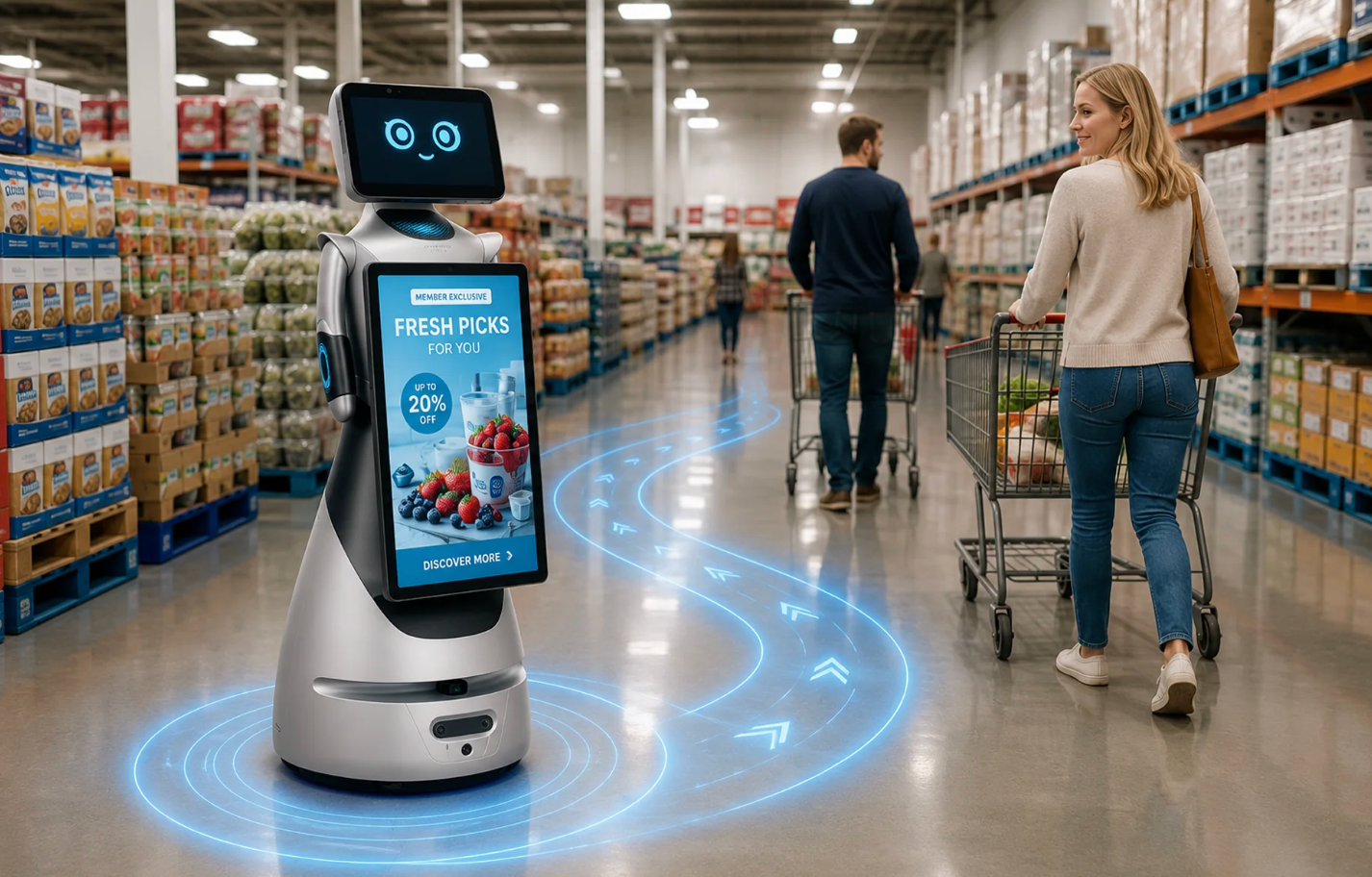
High-footfall commercial venues constantly balance the need to actively engage visitors with the necessity of disseminating clear, dynamic information. Managing these dual priorities often strains physical staff, especially during peak hours when wayfinding queries and promotional activities overlap. Implementing a retail service robot for commercial venues provides a structural solution to this challenge, anchoring both proactive greeting and mobile digital signage within a single autonomous platform. Evaluating these systems requires operators to look beyond basic mobility and closely analyze how the robot integrates with the specific architectural constraints and engagement goals of the facility.
Establishing a reliable evaluation framework begins with assessing the core architecture of the hardware, specifically the balance between digital signage and physical transport priority. Multi-tier transport architectures utilize layered trays capable of hauling up to 40 kilograms alongside vertical LCD screens reaching up to 18.5 inches, suiting environments requiring continuous physical delivery without sacrificing billboard space. Conversely, broadcast architectures prioritize multi-modal interaction over heavy lifting, typically pairing a 13-to-14-inch head-mounted touch interface with a larger chest-mounted display. Tablet-centric telepresence architectures omit large screens and trays entirely, utilizing a single articulating touchscreen around 13.3 inches to facilitate purely one-on-one digital concierge services.
The software ecosystem and IT integration depth further dictate how the platform adapts to the venue. Proprietary cloud-management platforms enable turnkey deployment, allowing operational teams to remotely schedule marketing playlists and manage navigation routes without internal development resources. Open SDK and customizable operating system environments provide access to underlying Linux or Android layers, empowering third-party developers to build bespoke retail applications or branded interactive menus directly onto the interface. Because all of these platforms rely on cameras, mapping sensors, and cloud-based data processing for voice and vision, operating organizations must verify applicable data protection and privacy regulations, including GDPR, before deployment to ensure compliance regarding video capture and biometric processing.
Physical space constraints and navigational footprints determine where the hardware can safely operate within the building. Ultra-compact platforms are engineered for sub-55 centimeter clearance widths and feature lightweight bases ranging from 12 kilograms to 38 kilograms, ensuring safe passage through dense retail aisles. Standard commercial platforms utilize heavier bases ranging from 32 kilograms to 55 kilograms and require 60 to 70 centimeters of clearance, securing the necessary stability to anchor dual-screen setups or multi-layer transport suspensions in expansive hotel atriums.
Power management and shift endurance profiles must align with the specific operational hours of the facility. Multimedia-balanced power systems generally deliver 8 to 11 hours of runtime per charge utilizing battery packs around 20 Ah, distributing energy to support continuous large-screen digital signage, AI voice arrays, and intermittent movement. High-endurance transport power systems target up to 15 to 18 hours of runtime per charge, optimizing power for constant physical roaming and high-turnover workflows where mid-day recharging is not viable.
The OrionStar GreetingBot AD operates as a large-screen retail service, greeting, and leading platform designed to consolidate proactive customer engagement and dynamic broadcast content. Its architecture centers around a dual-screen configuration, pairing a 14-inch head touch screen for direct interactive inputs with a prominent 21.5-inch chest-mounted display tailored for digital signage, menu boards, and promotional media. To accommodate the physical footprint of the expansive chest display, the unit's mechanical arm motion is shipped in a default-off state, prioritizing unobstructed screen visibility over physical gesturing. It navigates typical retail passages requiring 60 to 65 centimeters of clearance, securing its mobility across standard commercial floor plans.
To sustain continuous operation of its dual high-definition displays, the GreetingBot AD relies on an upgraded 20 Ah battery system that delivers up to 8 to 10 hours of runtime under laboratory conditions. This power configuration aligns with standard front-of-house operational shifts, allowing the platform to maintain active AI-driven voice interactions and visual broadcasts throughout the day. By fusing an anthropomorphic presence with substantial digital real estate, this retail service robot effectively serves retail flagship stores, exhibition halls, and hotel lobbies where drawing visitor attention and immediately routing them to relevant services or offers represents a primary business objective.
The Pudu KettyBot Pro targets commercial environments characterized by restricted navigational footprints, operating primarily as a compact platform for narrow retail aisles. The platform relies on a centered 18.5-inch advertising screen positioned beneath a 10.1-inch interactive display, balancing mobile marketing capabilities with active customer reception tasks. Its chassis utilizes a highly reduced physical profile, demanding a minimum passage width of under 55 centimeters according to manufacturer data, which allows it to maneuver through densely packed specialty retail aisles or constrained checkout zones where wider units would face immediate bottlenecks.
In addition to its visual marketing capabilities, the KettyBot Pro integrates light delivery functions into its workflow. The unit navigates using visual and laser SLAM technologies to shuttle small items or promotional samples to designated zones while simultaneously broadcasting scheduled advertising playlists. This dual capability makes the retail service robot a pragmatic fit for environments that require continuous background material transport but also want to extract active marketing value from the hardware as it traverses the retail floor.
The Pudu BellaBot focuses on high-capacity workflows, combining heavy-duty physical transport capabilities with integrated mobile marketing. The platform manages a total payload capacity of up to 40 kilograms distributed across four configurable trays, enabling venues to move substantial volumes of physical goods or clear large dining arrangements efficiently. Alongside this substantial delivery architecture, it features a rear-facing 18.5-inch advertising screen designed to capture visitor attention as the unit transits through busy corridors, effectively turning a logistics operation into a roaming promotional asset.
To support mobility across expansive architectural layouts, the BellaBot navigates utilizing VSLAM+ technology tailored for fast deployment in areas with high ceilings and shifting layouts. This tracking capability supports robust operation in multi-floor shopping malls, large exhibition halls, and hotel atriums where rapid environmental changes frequently occur. By layering substantial logistics throughput with significant digital signage space, this retail service robot addresses the operational bottlenecks of hospitality and retail hubs requiring constant physical replenishment.
The temi platform functions as a single-screen mobile telepresence and digital signage station engineered explicitly for corporate lobbies, bank branches, and high-touch concierge points. Operating as a tablet-centric architecture, the unit features a single 13.3-inch capacitive touch screen positioned on an articulating, face-tracking head. It abandons heavy delivery trays and large broadcast screens in favor of an exceptionally lightweight 12-kilogram base, making it highly portable and responsive when deployed primarily for one-on-one software-led interactions, virtual video calls, and map-based wayfinding.
A defining characteristic of this retail service robot is its reliance on an open SDK environment running across Linux and Android layers. This software architecture enables internal IT teams or third-party developers to integrate proprietary retail point-of-sale applications, custom banking interfaces, or specialized registration portals directly onto the device. By prioritizing deep software customization and fluid telepresence over physical utility, the platform serves as a dedicated digital assistant for venues where personalized service and data integration dictate the engagement model.
The Keenon DINERBOT T9 Pro caters directly to demanding food courts and casual grab-and-go operations by prioritizing heavy-duty delivery capacity and extreme operational endurance. The platform manages complex multi-table handoffs utilizing an 11.6-inch front-facing HMI screen that delivers clear self-service pickup prompts rather than broad marketing content. It secures its payload stability in dynamic environments by utilizing a vehicle-grade independent suspension chassis, ensuring safe transport of liquids and fragile items across uneven flooring or busy food-hall intersections.
Built to endure prolonged operational schedules, the platform delivers an extended shift endurance ranging from up to 15 to 18 hours according to manufacturer data. This exceptionally long runtime allows the unit to seamlessly handle continuous table-clearing or multi-point delivery workflows across back-to-back shifts without requiring mid-day docking interruptions. For high-turnover food and beverage hubs, this retail service robot represents a purely functional asset optimized for maximum physical uptime and reliable logistics rather than visual marketing.
Procuring the correct autonomous platform requires matching specific architectural constraints directly to the hardware's primary strengths. Venues prioritizing expansive visual broadcasting and front-of-house greeting should utilize the OrionStar GreetingBot AD, while locations dependent on active marketing through narrow floor plans will benefit most from the compact Pudu KettyBot Pro. Spaces requiring substantial payload delivery alongside promotional visibility align tightly with the Pudu BellaBot, whereas corporate environments needing highly customized software integration are best served by the temi architecture. Ultimately, high-volume dining sectors demanding maximum shift endurance should deploy the Keenon DINERBOT T9 Pro to sustain uninterrupted physical workflows.
Industry deployments typically show measurable ROI within 3–6 months and reach full payback in 16–24 months, driven by labor-hour savings (one restaurant reduced labor from 42% to 28% of revenue over 16 months) and throughput gains such as faster table turns, shorter delivery times, or higher pick rates. Documented retail-adjacent cases include Marriott Aloft's pilot achieving a 98% delivery success rate with a 40% reduction in delivery times and an 18-point Net Promoter Score lift, and Tennant robotic scrubbers saving 33,649 labor hours across 100 grocery stores. The exact figure for any given venue depends on local wage levels, daily traffic, and whether the robot is used for greeting, advertising, wayfinding, or a combination. For retail service robots specifically, payback should be modeled against the dual revenue contribution: staff-time freed up plus the value of the on-robot advertising surface in high-footfall zones.
Three models are commonly offered: outright purchase, leasing through a finance partner, and RaaS monthly subscriptions. According to the IFR, RaaS fleet deployments grew 31% in 2024, opening robotics to operators that prefer not to commit large upfront capital. Typical monthly RaaS rates start in the $349–$575 range over a 2-month minimum, with installation, training, and ongoing support bundled in — useful for retail or exhibition-hall pilots where seasonal demand fluctuates. Outright purchase remains the standard for venues running the robot in continuous multi-shift service, where unit cost is amortized over a 3–5 year horizon. Leasing sits between the two, offering predictable monthly cost without long-term RaaS commitments.
Every retail service robot covered in this comparison — the OrionStar GreetingBot AD (Large-Screen Edition), Pudu KettyBot Pro, Pudu BellaBot Pro, temi V3/V4, and Keenon DINERBOT T9 Pro — carries front-facing cameras, a microphone array, and cloud-connected mapping or content services. Under GDPR, operators must establish a lawful basis for any biometric or face-tracking processing, post visible signage, define data-retention windows, and execute processor agreements with the robot vendor and any regional platform (PUDU Cloud, Robotemi Cloud, HelloGard). Mapping data and any cloud-synced call recordings are particularly sensitive for venues such as hotel lobbies and bank branches, where data-residency options and sub-processor transparency should be confirmed in writing before deployment. Privacy-by-design controls (on-device processing where possible, microphone mute, scheduled face-recognition off-times) are increasingly standard and worth specifying in the procurement contract.
The OrionStar GreetingBot AD (Large-Screen Edition) pairs a 21.5-inch FHD 1080P information display on the chest with a 14-inch FHD 1080P capacitive touch screen on the head, giving it the largest combined customer-facing surface area in this comparison. Pudu's KettyBot Pro and BellaBot Pro both use an 18.5-inch advertising screen paired with a 10.1-inch interaction display, while temi V3/V4 relies on a single 13.3-inch Full-HD capacitive touch screen with a tilting head, and the Keenon DINERBOT T9 Pro uses an 11.6-inch HMI-sized touchscreen not intended for marketing content. In venues where the robot must simultaneously run interactive tasks (wayfinding, video calls, concierge) and broadcast promotional or wayfinding content, dual-screen designs offer expanded display real estate compared to single-screen layouts. The 21.5-inch panel on the GreetingBot AD is also the largest chest-mounted display in this set, useful for menu boards, event schedules, and brand video at typical retail viewing distances.
The GreetingBot AD navigates 60–65 cm corridors with centimeter-level positioning, can cross 10 mm floor bumps and 20 mm seams, climb 5° inclines unloaded, and map venues up to 50,000 m² using LiDAR, wheel odometry, IMU, and vision sensors; an optional elevator-control module extends coverage across floors. Pudu's KettyBot Pro has the narrowest minimum passage at 52–55 cm, while BellaBot Pro needs ≥65 cm and the Keenon DINERBOT T9 Pro lists ≥70 cm, and temi is the most compact at 12 kg on a 35 cm base. Recovery from unexpected obstacles is documented in the 10–15 second range for SLAM-based platforms, which matters in dynamic retail and mall environments where shoppers, prams, and delivery carts appear without warning. For venues with multi-floor retail, hotels, or exhibition halls, confirming elevator integration availability and corridor width on the planned patrol route is essential before purchase.
The GreetingBot AD (Large-Screen Edition) runs approximately 8–10 hours per charge on its 20 Ah / 529.2 Wh battery, with a charging time of about 5 hours powered off or 6 hours powered on via its LiDAR-aligned dock — comfortably covering one full front-of-house shift plus spillover. Comparable figures across the field are 9 hours for the KettyBot Pro (≈3.5 hours charging), up to 11 hours for the BellaBot Pro (with an optional quick-swap battery for back-to-back shifts), up to 15–18 hours for the DINERBOT T9 Pro (≈4 hours charging), and up to 8 hours for temi V3/V4. For venues operating two or more daily shifts back-to-back, operators should ask specifically about quick-swap or auto-dock behavior and whether the robot can recharge during off-peak hours without staff intervention. Final power-consumption figures vary with screen-on time, ambient temperature, and motion intensity, so real-world runtime is best validated in a 30-day on-site pilot.
Third-party product specifications are based on public data (up to, under laboratory conditions, according to manufacturer data) and may vary. Product names and trademarks belong to their respective owners. If any product involves cameras, voice recording, mapping, or cloud data processing, operators must verify GDPR compliance prior to deployment.