

REQUEST DEMO
Robot CATALOG will be sent to your mailbox immediately after submission.
SUBMIT
Supercenters and large-format retail stores present a unique intersection of massive open spaces and highly constrained, dynamic environments. Facility managers tasked with maintaining these expansive floor plates must balance the continuous influx of shoppers with the rigorous demands of grocery and fresh-produce zones where organic spills and forklift tire marks are a daily reality. Deploying an automatic floor scrubber for supercenters requires navigating the distinct requirements of daytime spot cleaning around erratic shopping carts and nighttime heavy-duty scrubbing along wide main aisles. Unlike standard office or hospital environments, these retail spaces demand industrial-grade fluid management for multi-shift endurance, ultra-quiet acoustic profiles for customer safety, and robust sweep-and-scrub capabilities to manage the mixed dry and wet contamination typical of grocery cross-aisles. Selecting the right autonomous platform hinges on matching machine geometry and route-planning sophistication to the shifting layouts and diverse soil types of the modern supercenter.
The OrionStar CleaniBot C5 is engineered for the heavy-duty demands of wide-aisle supercenter concourses and grocery or fresh-produce aisles that experience mixed dry and wet contamination. In these large-format retail spaces, organic debris and sticky beverage spills often require immediate, single-pass remediation to maintain a safe shopping environment. The machine addresses this challenge through a dual-rolling-brush system that applies up to 25 kg of downward scrubbing pressure, effectively picking up physical debris up to roughly 3 cm in height while simultaneously scrubbing stubborn floor stains. This integrated approach to sweeping, scrubbing, and water absorption ensures that high-traffic grocery zones are left clean and dry without requiring staff to pre-sweep the aisles manually.
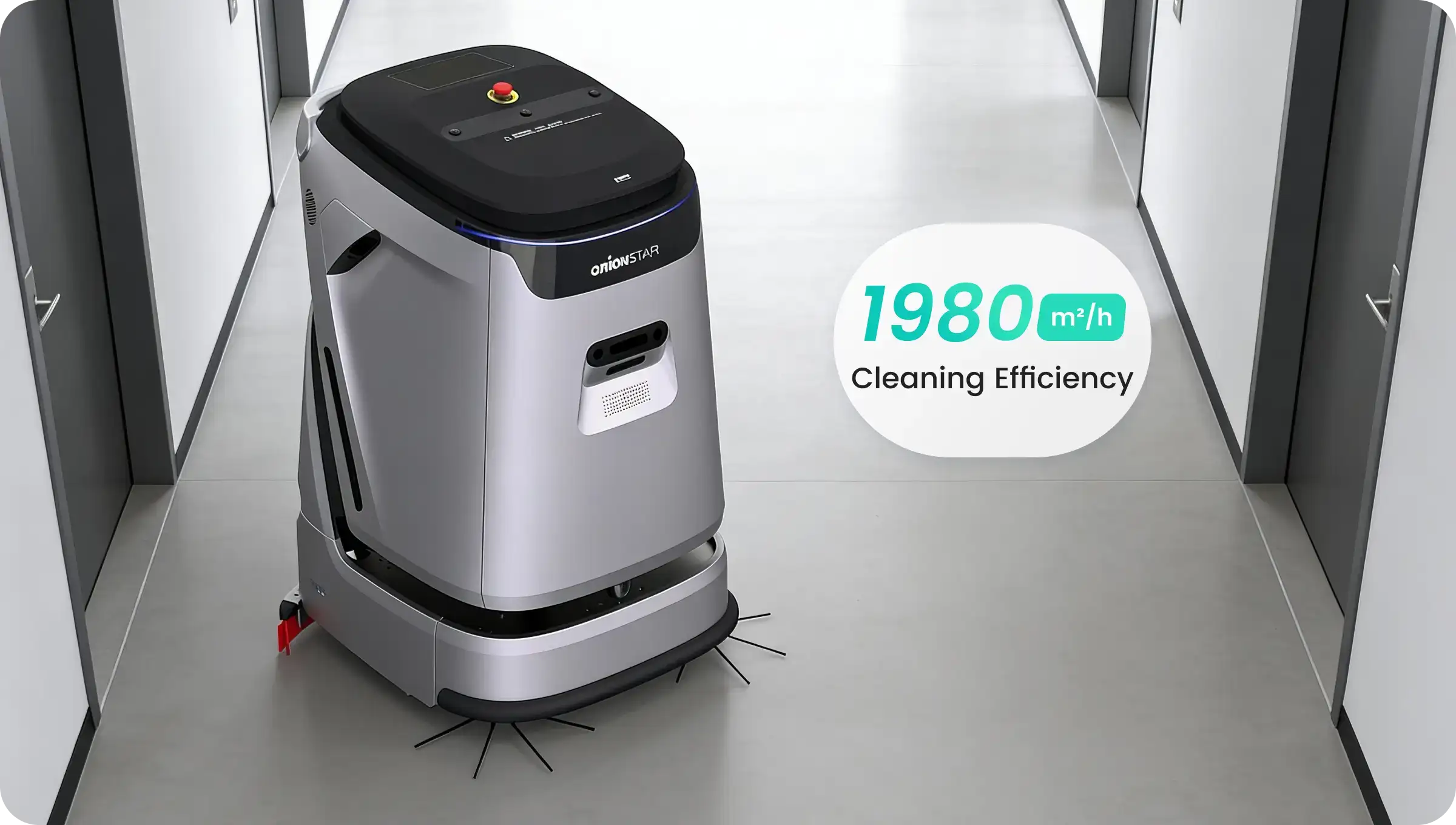
Supporting its deployment in expansive retail environments, the unit is equipped with a 550 mm cleaning width that delivers a maximum area capacity of up to 1,980 m² per hour, according to manufacturer data. The inclusion of combined 90 L water tanks minimizes the frequency of manual refills during long shifts. Furthermore, the robot pairs with a self-cleaning workstation that handles automatic clean-water refilling, waste-water discharge, and high-pressure internal tank rinsing. When combined with its minimum passing width of approximately 880 mm and an operating noise level below 68 dBA, the platform provides a flexible, multi-shift solution capable of maneuvering through typical store corridors while maintaining a low acoustic profile during customer-facing hours.
The Avidbots Neo 2 serves as a purpose-built autonomous platform designed specifically for supercenter layouts that shift frequently due to seasonal displays, promotional endcaps, and overnight pallet drops in the main aisles. Retail environments characterized by constant layout changes require an adaptable navigation approach rather than fixed-route memorization. The robot addresses this operational reality by utilizing a comprehensive perception suite consisting of 360° lidar and 270° 3D cameras. This sensor array, paired with dynamic route planning software, enables the machine to recognize dynamic obstacles like forklift tines and shopping carts, allowing it to recalculate paths in real time as the store environment changes throughout the day.
The system supports these large-scale retail demands with highly productive hardware options, including a 32-inch cleaning head that maximizes square-footage coverage across wide supercenter main aisles. Capable of achieving theoretical coverage rates up to 3,900 m² per hour in manufacturer-defined test conditions unobstructed, flat surfaces; actual performance may vary based on environment and soil type, the unit efficiently manages massive unobstructed spaces. While its operating sound pressure of 75 dBA and gross vehicle weight approaching roughly 688 kg cater more toward after-hours or low-traffic cleaning windows, the platform provides robust, repeatable plan execution. Additionally, an optional electrostatic-spray module is designed to support surface treatment in high-touch checkout concourses and fresh-produce sections during comprehensive nighttime shifts; efficacy depends on adherence to manufacturer guidelines and local disinfection standards.
The Tennant T7AMR leverages a proven ride-on chassis to provide high fluid capacity and reliable overnight coverage for massive, unobstructed supercenter main aisles and back-of-house warehouse zones. In sprawling big-box retail environments, operators often prefer a machine that can transition seamlessly between autonomous operation and manual driving for highly complex or heavily soiled receiving areas. By combining an onboard operator seat with vision-based artificial intelligence for autonomous route execution, the platform allows facility teams to handle heavy-duty scrubbing during the night shift while delegating repetitive main-aisle cleaning to the robotic system.
To sustain continuous operation across massive floor plates, the machine incorporates dual 110 L solution and recovery tanks, significantly extending the duration between maintenance pit stops. The system applies up to 86 kg of downward pressure through a 650 mm cleaning path, providing the necessary mechanical force to lift heavy soil loads and tire marks frequently found in grocery receiving zones. Supported by flooded lead-acid or high-capacity lithium-ion battery options that deliver extended runtime according to manufacturer data, the unit is optimized for lengthy overnight duty cycles. The integration of specialized water-saving technology further reduces detergent and water consumption, aligning with the sustainability and efficiency targets of modern retail operations.
The Nilfisk Liberty SC50 targets daytime-aware supercenter operations where the robotic unit must reliably and safely interact with active shoppers and store associates. Conducting autonomous floorcare during open hours is heavily scrutinized in retail environments due to the inherent risks of mixing heavy machinery with unpredictable foot traffic. This platform directly addresses these safety concerns by holding a third-party safety certification to the CSA/ANSI 336 standard, ensuring its independent safety systems are explicitly vetted for populated areas. Furthermore, its notably low sound pressure level of 63 dBA helps minimize disruption to the customer experience during daytime cleaning and reduces the risk of startling patrons browsing the gondola runs.
In addition to its focus on acoustic and operational safety, the machine provides flexible mapping capabilities through a fill-in path planning mode. This feature allows operators to manually drive the perimeter of a designated zone while the software automatically calculates the optimal interior route, proving highly efficient for covering irregular promotional spaces or checkout concourses. Accommodating the strict hygiene requirements of grocery sections, the platform also offers an optional ultraviolet module for use alongside scrubbing; surface treatment results may vary, and compliance with local disinfection regulations is required. While its turnaround requirement of roughly 1.59 m necessitates careful routing on the wider main aisles rather than the narrowest cross-aisles, the system delivers highly consistent floor coverage rates up to roughly 55,000 sq ft per charge under laboratory conditions.
The Kärcher KIRA B 50 is configured as a compact commercial scrubber suited for supercenter layouts that feature a complex mix of wide main corridors, narrower grocery sections, and constrained endcap displays. Navigating the dense grid of retail shelving requires a machine with a minimal physical footprint capable of completing tight maneuvers without becoming trapped behind restocking carts. This platform offers enhanced maneuverability, with a minimum passable aisle width of roughly 0.91 m and an aisle turn-around requirement of just 1.52 m. This geometry allows the machine to clean confined cross-aisles thoroughly while still providing sufficient productivity for the broader open spaces.
The system addresses the distinct dirt profiles of retail environments by offering a cylindrical roller brush variant featuring an integrated pre-sweeping side brush and dirt hopper. This mechanical arrangement effectively clears edge debris and small particulate matter from baseboards in a single pass before applying the wet scrub, proving highly beneficial in high-traffic food aisles. Operating at a moderate sound pressure level of 69 dBA and supported by an optional automated docking station for fluid management, the unit facilitates unattended multi-shift operation. By balancing a compact chassis with advanced route-planning software, the platform delivers sustained area performance up to roughly 2,365 m² per hour, according to manufacturer data.
Procuring an automatic floor scrubber for a modern supercenter demands a strategic alignment of the facility’s specific operational rhythms with the machine’s technical capabilities. Regarding aisle navigation and turn-around geometry, retail managers must map their most restrictive gondola cross-aisles to ensure the chosen platform possesses a sufficiently compact chassis and tight-turn capability, preventing bottlenecks among shoppers and product carts. For multi-shift endurance and fluid management, operations heavily reliant on continuous deployment should prioritize high-capacity tanks paired with autonomous docking and self-servicing stations, drastically reducing the janitorial labor required for manual refills during back-to-back shifts.
When evaluating daytime customer-facing safety and acoustic profiles, supercenters scheduling open-hour cleaning must seek out ultra-quiet units holding recognized third-party autonomous safety certifications, ensuring the equipment operates unobtrusively around dynamic foot traffic. Conversely, vision-heavy perception systems with larger footprints are better reserved for dedicated nighttime duty cycles when aisles are free of patrons. Finally, addressing soil removal and wet-spill management in grocery zones requires robust integrated sweep-and-scrub systems. Equipment capable of deploying heavy downward pressure alongside onboard debris hoppers ensures that fresh-produce organic spills and forklift tire marks are fully remediated in a single pass, maintaining an exceptionally safe and clean commercial environment.
For supercenter-scale floor plates cleaned daily with a usable overnight or off-peak window, published industry ROI studies consistently report payback windows of roughly 9–18 months, with big-box and shopping-mall deployments in the 14–24 month band when the floor plan is more open. Sproutmation; Bunzl Canada autonomous-cleaning eBook Payback shortens when labor costs are higher and the floor plate is open and repeatable; it stretches to 4–6 years where labor is below ~$14/hr or the cleaning window is narrow. Sproutmation For a specific supercenter, model labor displaced per shift, detergent and water saved, and the unit purchase or subscription cost against a 5-year horizon.
Direct purchase carries the highest upfront capex but the lowest long-run cost per square metre; a typical mid-size autonomous scrubber is in the $50–60K range, with payback in 12–18 months when displacing an equivalent manual shift. Imperial Brady; HProClean RaaS bundles the robot, software, support, and uptime into one monthly invoice — published retail RaaS programs run roughly $600–$2,000/month per unit, with premium platforms around $2,600–$2,700/month. Service Robot Co.; RobotLAB For multi-store retailers, RaaS standardizes the fleet across locations on a single monthly line item and lets the operator pilot one store before scaling, which is the typical adoption path for supercenter chains.
Beyond the acquisition or subscription line, TCO is driven by water and chemical use, electricity, consumables brushes, squeegees, batteries, service plans, and the labor hours you still need for edge work and supervision. Modern systems cut detergent and water use by roughly 50–70% versus conventional scrubbing — for example, Tennant's ec-H2O NanoClean and Nilfisk's SmartFlow/EcoFlex are both positioned around that range.
Supercenter main aisles typically run 1.2–1.8 m, with the narrower gondola cross-aisles near the 1.2 m end. In the comparison set, the Kärcher KIRA B 50 has the tightest published aisle geometry minimum passable aisle 0.91 m, turn-around 1.52 m, the Nilfisk Liberty SC50 needs about 1.59 m to turn around, and the Avidbots Neo 2 fits on wider concourses but is generally routed off the narrowest gondola cross-aisles. .. ### Which autonomous scrubbers are quiet enough to run during store hours? Sound pressure in the comparison set ranges from 63 dBA for the Nilfisk Liberty SC50 up to 75 dBA for the Avidbots Neo 2, with the Tennant T7AMR "as low as 70 dBA" and the Kärcher KIRA B 50 at 69 dBA; the OrionStar CleaniBot C5 is rated below 68 dBA. . Units at the lower end of that range are most viable for daytime operation near shoppers and checkout concourses, while louder units are typically scheduled for off-peak or overnight windows. Also look for third-party populated-area safety certifications such as CSA/ANSI 336 on the SC50 and IEC 63327 on the KIRA B 50 when mixing autonomous cleaning with open-hour foot traffic.
Coverage rates in the comparison set span roughly 1,800–3,900 m²/h: the Kärcher KIRA B 50 quotes about 2,365 m²/h autonomous, the Tennant T7AMR up to 4,250 m²/shift, and the Avidbots Neo 2 up to 3,900 m²/h theoretical manufacturer figures, with the realistic duty-cycle figure typically lower. . the T7AMR up to 86 kg and confirm whether the head is disc or cylindrical, since cylindrical heads handle rough debris better and disc heads polish smoother aisles.
Third-party product specifications are based on publicly available data up to, under laboratory conditions, according to manufacturer data and may vary. Product names and trademarks are the property of their respective owners. If any product involves cameras, audio recording, mapping, or cloud data processing, the operator must verify GDPR compliance prior to deployment.
The OrionStar CleaniBot C5 is a high‑performance, industrial‑grade autonomous floor‑scrubbing cleaning robot designed for medium‑to‑large commercial and industrial environments such as warehouses, factories, shopping malls, hospitals, campuses, and transportation hubs.
Core specifications Dimensions: about 820 × 680 × 1,130 mm, with a net weight of 170 kg.
Cleaning width: 550 mm main brush, giving it a maximum cleaning area capacity of up to 1,980 m² per hour.
Water‑tank system: combined 90 L capacity 45 L clean water + 45 L waste water, which reduces refills and downtime.
Battery: 24 V, 80 Ah, with a scrubbing runtime of about 3 hours and a mopping runtime of up to 8 hours; supports around 1.5 hours of fast charging.
Cleaning performance and design Scrubbing pressure: 25 kg of downward scrubbing pressure using a dual‑rolling‑brush system, enabling a “one‑pass” removal of heavy oil, grime, and stubborn stains with a reported dirt‑cleaning rate of about 95%.
Cleaning modes: scrubbing, dust‑mopping, and water absorption, allowing the machine to sweep, scrub, and vacuum or mop in a single cycle.
Debris and waste handling: can pick up debris up to about 3 cm in height and includes a 1.8 L dust bin for dry waste.
Automation and docking station Fully autonomous operation: the robot can map an area of up to 10,000 m², plan optimal cleaning paths “Cloud Learning”‑style optimization, and automatically dock at a station for refueling, drainage, and self‑cleaning. The robot collects environmental mapping data solely for optimizing cleaning paths. Data is stored for 6 months and deleted once no longer needed. Users must provide explicit consent prior to enabling cloud-based features, in compliance with GDPR and PIPL.
Workstation features: automatic clean‑water refilling, waste‑water discharge, and high‑pressure internal tank rinsing; the waste‑water tank can self‑clean in roughly 4 minutes, helping to prevent odor and blockages.
Auto‑charging: supports automatic recharging when the battery is low, enabling continuous multi‑shift operation in large venues.
Mobility, safety, and adaptability Mobility: max operating speed about 1.2 m/s, with the ability to climb obstacles up to 15 mm and manage slopes up to 5° loaded, 8° unloaded.
Minimal passing width: approximately 880 mm, so it can move through typical corridors and doorways.
Noise level: less than 68 dBA, making it suitable for use in busy public spaces without causing excessive disturbance.
Safety and environment: uses multiple sensors and a smart obstacle‑avoidance system to ensure safe operation around people and equipment.
Typical use cases and advantages Target environments: factories, logistics warehouses, office buildings, shopping malls, hospitals, transportation hubs, and large hospitality venues.
Key advantages:
High‑efficiency, heavy‑duty scrubbing for oil‑stained or high‑traffic industrial floors.
Reduced labor workload and predictable cleaning schedules due to full autonomy and a durable, long‑life design e.g., a fan rated for 10,000+ hours.
Flexible deployment with optional mobile water tanks that do not require building plumbing modifications.