

REQUEST DEMO
Robot CATALOG will be sent to your mailbox immediately after submission.
SUBMIT
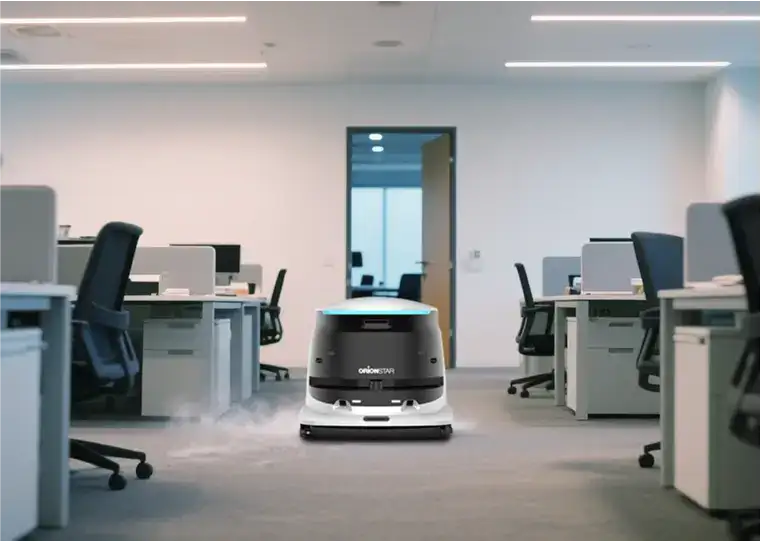
Office facilities at office buildings are at an inflection point. Facility managers face mounting pressures from rising operational costs and shrinking talent pools. Furthermore, the shift toward hybrid work has permanently altered occupant expectations. Well-maintained lobbies, corridors, and open-plan offices are now essential to encourage office attendance. Traditional manual maintenance is struggling to keep pace with these shifting demands. Fortunately, technology maturity has finally intersected with acceptable cost curves. Therefore, commercial cleaning robots are emerging as an industry-level solution. These systems shift maintenance from reactive labor to predictable, data-driven operations. Instead of deploying teams to manually scrub expansive floors, operators can rely on automated fleets. Above all, this transition transforms commercial cleaning robots into core building infrastructure. In short, automation provides the reliability and consistency that modern office facilities require.
These pressures together show that traditional modes are no longer sustainable.
The OrionStar CleaniBot series provides a differentiated two-model solution to address these operational constraints. Rather than forcing one machine to handle every environment, the series relies on complementary logic. Each plays its specific role and covers different scenarios within complex office buildings.
The CleaniBot C5 is built for expansive, heavy-duty zones like parking areas and large entry lobbies. It features a 550 mm cleaning width and an 80 Ah battery. According to manufacturer data, it covers up to 1,980 square meters per hour. Its 90-liter combined water-tank system ensures extended runtime in large areas. Therefore, it easily handles high-traffic surfaces where heavy soil accumulates.
Conversely, the CleaniBot S55 Pro is designed for tighter, occupied spaces such as open-plan offices, meeting rooms, pantries, and corridors. It offers a compact footprint and multiple modes, including a quiet 45 dB dust mopping setting. According to manufacturer data, it easily navigates minimum passing widths of 700 mm. This makes it ideal for maneuvering around desks and foot traffic without causing excessive disturbance.
Moreover, both machines function as connected devices. Facility teams can manage these robots through remote deployment, cloud platforms, and automated data reporting. Because these products utilize cameras and sensors for autonomous navigation, data privacy is paramount. Facility operators should verify GDPR compliance regarding location mapping and performance data. Data privacy is secured in compliance with local regulations (e.g., GDPR). Cloud data transmission is encrypted, and optical sensors are utilized strictly for real-time obstacle avoidance without retaining personal identifiable information. In short, the models work together to seamlessly map, clean, and report on the entire facility.
These results are not theory — they are what facility managers are already validating.
Automation does not replace people; instead, it elevates them. The integration of robots shifts the daily operational dynamic toward human-robot collaboration. Robots take on repetitive, large-area tasks like sweeping expansive corridors and scrubbing lobbies. Consequently, facility staff can shift to higher-value work. This includes quality supervision, targeted restroom deep cleaning, and direct customer service.
Moreover, new roles and essential skills are emerging within office facility teams. Workers now engage in route design, fleet management, and real-time performance monitoring. Facility managers must become more technically proficient to utilize business intelligence and IoT data. Therefore, clear role definitions help align resources with actual building demand. Delegating taxing floor work to machines improves ergonomics for cleaning crews. Above all, human oversight remains critical to manage exceptions and oversee overall facility quality.
Commercial cleaning robots are rapidly becoming essential infrastructure for office facilities. As operational pressures mount, data-driven automation provides a reliable path to consistent building maintenance. Facility managers must now look beyond single-machine deployments and consider integrated strategies. To match specific spatial demands, the OrionStar CleaniBot series offers multiple models tailored for different scenarios, allowing professionals to explore configurations that fit their exact layouts. Ultimately, the future of facility management relies on seamless collaboration between specialized hardware, digital platforms, and skilled human operators. The industry is moving decisively from reactive manual upkeep to proactive, automated floor care.