

REQUEST DEMO
Robot CATALOG will be sent to your mailbox immediately after submission.
SUBMIT
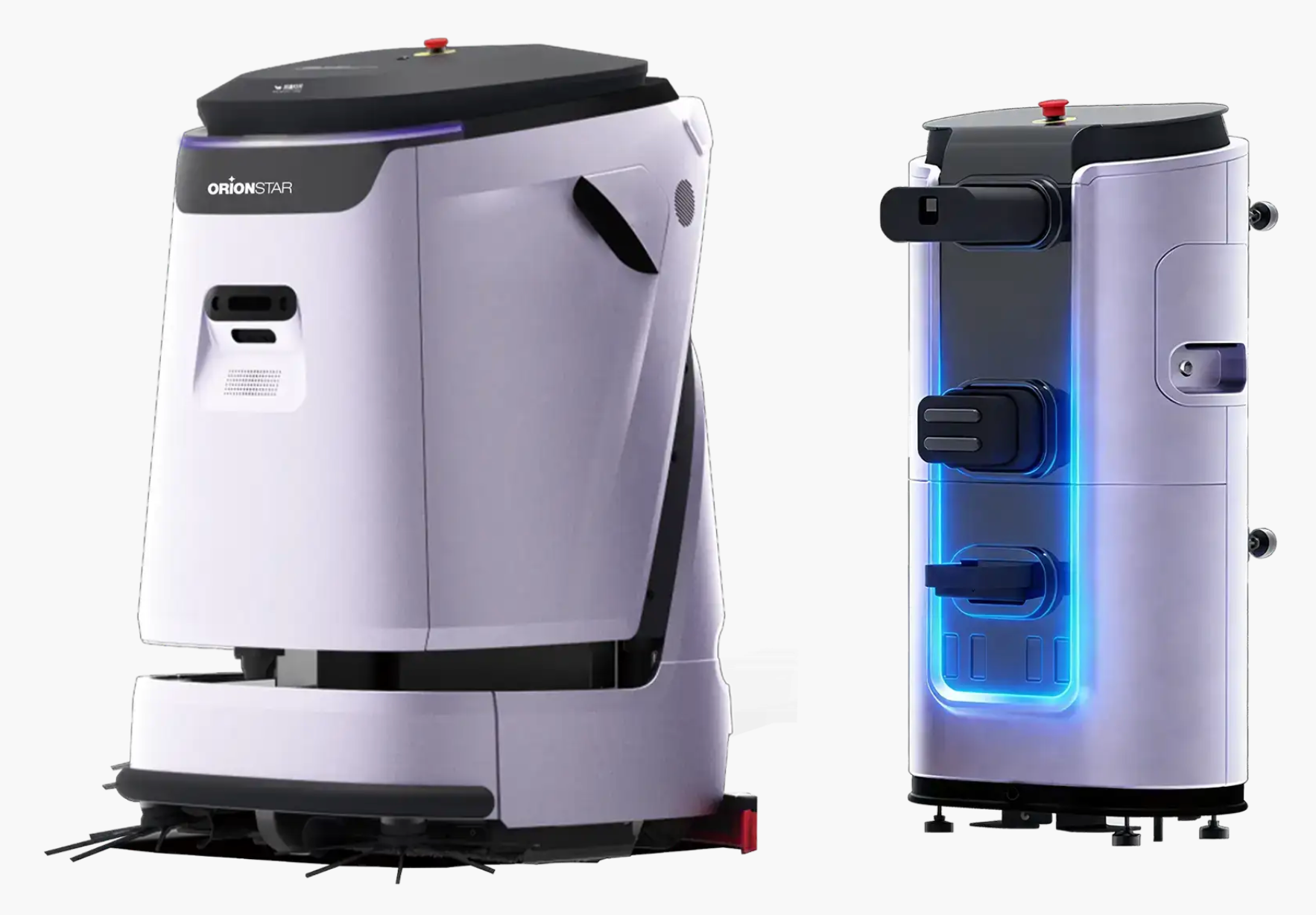
Catering operations present rigorous floor maintenance challenges across contrasting zones, spanning grease-laden central production kitchens, congested kitchen-adjacent prep and wash-up areas, heavily trafficked service corridors, expansive banquet halls, and delicate client dining rooms. Facility managers face the complex task of selecting equipment that can lift stubborn food debris while polishing smooth floors without disrupting event logistics. Addressing these extreme spatial constraints, diverse surface types, and variable fluid consumption demands requires a structured evaluation of cleaning mechanism architectures, water handling automation, and dimensional footprints.
Catering operations encompass diverse surface types that demand specific cleaning mechanism architectures. Integrated cylindrical brush systems pre-sweep coarse food debris and scrub heavily soiled kitchen grease in a single pass, handling solid waste and liquid slurry simultaneously to support central kitchen resets. Interchangeable head architectures offer modular configurations, allowing operators to switch between disc mechanisms for polishing guest dining floors and roller mechanisms for deep-cleaning prep areas. Dedicated compact disc systems focus strictly on high-speed polishing and light soil removal, excelling in client dining rooms where navigating table grids and maintaining the aesthetic finish of smooth, hard floors is the primary objective.
Central production kitchens generate continuous oil and grime that require significant fluid exchange, making water autonomy and fluid handling capacity critical procurement factors. Ultra-large onboard tank architectures exceeding one hundred liters prioritize maximum uninterrupted runtime per shift, relying on manual refill and drainage processes supported by facility staff to cover massive floor plans. Mid-sized tank architectures in the thirty to ninety-liter range pair with fully automated docking stations to execute continuous self-refilling and self-drainage through fixed plumbing connections or mobile water tanks. Compact fluid systems under fifteen liters utilize quick manual tank swaps or fast manual refills to accommodate short, high-frequency cleaning intervals in specific front-of-house zones between event rounds.
Catering layouts feature extreme spatial variation, meaning dimensional footprints and navigational logic dictate where machines can operate successfully. Large-format mapping and computer vision architectures exceeding widths of nine hundred millimeters navigate wide environments dynamically but struggle to enter constrained kitchen aisles. Mid-sized mapping configurations between seven hundred and eight hundred eighty millimeters navigate standard commercial doorways and busy service corridors efficiently. Ultra-compact teach-and-repeat marker architectures under five hundred millimeters execute defined routes securely between fixed dining room table grids. Because mapping, fleet management, and autonomous navigation frequently utilize onboard cameras and cloud-based data processing, facility operators should utilize systems featuring edge-processing or anonymization protocols to meet GDPR and local privacy regulations when deploying in staff or guest zones.
The OrionStar CleaniBot C5 positions itself as a heavy-duty solution for central production kitchens and mixed back-of-house floors where heavy oil and grime accumulate constantly. The machine addresses these environments using a dual-rolling-brush system that exerts up to 25 kg of downward pressure, achieving a reported dirt-cleaning rate of roughly 95 percent under standard test conditions according to manufacturer data. By processing coarse debris up to approximately 3 cm in height and scrubbing simultaneously, this architecture manages the heavy grease loads typical of catering production zones without requiring a separate pre-sweeping phase from the culinary staff.
To support continuous multi-shift operations, the unit integrates a 90 L combined water tank system with a dedicated docking station that executes automatic clean-water refilling, waste-water discharge, and internal tank rinsing. Facility managers can deploy this fluid automation either via fixed plumbing connections or optional mobile water tanks for venues lacking dedicated drainage infrastructure. The system maps operational zones autonomously up to 10,000 square meters, requiring a minimal passing width of approximately 880 mm to navigate standard service corridors while operating below 68 dB(A) to minimize disruption near active staff.
The Avidbots Neo 2W focuses its deployment on vast production floors and wide loading areas where extended continuous runtime takes precedence over tight maneuverability. It utilizes a cylindrical cleaning head that pre-sweeps debris and scrubs in a single pass, with the 32-inch variant exerting variable brush pressure up to approximately 45 kg under defined test conditions to manage heavy kitchen grease. This integrated sweeping configuration processes back-of-house debris efficiently, though the machine's moderate rotation speeds prioritize broad area debris extraction over high-gloss floor polishing.
The architecture features highly expansive fluid capacities, holding up to 109 L of solution and 135 L of recovery water to support continuous cleaning shifts lasting four to six hours. Because it lacks a fixed-pipe automated docking station for autonomous fluid exchange, the system requires manual water handling by facility staff between operating cycles. The machine relies on dynamic mapping and camera-based navigation that necessitates a 3.05 m minimum turnaround radius, making it well-suited for wide banquet halls, while requiring larger turning clearance in kitchen-adjacent prep zones.
The Gausium Scrubber 50 Pro positions itself as a highly adaptable fleet asset capable of transitioning between grease-prone prep areas and polished guest dining floors through an interchangeable head configuration. Facility operators modify the machine by installing a roller brush mechanism for coarse debris pickup in back-of-house operations or swapping to a disc mechanism for maintaining smooth banquet hall surfaces. This modularity allows catering companies to address both food preparation slurry and front-of-house aesthetics using a single unified equipment chassis across different facility zones.
The equipment manages fluid consumption through a five-stage water recycling filtration system that reduces freshwater usage, while relying on a plumbed workstation to automate tank refills and drainage. The machine navigates standard commercial corridors with a minimum passable width of roughly 800 mm, dynamically avoiding shifting obstacles using depth and RGB cameras. Because its navigation and fleet management systems rely heavily on visual data and cloud mapping processing, the architecture necessitates a thorough GDPR compliance review before deployment in European guest-facing hospitality environments.
The Kärcher KIRA B 50 leverages an established European dealer and service network to support multi-site catering operators requiring standardized floor maintenance across service corridors and large banquet halls. It employs a cylindrical roller brush operating at up to 1,200 RPM combined with an integrated side brush under defined test conditions. This specific high-speed, low-pressure architecture is engineered primarily for sweeping and maintaining polished hard floors, being optimized specifically for the daily maintenance of polished surfaces.
The machine interfaces with an optional docking station that automates the fresh water fill, dirty water drain, tank rinse, and battery charging cycles strictly through a fixed plumbing connection. It navigates environments requiring a minimum turnaround width of about 1.52 m, executing programmed routes while utilizing cloud-based fleet management interfaces. Catering operators deploying this system across multi-regional European sites must evaluate the cloud platform specifics for data privacy and regional compliance prior to live-service implementation.
The ICE Co-Botics Cobi 18 focuses strictly on ultra-compact maneuverability to clean tight client dining room table grids and small kitchen-adjacent zones where larger industrial machines cannot physically operate. It utilizes a dedicated disc scrubbing path of roughly 48 cm wide to maintain smooth front-of-house flooring, executing delicate pre-service and post-service passes between event seating arrangements. This specialized focus makes it highly effective for narrow dining rooms, while heavier food debris may require different architectural solutions.
The system requires manual tank refills and drainage due to its highly compact 10 L clean water capacity, operating for approximately 60 to 90 minutes per charge according to manufacturer data. It navigates via a teach-and-repeat methodology using static location markers instead of dynamic environmental mapping, ensuring predictable routes through noise-sensitive service windows. The equipment utilizes a cloud-connected fleet management software subscription that requires facility managers to verify data privacy protocols for European catering deployments.
Procuring an autonomous floor scrubber for catering operations requires aligning the machine's underlying cleaning mechanism and fluid handling automation with the specific spatial constraints of the target zone. Central production kitchens handling persistent heavy grease benefit from dual-rolling or cylindrical brush systems paired with automated docking stations to minimize manual water handling during overnight resets. Conversely, client dining rooms and congested banquet halls demand compact disc architectures with narrow turning capabilities to navigate table grids and polish hard floors. By carefully evaluating these structural factors and confirming regional data compliance for mapped environments, catering companies can successfully integrate automated floor maintenance across their diverse operational spaces.
Industry analyses consistently place payback for autonomous scrubbers at roughly 9 to 18 months for qualifying facilities, with broader ranges of one to three years depending on shift coverage and labor cost. For catering operators the math is driven mainly by how many cleaning-staff hours the robot substitutes during overnight kitchen resets and pre-service banquet-hall passes, so venues running multiple shifts or large banquet halls typically land in the lower half of that range. The OrionStar CleaniBot C5's up to 1,980 m²/h cleaning capacity and an estimated 3-hour scrubbing runtime depending on floor types and layout per charge let a single unit cover a sizeable central production kitchen plus adjacent service corridors in one overnight cycle. Vendors such as ICE Co-Botics also offer subscription models that convert capex into a predictable opex line, which shortens the financial payback discussion but extends the commercial commitment.
Both models are widely available and the right choice depends on how the catering operator manages capex and fleet churn. ICE Co-Botics Cobi 18 is sold on a subscription that starts at roughly $15 per day all-inclusive (consumables, support, repairs and replacement parts), which removes upfront capital risk and is attractive to multi-venue caterers that want predictable monthly costs. Most other vendors in this category, including the CleaniBot C5, Avidbots Neo 2W, Gausium Scrubber 50 Pro and Kärcher KIRA B 50, are sold outright with optional service contracts, so catering operators that prefer asset ownership and a longer depreciation horizon will lean purchase. A practical approach is to run a one-shift pilot on subscription to validate nightly route coverage in a single venue, then migrate to purchase once utilization is proven across multiple sites.
A well-planned deployment is minimally disruptive because the robot runs on a mapped route and does not require continuous supervision. The CleaniBot C5 supports fully autonomous operation across up to 10,000 m², with auto-docking for refilling, drainage and self-cleaning, so staff handovers can be aligned to existing shift changeovers rather than live service windows. Most pilots report that cleaners are redeployed from repetitive floor work to guest-facing or detail-finishing tasks rather than being cut, which is a useful framing when negotiating with site teams. Catering operators should still budget for two to four weeks of route tuning during the first banquet-hall rollout, because table layouts and service-corridor configurations change with each event type.
Grease removal depends on brush pressure, head geometry and the pre-sweep capability of the cleaning head. The OrionStar CleaniBot C5 uses a dual-rolling-brush system with about 25 kg of downward pressure and a reported dirt-cleaning rate of approximately 95%, which is sufficient for typical food-service soiling. For heavier degreasing, the Avidbots Neo 2W's cylindrical head offers variable brush pressure up to about 45 kg on the 32-inch head, while the Gausium Scrubber 50 Pro lets operators switch to a roller head suited to coarse debris pickup. Kärcher's KIRA B 50 is engineered more for polished hard floors, so a separate degreasing protocol is still recommended for central production kitchens. None of these machines replaces periodic manual deep cleaning of drains, grout lines or under-equipment zones, so procurement should plan a hybrid crew-and-robot workflow rather than a full manual replacement.
Noise output is generally compatible with back-of-house work but requires care in front-of-house dining rooms. The CleaniBot C5 runs at less than 68 dB(A), the Kärcher KIRA B 50 at about 69 dB(A) and the ICE Co-Botics Cobi 18 in ECO mode at 66–68 dB, all of which sit below typical ambient restaurant noise during service. The Avidbots Neo 2W is louder at 75 dB(A) operating sound pressure with the audio system peaking at 83 dB(A), which makes it more appropriate for kitchen resets and banquet-hall turnovers between seatings rather than live dining service. As a rule of thumb, route live-service dining-room coverage to sub-70 dB machines or schedule them for pre-service or post-service windows only.
Footprint represents a primary site-fit constraint in catering venues, because service corridors, kitchen pass-throughs and banquet-hall aisles are often narrower than industrial spaces. The CleaniBot C5 needs a minimum passing width of roughly 880 mm, which fits typical corridor and doorway layouts, while the Gausium Scrubber 50 Pro needs about 800 mm of passable width and 1,100 mm for U-turns. The Avidbots Neo 2W is wider at 935 mm with a 3.05 m minimum autonomous turn-around, which is workable in central production kitchens but tight in dining-room aisles. For the most constrained front-of-house layouts, the ICE Co-Botics Cobi 18 at 48 × 48 cm is the most compact option in this category and is explicitly designed to fit between banquet-hall tables, though its small tanks and 60–90 minute runtime limit it to dining-room and front-of-house coverage rather than full-shift kitchen work.
Third-party product specifications are based on publicly available data (up to, under defined test conditions, according to manufacturer data) and may vary. Competitor specifications are based on publicly available data as of September 2026. Product names and trademarks are the property of their respective owners. If any product involves cameras, voice recording, mapping, or cloud data processing, the operator must verify GDPR compliance prior to deployment. The purchaser is solely responsible for ensuring that the deployment of camera or sensor-equipped robotics complies with local privacy laws, including the GDPR. OrionStar provides data processing agreements (DPA) and local storage options to assist with compliance.