

REQUEST DEMO
Robot CATALOG will be sent to your mailbox immediately after submission.
SUBMIT
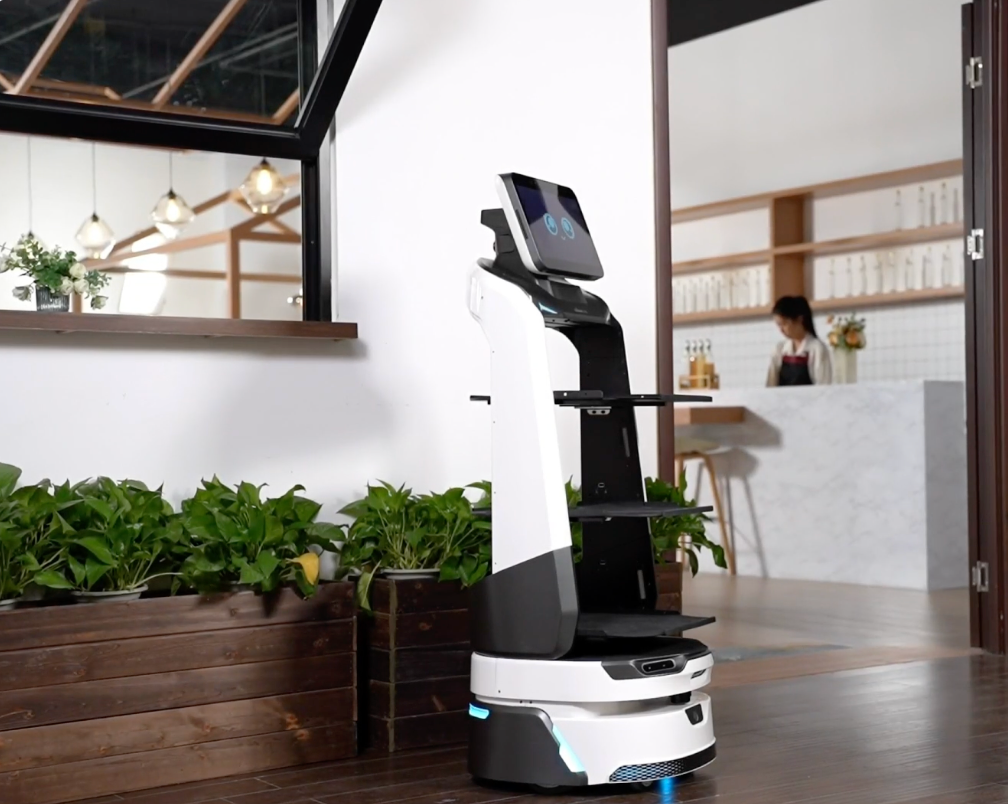
Fast food and quick-service venues present a challenging environment characterized by high table turnover, counter-to-table service flows, drive-thru support logistics, and tight spatial constraints. Operators face the daily friction of moving large volumes of meals through narrow between-table aisles while balancing beverage-heavy trays that are prone to tipping. Evaluating robotic solutions requires balancing spatial constraints against payload throughput, as ultra-compact chassis architectures prioritize maneuverability in tight layouts while heavy-duty multi-tier architectures maximize per-trip capacity to rapidly clear tables.
Furthermore, liquid stability for beverage-heavy orders relies on careful vibration management, utilizing either active chassis suspension systems or momentum-dispersing tray surfaces to keep tall, open fountain cups level over floor transitions. Uptime and shift coverage also dictate how daily power is managed, differentiating between extended-capacity internal batteries designed for predictable nighttime docking and quick-swap external modules tailored for non-stop service. Finally, restaurant operators must weigh customer engagement configurations, choosing between large-format digital displays, character-driven emotive interfaces, or strictly utility-focused minimalist designs depending on their localized marketing and brand strategy.
OrionStar LuckiBot Pro is positioned as a flagship open-tray platform tailored for counter-to-table service during high-volume peak shifts, easily handling mixed loads of tall beverage cups and heavy combo platters. This heavy-duty delivery capability is supported by a total payload capacity of up to 60 kg, divided across up to four adjustable tray layers, according to manufacturer data.
For rapid deployment in dining rooms and drive-thru support areas, the platform navigates complex floor plans utilizing an advanced visual SLAM system. It reaches a cruising speed of up to 1.2 meters per second, according to manufacturer data, while its footprint requires an estimated clear aisle width of at least 60 cm for optimal passage.
When evaluating high-speed obstacle avoidance, emergency stop response, and liquid transport stability, the system relies on a 240-degree 3D all-around perception array powered by triple RGBD cameras and LiDAR. It demonstrates a rapid, precise emergency stop response when encountering tiny obstacles like dropped utensils or lingering guests. Furthermore, liquid transport stability for open fountain drinks is maintained through a dedicated Soup Delivery Mode and an integrated Torsion Bar Suspension system that minimizes chassis vibration across uneven flooring, according to manufacturer data.
Sustaining high table turnover requires robust power management throughout the day. The robot delivers up to 12 hours of continuous run time on a single shift under typical cruising scenes, while requiring 4.5 hours of dedicated plug-in charging time to reach full battery capacity. Between transit cycles, operators can leverage its 14-inch 1080P full HD display to broadcast dynamic value-meal promotions to guests waiting in line.
Pudu BellaBot is engineered for high-visibility counter-to-table operations where peak shift rushes require simultaneous transport of mixed drink cups and food trays alongside family-oriented guest engagement. To support these demanding quick-service shifts, the robot carries a total load of up to 40 kg distributed across up to four infrared-sensing trays, according to manufacturer data.
Maneuvering through busy dining areas, the platform combines marker or laser positioning with 3D perception to establish clear routing paths. The system achieves an adjustable drive speed of up to 1.2 meters per second, requiring operators to maintain a minimum passage width of roughly 60 cm to comfortably accommodate its chassis depth, according to manufacturer data.
Handling high-speed obstacle avoidance, emergency stop response, and liquid transport stability is managed by three integrated RGBD cameras. The system executes evasive maneuvers or emergency stops with a published response time of up to 0.5 seconds, according to manufacturer data. Liquid transport stability for stacked sodas is further managed by an automotive-grade independent suspension system with adaptive variable damping that absorbs transitions over threshold bumps.
To keep operations moving throughout extended hours, the unit provides up to 13 hours of continuous runtime under no-load conditions. Rather than waiting for a standard 4.5-hour plug-in charging time, operators can utilize an external quick-swap battery mechanism to instantly replenish power for back-to-back or overnight shifts.
Keenon DINERBOT T9 focuses on long repetitive counter-to-table runs in dense dining rooms, serving operators who need to clear heavy peak shifts by maximizing the transport of mixed drink cups and food combo plates. The unit supports this high-turnover strategy with a carrying capacity of up to 40 kg spread across up to four independently height-adjustable tray spaces, according to manufacturer data.
Routing through complex restaurant layouts involves proprietary 3D perception technology and patented algorithms to maintain consistent traffic flow. The robot travels at a top speed of up to 1.0 meters per second, but spatial planning is critical since it requires a minimum aisle width of up to 70 cm for clear passage, according to manufacturer data.
The unit addresses high-speed obstacle avoidance, emergency stop response, and liquid transport stability through an instant response perception array designed to halt the chassis safely when children or chairs enter its path. Liquid transport stability during fast transits is supported by an independent suspension framework that keeps adjustable trays level, reducing the risk of open beverage spills on uneven fast food floors.
Designed to withstand demanding operating schedules, the internal battery yields up to 13 to 18 hours of continuous run time depending on the load profile, according to manufacturer data. Following a full operational shift, the system requires approximately 4 hours of charging time via a standard wall connection to prepare for the next day.
Bear Robotics Servi is positioned for ultra-compact quick-service environments where counter-to-table workflows and peak shift surges must navigate the tightest seating arrangements while carrying mixed drink cups and meal baskets. This nimble approach is supported by a total payload limit of up to 30 kg utilizing up to two standard trays and one bus tub, according to manufacturer data.
The robotic runner utilizes a LiDAR-based SLAM architecture paired with RGB cameras to adapt instantly to dynamic dining rooms. It operates at an adjustable drive speed of up to 1.2 meters per second, and while a hard minimum aisle width is not explicitly specified, its highly compact base suggests capability in pathways under 60 cm, according to manufacturer data.
High-speed obstacle avoidance, emergency stop response, and liquid transport stability are core functions of its 360-degree sensor suite, which rapidly recalculates routes or halts to prevent collisions in narrow spaces. Liquid transport stability is specifically addressed through patented Stabilizing Trays engineered to disperse kinetic momentum, keeping open fountain cups level during sudden stops or sharp turns.
Power endurance is optimized for standard restaurant operating hours, providing up to 12 hours of continuous run time per cycle. Once depleted, operators must factor in up to 4 hours of dedicated plug-in charging time to restore full capacity, managed securely via the cloud-based fleet control suite.
Richtech Matradee L is configured for high-volume family dining and counter-to-table environments where clearing peak shift backlogs relies on transporting massive mixed loads of drink cups and food plates in a single trip. This heavy-duty application is enabled by a payload rating of up to 80 pounds across up to four adjustable shelves, according to manufacturer data.
Moving significant weights across the restaurant floor is coordinated by a combination of LiDAR and AI-enhanced 3D cameras for intelligent routing. The platform reaches a maximum cruising speed of up to 1.2 meters per second, though operators must account for its larger footprint which typically demands a minimum passage width of at least 65 to 70 cm, according to manufacturer data.
In terms of high-speed obstacle avoidance, emergency stop response, and liquid transport stability, the system detects lingering obstacles within a three-foot radius and executes safe bypass maneuvers or sudden stops. Rather than relying heavily on active suspension hardware, liquid transport stability is managed through smooth algorithmic rerouting to avoid sharp jerky movements that could upset open beverages during transit.
To cover extended operating periods, the built-in power system delivers up to 15 hours of continuous run time, according to manufacturer data. After a prolonged shift handling heavy family orders, the unit requires approximately 4 hours of charging time at its base station while its dual digital screens can be configured for the next day's advertising.
Selecting the appropriate robotic runner demands a calculated assessment of a venue's specific spatial constraints and operational realities. For environments where maximizing per-trip payload throughput is the dominant priority, operators should evaluate heavy-duty architectures that clear multiple tables simultaneously, provided their floor plans comfortably accommodate wider chassis profiles. Conversely, older restaurant layouts with severely restricted seating pathways will benefit most from ultra-compact models that trade absolute carrying capacity for smooth navigation through narrow aisles.
Mitigating spills during the transport of tall, open cups requires operators to prioritize units equipped with advanced active suspension systems or momentum-dispersing trays that address liquid stability directly at the hardware level. Additionally, the daily operational hours of the business dictate the ideal power management strategy, where non-stop late-night service heavily favors hot-swappable battery systems, whereas standard open-to-close windows are easily covered by integrated high-capacity batteries. Ultimately, aligning these mechanical capabilities with the brand's digital engagement and customer interface goals will yield the most effective long-term deployment.
Industry benchmarks consistently put the payback window for restaurant service robots at roughly 18–24 months at current U.S. labor rates, driven by restaurant staff turnover of 75–80% per year, an average replacement cost of about $5,864 per employee (Cornell CHR), and labor running a median 36.5% of full-service sales. Operators report 30–50% more tables served per shift after deployment, with table-turn benchmarks moving from ~1.7 to ~2.6 per hour and kitchen-to-table time falling ~18% during peak hours. Actual payback varies with local wages, shift coverage and deployment scope, so the figure should be modeled per store rather than taken as a guarantee.
Beyond the hardware, buyers should plan for site survey and mapping (LiDAR + RGBD mapping typically requires one or two supervised runs), staff training, charging dock installation, and any kitchen or POS integration work. Vendors in this category typically bundle the first year of training and 24/7 technical support with the unit (e.g., LuckiBot Pro), but ongoing service contracts, fleet-management cloud subscriptions and consumables (tray covers, sealed food protectors, replacement batteries) recur annually. For QSR operators running multi-store fleets, the cloud platform cost — Bear Universe, PUDU Link, Keenon cloud or Richtech cloud — is a line item worth quoting before signature.
Multi-unit contracts should be evaluated on three axes: (1) cloud orchestration maturity — whether the vendor supports multi-robot coordination without deadlocks in busy rooms (Bear Robotics' Bear Universe and Pudu's PUDU Link are the most explicit on this point); (2) per-robot customization and over-the-air update cadence; and (3) service-level commitments around uptime, response time and replacement units during outages. Operators should also clarify data ownership — camera, mapping and cloud telemetry generated in-store is typically governed by GDPR or local data-protection rules and the contract should name who owns and processes that data. Pricing structure (purchase vs RaaS lease) materially changes TCO and should be compared on the same shift-coverage assumption.
There is no single industry standard, and published minimum-aisle numbers vary sharply across this product category. The most compact unit commonly cited for tight QSR aisles is Bear Robotics Servi at a 44.5 × 43 cm footprint, with the manufacturer marketing it for the "tightest spaces" and a 14-minute install benchmark for a 1,000 sq ft room with 10 tables. Keenon's DINERBOT T9 is the outlier here — its officially published 70 cm minimum passage width is wider than typical QSR aisles and is the main layout caveat for that model. BellaBot (~56.5 × 53.7 cm) and LuckiBot Pro (55.8 × 52.5 cm) sit in the middle and generally require at least ~60 cm of clear aisle, while Richtech Matradee L (~57.9 cm wide) is the widest of the four and realistically needs 65–70 cm to pass comfortably. Operators should run a layout audit against the specific SKU footprint before purchase.
Spill prevention is a recognized weak point for this category and is addressed differently by each vendor. Servi uses patented Stabilizing Trays designed to disperse momentum and keep open cups level, which is one reason it is heavily deployed in QSR-adjacent venues. DINERBOT T9 and BellaBot both use independent suspension systems — T9 cites independent suspension, while BellaBot specifies an automotive-grade independent suspension with adaptive variable damping — explicitly to keep stacked drinks and plates level over floor transitions; BellaBot adds a Pudu-cited 0.5-second obstacle response as the only explicit number in this category. LuckiBot Pro pairs a dedicated Soup Delivery Mode (low-vibration liquid transport) with Torsion Bar Suspension and a quasi-circular chassis, while Matradee L relies on LiDAR + 3D cameras for routing around obstacles rather than tray-level stabilization. For QSR orders dominated by fountain drink cups, prioritizing tray stabilization + obstacle response is more important than raw payload.
Advertised single-shift runtimes in this category range from 10 to 18 hours depending on model and load. LuckiBot Pro and Servi are both rated around 12 hours per charge (LuckiBot Pro at "up to 12 hours" on a typical cruising scene; Servi at 10–12 hours), DINERBOT T9 is published at 13–18 hours, BellaBot at 13 hours no-load, and Matradee L at up to 15 hours. Charging time is fairly consistent across the set at roughly 4 to 4.5 hours wall plug, with most vendors offering an automatic dock plus cable fallback. For 24/7 or split-shift QSR operators, BellaBot's quick battery-swap option is the notable differentiator, since it lets a fresh battery go in without waiting for a full recharge cycle. A single robot can typically cover a full lunch-to-dinner window on one charge, but operators running two consecutive meal periods should confirm whether auto-dock windows or battery swap better fit the floor plan.
Footnote: Third-party product specifications are based on publicly available data (up to, under laboratory conditions, according to manufacturer data) and may vary. Product names and trademarks belong to their respective owners. If any product involves cameras, voice recording, mapping, or cloud-side data processing, the operating party must verify GDPR compliance prior to deployment.