REQUEST DEMO
Resources > Blogs > Optimizing Order Fulfillment: How Intralogistics Robots Are Transforming Picking Aisles in Distribution Centers

Optimizing Order Fulfillment: How Intralogistics Robots Are Transforming Picking Aisles in Distribution Centers

2026-09-07 04:46 OrionStar

Optimizing Order Fulfillment: How Intralogistics Robots Are Transforming Picking Aisles in Distribution Centers

Introduction

Distribution Centers face critical operational challenges in picking aisles, characterized by chronic labor shortages, escalating turnover costs, and the pressing need to improve workplace safety and ergonomics. As e-commerce continues to drive higher throughput demands, the traditional manual order fulfillment process—where workers spend the majority of their shift walking between storage locations—has become financially and operationally unsustainable. Intralogistics robots are emerging as a highly effective solution to these bottlenecks, shifting the focus from manual material transport to intelligent, automated workflows that keep operations moving efficiently.

The growing need for smarter operations in picking aisles

  • Chronic labor shortages leave facilities struggling to fill positions, with operators reporting an inability to find enough workers to meet fulfillment demands.
  • Escalating turnover rates create immense financial burdens, costing roughly $18,600 in recruitment, training, and lost output for each departing worker in the U.S. market.
  • Excessive non-value-added walking time severely limits productivity, as walking, searching, and reaching consume 50 to 70 percent of a picker's time in conventional aisles.
  • Rising musculoskeletal injury claims stem from the repetitive reaching, twisting, and heavy lifting required during manual picking processes.

How intralogistics robots can help

  • VSLAM+ navigation allows robots to dynamically map and traverse complex facility layouts without requiring infrastructure modifications or pre-set markers.
  • Autonomous route planning calculates the most efficient travel paths in real time, minimizing non-value-added travel time and ensuring timely delivery of goods.
  • Multi-robot cooperation enables fleets to seamlessly coordinate at intersections and aisles, preventing congestion and maintaining high operational throughput.
  • Layered obstacle avoidance utilizes diverse sensor arrays to detect and safely bypass human workers, forklifts, and unexpected obstructions in dynamic environments.
  • Automatic charging and docking capabilities ensure that robots can independently return to power stations when battery levels drop, facilitating uninterrupted operation across shifts.
  • Real-time monitoring provides continuous visibility into fleet status and workflow efficiency, though facility managers must ensure that any onboard data collection or camera systems comply with GDPR regulations in applicable regions.

A closer look: OrionStar CarryBot D150 in action

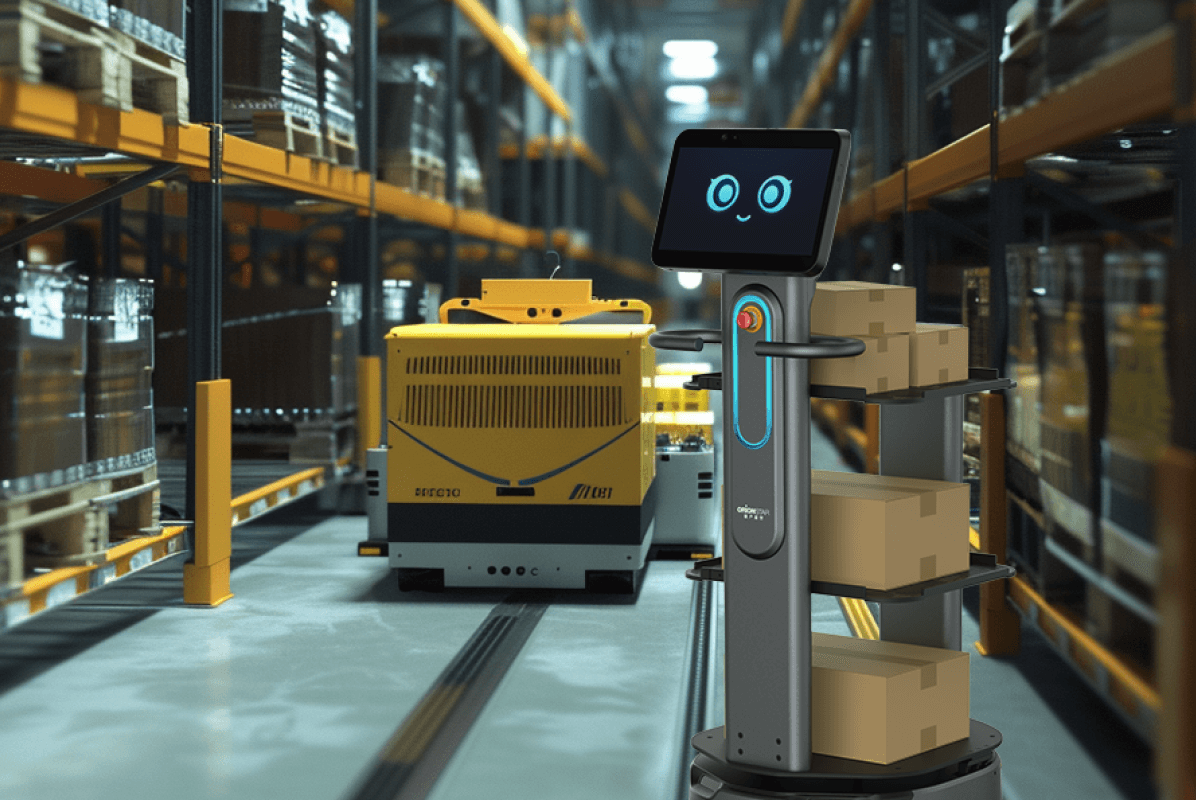
The OrionStar CarryBot D150 demonstrates how these general capabilities function in active logistics environments, utilizing VSLAM+ technology and a multi-sensor suite for marker-free navigation and dynamic obstacle avoidance. According to manufacturer data, this variant supports a net payload capacity of up to 150 kg and can operate for up to 12 hours on a single charge, depending on the floor type and payload weight. By leveraging multi-robot cooperation rules and an open system architecture, it autonomously navigates intersecting aisles and handles heavy material transport without requiring significant facility modifications.

Benefits for distribution center operators, fulfillment managers, warehouse supervisors

  • Labor optimization: Deploying collaborative routing significantly reduces non-value-added walking, which traditionally consumes 50 to 70 percent of a worker's shift.
  • Cost reduction: Automating material transport helps mitigate the financial impact of employee turnover, which averages approximately $18,600 per departing warehouse worker.
  • Increased throughput: Facilities integrating automated picking processes report fulfillment speeds that are up to 50 percent faster compared to entirely manual operations.
  • Enhanced accuracy: Utilizing digital tracking and automated item transport enables operators to achieve up to 99.99 percent pick accuracy, drastically reducing costly fulfillment errors.
  • Improved safety: Eliminating the need for manual pushing and heavy lifting in narrow aisles lowers the risk of musculoskeletal injuries and subsequent workers' compensation claims.

Real-world applications

Receiving aisles

In receiving zones, inbound inventory must be quickly transported to storage locations to prevent dock bottlenecks. Intralogistics robots automate the repetitive transit of these heavy loads, allowing human workers to concentrate on quality inspections and inventory logging.

Active picking aisles

This zone is where fulfillment associates traditionally spend the most time traveling between storage locations to complete orders. Collaborative robots traverse these aisles alongside workers, carrying picked items directly to packing stations and drastically cutting down human travel distances.

Replenishment aisles

Ensuring that forward picking faces remain fully stocked is critical for maintaining consistent fulfillment speeds. Autonomous mobile robots safely transport bulk goods from reserve storage directly into replenishment aisles, effectively navigating narrow spaces while yielding to active pickers.

Packing and staging areas

Completed orders must flow seamlessly from the picking zones to the shipping docks to avoid end-of-line congestion. Robots bridge this gap by delivering outbound goods directly to packing workstations, ensuring a continuous and automated rhythm for final shipment preparation.

Integration with other smart systems

Intralogistics robots deliver their maximum value when integrated into a distribution center’s existing operational technology stack, particularly the Warehouse Management System (WMS) and Warehouse Control System (WCS). By utilizing native APIs or vendor-neutral adapters, robots receive retrieval triggers automatically and update inventory levels in real time as items are picked and transported. Additionally, IoT connectivity allows these fleets to publish telemetry data that can automatically trigger maintenance tasks in a Computerized Maintenance Management System (CMMS) or interface with a Building Management System (BMS) to dim lighting in unoccupied aisle sections.

Supporting ESG and sustainability goals

  • Concentrating pick activity and integrating with building management systems allows facilities to reduce energy usage per order by dimming lights in unused aisle zones.
  • Replacing manual lifting and repetitive physical strain with automated transport lowers workplace injury rates, supporting critical occupational health and safety disclosures.
  • Utilizing battery-electric platforms provides auditable digital records of fleet efficiency, streamlining environmental reporting for frameworks such as the EU Corporate Sustainability Reporting Directive (CSRD).
  • Adopting robotic automation enables distribution centers to effectively align their operational scaling strategies with long-term environmental and social governance commitments.

Closing

Intralogistics robots are fundamentally changing how distribution centers manage picking aisles, shifting the operational focus from labor-intensive material handling to efficient, data-driven workflows. By addressing chronic labor shortages, improving worker safety, and increasing overall throughput, these automated systems provide a scalable response to the demands of modern fulfillment. For facilities evaluating these technologies, the OrionStar CarryBot series offers multiple hardware configurations designed to accommodate different payload capacities and layout structures, providing a practical pathway for integrating autonomous mobility into logistics networks.