

REQUEST DEMO
Robot CATALOG will be sent to your mailbox immediately after submission.
SUBMIT
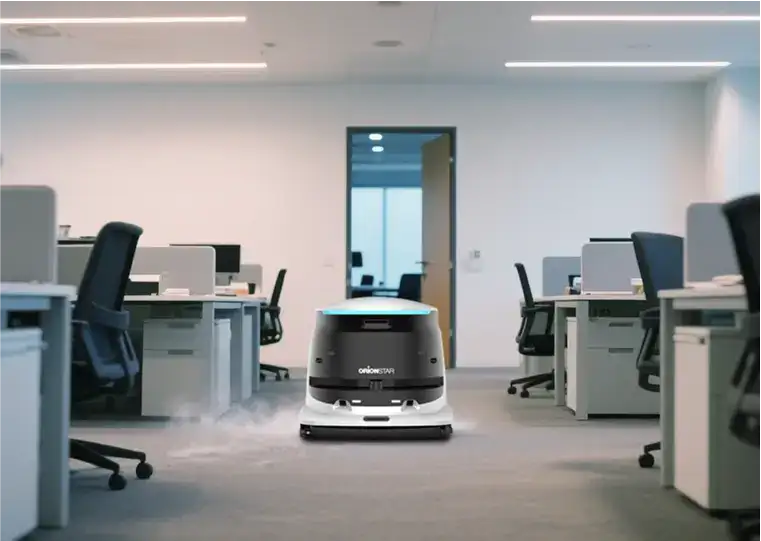
Deploying automation in corporate office floors, multi-tenant office buildings, business parks, and reception lobbies introduces distinct operational challenges that differ heavily from industrial environments. Facility managers must account for structural nuances such as single-door entries, tight cubicle aisles, intricate conference floors, and break rooms filled with shifting rolling furniture. Furthermore, corporate facilities rarely feature just one type of flooring, demanding equipment that can seamlessly transition from hard floors in pantries and corridors to low-pile carpets in executive suites. The acoustic profile of the machine dictates operational scheduling entirely, as daytime operation in occupied open-plan workspaces requires equipment generating acoustic outputs below 65 dB to prevent disruption.
Procurement teams must also navigate complex data protection landscapes when evaluating mapping adaptability. Office layouts change frequently, requiring a choice between manual teach-and-repeat route learning, AI route learning, or full autonomous SLAM with dynamic path planning. Crucially, the underlying navigation stack directly affects data-protection posture under European privacy regulations. Sensor-only configurations without cameras or voice recording minimize privacy risks, whereas camera-based or vision-SLAM systems capture spatial data that can inadvertently include sensitive employee workstation layouts. Consequently, organizations must rigorously evaluate form factor, acoustic profile, task versatility, and mapping technology to select a platform that aligns with both physical cleaning requirements and stringent data compliance protocols.
The CleaniBot S55 Pro serves as a highly versatile solution tailored for offices needing flexible daytime and nighttime cleaning capabilities alongside comprehensive digital fleet reporting. Its defining feature is multi-mode floor care, allowing a single unit to handle scrubbing, sweeping, vacuuming, mopping, and dust mopping across varied surfaces. This integrated approach ensures that hard-surface reception lobbies, high-traffic corridors, and mixed-surface pantries can all be maintained without requiring multiple specialized machines.
The system relies on advanced LiDAR mapping capable of covering areas up to 10,000 square meters, under laboratory conditions, to dynamically navigate shifting multi-tenant office layouts. It achieves an exceptionally low acoustic profile, rated at 55 dB in scrubbing mode and dropping to 45 dB during dust mopping, according to manufacturer data, safely meeting the sub-65 dB threshold required for daytime operation in occupied spaces. Equipped with Wi-Fi and 4G connectivity, the platform facilitates remote deployment and cloud-based maintenance reporting. Because the navigation stack utilizes LiDAR and stereo cameras for cliff detection and real-time mapping, operators must verify GDPR compliance before deployment to ensure floor plan data is managed securely. All spatial and operational data processed by CleaniBot S55 Pro is managed in strict adherence to local data protection regulations (e.g., GDPR), utilizing localized servers, encrypted transmission, and explicit role-based access controls. No raw incidental imagery is retained.
Engineered for large multi-floor office portfolios and expansive business parks, the Avidbots Neo 2W addresses the heavy-duty demands of high-traffic corporate spaces. This enterprise-grade platform prioritizes broad coverage over tight maneuverability, making it highly effective for wide reception concourses and extensive main corridors rather than narrow break rooms. It provides facility management with granular, audit-grade cleaning reports through its centralized command center, delivering crucial metrics on sector-level coverage and fleet productivity.
Navigation is driven by dual-camera 3D SLAM mapping combined with full-coverage path planning, enabling the machine to adapt continuously to temporary event displays or relocated lobby furniture. Due to its substantial size and an operating noise level reaching up to 75 dB(A) according to manufacturer data, its acoustic profile typically aligns it with scheduled night-shift operations rather than daytime office environments. The sophisticated vision-SLAM navigation stack captures detailed spatial data through its continuous camera feeds, meaning procurement teams must strictly evaluate cloud data residency and role-based access controls to maintain GDPR compliance in shared multi-tenant buildings.
The ICE Co-Botics Cobi 18 offers a highly targeted approach for shared daytime office operation where tight spaces and strict privacy standards intersect. Designed as a compact 48 cm cobot, it easily navigates through narrow single-door pantries, tight cubicle aisles, and standard passenger elevators. It functions as a dedicated scrubber-dryer, dispensing cleaning solution and recovering dirty water to address wet spills in break rooms and tiled entrances safely while staff are present nearby.
The machine relies on a teach-and-repeat navigation paradigm, requiring an operator to manually drive the unit along its intended route before the machine stores and replays the path. This platform distinguishes itself through a sensor-only navigation stack featuring no cameras and no voice recording mechanisms, which drastically simplifies the data-protection posture for European offices operating under GDPR regulations. Operating at 66 to 68 dB in Eco mode and up to 70 dB in Max mode according to manufacturer data, its acoustic output hovers near the threshold for daytime environments, requiring careful scheduling in highly sensitive open-plan zones.
Positioned specifically for corporate environments prioritizing carpet care and brand recognition, the SoftBank Robotics Whiz addresses the dry-soil maintenance needs of modern offices. As a vacuum-focused autonomous sweeper, it handles dust and debris removal across conference floors, executive suites, and carpeted corridors. Its subscription-based deployment model frequently appeals to facility operators looking to pilot automated cleaning fleets across multiple sites without significant initial capital expenditures.
Rather than utilizing full SLAM, the system employs AI route learning based on manual teach-and-repeat workflows, storing hundreds of specific paths that the machine can subsequently execute autonomously. Generating approximately 62 dB in normal mode according to manufacturer data, it comfortably satisfies the sub-65 dB requirement for non-disruptive daytime vacuuming near occupied workstations. Because its navigation architecture relies on optical and 3-D cameras working alongside LiDAR to upload visual maps to a centralized dashboard, organizations must thoroughly assess data processing addendums and ensure GDPR compliance prior to capturing any multi-tenant office layouts.
The Kärcher KIRA CV 1 targets high-coverage office floor plans that demand aggressive hard-floor maintenance with minimal daily water handling. Built as a large-tank scrubber-drier, this platform is scaled to manage extensive business park corridors, massive lobbies, and long interconnecting walkways that quickly deplete smaller autonomous units. Its structural footprint prioritizes sustained cleaning throughput over the ability to navigate beneath low office desks or into confined kitchen areas.
A central advantage of this system is its auto fill and dump dock, which allows the machine to autonomously manage its own solution replenishment and wastewater disposal during extended cleaning shifts. This automation drastically reduces the manual touch-points required from facility staff. Before integrating this high-capacity system, operations teams must cross-reference its acoustic output against their site's daytime noise thresholds and verify GDPR compliance concerning how its autonomous mapping sensors process and store spatial data within corporate environments.
To determine the most appropriate autonomous floor scrubber, facility managers must align the machine’s capabilities directly with the unique demands of their corporate spaces. Mixed-surface environments requiring quiet daytime operation benefit heavily from multi-mode platforms utilizing LiDAR, as they can adapt their acoustic output and cleaning mechanisms to specific zones. Expansive corporate campuses needing deep, heavy-duty cleaning are best served by enterprise-scale 3D SLAM systems scheduled for overnight shifts. Tight, highly regulated European office environments often favor compact, sensor-only teach-and-repeat models that eliminate camera-based privacy concerns. Dedicated AI vacuums remain ideal for carpet-heavy portfolios, while large-tank systems equipped with auto-docks solve the logistical challenges of high-coverage wet scrubbing.
Third-party product specifications are based on publicly available data (up to, under laboratory conditions, according to manufacturer data) and may vary; product names and trademarks are the property of their respective owners; if any product involves cameras, voice recording, mapping, or cloud data processing, the operator must verify GDPR compliance before deployment.
Industry ROI guidance for 2025–2026 puts typical payback at roughly 9–18 months for daily-use facilities with about 50,000 sq ft or more of repeatable route, with annual robot operating cost (solution, wear parts, preventive maintenance, oversight time) commonly modelled at USD 4,000–7,000 per unit. Offices are more fragmented than warehouses, so the driver is not building size but how much repetitive hard-floor coverage — lobbies, corridors, lift halls, conference floors, pantries — one machine can absorb per day. Build the case on loaded labour cost rather than base wage: industry benchmarks suggest multiplying the hourly wage by roughly 1.35–1.45 once payroll taxes, workers' compensation, benefits, paid time off and supervision are included. A defensible model then stress-tests the result by cutting expected labour offset by 25%, which protects the business case against optimistic brochure coverage figures. Vendor-specific pricing for the models in this comparison is not publicly specified beyond Kärcher's published USD 12,999 list price for the KIRA CV 50 Bp on its US site.
All three structures work in offices, and the right one usually depends on whether your finance team wants CapEx or OpEx and who you want accountable for uptime after go-live. Buying generally produces the strongest five-year return but leaves your team owning maintenance planning, map updates and asset lifecycle. Leasing or financing lowers upfront cash while keeping the asset, though service is often contracted separately, which can fragment uptime responsibility. Full-service RaaS bundles support into a predictable monthly figure — industry planning ranges for commercial cleaning robots sit around USD 575–2,300 per month depending on machine class, term and service scope — and SoftBank Robotics' Whiz is the clearest example in this set of a subscription-first office offering. For a first office pilot in a multi-tenant building, an OpEx structure is often easier to approve because the monthly number can be compared directly against avoided night-shift labour.
Any robot that maps floor plans or carries cameras raises GDPR questions in an office context, because workstation layouts and incidental images of staff can constitute or approach personal data. Where cameras are involved, operators may need a Data Protection Impact Assessment under GDPR Article 35, plus documented data minimisation and purpose limitation. Practically, procurement should request the vendor's data-processing addendum, confirm where map and telemetry data is stored, and require role-based access so floor-plan visibility can be restricted between tenants in a shared building — Avidbots' Command Center and SoftBank's Whiz Connect both store cloud-side cleaning maps and reports, and Kärcher does not publicly document EU-versus-US routing for the KIRA CV 50 Bp. Vendor practice varies: Tennant, for example, publicly states that BrainOS-powered robot data is encrypted in transit and at rest, cycle-deleted on the robot, and processed in the US, with automated facial blurring applied to incidentally captured images. OrionStar CleaniBot S55 Pro supports Wi-Fi and 4G connectivity for remote deployment, cloud-based maintenance, OTA updates and data reporting; specific regional data-residency options are not publicly specified and should be confirmed contractually.
Noise is the single hardest constraint in occupied offices, where anything much above roughly 65 dB becomes disruptive in open-plan areas and meeting-room corridors. According to manufacturer data, the CleaniBot S55 Pro is rated at 55 dB in scrubbing mode and 45 dB in dust mopping mode, which makes daytime maintenance passes plausible in reception and corridor zones. Among the alternatives, Kärcher's KIRA CV 50 Bp publishes 57 dB(A), SoftBank's Whiz 62 dB in normal mode, ICE Co-Botics' Cobi 18 sits at 66–68 dB in ECO and 68–70 dB in MAX, and Avidbots' Neo 2W is rated at 75 dB(A) operating (up to 83 dB(A) for its audio system), placing it firmly in the night-shift category for offices. Facility teams should also ask for the safety certification position: IEC 63327 is the first international standard written specifically for autonomous floor cleaning machines in public and commercial spaces, and it covers motion safety, obstacle detection, fail-safe behaviour and electrical safety in wet cleaning conditions.
Mixed floor coverings often challenge single-purpose office robots. Vacuum-only platforms such as the Kärcher KIRA CV 50 Bp (350 mm path, carpet and hard floor) and SoftBank Whiz (HEPA filtration, 4.0 L dust bag) handle dry soil well but cannot wet-scrub pantry or break-room floors, while a dedicated scrubber-dryer such as the ICE Co-Botics Cobi 18 covers wet cleaning but not carpet vacuuming. Multi-mode platforms reduce that split: according to manufacturer data, the CleaniBot S55 Pro switches between Scrubbing, Power Scrubbing, Sweep & Vacuum, ECO Vacuum, Sweep/Vacuum/Mop and Dust Mopping, with a 550 mm main brush width, a 22 L clean water tank and a 15 L wastewater tank, and can be assigned different modes per zone. Practically, ask each vendor to map its modes against your actual floor inventory before committing, since a second machine adds a second maintenance routine, charging position and training burden.
Two things matter here: physical clearance and how the robot learns a route. On clearance, the CleaniBot S55 Pro is specified at 650 × 580 × 550 mm with a 700 mm minimum passing width, and the Kärcher KIRA CV 50 Bp is the lowest-profile option in this set at roughly 58 × 58 × 30 cm, useful for reaching under desks; by contrast the Avidbots Neo 2W measures about 152 × 76–94 × 137 cm at 580–690 kg, which suits large lobbies and towers rather than pantries and conference corridors. On route learning, teach-and-repeat systems such as Cobi 18 (up to 60 stored routes) and Whiz require a human-driven mapping run per route, so multi-tenant reconfigurations mean re-teaching. LiDAR/SLAM-based platforms handle change with less manual effort: according to manufacturer data, the CleaniBot S55 Pro builds maps up to 10,000 m² with automatic positioning and real-time map updating, using LiDAR, a stereo camera for cliff and step detection, ultrasonic sensors and line lasers for wall and corner work. Runtime should be checked against your shift window too — S55 Pro figures range from 3.5 h in Power Scrubbing to 19.5 h in ECO Vacuum and 28 h in Dust Mop, with charging in under 4 hours and automatic recharging supported.