

REQUEST DEMO
Robot CATALOG will be sent to your mailbox immediately after submission.
SUBMIT
Hard facilities management in modern logistics and manufacturing environments presents unique maintenance hurdles that require robust automated solutions. Facility managers overseeing large distribution centers, manufacturing warehouses, and cold-storage depots face continuous, shift-based 24/7 operational windows that leave little room for manual floor maintenance downtime. The physical environment is equally demanding, characterized by expansive concrete or epoxy floors frequently marred by heavy oil and grease stains, constant forklift traffic, and complex architectural elements like dock doors and narrow pallet racks. Addressing these challenges requires strategic alignment between facility rhythms and machine capabilities, focusing heavily on continuous multi-shift replenishment strategies and advanced infrastructure navigation. Because autonomous navigation relies heavily on cameras, spatial mapping, and cloud-based data processing to maneuver through these spaces, facility operators must proactively verify applicable data residency, privacy regulations, and GDPR compliance before deployment in their logistics centers.
Evaluating automated floor care solutions for these spaces requires a precise framework built around continuous operation power systems, floor soil adaptability, dynamic layout navigation, and environmental tolerance. Procurement teams must differentiate between heavy-duty wet scrubbing architectures capable of managing oil stains and dedicated dry-sweeping systems suited only for light debris. Navigational adaptability is equally critical, as machines must safely maneuver through frequently changing bulk storage areas and tight pallet-rack end-caps. By analyzing how different platforms balance massive onboard fluid containment against agile, rapid-charge power systems, facility operators can identify the most effective deployment strategy for their specific logistical footprint.
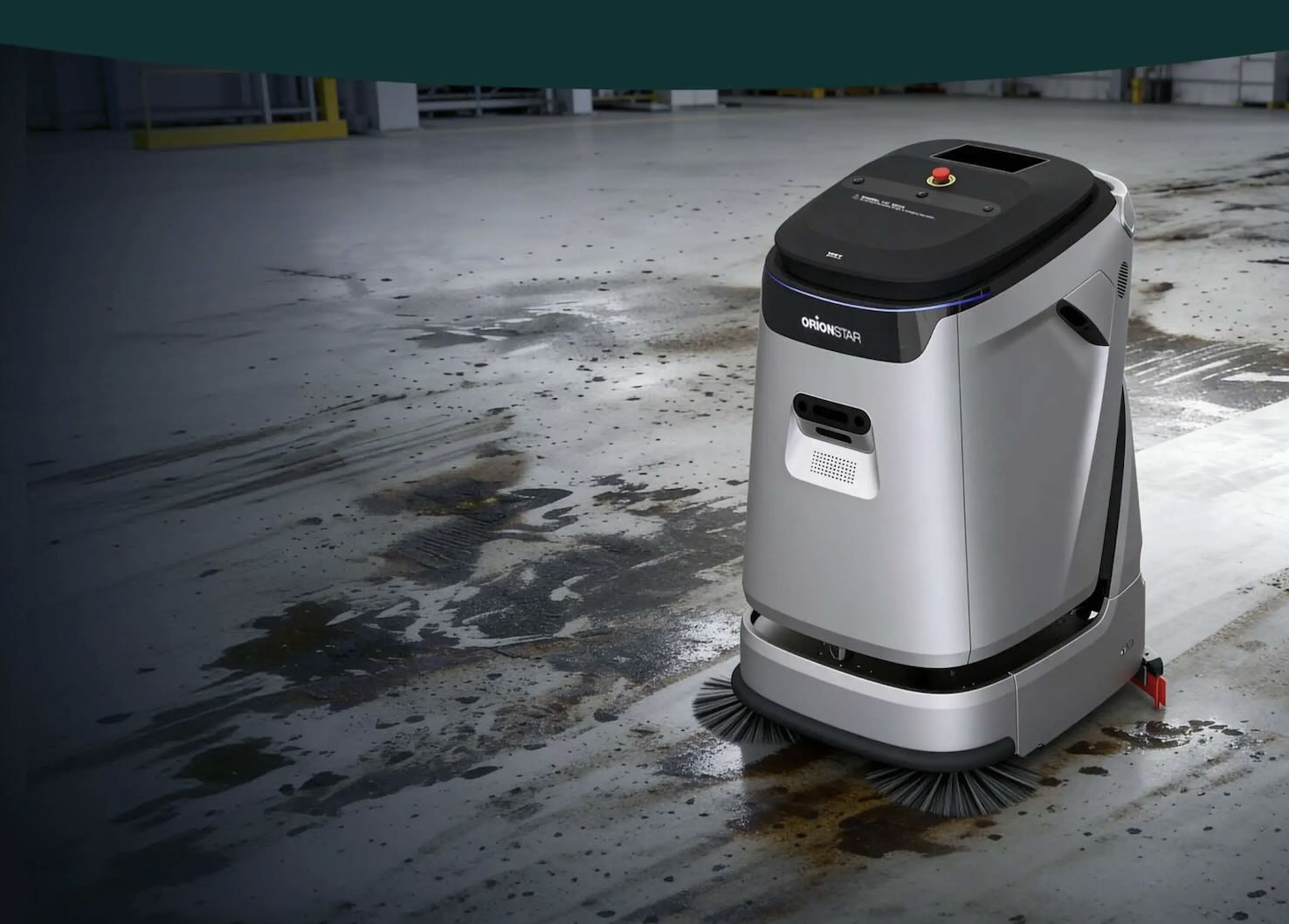
Positioned as a medium-to-large industrial autonomous scrubber, the OrionStar CleaniBot C5 addresses the core demands of heavy-duty warehouse environments burdened by grease and oil accumulation on concrete floors. The platform is designed around a hybrid wet-scrubbing and dry-sweeping architecture, enabling it to manage both stubborn liquid spills and scattered dry debris in a single continuous pass. This multi-functional approach is particularly valuable for manufacturing warehouses and logistics hubs where floor soils are highly variable and pre-sweeping massive square footage is not feasible within tight shift schedules. The inclusion of a fully autonomous docking station further supports 24/7 multi-shift operations, allowing the machine to manage its own clean-water refilling, wastewater discharge, and internal tank rinsing with minimal human intervention.
The scrubbing performance relies on a dual-rolling-brush system capable of delivering up to 25 kg of downward pressure, which achieves an estimated dirt-cleaning rate of about 95 percent according to manufacturer data. The system utilizes a combined 90-liter water tank capacity, integrating equal parts clean and wastewater storage to sustain prolonged cleaning cycles. Operating on a 24-volt, 80-ampere-hour battery pack, the platform delivers a scrubbing runtime of up to three hours under laboratory conditions and supports a rapid charge cycle of about 1.5 hours, facilitating seamless deployment across overlapping warehouse shifts. With a minimal passing width of approximately 880 millimeters, the machine safely navigates standard doorways and narrow pallet racks while maintaining a relatively quiet sound profile. All cloud-based mapping and data processing features are configured to comply with GDPR data residency and localized processing requirements.
The Tennant X4 ROVR is deployed widely in logistics and manufacturing contexts where tighter architectural clearances dictate a more agile approach to automated floor care. Positioned specifically for mid-sized spaces, this autonomous industrial scrubber operates effectively in back-of-house micro-fulfillment zones, dock staging areas, and narrower pallet-rack aisles that restrict larger industrial equipment. The machine utilizes a high-mobility, agile storage architecture based on lithium-ion power and auto-generated routing, allowing it to weave cleaning tasks into active multi-shift operations through frequent, shorter opportunity-charging sessions rather than requiring long blocks of dedicated downtime.
Engineered for wet scrubbing, the platform features a dual-disk scrub path with a 500-millimeter cleaning width and applies up to 19 kg of main down pressure according to manufacturer data. Its fluid management relies on twin 38-liter solution and recovery tanks, combined with a velocity-controlled delivery system that synchronizes chemical consumption with actual cleaning speed to maximize coverage per cycle. The onboard lithium-ion battery supports up to 2.5 hours of continuous operation under laboratory conditions. Navigation is driven by a fusion of automotive-grade spatial sensors and visual cameras that dynamically replan routes around unexpected obstacles like dropped pallets or moving forklifts, operating within a compact 56-centimeter machine width footprint.
Coming from a highly established European cleaning equipment brand, the Nilfisk Liberty SC60 targets expansive logistics centers that demand massive floor coverage and extended operational durations. This mid-to-large autonomous scrubber is designed around a high-capacity onboard containment philosophy, prioritizing maximum fluid payload and wide-area cleaning over compact agility. It is suited for vast, largely debris-free distribution center floors where the primary goal is covering maximum square footage over a long overnight or dedicated cleaning shift, relying on its substantial physical dimensions to reduce the total number of manual refill cycles required.
The platform operates exclusively as a wet scrubber, featuring an expansive 71-centimeter cleaning width that optimizes productivity across wide pallet-rack main aisles. Fluid containment is handled by exceptionally large tanks, utilizing up to 99 liters for clean solution and 105 liters for recovery, maximizing the area covered before service is required according to manufacturer data. Powered by a heavy-duty 24-volt AGM battery configuration, the machine sustains long runtimes while maintaining a minimum turnaround aisle width of 1.88 meters under laboratory conditions. Its multi-sensor navigation system processes spatial data to navigate complex warehouse layouts efficiently, though operators must evaluate the heavy overall machine weight against specific dock-door and lift loading tolerances before final deployment.
The Kärcher KIRA CV 50 represents a dedicated dry-vacuuming architecture from the renowned German cleaning equipment maker, focusing exclusively on light-duty debris rather than heavy industrial soil removal. While it does not perform wet scrubbing or chemical dosing for oil-stained concrete floors, it serves a complementary role in hard FM services by targeting carpeted dock offices, packing stations, and mezzanine administration zones. Its deployment strategy centers around quiet, continuous operation in occupied spaces where scattered cardboard dust and packaging fragments are the primary contaminants, providing an automated sweeping solution that addresses dry particulate buildup.
Operating without fluid tanks, the machine provides a 350-millimeter working width and utilizes a 4.47-liter internal container to capture dry waste. The system runs on a 36-volt power platform with hot-swappable batteries, delivering an operating time of up to 140 minutes in standard mode according to manufacturer data. Its exceptionally low sound pressure level of 57 decibels makes it highly suitable for active environments where noise disturbances must be minimized. Navigation is facilitated by a multi-sensor array, achieving a theoretical area performance of up to 525 square meters per hour under laboratory conditions while managing slight inclines of up to six percent.
The Avidbots Neo 2, specifically in its purpose-built warehouse configuration, is engineered to confront demanding physical challenges present in large-scale third-party logistics and manufacturing facilities. The platform employs a wide-area mapping architecture coupled with heavy-duty environmental obstruction models specifically tuned to recognize common logistics hazards such as overhanging pallets and forklift tines. By focusing on dynamic layout adaptation, the system continuously updates its spatial understanding to navigate ever-changing bulk storage floors, functioning as a robust wet-scrubbing solution for concrete and epoxy surfaces subjected to severe forklift traffic and heavy industrial grime.
The system offers substantial fluid capacities, carrying up to 109 liters of solution and 135 liters of recovery water, supporting extended continuous operations. Depending on the configuration, it utilizes either disk or heavy-duty cylindrical scrubbing mechanisms, applying downward pressure levels ranging up to 45 kg on wider variants according to manufacturer data. Powered by a bank of AGM batteries, the machine operates for up to six hours under laboratory conditions, achieving maximum theoretical performance rates approaching 3,941 square meters per hour. The platform requires a wide turnaround clearance of over three meters and operates optimally in ambient temperatures above five degrees Celsius, necessitating careful evaluation for specific cold-storage applications.
Selecting the appropriate automated floor care platform for hard facilities management requires balancing machine capabilities against specific structural and operational constraints. Facilities relying on massive, uninterrupted overnight maintenance windows frequently benefit from high-capacity architectures that prioritize maximum fluid payload and extended AGM battery runtimes, reducing the total number of daily interventions. Conversely, warehouses operating on aggressive 24/7 schedules may find greater utility in agile, lithium-ion-powered systems that leverage shorter opportunity charging cycles and narrower chassis designs to navigate tight back-of-house aisles continuously.
Procurement teams must carefully assess their specific floor soil profiles to determine whether heavy-duty cylindrical scrubbing is necessary for managing scattered pallet debris and thick oil stains, or if high-coverage disc scrubbing will suffice for relatively uniform surfaces. Environmental factors, including dock plate inclines and ambient temperature extremes in cold-storage zones, must also heavily influence the final selection. By thoroughly mapping these architectural realities against the robot's navigational footprint and power replenishment needs, operators can successfully integrate these platforms into their active logistics workflows while maintaining a consistently clean and safe industrial environment.
Third-party product specifications based on public data (up to, under laboratory conditions, according to manufacturer data), may vary; product names and trademarks belong to their respective owners; if any product involves cameras, voice recording, mapping, or cloud data processing, operations must verify GDPR compliance before deployment.
Publicly cited deployments point to material labor-hour reductions: DHL has stated that floor-cleaning robots can cut cleaning labor hours by up to 80%, while Christie Lites reports that deploying an Avidbots Neo in its warehouse roughly doubled cleaning-team productivity. Peak productivity across the peer set ranges from about 1,860 m²/hr (Tennant X4 ROVR per solution tank) to 3,941 m²/hr (Avidbots Neo 2W, 32-inch cylindrical), with the OrionStar CleaniBot C5 rated at up to 1,980 m²/hr. In tight labor markets these hours are typically reinvested into dock staging, safety walks or inventory checks rather than net headcount reductions. Vendors should be asked to provide a site-specific productivity estimate based on aisle width, dock thresholds and shift pattern before contract signature.
Most vendors follow a four-stage flow: a site survey and floor-mapping visit, a short paid or conditional pilot (typically 2–4 weeks), a fleet-sizing and contract proposal, and then commissioning with operator training. Avidbots runs a customer-success-led model where factory-trained technicians build a site-specific cleaning plan, train staff and configure the Command Center fleet dashboard; Nilfisk and Tennant reach buyers through their authorised dealer networks and pair BrainOS software with on-site commissioning. Subscription-based autonomy is common — the Tennant X4 ROVR requires an active BrainOS subscription for autonomous mode — so procurement contracts should clearly separate year-one hardware from recurring software fees. Hard FM buyers should also confirm GDPR-relevant terms (data residency, controller/processor roles, retention windows) before signing, since most units stream mapping and sensor data to vendor clouds.
A credible TCO model should cover the upfront unit price, installation and site-survey fees, the autonomy-software subscription (BrainOS, Avidbots Command Center, KIRA Robots, etc.) and any dedicated charging or docking-station infrastructure. Operating costs include water, detergent, electricity for charging and periodic battery replacement; the CleaniBot C5 uses a 24V/80Ah pack with around 1.5 hours of fast charging, while AGM-based peers like Avidbots Neo 2 and Nilfisk SC60 often rely on hot-swap battery rotation. Maintenance budgets should cover brushes, squeegees, tanks, sensors and any annual service contract; published indicators such as the CleaniBot C5's 10,000+ hour fan rating are useful proxies for component life expectancy. The labor-side offset should be modelled with a realistic m²/hr figure for the specific floor type and aisle layout, since published peak rates (for example, Neo 2W at 3,941 m²/hr or CleaniBot C5 at 1,980 m²/hr) are best-case and rarely sustained across a full shift.
The peer set uses a combination of 2-D or 3-D LiDAR, RGB cameras and bumpers to detect and re-route around moving and stationary obstacles. Avidbots Neo 2W is the only model with obstacle detection tuned specifically for pallets and forklift tines, and DSV has publicly confirmed the robot operated safely "with 25 forklifts operating continuously, along with people traffic." Most units also carry emergency-stop buttons, blue-light path projection, turn indicators and amber strobes to warn warehouse staff. Minimum turn-around aisle width remains a real constraint: Neo 2W needs 3.05 m, while Nilfisk SC60 turns in 1.88 m and the OrionStar CleaniBot C5 passes through approximately 880 mm — so aisle surveys should be run before purchase. Buyers should request a live demonstration in their own facility, with their own forklift traffic, before signing.
Wet-scrubbing autonomous robots are designed for exactly this soil profile, while dry-vacuum units are not. The OrionStar CleaniBot C5 uses a dual-rolling-brush system with 25 kg of downward pressure and reports a "one-pass" dirt-cleaning rate of around 95% on heavy oil and grime. Avidbots Neo 2 offers both disc and cylindrical heads — cylindrical is recommended for rougher debris common in warehouses — with up to 45 kg of down pressure on the 32-inch variant. Epoxy, concrete and resin-coated industrial floors are within the published capability of these units, provided floor joints and cracks stay within the robot's stated climbing tolerance (CleaniBot C5: 15 mm obstacles, 5° loaded / 8° unloaded slopes). Dry-vacuum-only models such as the Kärcher KIRA CV 50 Bp do not perform wet scrubbing at all and should not be specified for oil-stained dock areas.
Cold-storage deployment requires specialized evaluation across most automated platforms, as standard operating temperatures (often 5–35 °C) necessitate careful planning for frozen-goods warehouses. Operating-temperature ranges for Nilfisk SC60, Tennant X4 ROVR and Kärcher KIRA CV 50 are not publicly specified, so buyers should confirm cold-storage suitability with each vendor before purchase. For 24/7 multi-shift operations the key metrics are battery run-time, fast-charge behaviour and tank capacity: CleaniBot C5 delivers around 3 hours of scrubbing per charge with about 1.5 hours of fast charging, Avidbots Neo 2 quotes 4–6 hours with swappable AGM batteries, and Tennant X4 ROVR supports opportunity charging with up to 2.5 hours per charge. Warehouses running three shifts should also plan docking-station locations for autonomous refill, waste-water discharge and self-cleaning cycles between shifts.