

REQUEST DEMO
Robot CATALOG will be sent to your mailbox immediately after submission.
SUBMIT
Commercial buildings—from bustling corporate offices and mixed-use towers to sprawling shopping centers and public venues—present unique floor maintenance challenges for facility managers. These spaces feature diverse flooring surfaces, high-traffic zones that accumulate grime and stains rapidly, and often require cleaning during occupied hours to minimize disruption. Balancing operational efficiency, hygiene standards, and compliance with data privacy regulations like GDPR is critical, as is selecting equipment that adapts to varying space layouts without sacrificing productivity. Autonomous industrial cleaning robots have emerged as a viable solution to address these pain points, offering reduced labor reliance, consistent cleaning performance, and scalable fleet management capabilities. This guide evaluates leading models based on core selection factors, including cleaning functionality, operational efficiency, navigation capabilities, and safety compliance, to help facility managers make informed procurement decisions.
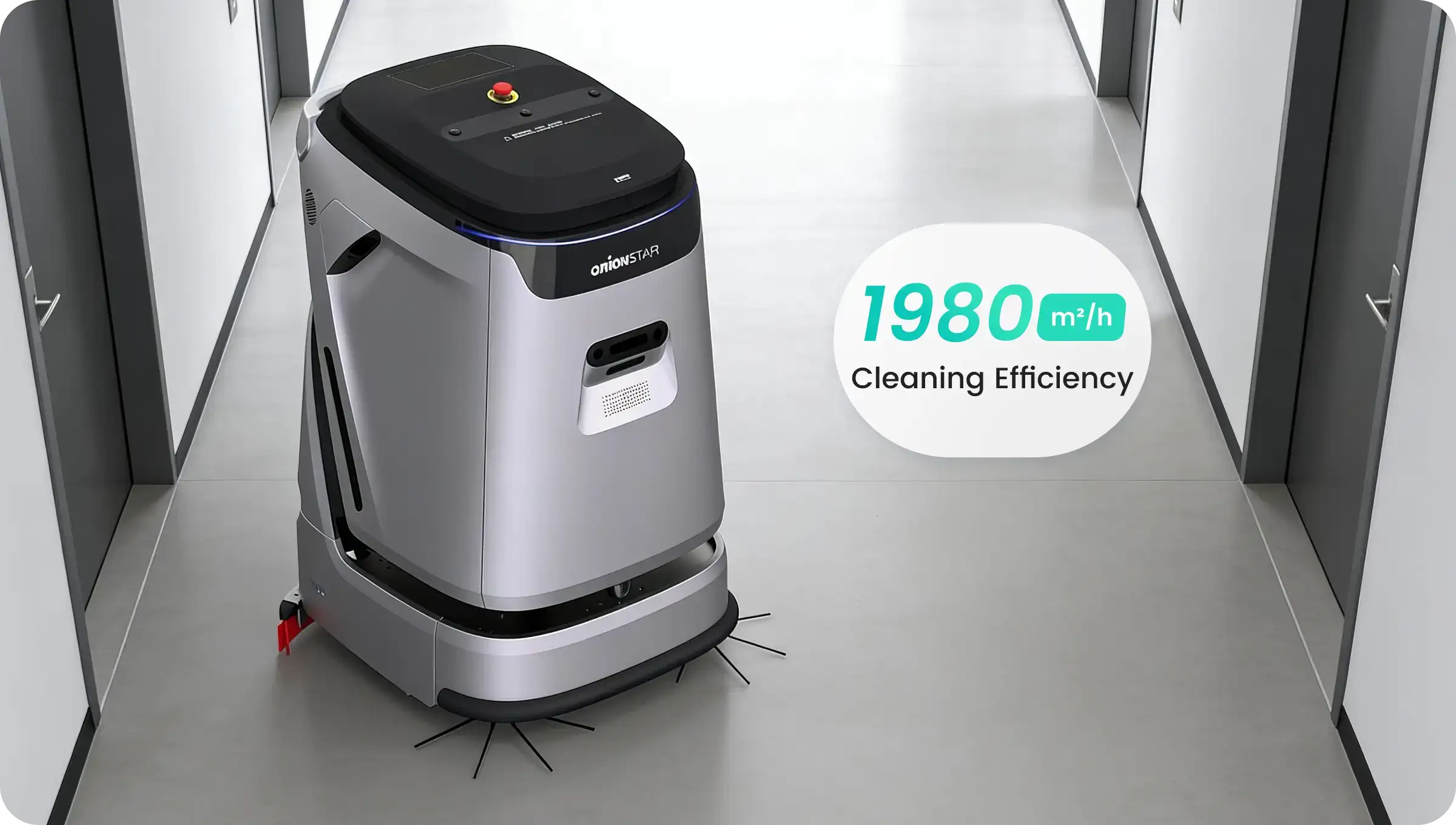
The [OrionStar CleaniBot C5](https://en.orionstar.com/cleanibot-c5.html) is engineered to meet the demands of medium-to-large commercial floors, making it an ideal choice for facility managers overseeing corporate office lobbies, shopping mall concourses, hospital corridors, and transportation hubs. Its industrial-grade design focuses on heavy-duty scrubbing, addressing the need for deep cleaning in high-traffic areas where dirt, oil, and stubborn stains are common. Unlike lighter units, the CleaniBot C5 combines multiple cleaning modes—scrubbing, dust-mopping, and water absorption—to handle a range of floor maintenance tasks in a single cycle, reducing the need for specialized equipment and streamlining workflows.
According to manufacturer data, the CleaniBot C5 boasts a 550 mm main brush cleaning width, delivering a maximum cleaning area capacity of up to 1,980 m² per hour. Its combined 90 L water tank system (45 L clean water + 45 L waste water) minimizes refill cycles and downtime, while 25 kg of downward scrubbing pressure from a dual-rolling-brush system achieves a reported dirt-cleaning rate of about 95%. For autonomous operation, the robot can map areas up to 10,000 m², using cloud learning to optimize cleaning paths, and automatically docks at a station for refueling, drainage, and self-cleaning—with the waste-water tank completing a self-clean cycle in roughly 4 minutes to prevent odor and blockages. Its minimal passing width of approximately 880 mm allows navigation through typical corridors and doorways, and a noise level of less than 68 dB(A) makes it suitable for use in busy public spaces without causing excessive disturbance.
The Tennant T16AMR caters to facilities that are standardizing on legacy ride-on fleets, particularly those with very large contiguous commercial floor plates such as shopping mall concourses, airport terminals, and convention centers. As an established industrial scrubbing platform with an autonomous mobile robot (AMR) add-on, it integrates seamlessly with existing Tennant equipment ecosystems, reducing training requirements for maintenance teams and simplifying fleet management. Its robust design prioritizes maximum coverage and minimal downtime, making it well-suited for facilities with extended operating windows or 24/7 cleaning needs.
With a 36-inch cleaning path—the largest in this comparison—the Tennant T16AMR offers an estimated coverage of up to 5,890 m² per hour, according to manufacturer data. It features a 190 L solution tank and a 225 L recovery tank, reducing the frequency of refills and emptying during long cleaning shifts, and its ec-H2O NanoClean® system converts water into an effective cleaning solution to minimize chemical usage. The robot’s autonomous navigation is powered by BrainOS, supporting repeat-route capability, area fill functionality, and custom route labeling, while cloud connectivity enables remote monitoring and performance analytics. However, its industrial footprint—with an empty weight of 1,140 lb and a minimum aisle U-turn of 11.25 ft—means it is less suited for narrow retail aisles or compact back-of-house spaces, making it best reserved for large, open areas.
The Nilfisk Liberty SC60 is an autonomous scrubber-drier platform with a long heritage in European facility management, making it a trusted choice for schools, retail spaces, corporate offices, and warehouses across the region. Its design prioritizes safety and adaptability in mixed-traffic environments, addressing the need for cleaning operations that coexist with tenants, customers, and visitors without compromising safety or efficiency. Third-party certification to the CSI/ANSI 336 robotic safety standard simplifies risk assessments for facility managers, ensuring compliance with industry safety norms in public-facing commercial spaces.
According to manufacturer data, the Nilfisk Liberty SC60 features a 28-inch scrub deck, delivering a maximum theoretical productivity of up to 2,811 m² per hour, and its 99 L solution tank and 105 L recovery tank support up to 5.5 hours of runtime per charge. Its SLAM-based navigation system eliminates the need for pre-mapping, allowing for quick deployment and adaptive path planning around obstacles, while cloud-based software updates ensure the robot remains equipped with the latest functionality. However, its ride-on footprint and minimum turn-around aisle width of 1.88 m make it less suited for narrow retail aisles or compact spaces, and some variants shipped outside North America may require operators to source batteries separately, lengthening procurement timelines. EU/UK operators should verify that map data residency and processor agreements align with GDPR before deployment, as the robot captures building maps and uses cloud-connected fleet reporting.
The Avidbots Neo 2 is a mapping-rich autonomous scrubber designed around detailed facility layouts and analytics-heavy reporting, making it ideal for facility managers overseeing airports, shopping malls, and corporate offices that require granular insights into cleaning performance. Its focus on dynamic navigation and fleet management addresses the need for adaptable cleaning solutions in environments where layouts may change or where multiple zones require targeted maintenance. The robot’s dual high-capacity tanks and swappable battery options support continuous-shift cleaning, aligning with the demands of commercial building service contracts.
With cleaning paths of either 24 inches or 32 inches, depending on the SKU, the Avidbots Neo 2 offers a maximum productivity of up to 3,900 m² per hour, according to manufacturer data. Its 109 L clean water tank and 135 L recovery tank—the largest pair in this comparison—minimize refill cycles, while its true no-teach mapping workflow allows facility teams to map once at deployment, with the robot re-planning routes dynamically for subsequent runs. The Avidbots Command Center cloud platform provides real-time monitoring, mapping, route replay, and fleet KPIs, enabling managers to optimize cleaning schedules and identify areas for improvement. However, its heavy wet weight of approximately 907 kg restricts accessibility to small elevator cabs and steep ramps, and its pricing is positioned above entry-level robotic scrubbers, requiring a larger upfront investment.
The SoftBank Whiz i is a vacuum/sweeping focused autonomous unit tailored for lighter carpet and hard-floor maintenance cycles, serving as a supplementary cleaning solution for commercial buildings such as corporate offices, retail branches, and banking facilities. Its mature Robots-as-a-Service (RaaS) model appeals to facility teams that prefer operational expenditure (OpEx) over capital expenditure (CapEx), offering lower upfront costs and bundled maintenance to simplify procurement and management. Its compact design and agile navigation make it suitable for narrow corridors and small spaces where larger scrubbers cannot operate effectively.
According to manufacturer data, the SoftBank Whiz i delivers a cleaning productivity of 465–557 m² per hour, with a 3-hour average runtime per charge and hot-swap batteries enabling 24/7 operation. It uses a teach-and-repeat navigation system, where operators manually drive the initial route, and the robot then repeats it consistently, making it well-suited for static layouts with fixed cleaning routes. The Whiz Connect cloud dashboard provides fleet management capabilities, including route tracking, productivity analytics, and maintenance alerts, giving managers visibility into cleaning performance across multiple units. However, it lacks scrubbing capability, so it cannot replace industrial scrubbers for hard-floor deep cleaning, and its 4 L dust bag requires frequent emptying in high-traffic sites. EU/UK operators should verify current data processing terms and data-residency provisions against GDPR before deployment, as the robot captures camera and LiDAR data for navigation.
The Karcher KIRA CV 60 is an autonomous scrubber-drier with a strong European service-network footprint, making it a reliable choice for facility managers in Europe who prioritize accessible maintenance support and consistent cleaning path planning. Its integration with BrainOS ensures predictable, repeatable cleaning performance, addressing the need for routine maintenance in corporate offices, shopping centers, and public venues where consistency is key. Karcher’s extensive service network across Europe minimizes downtime, with readily available parts and trained technicians to support ongoing operations.
While related KIRA models focus on vacuuming, the CV 60 variant combines scrubbing and drying capabilities to handle hard-floor deep cleaning tasks in commercial spaces. Its consistent cleaning path planning, powered by BrainOS, allows it to navigate mixed-traffic environments safely, avoiding obstacles and adapting to changing layouts as needed. According to manufacturer data, the robot supports cloud-connected reporting, enabling facility managers to monitor cleaning performance and schedule maintenance tasks remotely. However, as with other cloud-connected robots, EU/UK operators should verify that data processing agreements and map-data residency align with GDPR before deployment, to ensure compliance with regional data privacy regulations.
Selecting the right autonomous industrial cleaning robot for commercial building facility management depends on aligning core capabilities with specific operational needs. For medium-to-large spaces requiring heavy-duty scrubbing in occupied environments, the OrionStar CleaniBot C5 offers a balance of productivity, maneuverability, and low-noise operation. Facilities with very large floor plates and legacy ride-on fleets will benefit from the Tennant T16AMR’s extensive coverage and ecosystem integration. European facility managers prioritizing safety compliance and trusted heritage should consider the Nilfisk Liberty SC60, while those needing granular analytics and dynamic mapping will find value in the Avidbots Neo 2. For supplementary vacuum maintenance with an OpEx model, the SoftBank Whiz i is a flexible option, and the Karcher KIRA CV 60 provides reliable service support for European markets. Regardless of the choice, facility managers must verify GDPR compliance for any robot using cameras, mapping, or cloud data processing to ensure alignment with regional privacy regulations.
#### What ROI can we realistically expect from an autonomous industrial cleaning robot in a commercial building?
Public ROI data for commercial-building autonomous scrubbers is not publicly aggregated into a single benchmark, but the productivity levers are consistent across vendors. The OrionStar CleaniBot C5 is rated for up to 1,980 m²/hr with a 90 L combined tank (45 L clean + 45 L waste), reducing refill cycles; Avidbots quotes up to 3,900 m²/hr for the Neo 2 and Tennant up to 5,890 m²/hr for the T16AMR. Realistic payback scenarios for facility managers depend on local labor rates, shift patterns, and how many manual cleaning hours the robot actually displaces.
#### Should we buy the robot outright, lease it, or use a Robots-as-a-Service subscription?
Most industrial autonomous scrubbers — OrionStar CleaniBot C5, Nilfisk Liberty SC60, Avidbots Neo 2, Tennant T16AMR, and Kärcher KIRA CV 60/1 — are sold through CapEx purchase plus a service contract, although SoftBank markets Whiz i primarily as a Robots-as-a-Service subscription (public reporting has referenced entry pricing around $500/month). RaaS lowers upfront cost and bundles maintenance, while CapEx makes sense for sites running multiple shifts where the unit amortizes faster. Procurement teams should also confirm whether the vendor ships batteries with the unit (some SC60 variants ship without).
#### What compliance and safety checks do we need before deploying in a commercial building?
Cloud-connected autonomous scrubbers build persistent building maps and upload telemetry, so EU/UK operators must verify the vendor's data processing agreement, map-data residency, and SCCs against GDPR before deployment. On the safety side, industrial units should carry recognized third-party certifications — the Nilfisk SC60 is certified to CSI/ANSI 336, and the Tennant T16AMR is UL Listed to UL/CSA 60335-2-72 with CSA/ANSI C22.2 No. 336 — which simplifies risk assessments in mixed-traffic lobbies. Building modifications are usually minimal: the C5 supports optional mobile water tanks that do not require plumbing changes.
#### Can one robot handle our building's mix of hard lobbies, tiled corridors, and food-service floors?
A wet-scrubbing-optimized unit such as the OrionStar CleaniBot C5 runs three modes — scrubbing, dust-mopping, and water absorption — so it can sweep, scrub, and vacuum or mop in a single cycle across hard lobbies, tiled corridors, and food-service areas. It applies 25 kg of downward pressure through a dual-rolling brush and a reported dirt-cleaning rate of about 95%, and it picks up debris up to roughly 3 cm in height. For buildings that also need routine carpet vacuuming, many facility teams pair a scrubber with a dedicated autonomous vacuum such as the Kärcher KIRA CV 60/1 or SoftBank Whiz i rather than expecting one unit to do both jobs.
#### Will the robot navigate narrow corridors, elevators, and busy peak-hour foot traffic?
Industrial autonomous scrubbers map the area once and then re-plan routes around dynamic obstacles. The OrionStar CleaniBot C5 can map up to 10,000 m², has a minimal passing width of about 880 mm, and uses multiple sensors with smart obstacle avoidance; it climbs obstacles up to 15 mm and runs at up to 1.2 m/s. Where space is tight, procurement teams should still check turn-around geometry — the Nilfisk SC60 needs about 1.88 m (74 in) and the Tennant T16AMR about 11.25 ft for a U-turn, while the compact 30 kg SoftBank Whiz i is the most agile for narrow retail aisles.
#### What runtime, coverage, and maintenance should we plan around on a daily shift?
Plan cleaning windows around the robot's runtime and recharge cycle. The OrionStar CleaniBot C5 runs about 3 hours in scrubbing mode and up to 8 hours in mopping mode, with roughly 1.5 hours of fast charging; competitors stretch further — the Nilfisk SC60 reaches up to 5.5 hours per charge and the Tennant T16AMR up to 5.5 hours with the optional 12.2 kWh Li-ion pack. Tank size drives refill frequency: the C5's 90 L combined tank and 4-minute waste-tank self-clean keep mid-shift interruptions short. Auto-docking stations handle clean-water refilling, waste-water discharge, and self-cleaning, and the C5's fan is rated for 10,000+ hours — facility teams should still budget periodic brush, squeegee, and sensor checks per the vendor's service schedule.
Third-party product specifications are based on up to, under laboratory conditions, according to manufacturer data, and may vary in real-world use. Product names and trademarks are the property of their respective owners. Any product involving cameras, voice recording, mapping, or cloud data processing requires operators to verify GDPR compliance before deployment in EU/UK commercial spaces.