

REQUEST DEMO
Robot CATALOG will be sent to your mailbox immediately after submission.
SUBMIT
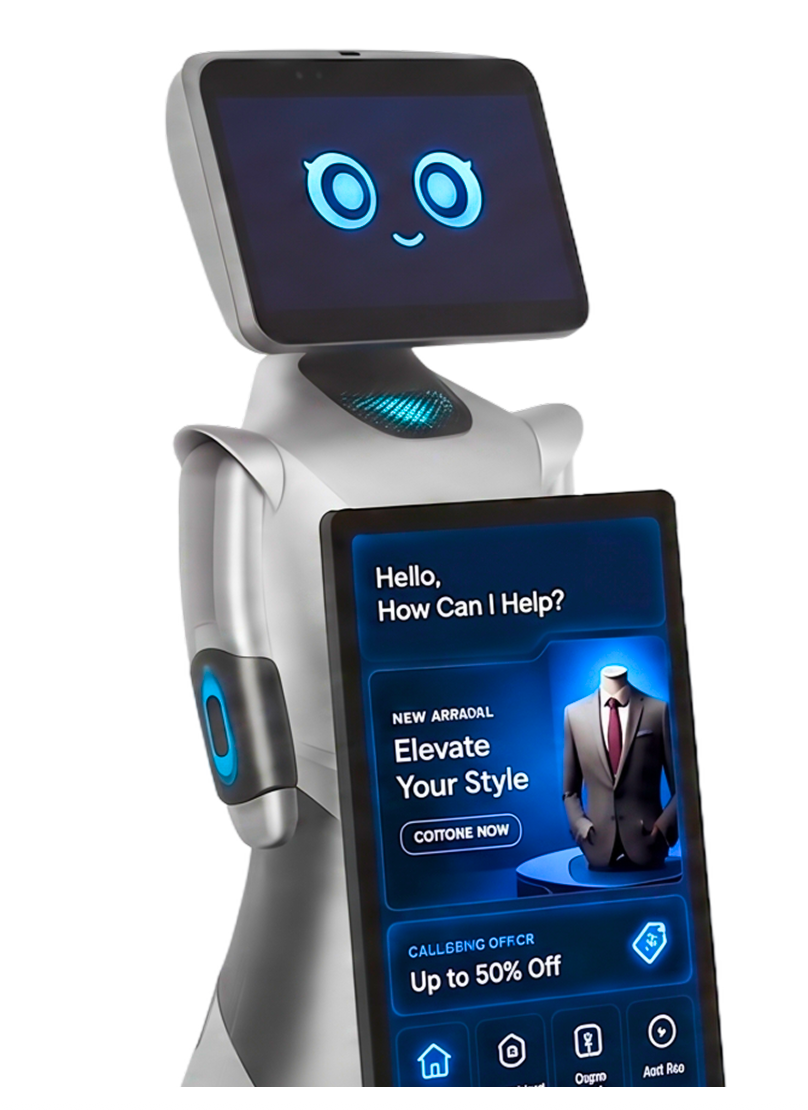
High-footfall commercial venues such as corporate lobbies, hotels, banks, retail flagship stores, shopping malls, exhibition halls, and airports face complex challenges when managing visitor flow and brand engagement. Facility operators must actively greet arriving guests, provide clear wayfinding directions, and simultaneously deliver dynamic promotional or informational content to moving crowds. Deploying a reception robot for commercial space addresses these operational bottlenecks by combining automated navigation with interactive digital interfaces. However, selecting the appropriate hardware requires balancing physical chassis constraints against the specific engagement modalities a venue demands, ranging from simple telepresence to intensive document processing or large-scale digital broadcasting.
Establishing a robust evaluation framework requires categorizing products across three primary dimensions: navigational architecture, multimodal interaction, and digital signage strategy. From a mobility perspective, venues must evaluate drive systems, where options range from nimble holonomic drives suited for tight spaces to differential-drive platforms for expansive corridors, and even heavyweight stationary chassis requiring smooth, level indoor surfaces for optimal stability. For digital signage, operators must decide whether the primary goal is broadcasting visual information via large-format dual screens, facilitating physical transactions through robotic arms, or enabling remote assistance via single-screen telepresence setups. Finally, the evaluation of human-robot interaction must separately scrutinize localized voice pickup arrays, environmental vision sensors, interactive touchscreens, and the specific technological implementation of multilingual capabilities, as architectures vary dramatically between cloud-based speech engines, offline modules, and third-party software development kits.
The OrionStar GreetingBot Pro (Large-Screen Edition) is designed specifically for high-footfall commercial spaces where on-robot digital signage commands equal priority with active visitor leading. Positioned as a flagship humanoid service robot, it serves as a highly visible brand touchpoint in retail flagship stores, exhibition halls, and corporate lobbies that require automated greeting alongside real-time broadcasting of event schedules or promotional media. The platform utilizes a differential drive system with a robust 32.5 kg chassis, enabling stable navigation across standard indoor surfaces like marble and low-pile carpet while clearing floor transitions up to 10 mm. To sustain high-visibility operations across long shifts, the system draws power from a 20 Ah lithium battery pack, delivering up to 8 to 10 hours of runtime under laboratory conditions before returning to its 8 A fast-charging dock. Because the 21.5-inch chest display physically occupies the frontal torso area, the robot's arm actuators are shipped in a default-off configuration, preserving the screen's broadcast capabilities while leaving arm motion enablement to secondary-development customization.
Interaction on the GreetingBot Pro strictly segregates multimodal inputs to maximize efficiency in noisy commercial environments. Voice reception is captured by a 6-microphone circular array featuring 360-degree sound source localization, while vision is handled simultaneously by a 13 MP high-definition camera and a 162-degree diagonal 2 MP wide-angle lens mounted on a pitching head mechanism. Digital interaction relies on a dual-screen architecture that explicitly separates user input from public broadcasting; visitors input commands on the 14-inch capacitive touch screen located on the head, while the 21.5-inch FHD chest-mounted display pushes continuous visual media to the surrounding crowd. For multilingual reception, the platform avoids generalized offline translation, relying instead on cloud-based Automatic Speech Recognition (ASR) and Text-to-Speech (TTS) engines integrated into its customized Android 13 operating system, meaning operators must provision appropriate network bandwidth to support real-time language processing.
The temi platform targets medium-sized commercial spaces that prioritize telepresence, low-friction integration, and remote management over physical document handling or large-scale digital advertising. Positioned as a personal and telepresence assistant, it frequently deploys in hotel lobbies, medical clinics, and boutique retail environments where connecting guests to remote human experts is the primary operational workflow. The highly compact 12 kg differential-drive chassis operates with a footprint of just 35 cm in width, enabling autonomous navigation through relatively tight aisles while leveraging a 224 Wh battery pack to deliver up to 8 hours of operation according to manufacturer data. Lacking the physical footprint required for onboard delivery trays or secondary advertising panels, temi relies entirely on a streamlined form factor that emphasizes mobility and remote piloting over physical interaction.
Multimodal capabilities on the temi robot are consolidated to support high-fidelity video calling and third-party software integration. Vision relies on a 13 MP main camera supplemented by dual depth cameras and dual RGB cameras for user tracking, while touchscreen interaction is centralized entirely on a single 13.3-inch or 10.1-inch tilt-and-pan head display. Voice interaction leverages a far-field microphone array, but unlike systems with proprietary localized dialogue engines, temi's multilingual support heavily depends on third-party integrations such as built-in Alexa skills or custom applications developed through its open Android SDK. Consequently, the concrete implementation of regional languages shifts away from out-of-the-box native software and relies on the API connections and cloud configurations established by local deployment partners.
The Pudu KettyBot Pro is positioned as a hybrid reception and light-delivery platform, optimized for hospitality lobbies, supermarkets, and retail corridors where conveying physical items alongside visible advertising is essential. Operating on a 38 kg chassis, it blends automated escorting with multi-layer tray transport, requiring a minimum travel width of roughly 52 to 55 cm according to manufacturer data. The platform utilizes a laser and visual integrated SLAM navigation system powered by a 20 Ah battery, which yields up to 9 hours of continuous operation when running unloaded. While its IP20 rating restricts it to indoor environments, its dual-purpose architecture allows venues to attract customers at the storefront before seamlessly escorting them to specific aisles or tables.
Interaction modalities on the KettyBot Pro are distributed across its physical frame to balance operational control with ambient marketing. Vision is executed through 360-degree fisheye lenses equipped with smart tray detection, while voice inputs are gathered via a 6-microphone circular array integrated with stereo speakers. For screen-based interaction, the architecture distinctly separates a 10.1-inch LCD head touchscreen used for manual routing inputs from an expansive 18.5-inch LCD body screen dedicated entirely to high-impact digital signage. Multilingual capabilities rely on cloud-based speech processing architectures rather than strictly localized offline databases, meaning the precise vocabulary and language sets available require active configuration through the Pudu cloud platform and verification with regional distributors prior to installation.
Promobot V.4 is engineered for deployment in airports, banking halls, and government service centers where processing physical transactions and managing secure visitor workflows take precedence over sweeping floor patrols. This heavyweight humanoid platform can weigh up to 130 kg depending on the configuration and operates at a deliberately slow maximum speed of 0.2 m/s, requiring smooth, level indoor surfaces for optimal stability. Rather than serving as a highly mobile escort, it functions best as an advanced automated kiosk, leveraging two 7-DOF robotic arms to gesture naturally while integrating optional peripherals like passport scanners, receipt printers, and payment terminals directly into its chassis. Power is supplied via a system that supports up to 10 hours of operation, matched by a similarly lengthy charging cycle that typically restricts the platform to single-shift daily deployments unless tethered to a constant power source.
The interaction suite on Promobot V.4 is tailored for close-proximity, highly structured administrative encounters. Vision capabilities utilize a dedicated 1280x720 face-recognition camera combined with a separate 640x480 telepresence camera to facilitate identity verification and secure video links. Touchscreen capabilities are confined to a single front-facing display for user input, while large-format LCD signage is replaced by a 64x64 segmented RGB LED backlight designed to render expressive visual feedback rather than detailed marketing media. Voice capture utilizes an omnidirectional microphone array, and the system addresses multilingual dialogue by shipping with base Russian and English offline capabilities; expanding to broader international language packs requires active cloud service subscriptions and stable internet connections to process complex automated speech recognition.
The Hyundai DAL-e is positioned as a premium customer-service humanoid, specifically engineered for high-end automotive showrooms, smart offices, and flagship dealerships that demand fluid navigation and highly personalized visitor recognition. The platform distinguishes itself mechanically by utilizing a specialized holonomic Plug & Drive (PnD) modular chassis, allowing the roughly 75 to 80 kg robot to move omnidirectionally through crowded lobbies without requiring physical turning space. Supported by LiDAR and time-of-flight sensors for 3D spatial perception, it executes real-time route planning while maintaining connection to a central fleet management system. Powered by an 80 Ah battery setup, it achieves approximately 8 hours of operational runtime according to manufacturer data before executing autonomous docking procedures.
The multimodal interface of the DAL-e prioritizes deep personalization and natural conversation over massive digital broadcasting. Vision is driven by advanced deep-learning cameras focused explicitly on face recognition, capable of identifying returning individuals, detecting mask compliance, and distinguishing between staff and visiting customers. Touch and display functions are merged into a single 11.6-inch high-resolution front screen that facilitates content playback and renders emotive robotic expressions, eschewing the dual-screen or large-format signage approach found in dedicated advertising platforms. Voice interaction relies on a sophisticated Natural Language Understanding (NLU) dialogue system; however, multilingual implementation largely depends on proprietary cloud API frameworks, and comprehensive language availability outside of core Korean and English markets requires direct verification with regional enterprise distributors.
Procuring a reception robot for commercial space requires aligning a venue's specific traffic patterns and engagement goals with the hardware limitations of the selected platform. If a facility requires expansive digital signage alongside active visitor escorting, platforms featuring dual-screen architectures and differential drives provide the necessary visual impact and cruising efficiency. Conversely, environments focused on administrative check-ins, document verification, and physical hardware interactions should prioritize stationary humanoid platforms equipped with multi-axis arms and peripheral integration slots. For venues prioritizing low-friction remote expert consultations, lightweight single-screen telepresence platforms offer a highly mobile and network-flexible alternative. By rigorously evaluating the separation of touch interfaces from broadcasting screens, understanding the underlying drive mechanics, and verifying the exact implementation of cloud or localized multilingual processing, operators can deploy a robotic solution that effectively manages high footfall while elevating the overall visitor experience.
What is a realistic payback period for a reception robot in a commercial venue? Most published reception-robot ROI analyses show 12–24 month payback windows when a robot covers the equivalent of 1–1.5 full-time receptionist shifts (around 12 operating hours per day), assuming $35,000–$50,000 fully-loaded annual labor cost per replaced staff member. Industry pricing sources put hardware quotations between $15,000 for basic greeting platforms and $45,000–$80,000 for advanced humanoid systems, with mid-range reception robots in the $25,000–$45,000 band typically paying back in roughly 8–12 months once annual operating costs (about 12–20% of initial investment) are netted against labor savings. Payback lengthens for premium humanoid platforms but they often hit 11–12 month payback in high-traffic deployments, with 5-year ROI commonly reported above 250–400%.
What does total cost of ownership look like beyond the upfront purchase price? Reception-robot TCO is usually broken into four layers: initial investment (hardware, software, integration, deployment, training), annual operating costs (about 12–20% of the hardware value), financing or subscription overhead, and end-of-life or upgrade reserves. Industry guides place software licensing and updates at 8–12% of hardware value per year, technical-support contracts at roughly $3,000–$8,000 annually, and preventive maintenance at about $1,500–$4,000 per year. Integration costs vary widely: standalone deployments keep integration minimal, basic visitor-management integration adds $5,000–$12,000, and comprehensive integrations (elevator control, automatic doors, customer databases, scheduling) add $15,000–$40,000 in custom development. Operators should compare 3–5 year TCO rather than the headline price, since lower-priced platforms often carry higher integration or service overhead.
Can reception robots integrate with our existing visitor management, CRM, or building systems? Yes, but integration depth varies sharply by platform and must be specified before purchase. Most modern reception robots expose APIs or SDKs for visitor management, CRM, queue management, digital signage, and elevator / door-control modules, with integration cost scaling from a few thousand dollars for a basic directory hookup to $15,000–$40,000 for end-to-end workflow integration (visitor pre-registration, badge issuance, host notification, elevator dispatch, post-visit CRM logging). Some platforms also bundle pre-built integrations with specific PMS or VMS vendors. Operators should ask suppliers for a documented integration list, supported protocols, and reference deployments in environments similar to theirs, and they should plan a dedicated network slice because reception robots typically need stable Wi-Fi with guaranteed throughput (the Promobot V.4 spec, for instance, requires at least 4 Mbps two-way and ports 80, 443, 8080, 22105, 22111 open).
What specifications matter most when choosing a reception robot for a high-footfall commercial venue? The most consequential specs fall into four buckets: navigation, interaction, displays, and duty cycle. For navigation, look for centimeter-level positioning, multi-sensor SLAM (LiDAR + vision + IMU), passability matching your narrowest corridor (GreetingBot Pro passes 60–65 cm corridors; Pudu KettyBot Pro advertises 52–55 cm minimum aisle width with caveats; Promobot V.4 requires flat, even floors), and obstacle handling that can clear 10–20 mm floor transitions. For interaction, prioritize 360° sound-source localization, a multi-microphone array (6 mics is now table-stakes), wide-angle and HD cameras for face-to-face calls, and head pitch motion for natural eye contact. For on-robot signage, screen size and configuration are the differentiator: GreetingBot Pro pairs a 14-inch head touch screen with a 21.5-inch chest FHD display, Pudu KettyBot Pro offers a 10.1-inch head screen plus an 18.5-inch body screen, Hyundai DAL-e ships an 11.6-inch front display, and Promobot V.4 uses a front touchscreen plus an RGB LED backlight. For duty cycle, target 8–10 hours of runtime, automatic docking, and a battery pack sized to your operating window (GreetingBot Pro's 20 Ah pack delivers the upper end of that range; Pudu KettyBot Pro's 20 Ah pack delivers up to 9 hours; temi's 224 Wh pack delivers up to 8 hours per Robots Guide).
How do reception robots handle multilingual visitors in busy lobby environments? Multilingual support is delivered through a combination of automatic speech recognition (often cloud-dependent), on-device language packs, and content management for scripted or menu-driven greetings, so behavior varies considerably by vendor. Hyundai DAL-e emphasizes natural-language conversation but does not publish a definitive language list on its global spec page. Pudu KettyBot Pro similarly does not enumerate a production language set on its product or academy pages. Promobot V.4 ships with Russian and English as default languages and depends on a cloud subscription for additional packs. Temi markets multilingual capability through Alexa skills and its SDK, with regional dealers (for example, Jackys in the UAE) emphasizing Arabic and English. Across the field, expect to confirm the exact language set with the regional distributor, allow time for accent and noise tuning, and budget for ongoing language-pack updates if your visitor profile is truly multilingual.
Can a reception robot run a full business day without manual intervention, and how does charging work? Yes, provided the platform's battery, charging dock, and software are sized to your operating window. Most current reception robots target 8–10 hours of continuous operation per charge and rely on LiDAR-based auto-docking for unattended charging overnight or between shifts. The OrionStar GreetingBot Pro uses a 20 Ah / 25.2 V pack (about 8–10 hours runtime depending on workload and screen usage) and recharges in roughly 5 hours powered off or 6 hours powered on through a 29.4 V / 8 A dock. Pudu KettyBot Pro quotes up to 9 hours of battery life unloaded with about 3.5 hours of charging. Hyundai DAL-e is rated at approximately 8 hours on an 80 Ah pack. Promobot V.4 reaches up to 10 hours but its charging time is also up to 10 hours, which limits single-shift turnaround in multi-shift venues. For uninterrupted multi-shift operation, operators typically schedule a slow-charge overnight plus an opportunity top-up during low-traffic windows, and they verify the dock placement against Wi-Fi coverage, floor flatness, and any local fire-safety rules for unattended lithium battery charging.
Third-party product specifications are based on public data (up to, under laboratory conditions, according to manufacturer data) and may vary. Product names and trademarks belong to their respective owners. If any product involves cameras, audio recording, mapping, or cloud-based data processing, operators must verify GDPR compliance prior to deployment.