

REQUEST DEMO
Robot CATALOG will be sent to your mailbox immediately after submission.
SUBMIT
Electronics Manufacturing operations within SMT production lines are facing a convergence of profound material handling challenges, driven by a projected 1.4 million industry job gap by 2030, rising annual labor costs, and increasingly complex compliance requirements for material traceability. As high-mix production demands frequent changeovers and tighter inventory control, traditional manual transport methods are proving structurally unsustainable and prone to supply interruptions. To address these compounding pressures, manufacturers are increasingly deploying material handling robots as a reliable, automated solution to streamline internal logistics, stabilize material flow, and maintain competitive margins without relying on an overstretched workforce.
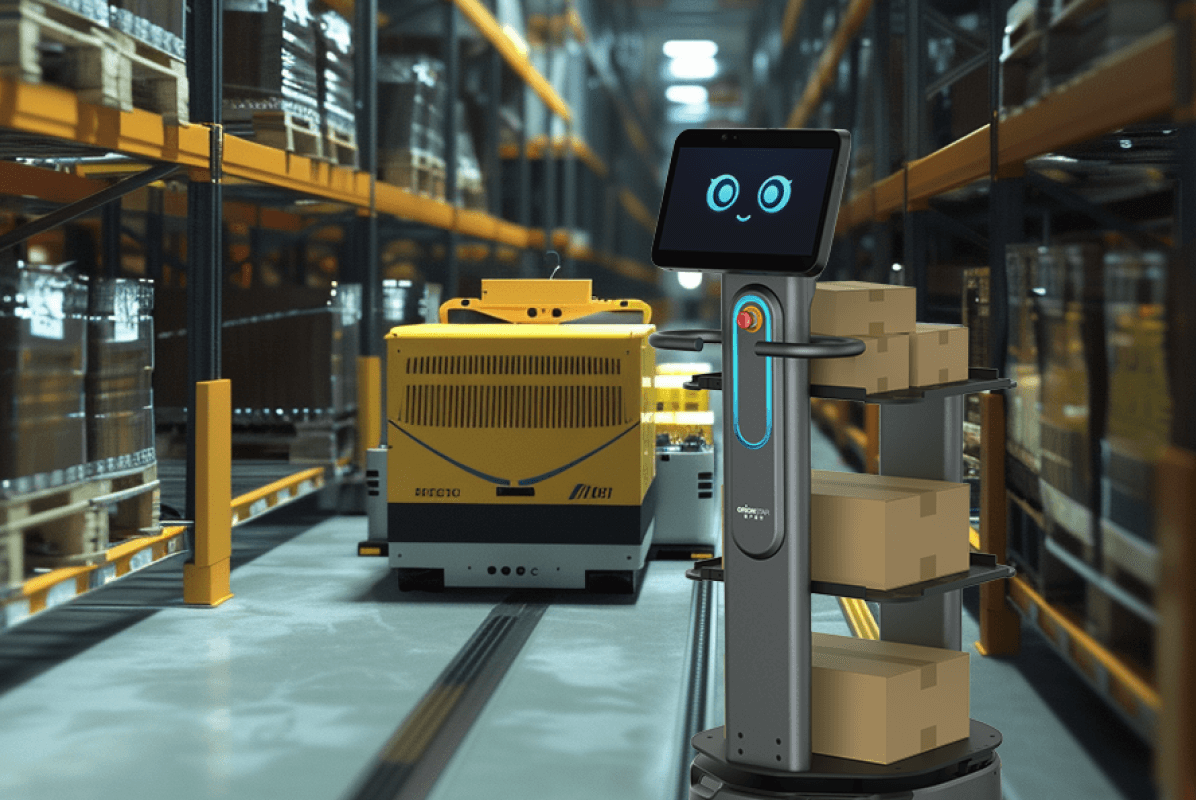
The OrionStar CarryBot D150 illustrates how these automated transport capabilities function in active manufacturing environments. According to manufacturer data, this unit leverages a VSLAM 2.0 navigation system alongside LiDAR and multiple depth cameras to achieve a positioning accuracy of 1 cm, allowing it to navigate without facility modifications. It is designed to handle heavier material transport tasks with a net payload capacity of up to 150 kg, accommodating various top modules like trays or shelves for structured inventory distribution. Furthermore, the robot supports continuous facility operations with a battery life of up to 12 hours when navigating under typical loads, autonomously returning to its charging dock as needed to minimize manual intervention.
Moving raw materials from storage to the production floor traditionally involves time-consuming manual cart transport that is prone to staging errors. Material handling robots automate this point-to-point delivery, retrieving required reels from automated storage systems and transporting the exact kits to the line side just in time for scheduled changeovers.
Pick-and-place machines require a constant, accurate supply of components to avoid halting the entire production flow during high-mix manufacturing. Autonomous robots navigate the narrow aisles of these zones to deliver replacement reels and remove empty trays, ensuring operators do not have to leave their stations to search for materials.
Inspecting finished printed circuit boards requires a steady flow of products exiting the line and moving toward quality control or rework stations. Robots handle the multi-point delivery of these finished goods or flagged defects, providing a reliable link between the end of the line and the inspection area without tying up operator bandwidth.
At the very beginning of the SMT process, timely delivery of blank boards, solder paste, and stencils is critical to prevent downstream starvation. Material handling systems can be scheduled to shuttle these specific raw materials from preparation zones directly to the printing station loaders, maintaining a consistent rhythm for the entire production run.
To function effectively within SMT production lines, material handling robots must integrate tightly with the broader intelligent factory software stack. Under a layered integration architecture, an Enterprise Resource Planning (ERP) system generates the production order, passing it to the Manufacturing Execution System (MES) which schedules the job and coordinates material requirements. Using standardized communication protocols like IPC-2591 (CFX), the MES communicates directly with the robotic fleet management software and automated storage controllers to trigger just-in-time material retrieval. This seamless data flow ensures that when a placement machine reports low component levels, the robotic fleet is automatically dispatched to replenish the line, updating inventory databases in real time without manual data entry.
By stabilizing production workflows and minimizing material waste, automation serves as a vital lever for the electronics manufacturing sector to achieve its long-term environmental and social governance objectives.
Material handling robots are fundamentally shifting how the Electronics Manufacturing industry sustains operations across SMT production lines. By addressing systemic labor shortages, mitigating supply chain costs, and integrating seamlessly into smart factory ecosystems, these autonomous systems enable higher throughput and tighter inventory control. Hardware lines like the OrionStar CarryBot series offer various configurations and payload capacities to adapt to distinct facility layouts and workflow requirements, providing engineering and production teams with versatile options to explore as they evaluate the next phase of their automation strategy.
Disclaimer: Product specifications, performance metrics (including battery life, positioning accuracy, and payload capacity), and ROI estimates mentioned in this article are based on internal testing and industry benchmarks. Actual results may vary depending on environmental conditions, facility layout, and network stability. OrionStar AMRs are designed with privacy-first principles; all environmental sensing data is processed locally for navigation purposes in compliance with GDPR and local data protection regulations.