

REQUEST DEMO
Robot CATALOG will be sent to your mailbox immediately after submission.
SUBMIT
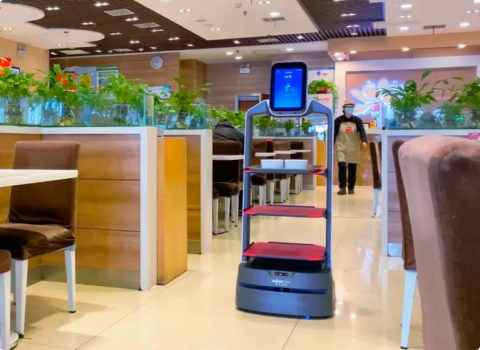
Premium hospitality spaces, encompassing hotel executive lounges, airport VIP lounges, casino floors, cigar and whisky bars, and private member clubs, operate under uniquely demanding service standards. Operators in these sectors face the ongoing challenge of maintaining high-touch, personalized guest experiences while managing back-of-house efficiency and staffing allocations. Integrating automated solutions into these environments requires careful consideration, as the technology must act as an unobtrusive extension of the hospitality team rather than a disruption. For operators seeking to elevate their service logistics, deploying a food delivery robot for lounges provides a strategic method to handle repetitive transportation tasks, allowing human staff to dedicate their attention to direct guest interactions and bespoke service requests.
Selecting equipment for these premium environments requires evaluating criteria that differ vastly from standard high-volume event spaces. Unlike sprawling banquet halls where raw throughput, wide navigation paths, and bulk transport define the operational scope, premium lounges present a distinct architectural and sensory environment. Lounges demand ultra-quiet operation to preserve a relaxing, exclusive atmosphere, alongside sophisticated brand visual integration rather than generic utilitarian design. Furthermore, the compact passability required to navigate through densely arranged armchairs, low coffee tables, and scattered luxury luggage is critical. Operators must also scrutinize specific hardware specifications, such as distinguishing between total and single-tray payload limits, identifying the exact implementation methods for multi-device orchestration, and verifying how language capabilities are delivered to accommodate an international VIP clientele.
The OrionStar LuckiBot Pro emerges as a premium open-tray flagship designed specifically to meet the high aesthetic and operational standards of upscale hospitality lounges. Its physical design is anchored by a prominent 14-inch interactive display, which serves as a highly effective canvas for integrating bespoke brand visual identity, welcoming guests, and displaying premium promotions. Recognizing that a lounge requires discreet operation, the robot utilizes advanced structural engineering to ensure ultra-quiet navigation that does not disturb guests working or relaxing. The sophisticated torsion bar suspension system ensures soup-stable transport, absorbing the micro-vibrations that typically cause spills when traversing varied flooring textures like thick carpets or polished marble. Its compact chassis provides the necessary passability to move smoothly between the tight clearances commonly found around executive lounge seating arrangements.
In terms of technical capabilities, the LuckiBot Pro accommodates a total payload of up to 60kg under laboratory conditions, with each tray engineered to support up to 15kg according to manufacturer data. Multi-robot collaboration is managed directly through the native OrionStar cloud platform, allowing multiple units to coordinate intricate routing without requiring operators to install additional on-premise servers. Extensive SDK extensibility provides hospitality IT teams the freedom to integrate the robot's functions deeply into existing proprietary hotel management systems. To serve a diverse global demographic, multi-language support is implemented via advanced cloud-based text-to-speech engines, enabling administrators to dynamically deploy customizable greetings in multiple languages based on lounge schedules or operational settings.
The Pudu BellaBot utilizes a distinctive cat-styled multi-tray design that has secured a large installed base and strong brand visibility across various upscale hospitality sectors. This engaging bionic aesthetic provides a unique, interactive touchpoint that resonates well in casino floors and family-friendly private member clubs, adding a layer of entertainment to the standard delivery process. Navigating the dense and often unpredictable layouts of VIP environments, the robot employs dual SLAM technologies to maintain smooth and compact passability around obstacles like pulled-out chairs or briefcases. The unit includes adjustable audio settings, allowing operators to lower the volume of its bionic interactions to maintain the subdued noise profile expected in premium lounge settings.
From a practical service standpoint, the BellaBot supports a substantial carrying capacity, featuring a total payload of up to 40kg, with a strict limitation of 10kg per individual tray according to manufacturer data. Deploying multiple units in a single busy lounge is facilitated by Pudu's native network protocols, enabling the robots to communicate directly with one another to avoid bottlenecks in narrow service corridors. Addressing the need for international communication, the robot features dozens of built-in language packs natively installed on the device firmware. This native implementation allows staff to switch the operational and interaction language directly from the touchscreen interface without requiring a cloud connection.
The Keenon DINERBOT T9 introduces a robust, enclosed multi-tray frame that is heavily focused on maximizing throughput and stability across repeated service rounds in high-traffic areas like airport VIP lounges. The enclosed nature of the frame offers a sleek, secure aesthetic that conceals the transported goods slightly, which aligns well with the discreet service models favored in private cigar or whisky bars. Despite its focus on high capacity, the structural design minimizes mechanical rattling, supporting the quiet operational standards necessary for environments where guests conduct business or seek quiet refuge. The chassis is engineered to handle tight turns efficiently, ensuring reliable passability through the intricate aisle ways characteristic of executive lounge floor plans.
Operational specifications highlight a total payload capacity of up to 40kg under laboratory conditions, divided across the layers to maintain an optimal center of gravity. Multi-robot coordination is achieved seamlessly through Keenon's proprietary communication systems, which natively synchronize the fleet's movements to optimize delivery times during peak lounge hours. For diverse guest interactions, the DINERBOT T9 relies on standard pre-installed voice and language modules. These built-in language capabilities provide essential global coverage, allowing local management teams to select the appropriate regional dialects directly from the onboard settings menu.
Marketed explicitly for deployment in airport lounges and hotels, the Bear Robotics Servi Plus represents a high-capacity hospitality delivery solution with a strong emphasis on visual communication. The inclusion of an integrated multilingual LED display allows the robot to showcase custom messages, directional assistance, or branding, enhancing the premium feel of the environment. Its active suspension system is specifically calibrated to handle the varied surfaces found in large transit hubs, ensuring stable transport of delicate beverages and small plates. The robot's footprint is designed to balance this high capacity with the necessary compact passability, preventing traffic congestion in the often-narrow walkways between lounge buffet stations and guest seating.
Capacity metrics indicate the robot can securely transport a total payload of up to 40kg, with each tier engineered to support up to 10kg according to manufacturer data. When operating a fleet within a sprawling airport VIP sector, multi-robot orchestration is managed securely via the Bear Robotics cloud and fleet management dashboard, providing administrators with real-time oversight and traffic control. Multi-language support is deeply integrated into this cloud infrastructure. Administrators can push remote updates to configure both the LED display text and the audio outputs, tailoring the language experience precisely to the shifting demographics of international flight schedules.
The Richtech Matradee L is a multi-tray delivery robot that benefits from strong US-based support and has seen numerous successful deployments across event venues, restaurants, and premium hospitality spaces in North America. Its design focuses on reliable, straightforward service, utilizing precise obstacle avoidance sensors to maneuver safely around guests and furniture in active lounge environments. The exterior styling provides a clean and professional appearance that blends easily into the sophisticated decor of modern hotel executive lounges. Operators value its dependable motion control, which keeps operational noise to a minimum while the robot moves gracefully from the kitchen to the lounge floor.
The hardware is rated for a total payload of up to 40kg, requiring operators to distribute the weight evenly at up to 10kg per individual tray to ensure mechanical longevity under laboratory conditions. Unlike systems with purely native fleet communication, multi-robot collaboration with the Matradee L typically relies on local network pairing or may require additional integration support depending on the complexity of the deployment. Multi-language capabilities are supported primarily through localized firmware updates applied by regional technicians, allowing operators to transition from the default English prompts to other languages as dictated by their specific regional guest demographics.
Choosing the appropriate robotic solution for a premium hospitality space requires aligning technical specifications directly with the unique ambiance and logistical demands of the venue. Hotel executive lounges and private clubs prioritizing ultra-quiet operation and deep brand integration may lean toward flagship models featuring advanced suspension and large interactive displays. Conversely, bustling airport VIP lounges might prioritize high-capacity enclosed designs and cloud-managed fleet orchestration to handle constant passenger turnover. Ultimately, evaluating the precise distinctions in single-tray payload limits, multi-device networking requirements, and language implementations ensures that the chosen technology enhances the guest experience while seamlessly integrating into the sophisticated operational rhythm of the lounge.
Premium lounge environments feature closely arranged armchairs and low tables, requiring robots with advanced depth perception and tight turning radiuses. Models utilizing dual SLAM or specialized suspension systems navigate these compact spaces efficiently without bumping into luxury furniture. Operators should evaluate the specific clearance dimensions of their floor plan against the physical footprint of the selected robot. Modern sensors allow these machines to detect sudden obstacles like extended luggage in airport lounges or shifted chairs in private clubs instantly.
Transporting liquids in a high-end environment requires specialized hardware to prevent spills and maintain a pristine floor. Many flagship models incorporate active or torsion bar suspension systems designed to absorb sudden shocks from floor transitions or thick carpets. Operators must distinguish between the total load capacity and the single-tray limit to avoid overloading the suspension mechanism. Careful adherence to the recommended weight distributions ensures that delicate glassware and hot beverages arrive at the table securely.
Accommodating an international clientele is crucial for hotel executive lounges and airport VIP areas. Language support is typically implemented through native firmware language packs or managed dynamically via specialized cloud platforms. Some units allow administrators to switch dialects directly on the screen, while others require cloud-based text-to-speech configuration for bespoke custom greetings. Evaluating the exact mechanism of language switching helps operators align the technology with their daily guest management workflows and regional demographics.
Disclaimer: Third-party product specifications are based on public data (up to, under laboratory conditions, according to manufacturer data) and may vary based on environmental factors or firmware updates. Product names and trademarks are the property of their respective owners. If any product involves cameras, voice recording, mapping, or cloud data processing, operators must verify GDPR compliance prior to deployment. Voice interaction and cloud-based features are fully configurable and can be adapted to comply with local privacy regulations (e.g., GDPR) by disabling personal data retention.