

REQUEST DEMO
Robot CATALOG will be sent to your mailbox immediately after submission.
SUBMIT
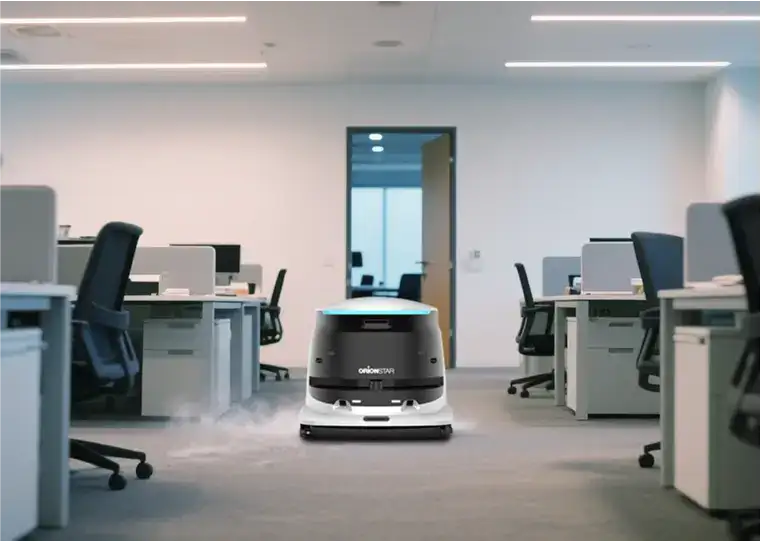
Corporate buildings and modern business environments require regular, high-quality floor maintenance that does not interrupt daily operations. Facility managers face unique operational challenges when deploying cleaning automation across diverse layouts that include multi-tenant office floors, reception lobbies, open-plan workspaces, corridors, conference floors, pantries, and break rooms. A major logistical hurdle involves managing mixed-surface floor plates, where a single level might feature hard marble near the elevators, polished concrete in the pantries, and low-pile carpet tiles throughout the desk areas and meeting rooms.
Alongside surface versatility, the coexistence of robotic equipment with white-collar workers and visiting clients dictates stringent operational boundaries. A successful automation deployment requires careful balancing of navigation technology to handle dynamic, populated spaces and strict acoustic management to ensure cleaning routines can proceed during standard working hours. Procuring the right equipment means evaluating how well a machine integrates into existing facility infrastructure while navigating the narrow aisles and shifting furniture layouts typical of active coworking spaces and serviced offices.
Office environments typically feature a mix of hard flooring in reception areas or corridors and soft flooring in open-plan desk zones, requiring specific decisions on floor surface versatility. Dedicated hard-floor scrubbing architectures focus entirely on delivering constant-flow liquid solution and squeegee recovery, maximizing wet-cleaning performance for heavily trafficked lobbies while leaving carpets to separate vacuum fleets. Alternatively, integrated multi-surface architectures incorporate distinct cleaning mechanisms into a single chassis, allowing operators to transition smoothly from washing hard floors to vacuuming low-pile carpets using either physical tool swaps or software-driven zone commands. Most of the dominant commercial models evaluated here are not restricted to dry-vacuum-only operations; they typically incorporate wet solution dispensing for active scrubbing.
Spatial adaptability directly influences how effectively a machine handles narrow corridors, glass-partitioned conference rooms, and shifting open-plan environments. Teach-and-repeat cobot architectures rely on a physical setup where an operator manually pushes the machine to memorize a specific static route, which suits smaller, predictable layouts like single-floor clinics. Conversely, dynamic multi-sensor SLAM architectures utilize onboard LiDAR, vision cameras, and collision sensors to build real-time maps and autonomously navigate around unexpected obstacles such as visiting clients or rearranged lobby seating. Heavy-duty industrial SLAM architectures scale up these sensor suites to maximize straight-line throughput, though their wide turnaround radii often relegate them to massive corporate atria rather than standard multi-tenant floor grids.
Maintaining cleanliness during working hours requires a deliberate approach to daytime operational discretion and noise management. Low-decibel acoustic profiles prioritize quiet operation by utilizing targeted energy-efficient modes or insulated motor designs, allowing the unit to clean near active cubicles and reception desks during daytime shifts without interrupting phone calls or meetings. In contrast, high-extraction acoustic profiles prioritize maximum down pressure and vacuum suction over noise reduction, producing decibel levels that are typically unacceptable for daytime occupancy and requiring strict scheduling for after-hours or empty-building weekend shifts.
The daily cadence of charging, refilling, and fleet maintenance determines the autonomy infrastructure required from the facility team. Fully self-sufficient workstation architectures connect directly to building plumbing for automated water exchanges, enabling unassisted daytime operations across large buildings when paired with elevator integration. Base-station auto-recharge architectures automate battery management via a standard dock while relying on daily manual intervention for fluid handling, fitting easily into standard janitorial routines. Finally, manual-intervention architectures forgo automatic docking entirely, requiring staff to physically plug the unit into a standard wall outlet, which serves well for compact offices utilizing targeted, on-demand cleaning sprints.
The OrionStar CleaniBot S55 Pro is engineered for multi-mode wet-and-dry floor care, positioned specifically for large commercial spaces that require office-wide deployment and daytime-rated acoustic discretion. Its integrated cleaning system transitions across scrubbing, sweeping, vacuuming, and dust mopping workflows, allowing facility managers to deploy a single robotic platform across hard-floor reception lobbies and low-pile carpeted conference floors. Through its Wi-Fi and 4G connectivity, the machine supports remote deployment and cloud-based data reporting, integrating smoothly into the digital management operations of multi-tenant buildings and expansive business parks.
Equipped with a multi-sensor SLAM system that includes LiDAR, stereo cameras, and ultrasonic sensors, the CleaniBot S55 Pro constructs maps up to 10,000 square meters according to manufacturer data, dynamically avoiding dynamic obstacles and detecting stairs or cliffs. Its physical footprint allows a minimum passing width of 700 mm, enabling navigation through standard office corridors and narrow break rooms. Designed with daytime occupancy in mind, it operates at 55 dB during standard scrubbing and drops to 45 dB in dust mopping mode, ensuring it can coexist acceptably with white-collar workers and visitors. The system achieves a cleaning efficiency of up to 1,368 square meters per hour in sweep-and-vacuum modes under laboratory conditions, supported by an auto-recharging dock and modular maintenance components.
The Pudu CC1 Pro is a compact autonomous scrubber offering multi-mode operation and remote management capabilities tailored for daytime office and small-business environments. Positioned explicitly for scenarios like commercial buildings and varied workspaces, it addresses the common challenge of mixed flooring by combining sweeping, scrubbing, vacuuming, and dust-mopping functions within one unit. Facility teams can manage daily operations through cloud-connected digital cleaning reports, facilitating oversight across distributed coworking spaces or localized corporate floors without intensive manual supervision.
The machine utilizes the PUDU SLAM positioning solution, fusing visual and laser navigation to adapt intelligently to changing floor layouts and occupant movement. With a cleaning operating noise specified at under 70 dB(A), the unit remains within acceptable thresholds for daytime operations around active office staff. It handles wet hard-floor scrubbing effectively and accommodates soft carpet zones via a separately purchased vacuuming assembly, achieving cleaning efficiencies of up to 1,000 square meters per hour according to manufacturer data. The inclusion of breakpoint resume cleaning ensures that if the battery depletes mid-task, the robot auto-recharges and finishes the assigned route.
The Gaussian Robotics Scrubber 50 presents an industrial-grade autonomous scrubbing solution with extensive deployment evidence across commercial public spaces and large corporate facilities. Its architecture emphasizes minimal human intervention through an optional integrated workstation that autonomously handles battery charging, clean water refilling, and wastewater discharging. This robust infrastructure, combined with elevator integration capabilities, makes it highly relevant for multi-tenant office buildings aiming to automate floor maintenance across several levels simultaneously.
Relying on a fusion of 2D LiDAR, 3D depth cameras, and ultrasonic sensors, the Scrubber 50 navigates complex environments and utilizes an AI-driven auto spot cleaning mode to target isolated spills in reception areas or pantries dynamically. Operating in the 55 to 70 dBA noise range, it maintains a profile acceptable for daytime occupancy depending on the specific cleaning mode selected. While primarily dedicated to wet scrubbing and dust mopping on hard floors, it cleans up to 1,987 square meters per hour under laboratory conditions. Facility planners should note its 800 mm minimum pass width and larger turnaround requirements, which require adequate clearance in open-plan workspaces.
The ICE Co-Botics Cobi 18 serves as a highly compact teach-and-repeat cobot scrubber uniquely sized for narrow office aisles, tight pantries, and dense coworking nooks. Rather than relying on complex SLAM mapping, it utilizes sensor-only navigation based on Home Location Code stickers, requiring an operator to manually push the machine to memorize a dedicated route. This predictable, non-dynamic approach appeals to small offices, single-floor clinics, or environments with static furniture where full-building autonomous mapping is unnecessary.
Measuring just 48 cm in width, the Cobi 18 physically fits under standard tables and through the most restrictive corridors, dispensing constant-flow liquid for wet scrubbing while recovering it with a squeegee to leave floors dry. It operates at 66 to 68 dB in its Eco mode, ensuring a discreet daytime presence near desk workers and meeting rooms. The unit achieves a productivity rate of up to 800 square meters per hour according to manufacturer data, running for roughly 90 minutes per charge. Because it lacks an auto-charging dock, facility staff must manually plug the unit in between shifts, making it a targeted tool rather than a fully independent infrastructure asset.
The Avidbots Neo 2W is a heavy-duty autonomous scrubber engineered for massive commercial floor plates, warehouses, and expansive multi-tenant atria where wide cleaning paths justify its substantial footprint. Powered by proprietary AI-driven planning that compares the live space against original maps at the start of every run, it handles frequent layout drift efficiently. Because of its large scale and reliance on wide cylindrical or disc cleaning heads, it is best deployed in sweeping corporate campuses rather than highly segmented office environments.
Generating 75 dB(A) of operating noise, the Neo 2W falls into the high-extraction acoustic category, meaning its operation must generally be restricted to nighttime or after-hours shifts to avoid disrupting white-collar workers. It excels in hard-floor wet scrubbing, delivering theoretical cleaning performances of up to 3,941 square meters per hour according to manufacturer data, supported by large-capacity tanks and hot-swappable industrial batteries for continuous shift work. Due to its size and a minimum autonomous turnaround width of over three meters, facility managers must verify that their corridors and architectural layouts can accommodate its heavy-duty physical presence.
Any deployment of autonomous equipment in corporate environments requires strict adherence to local data privacy standards. Because advanced navigation and spatial adaptability inherently rely on onboard cameras, 2D or 3D LiDAR mapping, and cloud-based fleet management systems to process facility layouts and obstacle data, operators must exercise appropriate regulatory diligence. Facility management teams must proactively verify GDPR compliance, confirm data residency regions, and establish lawful bases for processing before introducing these connected robotic systems into populated office spaces.
Procuring the correct automated floor care system ultimately depends on aligning the machine's architecture with the facility's specific daytime culture and physical constraints. For diverse environments containing both hard lobbies and soft-carpet conference floors, multi-surface platforms provide exceptional versatility, reducing the need for separate vacuuming fleets. Facilities attempting to implement automation during active business hours must prioritize low-decibel acoustic profiles and dynamic multi-sensor SLAM navigation to ensure safe, quiet coexistence with employees and visitors.
Conversely, expansive corporate campuses with broad, uninterrupted hard floors can leverage heavy-duty industrial architectures to maximize coverage, provided operations are strictly scheduled for nighttime shifts. Buildings with adequate utility access can benefit significantly from self-sufficient workstation architectures that handle automated water exchanges, drastically reducing daily manual janitorial interventions. By carefully evaluating floor versatility, navigation technology, noise management, and autonomy infrastructure, organizations can successfully integrate these robotic solutions into their overarching facility management strategies.
For facilities with over 50,000 square feet of cleanable area operating daily, the typical payback period ranges from 9 to 18 months, though general purchasing models often fall within a 1 to 3-year window. The exact return on investment depends on utilization rates, shift lengths, and local labor rates, which usually account for 60–80% of a facility's total cleaning budget. Buyers can calculate a simple payback period by dividing the total equipment investment by the annual net savings achieved. However, multi-tenant offices with highly fragmented areas or frequently changing layouts may experience a slower return compared to wide, continuous hard floors.
The choice depends heavily on whether your financial operations prefer capital expenditures (CapEx) or operating expenses (OpEx). Direct purchasing generally delivers the strongest 5-year ROI for stable corporate building deployments. Alternatively, Robot-as-a-Service (RaaS) or subscription models provide predictable monthly costs that bundle fleet management, maintenance, parts, and customer support. For example, some compact commercial models offer all-inclusive subscriptions starting around $15 per day, which can be ideal for serviced offices or business parks unable to secure large upfront CapEx approvals.
Autonomous scrubbers do not achieve a 100% labor replacement rate, as human staff are still required for cleaning corners, under-desk areas, restrooms, spill emergencies, and waste disposal. Instead, these robots take over repetitive floor coverage in broad open-plan workspaces, reception lobbies, and long corridors. A typical B2B financial model assumes reducing a daily 3-hour manual floor cleaning task down to about 1 hour of lightweight robot supervision. When conducting procurement due diligence, facility managers are advised to stress-test their models by adjusting the expected manual labor offset downward by 25%.
Yes, select autonomous floor scrubbers are designed to manage mixed-surface environments by integrating multiple cleaning modes into one chassis. For example, models like the CleaniBot S55 Pro and Pudu CC1 feature multi-mode systems that can scrub hard reception floors and then switch to a dry sweep-and-vacuum mode for low-pile carpets in conference zones. However, many industrial competitors are strictly configured for hard-floor scrubbing and do not claim soft carpet compatibility. Procurement teams should verify if a robot allows seamless mode switching or if it requires a separately purchased vacuuming assembly to handle office carpets.
Daytime operation in populated office spaces requires strict noise control, and several modern scrubbers are engineered to meet this requirement. Units like the CleaniBot S55 Pro operate at 55 dB during standard scrubbing and drop to a quiet 45 dB in dust mopping modes, making them highly suitable for coworking spaces and quiet corridors. Similarly, the Gausium Scrubber 50 operates in the 55–70 dBA range. Conversely, larger heavy-duty scrubbers can produce up to 75 dB(A) of operating noise, which is generally better reserved for after-hours deployment rather than daytime use around white-collar workers.
Modern office scrubbers utilize multi-sensor navigation systems—often combining LiDAR, 3D stereo cameras, and ultrasonic sensors—to dynamically avoid obstacles and adapt to reconfigured layouts. Compact designs are tailored for commercial floor plates; for instance, the CleaniBot S55 Pro requires a minimum passing width of just 700 mm to navigate narrow pantries and corridors. They also utilize line lasers to clean safely near walls and glass partitions, with some units defaulted to maintain a 10 cm distance. Facilities must review turning radius specifications carefully, as larger autonomous models may require over 3 meters to turn around, making them incompatible with tight office grids.
Third-party product specifications are based on public data up to the time of writing, evaluated under laboratory conditions or according to manufacturer data, and may vary in real-world applications. Product names and trademarks are the property of their respective owners. If any product involves cameras, voice recording, mapping, or cloud data processing, operators must verify GDPR compliance before deployment.
