

REQUEST DEMO
Robot CATALOG will be sent to your mailbox immediately after submission.
SUBMIT
Quick service restaurants are currently facing significant cleaning and maintenance challenges within quick service lobbies, as persistent labor shortages, rising operational costs, and stringent compliance requirements create bottlenecks in clearing tables and managing front-of-house hygiene. With front-of-house turnover hovering around 73% and job openings increasingly difficult to fill, operators struggle to keep up with the rapid pace of table turnover, bussing, and spill management during peak dining hours. To address these compounding pressures and maintain a welcoming, hygienic environment without overextending limited staff, food delivery robots have emerged as a practical, automated solution to streamline table clearing and order running.
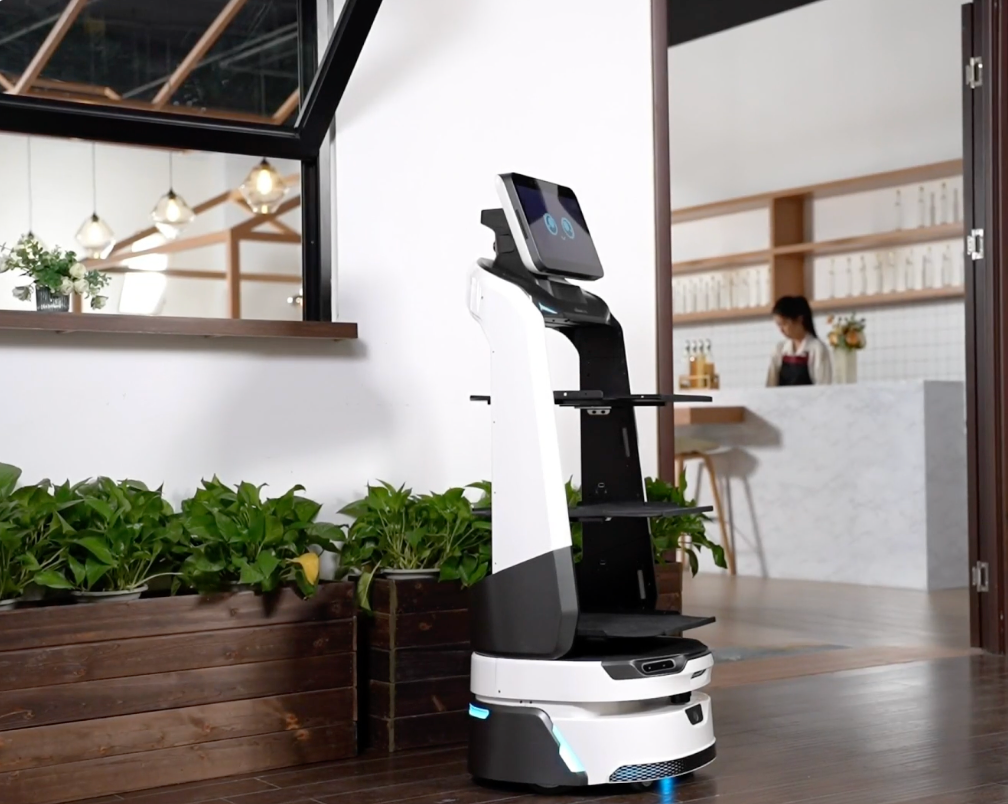
Illustrating these core capabilities, the OrionStar LuckiBot applies advanced automation directly to the dining room floor. According to manufacturer data, the unit features a total payload capacity of up to 40 kg distributed across three or four adjustable trays, allowing it to clear dishes from or serve up to four tables per single trip during peak operational hours. It utilizes a combination of LiDAR and visual SLAM to navigate complex environments, supported by 3D depth detection that enables an obstacle response time as short as 0.5 seconds to safely bypass guests and staff. Furthermore, it incorporates multiple operational modes and a six-microphone array for voice interaction, demonstrating how multi-mode robotic platforms can integrate smoothly into busy front-of-house routines.
During rush periods, order pickup counters often become congested as guests wait for their food, creating friction in the customer journey and making the area difficult to keep clean. Food delivery robots can take orders directly from the expo line to waiting guests, alleviating counter crowding and keeping the service flow moving efficiently.
Customers focused on self-service kiosks can easily be distracted or step backward into aisles, posing navigation challenges for staff carrying heavy trays or cleaning supplies. Automated robots utilize depth cameras and rapid obstacle avoidance to safely bypass queuing guests without interrupting the ordering process or causing spills.
Clearing abandoned trays and wiping down tables in dense dine-in seating areas is highly labor-intensive and frequently delayed when staff are overwhelmed. Robots can be dispatched to collect used tableware from multiple tables at once, speeding up turnover and maintaining a highly hygienic dining environment.
Spills and high foot traffic around drink refill stations create hazardous, slippery zones that require constant monitoring and careful navigation. Multi-link suspension systems on automated delivery units ensure that liquid loads remain stable when traversing these challenging or sticky floor surfaces, preventing further spills.
Integrating food delivery robots into the existing technology stack of quick service lobbies primarily involves connecting them with the kitchen display system (KDS) and point-of-sale (POS) layers. Through modern REST or GraphQL APIs, operators can link the robot's dispatch system directly to order-ready events, allowing the KDS to automatically assign destination tables and send the robot to the expo line without requiring manual handoffs. This seamless integration ensures that the delivery process is synchronized with third-party aggregators and self-service kiosks, while decentralized fleet coordination algorithms allow multiple units to update table states in real time on the floor dashboard.
Ultimately, deploying automated technology helps quick service restaurants align their operational upgrades with broader environmental and social governance goals.
The integration of automated technology is fundamentally changing how quick service restaurants operate and maintain quick service lobbies in the face of ongoing labor and economic pressures. By handling repetitive delivery and table-clearing tasks, food delivery robots allow human staff to focus on direct guest service and quality control. For operators evaluating automated solutions, the OrionStar LuckiBot series provides various models designed to meet different capacity and spatial requirements, offering a scalable path toward modernization.
Disclaimer: The operation of OrionStar robots involves environmental mapping and sensor data processing to ensure safe navigation. Business operators are responsible for ensuring that their deployment complies with local data privacy regulations (e.g., GDPR, CCPA), including obtaining necessary consents for visual and audio data processing within their premises.