

REQUEST DEMO
Robot CATALOG will be sent to your mailbox immediately after submission.
SUBMIT
Corporate campuses and multi-tenant office buildings present complex topological and operational challenges for property managers. Facility operators are tasked with maintaining high-traffic reception areas, shared corridors, end-of-trip facilities, and expansive parking structures while minimizing disruption to daytime tenant activities. Transitioning from traditional manual maintenance to automated cleaning solutions requires careful consideration of multi-tenant dynamics, shared amenity schedules, and specialized after-hours routines. Landlords and property managers must balance the constant demand for pristine environments against the physical scale and acoustic footprint of heavy robotic equipment. Furthermore, as these autonomous platforms increasingly rely on advanced environmental processing systems, stakeholders must carefully verify applicable data protection regulations before introducing camera-equipped machines into occupied corporate spaces.
Establishing a successful procurement strategy for an autonomous fleet depends on analyzing navigation capabilities, infrastructure integration, acoustic profiles, and cleaning modalities. Multi-sensor fusion systems enable machines to navigate complex lobbies and transparent architectural elements, while macro-environment mapping protocols allow for efficient coverage of large subterranean parking structures. Infrastructure integration dictates the level of human intervention required, with advanced units executing automated fluid exchanges and elevator navigation. Similarly, selecting the right cleaning modality—balancing dedicated heavy-duty hard-floor scrubbers against compact dry-vacuuming units—ensures that every flooring type from polished lobby tile to low-pile corridor carpet receives appropriate maintenance. By mapping these operational dimensions to specific architectural zones, property management teams can effectively evaluate the available equipment.
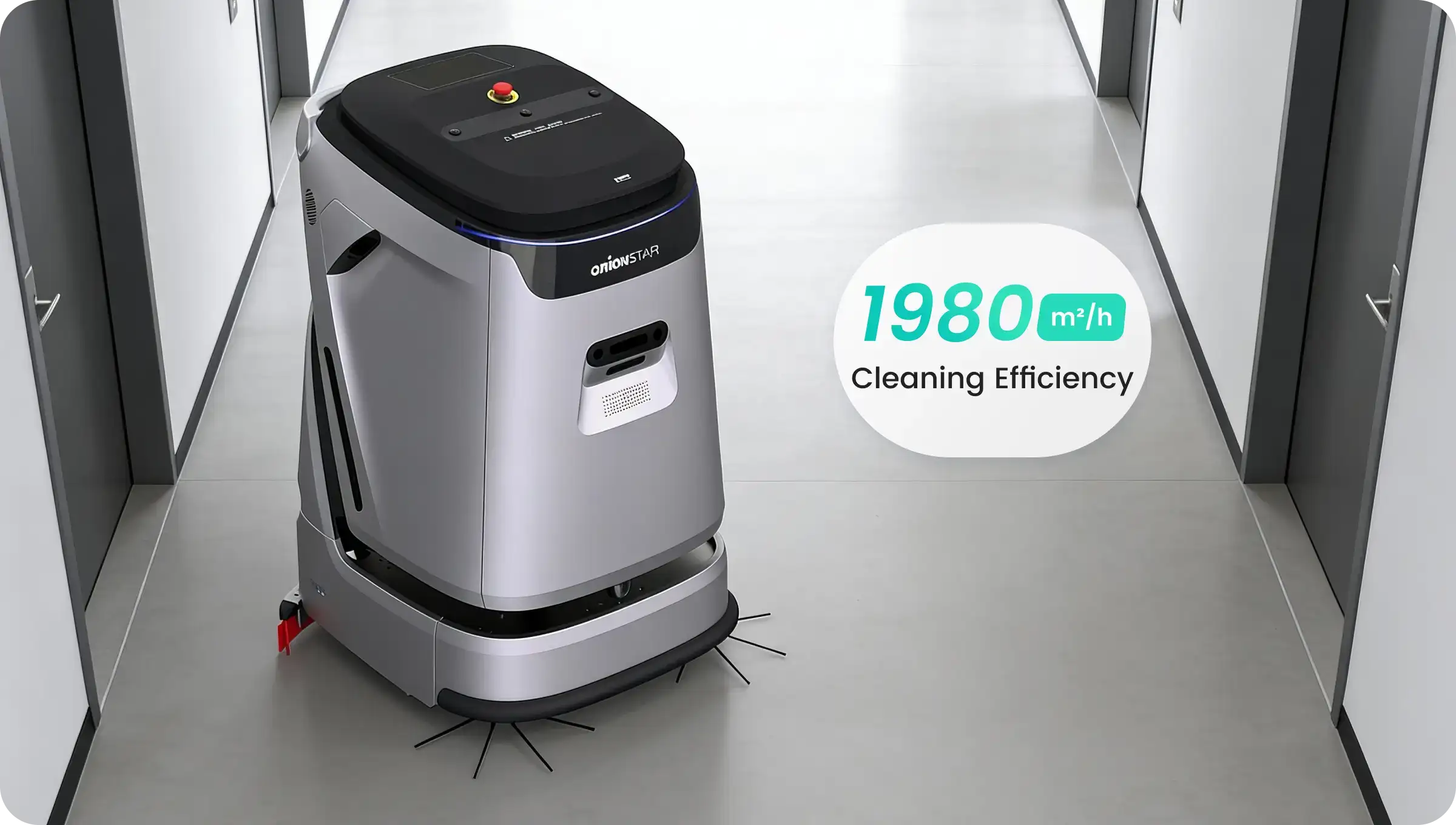
The OrionStar CleaniBot C5 functions as a heavy-duty industrial autonomous floor scrubber suited to large workplace lobbies, end-of-trip facilities, parking structures, and back-of-house service zones in multi-tenant office buildings. Weighing approximately 170 kg and featuring a combined 90 L water tank capacity, the machine minimizes manual refill interventions during extended after-hours cleaning shifts. Utilizing a 550 mm main brush, the platform achieves a maximum cleaning area capacity of up to 1,980 square meters per hour according to manufacturer data. The inclusion of a 25 kg downward scrubbing pressure system alongside dual-rolling brushes enables highly effective removal of heavy grime and oils often found in high-traffic logistics zones or exposed parking decks.
Beyond its core scrubbing mechanics, the CleaniBot C5 integrates advanced automation features designed to streamline landlord and property management operations. The robot executes fully autonomous environmental mapping for spaces up to 10,000 square meters and utilizes cloud-based path optimization to navigate dynamic obstacles safely. A comprehensive workstation facilitates automatic clean-water refilling, waste-water discharge, and high-pressure internal tank rinsing, which helps prevent odor accumulation in shared facility areas. Operating at a noise level below 68 dB(A), the unit maintains a relatively low acoustic profile for its industrial classification, supporting flexible deployment schedules across corporate campuses without requiring extensive plumbing modifications.
Positioned as an ultra-compact autonomous vacuuming robot, the Kärcher KIRA CV 50 serves as a dry-maintenance complement to wet-scrubbing machines rather than a direct substitute. Measuring approximately 580 by 580 by 300 mm and weighing around 15 kg without accessories, the machine is specifically engineered for narrow corridors, under-desk coverage, and daily dry-debris maintenance in commercial offices and lobbies. Its narrow 13.77-inch cleaning path and low clearance height allow it to navigate tight office cubicle aisles and maneuver around reception seating areas where larger industrial units cannot physically fit. Operating at a low sound pressure of 57 dB(A), the machine supports daytime operation in shared office spaces without interrupting tenant meetings or employee concentration.
The KIRA CV 50 relies on a multi-sensor array incorporating laser scanners, 3D sensors, and ultrasonic detection to execute safe obstacle avoidance among moving personnel. Achieving an autonomous area performance of up to 5,651 square feet per hour, the unit runs for up to 140 minutes on two exchangeable batteries under standard testing parameters. Because it is exclusively a vacuum-class unit utilizing 2.79 psi of suction, property managers evaluating multi-tenant buildings will need to pair this machine with dedicated wet scrubbers to maintain shared wet areas and back-of-house service zones. The lightweight physical profile enables a single technician to manually carry the unit between different floors, providing a flexible dry-cleaning asset for decentralized workplace management.
The Gaussian Robotics (Gausium) Scrubber 50 operates as a mid-size wet-scrubbing robot equipped with multi-modal sweeping, scrubbing, and mopping capabilities. Designed for office floors, end-of-trip facilities, and corridor-heavy multi-tenant spaces, the machine weighs up to 157 kg unladen and utilizes a 30 L clean-water tank paired with a 24 L waste-water tank. Achieving a maximum theoretical cleaning efficiency of up to 1,987 square meters per hour, the unit navigates dynamic environments using a combination of LiDAR, 3D depth cameras, and anti-collision sensors. Its minimum pass width of 800 mm allows it to safely traverse most standard office doorways and shared lobby circulation paths.
For multi-tenant building operators, the Scrubber 50 provides deep integration with existing smart building infrastructure to reduce operational friction. The platform offers an optional workstation that autonomously handles battery charging and fluid exchange, enabling unattended after-hours maintenance cycles. Furthermore, the manufacturer markets elevator integration capabilities that allow the robot to autonomously travel between different floors, significantly reducing the human intervention required across large corporate real estate portfolios. Reporting a noise level ranging from 55 to 70 dBA depending on the active cleaning mode, the machine adapts its acoustic output to suit both daytime corridor maintenance and heavier after-hours lobby scrubbing.
Operating as a ride-on autonomous scrubber, the Tennant T7AMR is a large-scale solution for typical office floors but remains exceptionally well-suited to wide concourses, expansive parking structures, and large back-of-house service zones. The machine features a substantial 650 mm cleaning path and large 110 L solution and recovery tanks, driving its total weight to approximately 492 kg. Because of its large physical footprint and ride-on form factor, the unit requires wide navigation aisles and avoids tight office circulation paths or crowded lobby furniture layouts. It effectively targets extensive hard-floor environments within corporate campuses where high-capacity fluid management and aggressive down pressure are necessary for proper surface maintenance.
Powered by the BrainOS autonomy platform, the T7AMR navigates via overlapping 3D environment sensors and LiDAR, managing obstacle avoidance and automatic braking in complex logistics areas. The unit supports comprehensive fleet and remote management through cloud-based dashboards, providing property managers with weekly usage reports and continuous performance telemetry. Operating at an acoustic level as low as 70 dBA, the machine remains viable for daytime operations in dedicated service corridors or subterranean parking decks away from standard office desks. Given its operational scale, the platform executes intensive environmental maintenance tasks while freeing facility staff to focus on highly detailed manual cleaning duties in tenant-facing spaces.
The Avidbots Neo 2W functions as a warehouse-tuned industrial autonomous scrubber specifically engineered for logistics-heavy zones, making it the right pick for parking decks, loading bays, and large storage zones within mixed-use workplace estates. Rather than navigating customer-facing lobbies or carpeted corridors, this variant utilizes an advanced obstacle detection stack tuned to recognize pallets, forklift tines, and other industrial floor-level hazards. The machine features highly durable, swappable batteries that extend its operational runtime to support massive corporate parking structures and back-of-house transit areas. By incorporating specialized bulk navigation capabilities, the unit seamlessly adapts to environments where storage configurations and aisle layouts change frequently.
Connectivity and remote fleet oversight represent core pillars of the Neo 2W deployment architecture. The platform connects directly to the Avidbots Command Center cloud dashboard via Wi-Fi and cellular networks, allowing workplace management teams to track real-time telemetry, monitor cleaning success, and synchronize map updates over the air. Facility operators can initiate cleaning programs remotely, directing the machine to autonomously navigate from a designated home base to the target parking deck or service bay and return upon completion. Because this system relies heavily on camera arrays, continuous mapping data, and cloud-based processing, property managers must evaluate data-residency policies and verify privacy compliance prior to active deployment.
Deploying an effective automated cleaning fleet across corporate campuses and multi-tenant offices requires matching specific hardware capabilities to the varied architectural zones of the building. Procurement teams should assign heavy-duty, high-capacity scrubbers to expansive parking structures and back-of-house loading bays where mechanical pressure and fluid volume dictate operational success. Conversely, compact vacuum-only units serve as essential daily maintenance tools for tight office cubicles and shared corridors, operating quietly alongside daytime tenant activities. Mid-size multi-modal scrubbers with smart building integrations bridge the structural gap, managing lobby environments and end-of-trip facilities efficiently. By evaluating acoustic footprints, spatial adaptability, and infrastructural integration, property managers can select a balanced portfolio of automated solutions that elevate building hygiene while optimizing long-term facility workflows.
For a workplace cleaning 1,500–2,000 m² per night, payback usually falls between 12 and 24 months once labor savings are netted against acquisition cost. The OrionStar CleaniBot C5 alone cleans up to 1,980 m² per hour with a 90 L combined water tank, which compresses a full-floor job into a single after-hours shift and removes most of the recurring wage line item. RaaS alternatives — for example RobotLAB's Gausium Scrubber 50 Pro at around $979 per month over 36 months — push capital outlay to zero and let the savings show up as an operating-expense delta from day one. Net payback therefore depends more on shift coverage, local labor rates, and whether the unit replaces a full FTE or augments an existing crew.
Three commercial models are in active use across the workplace segment: outright purchase (typical for Tennant T7AMR and OrionStar C5 deployments), RaaS subscriptions such as RobotLAB's $979/month 36-month program, and lease-to-own structures handled through authorised distributors. Workplace managers should specifically require clauses covering multi-tenant access (the ability to clean tenant floors under separate service contracts without re-mapping), software/firmware update rights, end-of-lease data return, and a defined service-level response window. Because the Avidbots Command Center and Tennant BrainOS dashboards both store site maps and cleaning telemetry in the cloud, contract terms must also cover data ownership, GDPR-aligned processing, and what happens to that data on contract termination. Most vendors will not publicly publish SLA response times — those need to be negotiated per site.
Autonomous scrubbers in this category all rely on remote monitoring, so the service wrapper is as important as the machine itself. Avidbots offers 24/7/365 Real-Time Monitoring and Remote Assistance through the Command Center, and the Neo 2W supports Wi-Fi plus 3G/4G LTE for over-the-air map updates and remote assistance. Tennant provides weekly fleet usage reports and KPI tracking through the BrainOS platform. For the OrionStar CleaniBot C5, the workstation's automatic tank rinse cycle (about 4 minutes) and self-cleaning docking station materially reduce the operator time needed per shift, which lowers the cost of any uptime guarantee the workplace team commits to in its own tenant SLAs. Workplace managers should expect to negotiate an annual uptime commitment (typically 90–95%) with a defined service-visit window.
Multi-floor operation is a real feature on some platforms and an open question on others. Gausium explicitly markets lift integration for the Scrubber 50, allowing it to ride elevators and clean multiple floors of a multi-tenant office building autonomously, which is the closest match to the workplace scenario. The OrionStar CleaniBot C5 supports mapping up to 10,000 m² and uses Cloud Learning-style path optimization, but elevator integration is not publicly specified in the product documentation and would need to be confirmed with the vendor. The Kärcher KIRA CV 50 is light enough (around 33–43 lb) to be carried between floors by a single technician, which is a manual workaround rather than a true autonomous solution. Workplace teams planning a multi-floor rollout should treat elevator integration as a separate scope item and validate it on a live site before signing.
For shared office corridors, lobbies, and end-of-trip facilities, anything at or below roughly 65 dB(A) is generally accepted as compatible with after-hours operation near occupied tenant space. The Kärcher KIRA CV 50 is the quietest unit in this comparison at 57 dB(A), the Gausium Scrubber 50 reports 55–70 dBA depending on mode, and the OrionStar CleaniBot C5 publishes under 68 dB(A). The Tennant T7AMR operates at an acoustic level of around 70 dBA, which is acceptable for back-of-house service zones but is typically reserved for fully unoccupied windows in office buildings. For mixed-use workplaces with residential tenants, choosing a sub-65 dB(A) unit avoids noise complaints and removes the need to coordinate cleaning around tenant quiet hours.
Not always with a single unit — floor-type variety is the most common reason workplace programs deploy two complementary machines. The OrionStar CleaniBot C5 is built for hard, heavy-soil surfaces with a 25 kg dual-rolling-brush down pressure and a 550 mm cleaning path, which makes it a strong fit for lobby tile, polished concrete, and parking-structure slabs. For broadloom and carpet tile in executive suites or end-of-trip facilities, the Kärcher KIRA CV 50 — a vacuum-class unit at 57 dB(A) — is the more appropriate choice, while Kärcher's wet-scrubbing KIRA B 50 would be paired with it for hard-floor wet work. The Avidbots Neo platform offers both disc and cylindrical cleaning heads, and the cylindrical variant is typically preferred for uneven grout lines and small debris in parking-structure transition zones. Workplace managers should also check gradeability against parking-ramp slopes: the C5 handles up to 8° unloaded, while the Gausium Scrubber 50 is rated to 4.6°.
Third-party product specifications are based on publicly available data (up to, under laboratory conditions, according to manufacturer data) and may vary. Product names and trademarks are the property of their respective owners. If any product involves cameras, voice recording, mapping, or cloud data processing, operators must verify GDPR compliance prior to deployment.
Data Privacy Notice: Autonomous floor scrubbers utilizing camera arrays, LiDAR, and cloud-based telemetry are subject to local data protection laws (e.g., GDPR, CCPA). Property managers should ensure adequate Data Processing Agreements (DPAs) are in place with equipment vendors and that appropriate visual signage is displayed in tenant-occupied areas before deployment. Mapped data and telemetry should be strictly limited to operational necessity.