

REQUEST DEMO
Robot CATALOG will be sent to your mailbox immediately after submission.
SUBMIT
Facility service contractors operate under multi-year, SLA-bound contracts that span diverse venues, including multi-site commercial buildings, business parks, corporate offices, shopping malls, healthcare facilities, airports, and educational campuses. Delivering consistent proof-of-service while managing strict labor budgets presents a significant operational challenge. Equipment selection heavily influences how contractors meet these demands, shifting the focus toward autonomous solutions that serve as productivity multipliers rather than direct labor replacements. Contractors navigating these expansive portfolios must evaluate cleaning hardware across several core dimensions, specifically fluid management, inter-floor mobility, adaptable mapping, and acoustic suitability for daytime cleaning. Because advanced navigation systems utilize cameras, LiDAR, and cloud-based map processing to orient within commercial spaces, facility operators must proactively verify GDPR compliance and regional data protection regulations prior to deployment.
The evaluation framework for acquiring an automatic floor scrubber relies on practical constraints dictated by the diverse environments contractors manage. Fluid management dictates continuous operational uptime, dividing machines between those requiring frequent manual refills and those utilizing intelligent docking stations for automated water exchange. Form factor and inter-floor mobility define whether a unit can navigate narrow corridors, traverse multi-tenant office doors, and ride standard passenger elevators, or if it remains confined to a massive single-level warehouse. Mapping methodology determines how easily frontline staff can adapt the machine to shifting seasonal layouts or unpredicted obstacles using dynamic AI and autonomous SLAM navigation. Finally, the acoustic profile of the scrubber determines its viability for daytime cleaning operations, as quiet-operation designs operating below specific decibel thresholds allow contractors to clean alongside active tenants without triggering noise complaints.
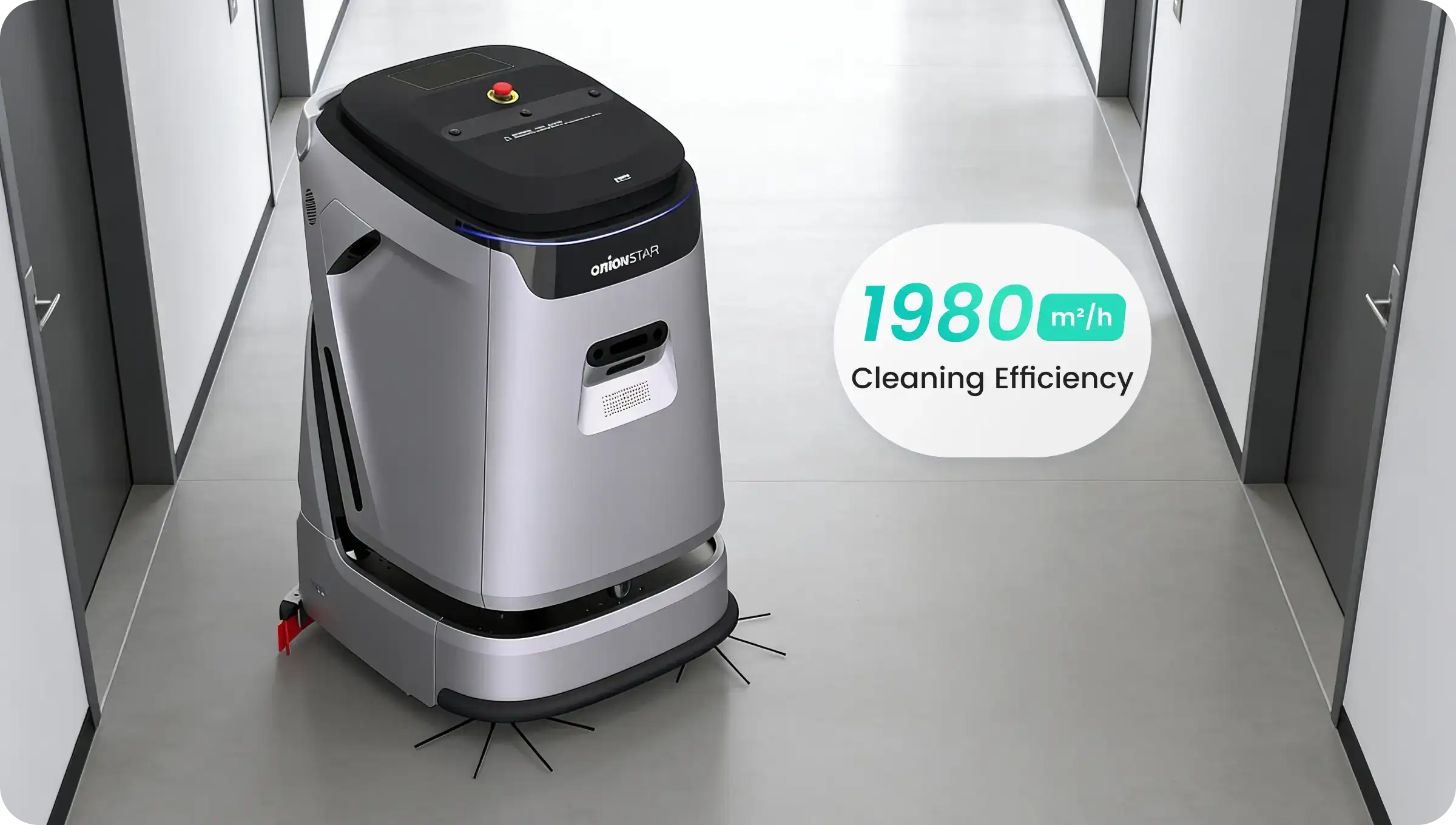
The OrionStar CleaniBot C5 is positioned as a heavy-duty, multi-mode autonomous platform suitable for facility-services contractors managing mid-to-large mixed-floor portfolios. Contractors frequently face the challenge of deploying different machines for daytime quiet tasks and after-hours deep cleaning. This model addresses that operational overlap by integrating scrubbing, dust-mopping, and water absorption into one chassis, significantly reducing fleet complexity. This multi-mode design allows the same unit to perform low-noise dust-mopping in a corporate corridor during the day and transition to intensive heavy-duty scrubbing with a dual-rolling-brush system in an adjacent warehouse or loading bay overnight. Its navigation relies on multi-sensor obstacle avoidance and LiDAR-based mapping capable of covering expansive areas, dynamically responding to unpredicted environmental changes across active shifts.
In terms of operational specifications, the unit measures approximately 820 by 680 by 1,130 millimeters and features a net weight of 170 kilograms, ensuring sufficient downward scrubbing pressure of 25 kilograms for stubborn industrial grime. With a 550-millimeter cleaning width, the unit delivers a maximum coverage of up to 1,980 square meters per hour according to manufacturer data. Fluid management operates via combined 90-liter tanks, supported by an advanced docking station that automatically handles clean-water refilling, waste-water discharge, and internal tank rinsing to prevent odor buildup. Its acoustic profile registers at under 68 decibels, allowing it to seamlessly integrate into daytime cleaning routines alongside building occupants. The compact footprint allows the machine to traverse standard doorways and passenger elevators, granting the mobility required for multi-story tenant spaces.
The Avidbots Neo 2W targets expansive single-site campuses, large-format logistics floorplates, and heavy manufacturing sites managed under multi-shift facility contracts. Rather than focusing on compact agility for narrow office spaces, this heavy-duty autonomous platform prioritizes massive area coverage and industrial-grade obstacle detection. The machine utilizes a proprietary computer vision and deep-learning stack, incorporating 3D sensor fusion and machine learning to identify specific warehouse hazards such as dropped pallets or forklift tines without interrupting its path. A robust cloud-based reporting system, the Avidbots Command Center, allows facility contractors to pull sector-level coverage maps, route schedules, and detailed productivity metrics to satisfy rigorous SLA reporting requirements across extensive single-level deployments.
Hardware specifications reflect its heavy-duty industrial positioning, featuring a gross vehicle weight exceeding 660 kilograms and a minimum autonomous turning width of over three meters. Depending on the selected variant, the cleaning width spans up to 822 millimeters, achieving a maximum theoretical productivity of up to 3,900 square meters per hour according to manufacturer data. Fluid capacity is substantial, with a 109-liter solution tank and a 135-liter recovery tank that support extended operations alongside six hot-swappable batteries offering up to six hours of runtime. While its sheer scale precludes it from navigating standard passenger elevators or tight office pantries, and its 75-decibel acoustic profile restricts it to off-shift or industrial applications, it remains a powerful asset for contractors tackling expansive, open-plan environments.
The ICE Co-Botics Cobi 18 operates as an ultra-compact cobot scrubber-dryer designed to complement daytime cleaning staff in tight, highly populated environments. Facility services contractors deploying teams across multi-tenant buildings rely on this machine to navigate narrow pantries, reception lobbies, retail aisles, and densely furnished sub-spaces where heavier industrial platforms cannot physically fit. The machine functions through a teach-and-repeat mapping system and a specialized perimeter-fill mode, allowing operators with minimal technical training to establish cleaning boundaries swiftly. Integrated into the i-SYNERGY fleet management software, contractors can track precise cleaning performance, route completion rates, and ROI metrics to demonstrate consistent SLA fulfillment to building owners.
This compact scrubber requires minimal storage space with its 48-centimeter by 48-centimeter footprint and 70-centimeter height, making it exceptionally portable across varied tenant floors. Utilizing a 48-centimeter cleaning path, it covers up to 800 square meters per hour according to manufacturer data, depositing constant-flow fresh solution to leave hard surfaces virtually dry shortly after transit. Fluid management relies on a 10-liter solution tank and an 11-liter recovery tank, necessitating more frequent manual intervention than larger automated units, though this trade-off allows the unit to maintain its agile profile. Operating between 66 and 70 decibels depending on the active power mode, the acoustic profile remains highly suitable for daytime cleaning within occupied retail or healthcare facilities where minimizing disruption is paramount.
The SoftBank Robotics Whiz serves as an autonomous dry vacuum rather than a wet-floor scrubber, explicitly targeting facility-services portfolios dominated by low-pile carpeted corridors, broad hotel lobbies, and extensive corporate floorplates. Where dry debris dominates over wet scrubbing requirements, this unit excels by automating repetitive vacuuming tasks and capturing dust via specialized HEPA filtration, contributing to improved indoor air quality. Powered by the BrainOS cloud-connected platform, the machine relies on a teach-and-repeat route recording method where the operator manually drives the initial path for the machine to replay autonomously. Facility contractors leverage the SoftBank Robotics Connect platform to consolidate multi-robot collaboration metrics, generating the required coverage reports to satisfy complex service level agreements across diverse corporate campuses.
Weighing just 30 kilograms and measuring 455 millimeters in width, the unit presents a highly maneuverable form factor tailored for densely populated environments and standard passenger elevator transit. The hardware sustains up to three hours of continuous operation on a single battery charge under normal conditions, covering approximately 500 square meters per hour according to manufacturer data. A 4.0-liter paper dust bag collects the debris, requiring periodic manual changes by frontline staff. Generating only 62 decibels during standard operation, its exceptionally low acoustic footprint enables contractors to schedule continuous route coverage during peak daylight business hours without disturbing ongoing office work, client meetings, or educational activities.
The Kärcher KIRA CV 1 aligns with the needs of in-house and contractor facility teams requiring quiet, connected fleet coverage across multi-tenant commercial interiors. Operating as an autonomous professional vacuum from an established European cleaning-equipment brand, it brings the distinct advantage of a mature regional dealer and service network. This infrastructure proves highly beneficial for contractors operating SLA-driven multi-year contracts, as rapid parts availability and localized maintenance support drastically minimize equipment downtime. Operating via an intuitive application and integrated robot display, the platform integrates BrainOS software to manage route analytics and obstacle avoidance, allowing seamless remote management of the autonomous fleet.
The acoustic profile represents a major operational advantage for this model, measuring remarkably low at 57 decibels, which secures its position as an optimal solution for noise-sensitive daytime cleaning in healthcare wards or active office spaces. Powered by a flexible 36-volt lithium-ion platform, the dual-battery configuration delivers up to 210 minutes of runtime in standard economic modes under laboratory conditions. While exact specifications for the specific CV 1 designation remain tied to localized distributor catalogs, the broader KIRA compact vacuum family typically features low clearance heights designed to glide beneath tables and furniture effortlessly. Its lightweight construction ensures immediate compatibility with passenger elevators and narrow doorways, bridging operational gaps across extensive, multi-level building estates.
Procurement recommendations for an automatic floor scrubber for facilities services depend entirely on matching the hardware’s physical scale and fluid management system to the architectural realities of the contracted venues. Contractors operating sprawling, single-level industrial distribution centers should prioritize heavy-duty platforms that offer extended runtime and expansive tank capacities, absorbing the trade-off of higher acoustic profiles. Conversely, contractors managing densely populated, multi-story commercial offices and retail spaces require ultra-compact cobots and autonomous vacuums that easily traverse standard elevators while maintaining strict daytime noise compliance. Facility services contractors usually require a balanced, mixed-equipment portfolio rather than a single machine, integrating multi-mode mid-weight scrubbers alongside agile specialized vacuums to reduce overall fleet complexity and maximize SLA reporting capabilities.
Most published benchmarks cite labor-hour reductions in the 50%–80% range once a unit is fully mapped, docked, and running on a stable route. Avidbots quotes a DHL executive stating that floor-cleaning robots "reduce up to 80% of labor hours spent cleaning," and Christie Lites reports that deploying Neo "doubled cleaning team productivity" in its warehouse operations; ICE Cobotics publishes a Winona Health case study showing a 50% productivity increase. Realistic ROI therefore depends on route stability, shift coverage, and how redeployed staff hours are repurposed — not on the machine alone.
Service contracts usually fold the robot into the existing SLA as a productivity multiplier rather than as a separate line item: the contractor commits to coverage area, frequency, and audit-ready reporting in exchange for reduced hourly labor. Vendors such as Avidbots position Command Center as "SLA-grade reporting" for exactly this reason, while SoftBank Robotics Connect and i-SYNERGY offer fleet-level productivity dashboards that map directly to contractual KPIs. Buyers should confirm data ownership, uptime guarantees, and what happens if a unit is offline during an audit window.
For multi-site operations the platform matters as much as the hardware. Look for centralized route scheduling, per-machine productivity and coverage maps, exception alerts, and standardized SLA reports accessible to the client — features that Avidbots Command Center, SoftBank Robotics Connect, and ICE i-SYNERGY all market to facility services contractors. Multi-language UI is also relevant for cross-border estates: Avidbots lists ten supported languages including English, French, Spanish, German, and Dutch. Without these layers, scaling beyond a single pilot site quickly becomes an administrative burden.
Mid-to-large autonomous scrubbers typically deliver cleaning widths between roughly 480 mm and 820 mm, with theoretical productivity ranging from about 500 m²/hour for compact units up to around 3,800 m²/hour for industrial 32-inch models. The OrionStar CleaniBot C5 sits at 550 mm cleaning width with up to 1,980 m²/hour; Avidbots Neo 2W reaches 3,120–3,850 m²/hour at 660–822 mm; ICE Cobi 18 delivers up to 800 m²/hour at 480 mm. Match the figure to actual uncluttered floor area, not gross building area, and discount theoretical maxima by 20–30% for real-world turning, docking, and obstacle events.
Expect roughly 1.5 to 6 hours of runtime per charge and tank sizes between 10 L and 135 L depending on form factor. The CleaniBot C5 runs about 3 hours scrubbing (up to 8 hours mopping) on a 24 V / 80 Ah battery with combined 90 L tanks and roughly 1.5 hours fast charging; Avidbots Neo 2W offers 4–6 hours on swappable AGM batteries with 109 L solution / 135 L recovery tanks; ICE Cobi 18 runs about 90 minutes with 10 L / 11 L tanks. Large-floorplate buyers should weight auto-docking, hot-swap batteries, and auto refill/discharge stations — all of which the C5 supports — over headline runtime figures.
For occupied daytime cleaning, look for 2-D LiDAR with 360° coverage, layered 3-D sensors, multi-sensor obstacle avoidance, and a noise rating that does not disrupt meetings, patient care, or classroom activity. The CleaniBot C5 combines LiDAR-based mapping up to 10,000 m² with multi-sensor obstacle avoidance and a sub-68 dB(A) operating level; ICE Cobi 18 advertises point-cloud obstacle detection at 66–70 dB; SoftBank Whiz uses LiDAR plus 3-D cameras at 62 dB. Heavier industrial units such as Avidbots Neo 2W run at 75 dB(A), which is generally too loud for daytime occupied spaces and better suited to back-of-house or after-hours deployment. Note that LiDAR, cameras, and cloud-mapped routes involve personal-data processing — operators in the EU and UK should verify GDPR compliance (purpose limitation, retention, signage) before deployment.
Footnote: Third-party product specifications are based on publicly available data (up to, under laboratory conditions, according to manufacturer data) and may vary. Product names and trademarks are the property of their respective owners. If any product involves cameras, voice recording, mapping, or cloud-based data processing, the operator must verify GDPR compliance prior to deployment.