

REQUEST DEMO
Robot CATALOG will be sent to your mailbox immediately after submission.
SUBMIT
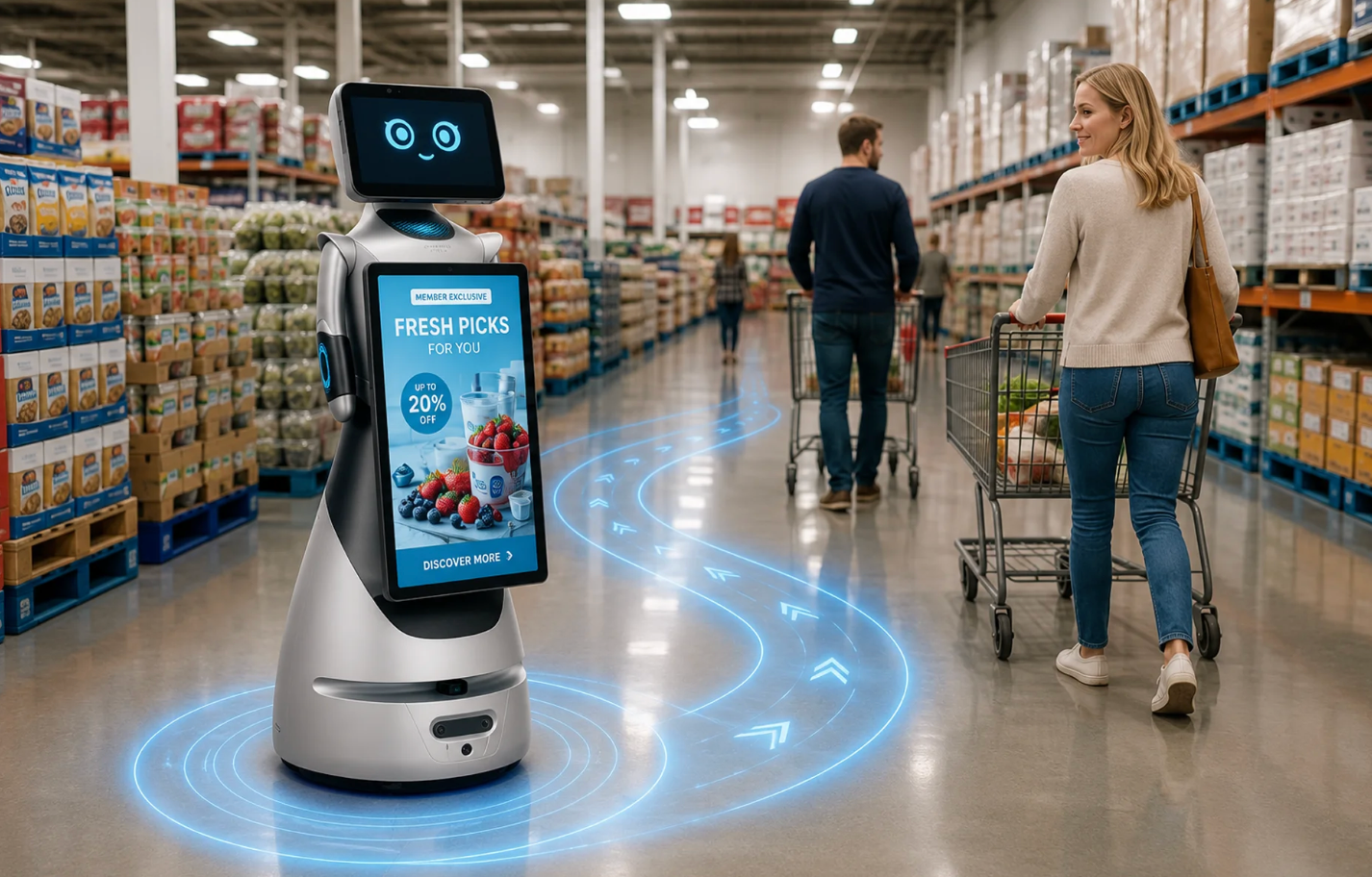
Deploying automated service technologies within global electronics stores, consumer electronics retail, mobile phone shops, and adjacent gadget retail floors introduces unique spatial and acoustic challenges. These retail environments are heavily characterized by densely merchandised spaces, tightly arranged aisles, freestanding promotional displays, and substantial foot traffic. Furthermore, consumer electronics stores are notoriously loud spaces filled with overlapping product demonstration audio, ambient store music, and constant conversational chatter from both shoppers and staff. Navigating this environment requires platforms specifically engineered to filter background interference while possessing the physical agility to traverse highly constrained merchandise gaps.
When evaluating platforms for this environment, buyers should establish a comparative baseline across four primary dimensions. The first is aisle passability, where operators must choose between ultra-compact maneuverability platforms designed for the tightest merchandising gaps and large-format promenade platforms built for spacious exhibition areas. The second dimension is the digital signage strategy. Retailers can deploy dynamic interactive-head displays that maintain direct eye-level contact for personalized specification viewing, or they can utilize fixed large-format body screens prioritizing ambient digital signage visible from a distance across the retail floor.
The third evaluation dimension focuses on interaction modality and noise resilience. Voice-first conversational architectures feature robust noise-cancellation algorithms capable of filtering heavy ambient noise to facilitate real-time vocal greetings. Alternatively, visual-and-touch-first systems rely on content management workflows, utilizing touch panels as the primary interaction medium for product search and pre-programmed advertising. Finally, operators must decide between pure guidance versus hybrid transport. Dedicated digital guidance platforms focus exclusively on leading shoppers and answering digital queries, while hybrid guidance-and-delivery platforms incorporate physical shelving into their chassis to transport physical items alongside the customer.
The OrionStar GreetingBot Mini focuses on providing smart reception, wayfinding, and promotional capabilities within a highly compact footprint. For electronics stores dealing with narrow aisles and densely packed display tables, this platform emphasizes physical maneuverability without sacrificing interactive communication. The architecture is engineered primarily for direct engagement, proactively detecting the presence of customers to initiate face-to-face interactions while leading them to target shelf positions.
According to manufacturer data, the unit features a minimal chassis diameter of up to 41 cm and achieves a minimum passable width of up to 55 cm under laboratory conditions, allowing it to easily navigate dense electronics-store layouts. For visual engagement, it incorporates a 14-inch FHD display that serves as the primary interface for showcasing product information and advertisements. Voice interaction is robust, with speech recognition accuracy reaching up to 97 percent even in noisy retail environments according to manufacturer data. A notable differentiator for international retail environments is its multilingual capability; the platform features native support for over thirty languages alongside automatic language detection, providing immediate utility for diverse customer demographics without requiring custom integrator programming. All voice and visual processing features on OrionStar devices are designed in compliance with local data protection regulations. Data processing modes (on-edge vs. cloud) can be configured by operators to meet regional GDPR requirements.
The temi platform targets autonomous greeting and customer escorting, utilizing an exceptionally slim profile to operate smoothly within the tightest merchandising gaps. Its design strategy positions the unit as an unobtrusive floor assistant that guides guests directly to specific product zones without disrupting the flow of human traffic. The platform leverages dynamic mapping and user-tracking algorithms to maintain its path and follow or lead shoppers through constrained retail layouts.
Based on manufacturer data, the unit possesses an ultra-slim body measuring up to 35 cm in width, making it highly suitable for narrow adjacent gadget aisles where larger models cannot operate. Visual product presentation is handled by a motorized, face-tracking 13.3-inch screen that autonomously tilts to maintain direct visibility for the shopper. Regarding multilingual deployments, the platform requires an integrator-driven approach; the base consumer model ships with English-only voice capabilities out of the box, meaning regional operators must rely on third-party integrators to configure specific language packs for varied retail demographics. The device also utilizes an open app platform that permits integrators to deploy customized product information and promotional content to the main screen.
The Pudu KettyBot Pro combines automated greeting and escort functions with significant built-in advertising surfaces and light delivery capabilities. It is explicitly positioned to function in retail environments where maintaining visible in-aisle advertising is as critical as guiding the shopper. A core operational advantage for this specific retail scenario is its documented deployment history at MediaMarkt, highlighting its direct applicability to consumer electronics retail workflows.
According to manufacturer data, the platform navigates with a travel width of up to 55 cm under laboratory conditions, which comfortably addresses standard main aisles while balancing the need for physical payload stability. It employs a dual-screen digital signage strategy, featuring a 10.1-inch head display paired with an 18.5-inch advertising display oriented toward the customer for maximum visual impact. This setup is managed via a dedicated merchant-management CMS workflow that allows staff to pre-set product locations and configure visible marketing materials per store. While highly capable in on-screen presentations, its multilingual voice support is not natively detailed out of the box and typically requires tailored integrator configuration for comprehensive localized deployments.
The LG CLOi GuideBot functions primarily as an autonomous tour guide and digital-signage centerpiece, engineered for flagship store deployments needing maximum in-store signage and centralized content control. Rather than prioritizing extreme agility in densely merchandised aisles, this platform emphasizes visual dominance and broad-reach ambient advertising. It is structurally designed to patrol wider promenades and spacious entrance lobbies, drawing customer attention through sheer display scale and sophisticated content scheduling.
According to manufacturer data, the unit integrates dual 27-inch touch LCDs on the front and back of its body, delivering the largest simultaneous two-sided display surface among the evaluated platforms. This massive digital real estate is driven by the CLOi Cloud CMS workflow, enabling retail managers to execute time- and location-based advertising while maintaining centralized control across multiple store branches. Because of its large form factor, it requires a minimum drive width of up to 80 cm under laboratory conditions, restricting it from navigating narrow electronics shelves. Additionally, retail-specific multilingual support is not publicly specified by default, often necessitating custom localization for international deployment.
The Keenon Robotics T10 operates as a hybrid guidance-and-delivery platform, combining proactive customer greeting with light item transport. For electronics stores that need both functions, this platform serves dual purposes by leading shoppers to a desired product section and subsequently helping transport small electronics, promotional items, or purchases. The design integrates interactive head movements with a substantial lower-body structure optimized for carrying payloads safely across dynamic retail floors.
Based on manufacturer data, the platform requires a minimum passage width of up to 59 cm under laboratory conditions, situating it within the capability range of mainstream aisles though precluding it from the tightest clearance zones. Visual interaction relies on a prominent 23.8-inch ad screen that facilitates deep product spotlights and video demonstrations managed via cloud connectivity. For diverse customer interactions, multilingual greeting packs are typically configured per market via the manufacturer's management platform rather than through native automatic detection. The robust sensor stack allows the system to capably navigate around the complex glass showcases and reflective electronics displays frequently encountered in modern retail environments.
Procuring reception robots for electronics stores requires retail operators to meticulously balance physical footprint, digital signage capabilities, and ambient noise resilience against their specific store layouts. Operators managing locations with densely packed shelving and narrow aisles should prioritize ultra-compact maneuverability platforms that feature automatic language detection to accommodate immediate customer needs. Conversely, retail managers overseeing expansive flagship stores with wide promenades may favor large-format models that offer centralized CMS workflows and dual-sided advertising screens to maximize brand visibility. Ultimately, the chosen platform must align its interaction modality and structural dimensions with the daily operational realities of the retail floor, ensuring that both shopper guidance and product presentation workflows operate efficiently.
Documented retail-service-robot deployments cluster around a 12–24 month payback period when labor displacement, throughput gains, and conversion uplift from always-on product presentation are all counted, and AMD Machines notes that successful automation investments typically fall in that 12–24 month window across 2,500+ installed cells. For a single electronics store, the actual figure depends heavily on the local fully-burdened labor cost for floor staff, opening hours (long retail hours favor robots that can run 12-hour shifts), and how much of the salesperson's time shifts from greeting and wayfinding to higher-value consultation and closing. Vendors such as Pudu and temi explicitly position their platforms at sub-$2,000 (temi, via integrator) to ~$23,000 (Keenon DINERBOT T10 list) entry points, but the realistic payback model must add integration, mapping, content updates, and ongoing maintenance rather than the unit sticker price.
Industry guidance treats the equipment quote as roughly 60–75% of total installed cost, with integration, content authoring, mapping of the actual store layout, customization of greetings and product scripts, staff training, and 3–5% annual preventive maintenance making up the rest. For an electronics retailer this means budgeting for SKU and price-list updates on the robot's CMS as the catalogue rotates, charging-dock siting that avoids customer flow, on-site Wi-Fi coverage verification, and content QA in every language the robot will speak. Most reception-robot vendors — OrionStar, temi, Pudu, Keenon, LG — publish per-unit pricing but require integrator or partner work for first deployment, so the procurement line item should be "robot + integration + first-year service" rather than hardware alone.
Every reception robot in this category uses cameras, microphones, mapping sensors, and cloud connectivity, so GDPR applies the moment a shopper's face or voice is processed; iFactory's 2025 GDPR/AI Act analysis notes cumulative GDPR fines have already crossed €5.65 billion and that AI vision cameras processing identifiable individuals trigger Article 4 obligations regardless of whether a human or algorithm watches the footage. The EU AI Act layered further obligations on top, with Article 5 prohibited practices effective 2 February 2025 and Chapter III high-risk obligations applying from 2 August 2026, so any operator planning a multi-store European rollout in 2026 should pressure-test the vendor on on-device vs. cloud audio/face handling, retention windows, signage, and processor/sub-processor agreements before signature. Procurement should treat privacy-by-design documentation as a deliverable, not a marketing claim — ask each vendor for their data-flow diagram and DPIA template up front.
Aisle passability is the single most important spec for an electronics-store deployment, and the four models in this comparison split sharply on it: temi V3 is the narrowest at 35 cm wide (12 kg body), OrionStar GreetingBot Mini requires 55 cm minimum passable width with a 41 cm chassis (21 kg), Pudu KettyBot Pro needs 55 cm travel width (38 kg body), while the Keenon T10 needs 59 cm and the LG CLOi GuideBot needs 80 cm — the latter two effectively rule out the tightest merchandising gaps. Operators should measure their tightest end-cap and between-shelf gaps with the merchandising fixtures actually in place, not the empty-floor spec sheet, before shortlisting; for dense mobile-phone shops and adjacent gadget aisles the temi and GreetingBot Mini form factors are the realistic candidates. Climbing ability (5° across this set) and obstacle recovery around glass display cases and reflective screens should be tested on-site, since lidar-only stacks can struggle with mirrors and glossy TV walls common in consumer-electronics stores.
Screen size and CMS workflow vary widely across this category: the LG CLOi GuideBot offers the largest combined surface with two 27-inch touch LCDs plus a 9.2-inch animated head (centrally managed through CLOi Cloud CMS), the Keenon T10 has a single 23.8-inch cloud-managed advertising screen, the Pudu KettyBot Pro pairs a 10.1-inch head screen with an 18.5-inch customer-facing ad display plus a pre-loaded product-search workflow that lets staff set product names and locations on the merchant-management platform (notably used at MediaMarkt), the OrionStar GreetingBot Mini uses a 14-inch FHD display with motorised head pitch for face-to-face interaction, and temi V3 has a 13.3-inch 1080p IPS LCD that auto-tilts to face-track visitors. For an electronics retailer, what matters as much as inches is whether the CMS lets non-technical store staff update SKU specs, prices, and promo creatives without engineer involvement, and whether the screen can stay legible under in-store lighting (temi lists 340 cd/m² typical brightness; comparable figures for the others are not publicly specified).
Reception-robot multilingual support is uneven across this set and is a frequent procurement surprise: OrionStar's GreetingBot Mini explicitly supports 30+ languages with real-time switching and automatic language detection (deployed across 50+ countries), Pudu and Keenon configure multilingual packs per market through their open platforms but do not publish a retail-ready language list, temi ships English-only out of the box with additional languages requiring integrator configuration, and LG's CLOi GuideBot does not publish a supported-language list for retail. For an electronics store near a tourist zone, airport, or in a multilingual European market, the practical question is not "how many languages does the marketing page claim" but "which languages are pre-loaded and switchable on day one, and which require a paid integrator engagement to add." Always request a live demo in the second language you most care about before signing.
Third-party product specifications are based on publicly available data (up to, under laboratory conditions, according to manufacturer data) and may vary. Product names and trademarks are the property of their respective owners. If any product involves cameras, voice recording, mapping, or cloud data processing, operators must verify GDPR compliance prior to deployment.