

REQUEST DEMO
Robot CATALOG will be sent to your mailbox immediately after submission.
SUBMIT
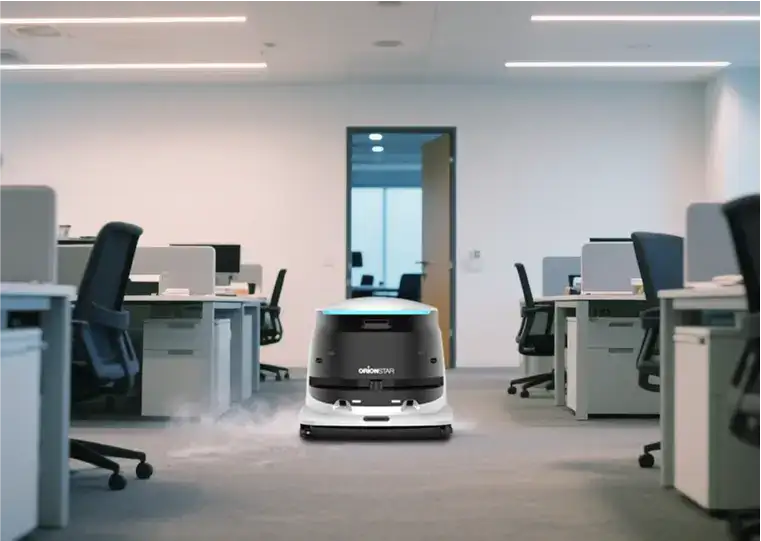
Facility Management in office buildings has reached a clear inflection point. For decades, the industry relied entirely on manual labor to maintain corporate environments, but that model is breaking under structural pressures. Today, building operators face a shrinking workforce, surging wage expectations, and tighter operational budgets. Simultaneously, corporate tenants demand stricter post-pandemic hygiene standards and consistent aesthetic quality. Therefore, technology must bridge the gap between elevated client expectations and limited human resources. Sensor technologies and autonomous navigation systems have finally matured, pushing hardware costs down while increasing reliability. As a result, commercial cleaning robots have evolved from experimental novelties into industry-level solutions. These autonomous platforms provide a scalable way to maintain vast commercial floor spaces without expanding headcount. By absorbing repetitive maintenance tasks, they allow facility operators to stabilize service delivery and rethink how they deploy their human teams across modern corporate real estate.
These pressures collectively point to one conclusion—the traditional manual operating model is fundamentally unsustainable.
As an integral part of the OrionStar CleaniBot series, the S55 Pro provides a comprehensive, one-stop floor care solution for complex office buildings. Modern commercial facilities feature diverse micro-environments, requiring an adaptable approach rather than a single cleaning method. For expansive open office areas and long corridors, the robot utilizes its sweep and vacuum mode, achieving cleaning efficiency of up to 1,368 square meters per hour according to manufacturer data. In reception zones, meeting rooms, and elevator lobbies where noise disruption must be minimized, the machine deploys a quiet dust mopping mode operating at a discreet 45 decibels. Conversely, high-traffic zones like pantries and areas outside restrooms require intensive liquid cleanup, which the robot handles through its dedicated scrubbing and power scrubbing configurations. Underground parking structures and transition spaces also benefit from its robust hard-floor capabilities and multi-sensor obstacle avoidance.
Beyond physical cleaning, the CleaniBot S55 Pro integrates seamlessly into modern digital operations. Facility managers can monitor performance through Wi-Fi and 4G connectivity, which supports remote deployment, cloud-based fleet maintenance, and over-the-air software updates. The system generates detailed data reports, enabling transparent oversight of daily cleaning schedules. Because the robot navigates using stereo cameras and advanced LiDAR mapping, data privacy is a critical consideration in corporate environments. Facility management teams must ensure that deployment aligns with local privacy frameworks. Operators should verify GDPR compliance with their vendors, confirming that visual data processing occurs locally on the device without storing personal information in tenant-restricted zones. Ultimately, this autonomous platform handles mixed-surface transitions smoothly, establishing a reliable baseline of cleanliness across the entire facility.
These results are not theory, they are the reality facility managers, building operators are already validating.
The introduction of robotics into facility management does not signal the end of the human workforce. Instead, it marks a necessary shift toward a cobotic, hybrid model where human staff and machines operate as a single scheduled system. Automation takes over the physically taxing, highly repetitive task of pushing a scrubber across vast expanses of open square footage. Consequently, facility managers can redirect their human teams toward tasks that require judgment, dexterity, and critical thinking. Human workers transition to managing restroom detail work, spill response, high-touch surface sanitation, and direct client service interactions.
Moreover, this technological shift creates entirely new career paths within the cleaning industry. Facilities are now seeing the emergence of specialized roles, such as robot fleet operators, data-quality leads, and day-shift supervisors who manage autonomous route performance. By removing the most monotonous 40 to 60 percent of a cleaner's physical shift, organizations reduce workplace injuries and burnout. In short, automation elevates the workforce, turning traditional janitors into skilled supervisors of advanced operational tools.
Commercial cleaning robots are rapidly transitioning from discretionary technology to foundational infrastructure within Facility Management. As operational pressures continue to mount, relying solely on manual labor to service vast corporate properties will soon become a competitive disadvantage. To address the diverse layouts and specific operational parameters of different properties, the OrionStar CleaniBot series provides multiple models designed to adapt to varying commercial environments. Moving forward, the industry will increasingly view autonomous floor care systems as standard building equipment, much like HVAC systems or security networks. Building operators who integrate these robotic platforms today are securing their operational resilience for the future. Above all, the successful facility management model of the next decade will be defined by how seamlessly operators can blend autonomous efficiency with human expertise.