

REQUEST DEMO
Robot CATALOG will be sent to your mailbox immediately after submission.
SUBMIT
The operational reality of modern hypermarkets presents distinct floor care challenges, requiring machinery capable of transitioning from vast parking decks to constricted checkout zones within a single continuous shift. Facility managers must account for highly diverse soil profiles, distinctly separating perishable zones like fresh produce sections and freezer aisles, which frequently endure wet and sticky spills, from the ambient and dry zones that typically require only daily dust removal. Evaluating an automatic floor scrubber for hypermarkets requires a rigorous look at how specialized equipment manages these varied demands without disrupting merchandise displays or burdening retail staff. A comprehensive procurement evaluation should center on physical footprint and navigational clearance, fluid sustenance and power management architecture, dry debris handling mechanisms, and adjustable scrubbing dynamics. Assessing autonomous platforms through this specific framework ensures the selected hardware aligns with the intense throughput and spatial constraints inherent to large-format general-merchandise environments.
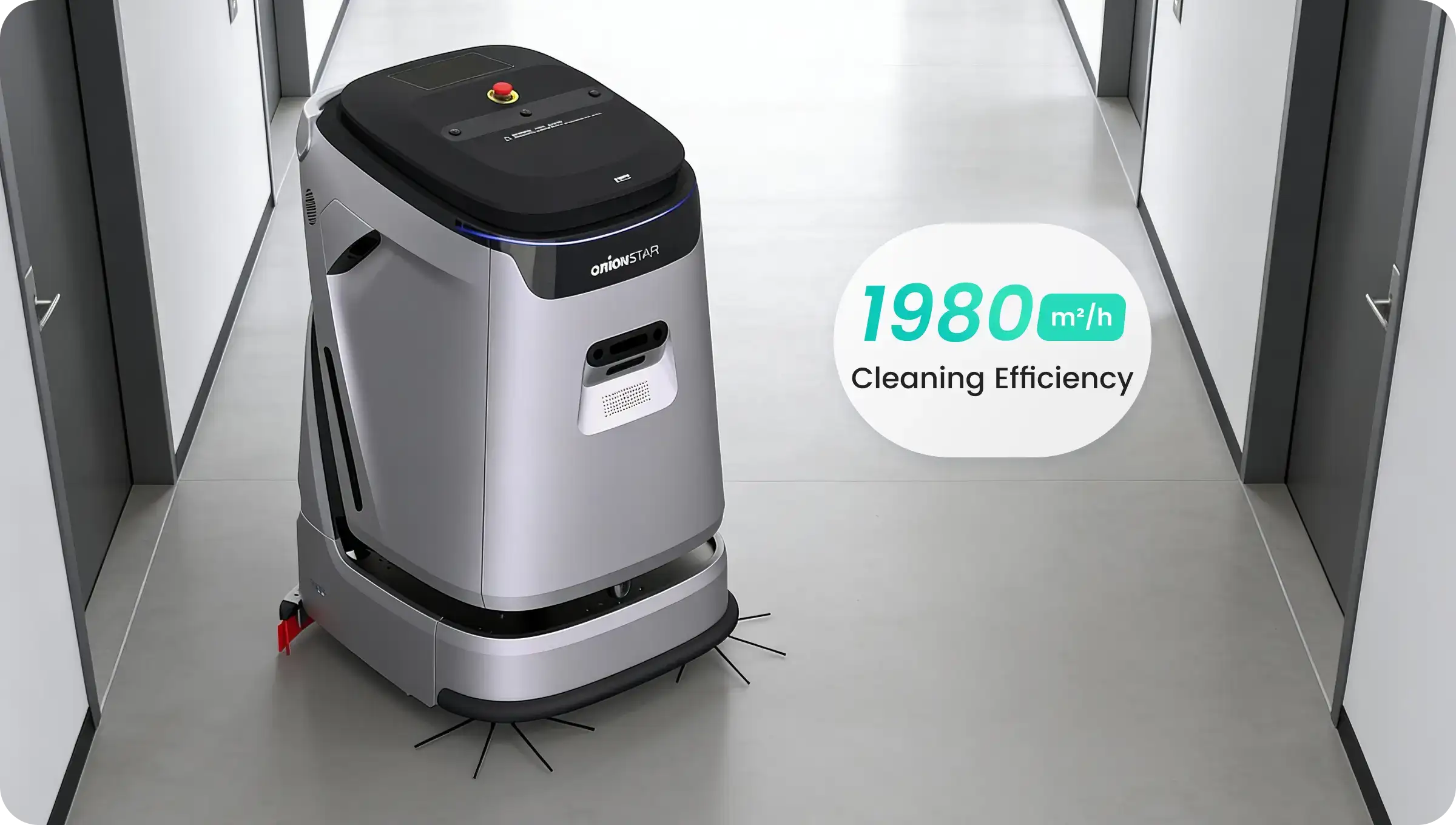
The OrionStar CleaniBot C5 operates as a heavy-duty industrial-grade autonomous mobile robot designed specifically to handle the extensive square footage and varied terrains found in modern hypermarkets. Positioned to manage demanding areas such as main aisles, fresh produce sections, backrooms, and parking decks, this machine addresses the rigorous daily traffic and debris typical of large-format retail settings. Its navigational system relies on multi-sensor obstacle avoidance, allowing it to safely maneuver around shopping trolleys and customer foot traffic while planning optimal cleaning paths across areas measuring up to 10,000 square meters. A minimal passing width of approximately 880 millimeters ensures the machine maintains accessibility through standard retail corridors and transitional zones without disturbing carefully arranged promotional displays.
In terms of operational specifications, the CleaniBot C5 delivers a maximum cleaning capacity of up to 1,980 square meters per hour, according to manufacturer data. It incorporates a combined 90-liter water tank system, splitting capacity evenly between clean and waste water, which significantly reduces the frequency of manual refills during long operational windows. A defining feature for continuous multi-shift operation is its fully automated docking station, which independently handles clean-water refilling, waste-water discharge, and high-pressure internal tank rinsing. Scrubbing dynamics are similarly robust, utilizing a dual-rolling-brush system that applies up to 25 kilograms of downward pressure to capture small dry debris while simultaneously executing scrubbing and water absorption. This integrated approach effectively manages sticky residue in fresh produce zones alongside light daily dust in ambient aisles.
The Tennant T16AMR enters the hypermarket space as a mid-to-large form factor autonomous mobile robot powered by the BrainOS autonomy platform. Building on a heritage of proven deployments across retail and warehouse environments, this heavy-duty machine is specifically tailored for vast, open retail-warehouse hybrids and expansive main aisles. The platform relies on a teach-and-repeat routing approach utilizing home markers, which allows facility managers to program custom routes tailored to the wide structural spans of hypermarket layouts. Due to its substantial physical dimensions and high operating weight, this model is most appropriately deployed in sections with generous clearances, prioritizing heavy-soil zones like receiving bays, parking deck transitions, and wide freezer aisles over highly constricted promotional gondolas.
Focusing on fluid sustenance and intense scrubbing dynamics, the T16AMR features exceptionally large storage capacities, including a 190-liter solution tank and a 225-liter recovery tank. Under laboratory conditions and based on manufacturer specifications, it provides robust soil removal by applying up to 91 kilograms of brush down pressure through a broad cylindrical scrubbing path. This extreme pressure makes the machine highly effective at stripping compacted shopping-cart wheel marks and embedded grime typical of high-traffic retail transit areas. Power management is handled via high-capacity battery options that support multi-hour runtimes, ensuring the machine can aggressively process massive floor areas in a single continuous run before returning for a bulk fluid dump at a dedicated utility station.
The Avidbots Neo 2W functions as a rugged, industrial-grade cleaning platform designed to tackle the dynamic, high-traffic conditions prevalent in hypermarket main aisles and back-of-store cross-dock areas. Recognizing the complexities of spaces shared by shoppers, pallet jacks, and shopping trolleys, this unit utilizes an advanced navigation system equipped with onboard sensors for comprehensive 360-degree visibility. The software actively classifies floor-level obstacles, allowing the machine to safely route around unexpected barriers without experiencing full operational stoppages. Its robust construction directly addresses the heavy daily wear associated with large-format retail environments, bringing warehouse-level durability directly onto the active sales floor.
Operational continuity is a primary focus for this platform, supported by industrial-strength swappable batteries designed to deliver up to six hours of cleaning on a single charge, according to manufacturer data. The machine separates its cleaning solution and recovery fluids into distinct tanks, ensuring consistent application of fresh water across long retail concourses. To handle the highly varied waste profiles of retail environments, it incorporates a specialized mechanical Debris Diverter system that actively pushes small items like shredded carton pieces and produce trimmings away from the main scrubbing mechanism. This prevents blockages and streak formation, particularly when the machine transitions from the heavy organic waste of fresh produce aisles to the scattered dry debris common in ambient backroom storage locations.
The ICE Co-Botics Cobi 18 is presented as a mid-format European autonomous mobile robot featuring an exceptionally compact footprint specifically engineered for constricted retail architecture. With physical dimensions measuring significantly smaller than heavy-duty industrial platforms, this machine excels at navigating tight checkout zones, deli islands, and heavily trafficked customer-facing areas that larger scrubbers physically cannot access. The navigational architecture leverages multi-sensor fusion to operate seamlessly alongside store staff and shoppers, deliberately accounting for complex retail obstacles like reflective floor-to-ceiling produce displays and bright storefront glass. Furthermore, its integration into a cloud fleet management system allows store operators to monitor performance and track analytics remotely without dedicating onsite IT resources.
Addressing the distinct soil types found across general-merchandise zones, this platform includes selectable operational modes that allow operators to transition fluidly between wet and dry environments. It maintains a constant flow of fresh cleaning solution coupled with dry-floor recovery, an approach that proves highly advantageous when navigating delicate transitions between sticky organic spills in fresh produce aisles and dry dust in ambient retail sections. According to manufacturer data, the unit can operate for up to 90 minutes on a single charge and utilizes localized tank configurations that facilitate rapid manual fluid top-ups. This specific design ensures that retail staff can quickly service the machine directly within the active retail environment, keeping checkout concourses and tightly packed promotional gondolas consistently clean throughout the operational day.
The Kärcher KIRA B 50 is positioned as a premium European autonomous scrubbing platform tailored for maintaining hard floors and specialized surfaces across public-access environments. Integrated with advanced Brain Corp software, the machine utilizes an array of specialized cameras and sensors to effortlessly adapt to designated cleaning routes throughout the retail space. Its certification for public-access environments aligns closely with the rigorous safety and hygiene standards required in hypermarket checkout zones and customer-facing concourses. Additionally, its quiet operational noise levels ensure it can function during daytime hours without disturbing shoppers or complicating ambient retail interactions.
A defining characteristic of this premium platform is its broad interoperability with existing facility ecosystems, notably highlighted by its VDA 5050 communication interface compatibility. This feature simplifies integration with third-party fleet-management platforms and building management systems commonly used by multi-site retail operators. Depending on the exact operational setup, the machine supports scheduled calendar deployment, allowing facility managers to align automated cleaning cycles with low-traffic hours or overnight stock replenishment activities. Based on manufacturer data, the unit relies on high-capacity battery architectures and optional docking stations to streamline daily maintenance, offering a sophisticated operational approach that balances aesthetic brand presentation with rigorous in-aisle scrubbing dynamics.
Selecting the appropriate autonomous scrubber for a hypermarket requires balancing extreme spatial contrasts with highly variable soil profiles. Regarding footprint and navigational clearance, operators must deploy heavy-duty industrial models for expansive parking decks and wide main aisles, while implementing ultra-compact platforms exclusively for constricted checkout zones and densely packed promotional islands. When evaluating fluid sustenance and power management, utilizing automated docking ecosystems supports continuous multi-shift operation with minimal physical staff intervention, whereas localized quick-swap configurations suit rapid daytime deployments. For dry debris management, relying on dual-rolling-brush systems or active mechanical diversion prevents scrub head blockages when processing shredded packaging and organic vegetable trimmings. Finally, evaluating scrubbing dynamics is crucial; managing heavy industrial grease in receiving bays demands extreme downward brush pressure, while transitioning between wet fresh produce sections and dry ambient aisles requires selectable operational modes that adjust mechanical abrasion accordingly.
Industry data on autonomous scrubber payback in big-box retail and grocery typically falls in the 9–18 month range, with large open-plan hypermarket layouts reaching payback faster (around 9–12 months) because of long straight runs and high linear footage per shift. A 2025 Progressive Grocer interview with an autonomous-scrubber vendor notes that payback can come in under a year for most grocery customers with outright purchase, and from "month one" when leasing, provided the store runs at least two hours of automated cleaning per day. For hypermarkets specifically, the biggest variable is whether the unit can own a repeatable nightly route covering main aisles, fresh produce and back-of-house; sites with frequent layout changes or fragmented zones should expect the longer end of the range. The other sensitivity is local labor cost, water and detergent consumption, and energy tariff, so operators should request a site-specific assessment rather than rely on a headline figure.
The three commercial models each suit different operational profiles: outright purchase maximizes long-term ROI for a multi-store chain with stable store footprints and in-house service capability, while leasing and RaaS shift capex to opex and bundle maintenance, consumables and software updates into a single monthly fee. Subscription models such as the ICE Co-Botics Cobi 18 bundle fleet management, analytics, repairs and consumables into the subscription, which fits retailers piloting autonomous cleaning on a per-store basis without committing to capex. For a single-store or small-format trial, RaaS reduces vendor-risk because the supplier owns uptime and replacement-part logistics. For a 20-plus-store rollout, the more common pattern in retail is an initial lease or RaaS pilot followed by purchase once routes, savings and service requirements have been validated per store.
The three areas that most often come up are data protection (GDPR/UK-GDPR for EU/UK sites), worker and customer safety around moving equipment, and food-safety hygiene in fresh-produce and deli-adjacent zones. All four models in our research — Avidbots Neo 2W, Kärcher KIRA, Tennant T16AMR and ICE Cobi 18 — rely on onboard cameras and sensors for mapping, so operators must verify each vendor's data-residency, retention and processor agreements before commissioning and update in-store privacy notices accordingly. For safety, look for machines that carry an autonomous-cleaning equipment certification such as UL/CSA 60335-2-72 or the ANSI/CSA 22.2 No. 336 standard referenced by the Tennant T16AMR. For food zones, operators should confirm tank and squeegee materials are food-area compatible (e.g. hygienic tanks), and confirm any detergent chemistry with the retailer's food-safety team before use adjacent to unpackaged produce, bakery or deli counters.
It depends on battery platform, tank size and route design: industrial scrubbers like the Tennant T16AMR can run up to 5.5 hours on the optional 12.2 kWh Li-ion pack and the Avidbots Neo 2W reaches about 6 hours on swappable industrial batteries, so a hot-swap battery workflow or auto-docking station is usually required for true overnight coverage. Mid-sized units like the OrionStar CleaniBot C5 deliver about 3 hours of scrubbing runtime per charge (and up to 8 hours in dust-mopping mode), so a multi-zone plan with auto-charging at a docking station is the practical pattern for a hypermarket main-aisle + produce run. The C5 also auto-refills clean water and discharges waste water at the dock, which removes a manual bottleneck during long shifts. Operators should size coverage by route m² per hour (the C5 is rated up to about 1,980 m²/hr and the Neo 2W up to 3,900 m²/hr theoretical) and verify that single-charge coverage can complete the most critical aisles before planning the rest of the shift.
Modern scrubbers handle wet, debris-laden retail floors through a combination of brush-down pressure, active solution control and obstacle re-routing. The OrionStar CleaniBot C5 applies about 25 kg of scrubbing pressure via a dual-rolling-brush system and can pick up debris up to about 3 cm in height, which covers typical retail scenarios such as shredded carton, packaging chips and produce trimmings. For tighter wet zones, the ICE Cobi 18 offers ECO / MAX / DRY-MOP modes that let operators tune water flow for fresh-produce wet cleaning versus dry-goods dust-mopping within a single shift, and its multi-sensor navigation is documented to handle bright storefront glass and reflective produce displays. Freezer aisles require attention to condensation management and squeegee recovery; the Tennant T16AMR's SmartRelease breakaway rear squeegee and Duramer hygienic tanks are explicitly designed for these heavy-soil retail back-of-store zones. For spill response, look for machines with a "human-in-the-loop" remote assistance option (such as the Avidbots Neo line) so an operator can intervene without dispatching someone physically to the unit.
All four models in this research expose some form of cloud fleet platform, but the integration depth differs and should be evaluated against the retailer's existing stack. The Avidbots Command Center, the Tennant / Brain Corp AMR cloud dashboard and the ICE i-SYNERGY platform provide web-based dashboards with cleaning reports, route uploads, alerts and fleet status — typically enough for store-facility leads to monitor coverage without a custom integration. For BMS-style interoperability, the Kärcher KIRA B 50 supports the VDA 5050 fleet-management interface, which is the most direct way to plug autonomous units into a multi-vendor facility platform. Most platforms export data via standard APIs or scheduled reports rather than streaming into a CMMS in real time, so operators planning to feed autonomous-scrubber KPIs into work-order management should confirm export formats and rate limits during procurement. Mapping, route uploads and over-the-air updates generally require either Wi-Fi coverage across the store or a cellular SIM option, which is worth confirming during the site survey.
Third-party product specifications are based on publicly available information (up to, under laboratory conditions, according to manufacturer data) and may vary. Product names and trademarks are the property of their respective owners. Operating entities must verify GDPR compliance prior to deployment in public-facing retail zones if any product utilizes cameras, environmental mapping, or cloud-based data processing.
Note on Data Privacy: Autonomous scrubbers operating in public retail environments utilizing visual SLAM or onboard cameras must comply with regional data protection regulations (e.g., GDPR, CCPA). Visual data should ideally be processed locally on the edge without capturing personally identifiable information (PII). Operating entities are responsible for updating in-store CCTV and privacy notices to reflect the deployment of autonomous mapping equipment.