

REQUEST DEMO
Robot CATALOG will be sent to your mailbox immediately after submission.
SUBMIT
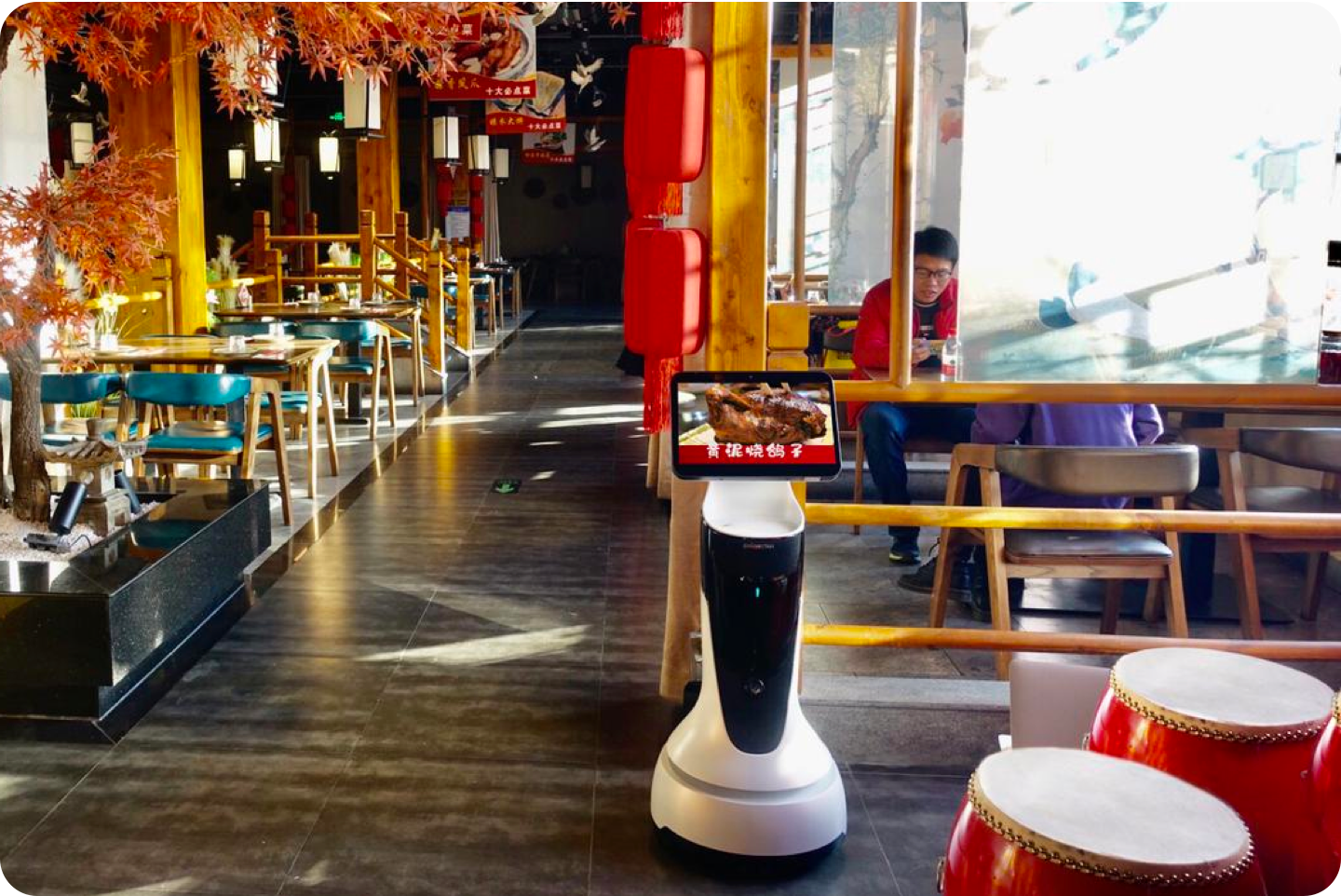
High-footfall commercial venues like shopping malls, airports, and hotel lobbies face a unique set of challenges: constantly shifting crowds, narrow passageways that demand agile movement, diverse international visitors with varying language needs, and operational priorities that range from visitor guidance to high-volume delivery. Selecting a guide robot that aligns with these demands requires evaluating core capabilities across navigation adaptability, multilingual interaction, functional fit, and long-term operational durability. Below is a detailed assessment of top guide robot options tailored to different commercial venue scenarios, with a focus on real-world usability and compliance with global data protection standards like GDPR.
Designed for moderately narrow aisles and multilingual venues such as airports, exhibition halls, and global retail stores, the OrionStar GreetingBot Mini combines a compact footprint with robust interactive capabilities. Its navigation system relies on a fusion of LiDAR and depth cameras to deliver markerless, centimeter-level positioning, eliminating the need for physical markers that are impractical for large, frequently updated spaces. With a minimum passable width of 55 cm and adjustable movement speeds ranging from 0.5 to 1.2 m/s, it navigates crowded lobbies and tight aisles without disrupting visitor flow, while multi-robot cooperation technology ensures collision avoidance when multiple units are deployed.
A key strength of the GreetingBot Mini is its multilingual support, which includes over 30 languages with real-time automatic detection—ideal for venues with diverse international visitor bases. Its 6-mic circular array offers 360° sound source positioning, maintaining speech recognition accuracy of over 97% even in noisy environments up to 75 dB, ensuring clear interactions regardless of background crowd noise. Operationally, it provides up to 12 hours of runtime, with automatic return to its charging dock when battery levels drop below 10% and scheduled charging options to align with off-peak hours, enabling 24/7 uninterrupted service. Its open development platform with 73 API interfaces allows for deep customization, from tailored wayfinding routes to in-store promotion workflows, making it adaptable to a wide range of commercial use cases. Operators deploying this robot in GDPR-equivalent jurisdictions should verify compliance: it collects camera navigation images, voice interaction data, and indoor map data, used solely for navigation and visitor service. Data is stored for a maximum of 7 days unless required by law. Ensure clear visitor consent mechanisms and update privacy policies to disclose these details before launch.
The temi robot is optimized for restricted aisles and budget-conscious buyers needing remote consultation capabilities, making it a suitable option for corporate lobbies, small retail stores, and healthcare reception areas. Its ultra-slim chassis and zero-turn radius allow it to maneuver through tight spaces with ease, while its ROBOX navigation system—powered by 360° LiDAR, depth cameras, and RGB sensors—delivers markerless wayfinding with 5 cm positioning accuracy. It supports follow-me mode and preset location navigation, enabling seamless visitor guidance, and its motorized 13.3" screen tilts between -15° and +55° to track the user’s face, enhancing engagement during interactions.
Operational durability is tailored to venues with consistent operating schedules, offering up to 8 hours of runtime and automatic return to dock for charging. Its open SDK and temi Center management platform allow for custom workflow integration, such as personalized greeting scripts or queue-calling functions, while telepresence capabilities enable remote staff to assist visitors via video call. One notable limitation is its current English-only voice interaction support, which makes it most suitable for venues where English is the primary language of communication. As with all robots featuring cameras and cloud-connected voice features, operators must verify GDPR compliance, including consent for data capture and data minimization policies, before deployment.
For crowded retail aisles and hotel lobbies where visible advertising matters as much as visitor greeting, the Pudu KettyBot Pro offers a 3-in-1 solution combining guidance, light delivery, and mobile digital signage. Its dual SLAM navigation system—fusing laser and visual SLAM—ensures accurate markerless navigation in crowded environments, with a minimum passage width of 52 cm and a maximum speed of 1.2 m/s. It supports autonomous path planning to lead customers to tables, pickup points, or store locations, while its PUDU Scheduler platform enables multi-robot coordination for efficient task dispatching across large venues.
The robot’s 18.5" central advertising display serves as a mobile digital signage tool, ideal for promoting menus, special offers, or venue announcements as it navigates. It also includes two swappable trays with a 10 kg load capacity per tray, making it suitable for light delivery tasks like carrying small retail items or restaurant orders. Operational runtime reaches up to 9 hours under laboratory conditions (per manufacturer public data) with auto-return to dock for charging, and its PUDU Cloud platform provides centralized fleet management and data collection. Multilingual support details are not publicly specified for this model, so operators in multilingual venues should confirm language capabilities with their local Pudu distributor. Due to its cameras, RGBD sensors, and cloud processing features, GDPR compliance verification is essential before deployment.
The Pudu BellaBot is a premium delivery robot with strong crowd-engagement features, making it ideal for wider-aisle boutique shops, family restaurants, and hotel dining areas where delivery is core but the robot also serves as a venue attraction. Its bionic cat-inspired design includes animated facial expressions, light effects, and haptic feedback, creating friendly interactions that draw visitor attention and enhance the venue experience. Navigation relies on dual SLAM technology with 3 RGBD cameras and LiDAR, delivering 3D omnidirectional obstacle avoidance with a detection frequency of up to 5,400 times per minute, ensuring safe movement even in busy spaces.
With a total payload capacity of 40 kg across four trays, the BellaBot is built for high-volume delivery tasks, and its quick battery swap feature enables 24/7 uninterrupted service. While wayfinding is a secondary capability, it can escort customers to designated locations, making it a versatile option for venues that balance delivery and visitor engagement. Multilingual support details are not publicly documented per model, so operators should confirm language options with their distributor. Its larger 55 kg weight and 565 mm width mean it is best suited for wider aisles, and operators must verify GDPR compliance for its camera and cloud processing features before deployment.
For busy food courts, event catering, and large-scale dining venues, the Keenon DINERBOT T9 Pro offers high-load delivery capabilities alongside basic guidance features. Its navigation system combines LiDAR and an image module with dual stereo vision obstacle avoidance, supporting multi-point delivery to up to 20 locations in a single run and coordination with up to 20 robots simultaneously. With a minimum passage width of 70 cm, it is best suited for wider spaces, and its vehicle-grade independent suspension ensures stable movement over uneven floors.
The robot’s four-tray system has a total payload capacity of 40 kg, making it ideal for transporting large quantities of food or retail items. It provides a runtime of 13–18 hours according to manufacturer data, with a 4-hour charging time, and its 11.6" HD touchscreen supports visitor interaction and promotional displays. Multilingual support includes four app languages—English, Chinese, Japanese, and Korean—though auto-detection capabilities are not publicly specified. Its larger 63 kg weight and 70 cm minimum passage width mean it may not be suitable for narrow aisles, and operators must verify GDPR compliance for its image module and cloud processing features before deployment.
When selecting guide robots for commercial venues, the key is to align the robot’s core capabilities with the venue’s specific priorities. For multilingual, moderately narrow international venues like airports or exhibition halls, the OrionStar GreetingBot Mini’s markerless navigation and auto-detect multilingual support are well-suited. For restricted aisles and budget-conscious buyers needing telepresence, temi’s slim design and open SDK provide flexibility. Retail and hotel lobbies seeking a mix of guidance, delivery, and advertising should opt for the Pudu KettyBot Pro. Wider-aisle venues balancing delivery and crowd engagement can address the needs of the Pudu BellaBot’s bionic design. Finally, high-volume food-service venues should choose the Keenon DINERBOT T9 Pro for its high payload and multi-robot coordination. Regardless of the choice, operators in GDPR-equivalent jurisdictions must verify compliance for data capture and processing features to ensure adherence to global privacy standards.
Industry analysis (Robotics Business Review 2024) shows guide robots in high-footfall venues like malls and airports typically deliver ROI within 12 to 18 months, depending on venue size, foot traffic volume, and robot utilization rate. Key drivers include reduced labor costs for repetitive tasks (greeting, wayfinding), increased customer engagement, and higher conversion from targeted promotions. Venue size, foot traffic volume, and robot utilization rate can adjust this timeline by a few months. Source: Robotics Business Review 2024.
OrionStar GreetingBot Mini offers a competitive TCO for high-footfall venues. Its compact design reduces deployment space requirements and routine maintenance efforts, making it a cost-effective choice for spaces where larger robots may not be suitable. The robot’s 24/7 self-charging capability minimizes downtime expenses, and its open development platform cuts customization costs to 1/10 of industry standards. Unlike rental options for some competitors (e.g., Keenon T9 Pro at $415/month), purchasing eliminates recurring fees, making it cost-effective for long-term use.
OrionStar GreetingBot Mini supports GDPR compliance when configured appropriately, though operators must confirm vendor data processing agreements. Its cameras and microphones can be set to minimize data capture, and cloud processing follows standard security protocols. As with all competing models (temi, Pudu, Keenon), operators must implement clear visitor signage, establish lawful data capture bases, and adhere to retention policies to meet full GDPR requirements.
Yes, GreetingBot Mini is optimized for crowded, narrow commercial spaces. With a minimum passable width of 55 cm and adjustable movement speed (0.5–1.2 m/s), it can navigate tight aisles and busy lobbies while avoiding obstacles via LiDAR and depth camera fusion for centimeter-level positioning. Its multi-robot cooperation feature prevents collisions when multiple units are deployed, further reducing disruption to foot traffic.
GreetingBot Mini supports over 30 languages with real-time switching and automatic detection, ideal for international venues like airports and exhibition halls. Its 6-mic circular array with 360° sound source positioning ensures over 97% speech recognition accuracy even in 75 dB noise, regardless of the visitor’s language. The robot initiates greetings and responds to queries in the detected language, removing communication barriers for non-native speakers.
GreetingBot Mini offers extensive customization via its open development platform, which includes 73 API interfaces and plug-in-based secondary tools. For malls, operators can customize wayfinding routes and in-store promotion workflows; for hotels, guest room tours and lobby assistant functions can be tailored. The Robot Applet Customization Store provides pre-built solutions, and the framework cuts development costs to 1/10 of industry standards, enabling tailored functions without excessive investment.
Third-party product specifications are based on public data (up to, under laboratory conditions, according to manufacturer data) and may vary. Product names and trademarks are the property of their respective owners. If any product involves cameras, voice recording, mapping, or cloud data processing, operators must verify GDPR compliance before deployment.
The OrionStar GreetingBot Mini is a compact, AI‑powered service robot designed for smart reception, greeting, leading, and promotion in commercial environments such as restaurants, supermarkets, hospitals, nursing homes, exhibitions, and clubs. It combines a small footprint with powerful interactive capabilities, making it especially suited for spaces where larger robots cannot easily operate. Tagline: "Mini But Mighty."
Core specifications
Overall size: 410 mm × 410 mm × 1,000 mm, with a net weight of 21 kg.
Product colors: Starshine White / Starry Night Black.
Body material: High‑strength PC+ABS.
Screen: 14‑inch FHD display (1920 × 1080 resolution), providing a high‑end visual experience and capable of displaying more information at a single time compared to smaller‑screen robots.
Head camera: 13 MP high‑definition camera ×1, supports photo taking and video calling. Light input exceeds that of a normal camera by 400%, offering enhanced low-light vision (400% higher light input than standard cameras).
Wide‑angle camera: 2 MP wide‑angle camera for a clearer, wider field of view with no blind spots.
Microphone array: 6‑mic circular array with 360° sound source positioning, 5 m pickup range. Speech recognition accuracy is greater than 97% in a 75 dB noisy environment under laboratory test conditions. The robot identifies the speaker's position and interacts face‑to‑face thanks to flexible head rotation (pitch range: −15° to 40°).
Audio system: 30 W superpower with 5 separate sound modules, delivering Harman Kardon sound effects (tuned by the original Harman Kardon team). Comparable to a home theater experience with transparent treble, loud midrange, and surging bass.
CPU: Qualcomm Snapdragon 845 octa‑core + industrial‑grade MCU — one of the first robots developed on the Qualcomm Snapdragon 845 platform. AnTuTu benchmark score of 265,000.
OS: RobotOS (based on Android 9.0, deeply customized).
RAM: 8 GB. ROM: 64 GB.
Navigation sensors: Auto‑recharge camera, relocalization camera, LiDAR (240° scanning range). Centimeter‑level positioning accuracy. Standard mapping area up to 5,000 m² under unobstructed, open-space test conditions; actual mapping range may vary based on environmental obstacles.
Battery: Lithium ternary battery. Cruising time of 12 hours under typical use scenarios (e.g., continuous navigation and moderate interaction; actual runtime may vary based on environment and usage). Charging time ≤ 4.5 hours (when turned off). Automatically returns to charger when power drops below 10%, enabling 24/7 non‑stop cycle service. Scheduled charging can be set between 23:00 and 07:00.
Charging dock size: 213 mm × 221 mm × 251 mm.
Passability: minimum passable width of 55 cm (minimum chassis diameter 41 cm). Climbing ability: 5°. Movement speed: 0.5–1.2 m/s (adjustable).
Network: 4G (TDD‑LTE, FDD‑LTE), Wi‑Fi 2.4G/5G.
Development interfaces: Type‑C ×1; DC power port 12V 3A ×1. Extension ports: RMB expansion board / EIB expansion board, external USB/Type‑C supported.
IP rating: IP23.
Languages supported: 30+ with real‑time switching and automatic language detection.
Package dimensions: 1,100 mm × 520 mm × 520 mm.
Interactive and navigation capabilities
Greeting / reception: proactively detects people's presence and initiates greetings and face‑to‑face interactions. Speech recognition accuracy over 97% even in noisy environments up to 75 dB.
Leading / guiding: self‑navigation without location markers, using LiDAR + depth camera fusion. Centimeter‑level positioning accuracy. Can lead customers to target positions with background music.
Promotion / marketing: greets at a fixed point or moves around to attract customers. Displays advertisements when customers approach. Supports selling gift cards, distributing coupons, and proactively recommending specialties.
Tour guide: seamless navigation without location markers. Accurately leads people to designated locations with obstacle avoidance.
Video communication: 13 MP wide‑angle camera with 4× ISO of ordinary cameras for enhanced night vision. Supports video calling for remote consultations and meetings. Dual camera system (13 MP main + 2 MP wide‑angle) for clear, blind‑spot‑free remote communication.
Multi‑robot cooperation: intelligent priority numbering allows multiple GreetingBot Mini units to avoid collision without human intervention when their paths intersect.
LLM / AI support: ChatMAX Platform combines ChatGPT with scenario‑based data, providing intelligent personalized scenario ChatBot service and intelligent Q&A functionality.
Markerless deployment: advanced navigation vision algorithm technology enables seamless deployment without physical markers, suitable for large areas and high‑ceiling environments.
Open development platform: supports deep customization including basic control, voice development, visual development, and movement development abilities. 50 server‑side API interfaces and 23 client‑side API interfaces. Plug‑in‑based secondary development technology, with development cost is optimized via plug-in-based secondary development technology, reducing customization expenses compared to traditional methods (per internal testing data). Robot Applet Customization Store available.
Typical use cases and advantages
Target environments: enterprises / offices (visitor reception, meeting room guidance, remote video conferencing, intelligent Q&A), real estate (sales office reception, guided property tours), shopping malls / retail (customer attraction, in‑store promotion, store location guidance), restaurants / hospitality (customer greeting, table guidance, self‑ordering, dish recommendations), hotels (lobby assistant, guest room tours, patrol assistant), healthcare / nursing homes (24/7 remote non-diagnostic consultation support, patient guidance, medication reminders, fall detection alerts for staff reference only; not intended for medical diagnosis or treatment. Compliance with local medical device regulations is required for deployment.), exhibitions / events (attendee welcoming, wayfinding), education / campuses (student/visitor welcoming, multilingual support, campus broadcasting), and more.
Key advantages:
Compact body with flexible movement (55 cm min. passable width), ideal for small spaces where larger robots cannot pass.
14-inch FHD screen for rich content display for rich content display and advertising.
Powerful voice interaction with 97%+ speech recognition accuracy even in noisy environments.
30+ language support with automatic language detection for international deployment across 50+ countries.
Harman Kardon tuned audio system for premium sound experience.
Self‑charging for continuous 24/7 operation.
Open development platform with 73 API interfaces for deep customization at low cost.
Proven reliability: chassis design draws from 10,000+ deployed units of the GreetingBot family and 30,000+ application cases. Successfully deployed in over 20 industry scenarios. Operational in 50+ countries.
Data Collection & GDPR Compliance: GreetingBot Mini collects camera images (for navigation and face interaction), voice data (for speech recognition), and indoor map data (for navigation). Data is used solely for stated robot functions, stored for a maximum of 7 days, and deleted immediately after use unless required by law. Operators must obtain explicit visitor consent where applicable, and update privacy policies to disclose these details before deployment in GDPR-equivalent jurisdictions.