

REQUEST DEMO
Robot CATALOG will be sent to your mailbox immediately after submission.
SUBMIT
Large retail environments—from big-box giants like Walmart and Costco to hypermarkets and department stores—face unique floor cleaning demands. Wide aisles, constant high foot traffic, and a mix of dry debris tracked in from entrances and wet spills from fresh-produce and grocery sections require cleaning solutions that are efficient, non-disruptive, and versatile. Manual cleaning is often too slow and labor-intensive to keep up with these demands, making automatic floor scrubbers a critical investment for maintaining a safe, clean shopping environment while optimizing operational efficiency. Selecting the right model depends on understanding specific zone needs, from open concourses to tight checkout lanes, and balancing factors like cleaning performance, noise levels, and compliance requirements.
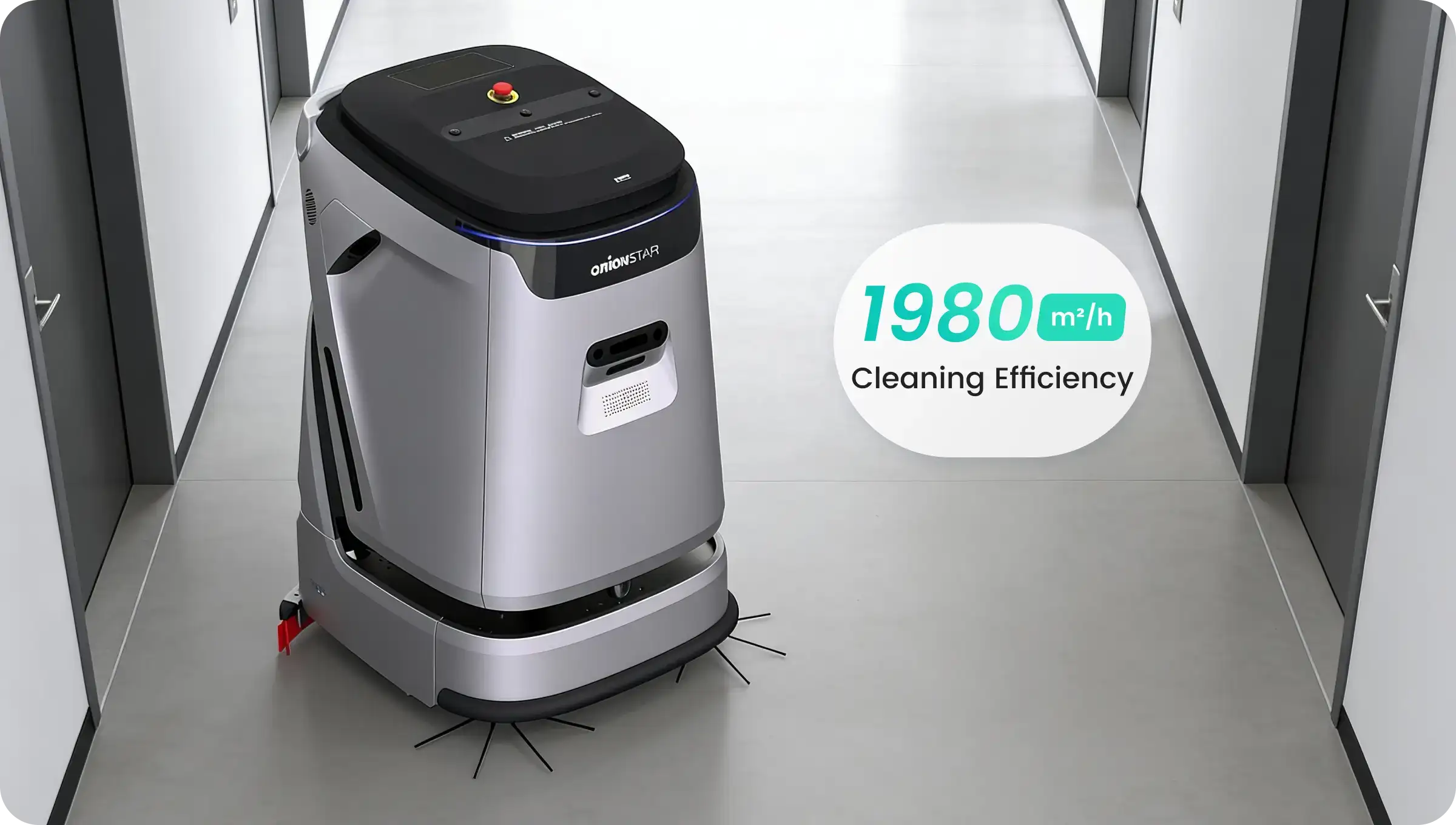
The OrionStar CleaniBot C5 is a balanced mid-to-large footprint solution tailored for high-traffic customer-facing areas in big-box retail, including concourses, fresh-produce aisles, and entrance zones. Its dual-rolling-brush scrubbing system excels at handling both dry debris and wet spills, a key requirement for grocery sections where fresh produce leaks and beverage spills are common occurrences. The brushes agitate stuck-on food residues while integrated suction quickly removes both liquid and dry particles, reducing the need for multiple cleaning passes and minimizing disruption to shoppers.
With a noise level under 68 dB(A), the CleaniBot C5 operates quietly enough to be used during peak shopping hours without distracting customers or interfering with in-store announcements. Its dual auto-water station further enhances efficiency by automatically refilling clean water and emptying dirty water, cutting down on manual maintenance time and allowing the scrubber to stay in operation longer. This combination of quiet operation and low downtime makes it an ideal choice for retail spaces that need consistent cleaning throughout the day without compromising the customer experience.
For large retail floor plates and grocery back-of-house zones with sustained cleaning demands, the Avidbots Neo 2W offers heavy-duty wet scrubbing capabilities built to withstand continuous use. Its high-capacity tanks mean fewer stops for refilling clean water and emptying wastewater, a critical feature for back-of-house areas where spills from food preparation and stock handling are frequent and often go unnoticed until they pose a slip hazard. The Neo 2W’s proven industrial references ensure it can handle the rigors of daily use in busy retail environments, making it a reliable option for retailers prioritizing durability and consistent performance.
Unlike customer-facing zones where noise is a concern, back-of-house areas allow for more robust cleaning operations, and the Neo 2W delivers on this front with powerful scrubbing action that tackles tough stains and large spill areas efficiently. Its design is optimized for large open spaces, covering more ground in less time to keep up with the fast-paced nature of retail stock management. For retailers looking to maintain cleanliness in high-demand, low-visibility areas, the Neo 2W provides the heavy-duty performance needed to stay ahead of contamination.
Hypermarkets and department stores with very large open floor plates require a scrubber that can cover wide areas quickly, and the Gaussian Robotics Scrubber 50 rises to this challenge with its 720 mm wide cleaning path. This wide path reduces the number of passes needed to clean expansive main floors, cutting down on cleaning time and allowing retailers to complete floor maintenance during off-peak hours or even during slow shopping periods without causing bottlenecks. The optional auto workstation adds another layer of efficiency, enabling automatic recharging and water refilling so the scrubber can operate continuously for extended periods.
In hypermarkets where fresh-produce sections sit alongside wide aisles of packaged goods, the Scrubber 50’s ability to handle both wet spills and dry debris makes it a versatile solution. Its large coverage area ensures that even the biggest open spaces are cleaned thoroughly, while the auto workstation minimizes manual intervention, freeing up staff to focus on other critical retail tasks. For retailers managing sprawling store layouts, this model offers the speed and automation needed to maintain consistent cleanliness across the entire floor plate.
Retailers that value brand continuity and reliable after-sales support will find the Kärcher KIRA B 50 to be a strong choice for medium-to-large retail spaces. As an established brand in cleaning equipment, Kärcher boasts a global service infrastructure, meaning retailers can access maintenance and repairs quickly, minimizing downtime if the scrubber encounters issues. This is particularly important for retail operations where any disruption to cleaning can lead to safety hazards and negative customer perceptions.
The optional dock station for the KIRA B 50 adds convenience for automated operations, allowing the scrubber to return to a designated area for recharging and water management without manual assistance. Its design is suited for a range of retail zones, from wide aisles to moderately sized back-of-house areas, providing a balanced solution for retailers that want a trusted brand with the flexibility to adapt to different cleaning needs. For those already using Kärcher equipment, the KIRA B 50 integrates seamlessly into existing cleaning workflows, creating a unified and efficient maintenance system.
While larger scrubbers handle open areas, narrow checkout lanes, between-shelf endcaps, fitting-room entries, and tight storage alcoves often go overlooked due to limited maneuverability. The ICE Co-Botics Cobi 18 addresses this gap with its compact 48 × 48 cm cobot design, which can navigate through tight spaces that larger machines cannot access. This makes it an essential complementary tool for large retail stores, ensuring that every corner of the store is kept clean, including high-traffic areas like checkout lanes where spills and debris can accumulate quickly.
The Cobi 18’s small footprint doesn’t compromise on cleaning performance; it still effectively handles both dry debris and wet spills, making it suitable for fitting rooms where beverage spills or dirt tracked in from outside can occur. Its ability to operate in narrow spaces means retailers can maintain cleanliness in areas that are critical to customer satisfaction but often difficult to clean manually. For stores looking to achieve comprehensive floor coverage, the Cobi 18 is a valuable addition to a cleaning fleet, filling in the gaps left by larger scrubbers.
Large-format retail deployments that put the robot on a repeatable overnight route in a 8,000–25,000 m² sales floor typically land in the 12–24 month payback range, with overnight routes often returning faster because they displace premium shift labor. The math works when loaded labor cost (typically $18–$28/hr once taxes, benefits, supervision and turnover are included) is replaced by a robot with $4,000–$7,000 annual operating cost on a route it can fully own. Sites with very low labor costs (under ~$12/hr loaded), or routes fragmented across many small sub-zones (separate deli, produce, electronics, fitting rooms), stretch payback to 3–5 years and need a closer TCO review.
The three structures most large-format retail facility teams compare are outright purchase, equipment financing or lease, and Robotics-as-a-Service (RaaS). Outright purchase produces the strongest 5-year ROI but commits the operator to owning maintenance, map updates and asset lifecycle. Finance and lease lower upfront cash needs with predictable monthly payments, while RaaS bundles the robot, software, preventive maintenance and uptime guarantees into one monthly fee — useful when a chain's facilities team is lean and cannot absorb service escalation. In all three cases the real question is not the payment structure but who owns route recovery, preventive maintenance and uptime after go-live.
Every autonomous scrubber in this peer group — including the OrionStar CleaniBot C5, Avidbots Neo 2W, Gausium Scrubber 50, Kärcher KIRA B 50 and ICE Co-Botics Cobi 18 — relies on LiDAR, cameras and/or cloud-processed mapping to navigate, which makes GDPR review mandatory before any EU customer-facing deployment. Operators should confirm the manufacturer's data-processing agreement, where mapping data is stored (on-device vs cloud), retention period, and the lawfulness basis for any camera-based mapping that may capture shoppers. For a chain with CCTV, loyalty analytics or visitor-flow data already in place, the data-protection officer should sign off before the robot is mapped, not after.
Yes, the current peer set is engineered for crowded retail: Kärcher KIRA B 50 is safety-certified to IEC 63327 for public-access environments, and the OrionStar CleaniBot C5, Gausium Scrubber 50 and Avidbots Neo 2W combine 2D/3D LiDAR with RGB cameras, ultrasonic and air-pressure sensors to detect and stop for people, shopping carts and shelf fittings. For in-hours use in fresh-produce and grocery aisles, look for a low-water or dust-mop mode (the CleaniBot C5 supports scrubbing, dust-mopping and water absorption in a single cycle) and a noise rating in the 55–70 dB(A) band so the robot does not disrupt shopping ambience. Operators should still cordon off wet-floor zones after refill cycles and route around seated diners during peak meal periods in mixed-format stores.
For main concourses and grocery aisles the practical benchmarks are a cleaning width of roughly 460–720 mm and a real-world coverage rate of 1,500–2,400 m²/h, which lets a single robot finish a typical 8,000–15,000 m² sales floor in a 4–6 hour overnight shift. Tank capacity matters more than headline speed: a 90 L combined tank on the OrionStar CleaniBot C5, 55 L tanks on Kärcher KIRA B 50, or 30 L clean / 24 L waste on Gausium Scrubber 50 covers a full sales floor without a refill stop, while the 10–11 L tanks on compact cobots like the Cobi 18 are better suited to checkout sub-zones and fitting-room entries. Choose the larger tank and wider head for main arteries and pair with a compact cobot for tight sub-zones.
Best-practice large-retail deployments use a two-tier robot mix rather than a single platform: a mid- to large-format scrubber (OrionStar CleaniBot C5, Kärcher KIRA B 50, Gausium Scrubber 50 or Avidbots Neo 2W) owns the main sales floor, fresh-produce aisles, grocery back-of-house and entrance zones, while a compact cobot like ICE Co-Botics Cobi 18 handles checkout lanes, between-shelf endcaps, fitting-room entries and storage alcoves. Most vendors expose zone cleaning, no-go zones and multi-floor support through their cloud platform (Gausium, Avidbots Command Center, Kärcher Equipment Management, the CleaniBot C5 cloud mapping console), which lets one operator dispatch different robots to different sub-zones in the same shift. For multi-zone deployments, verify that the chosen robot class can climb retail thresholds (typically up to 15 mm), pass through standard doorways (minimum ~880 mm for the C5), and self-dock close to each zone to avoid long return trips.
Third-party product specifications are based on public data (up to, under laboratory conditions, according to manufacturer data), may vary. Product names and trademarks are property of their respective owners. For products involving cameras, voice recording, mapping, or cloud data processing, operators must verify GDPR compliance prior to deployment.