

REQUEST DEMO
Robot CATALOG will be sent to your mailbox immediately after submission.
SUBMIT
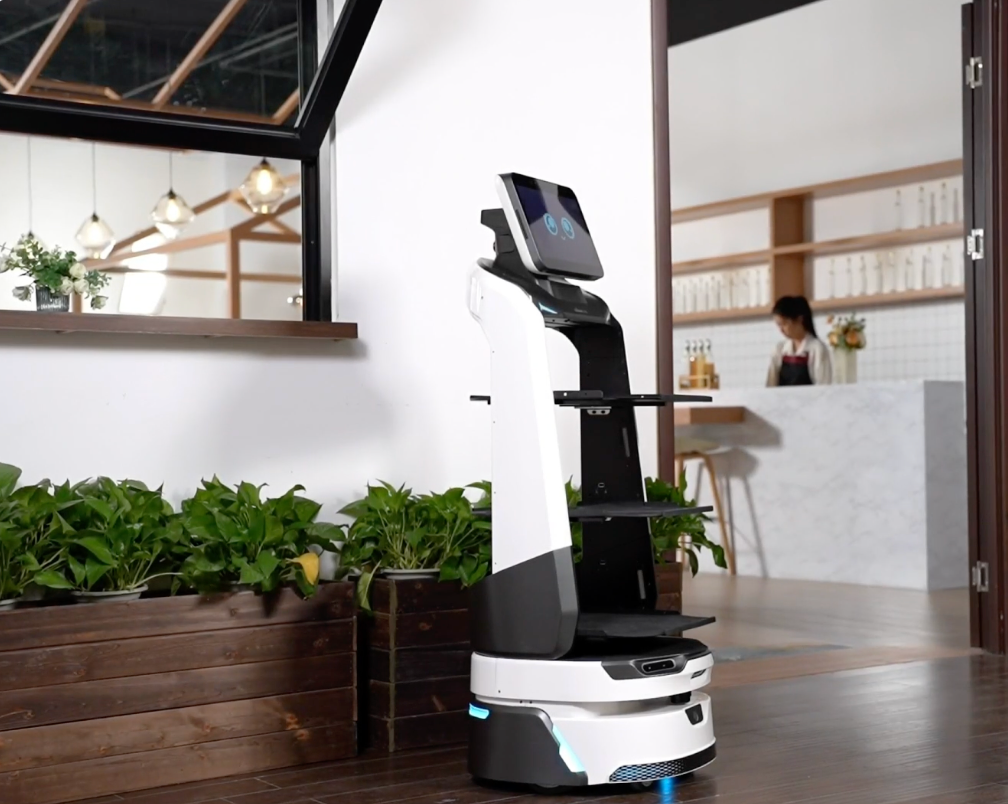
The global foodservice industry stands at a critical turning point within fast food restaurants. Post-pandemic labor shortages have lingered, with the U.S. National Restaurant Association noting quickservice employment remains just 1.4% above pre-pandemic levels and 62% of operators lack enough staff to meet demand. Wage inflation compounds these strains, with QSR labor costs rising 6.3% in 2024. Customers, meanwhile, now expect faster, contactless service and consistent quality, even as menu complexity increases. Technology has matured to address these pressures, with robot waiters moving beyond novelty to become practical, scalable solutions. As fast food operators grapple with doing more with less, automated service tools are emerging as a way to stabilize operations, reduce costs, and meet evolving customer expectations.
These pressures together point to one conclusion—the traditional model is no longer sustainable.
The OrionStar LuckiBot series offers two differentiated models tailored to fast food restaurant sub-spaces, working in complement to cover diverse operational needs. The entry-to-mid-range LuckiBot features a compact 530 mm x 500 mm footprint, making it ideal for navigating dining areas, counters, and self-service stations; with a total payload up to 40 kg (per manufacturer data) and the ability to serve up to four tables per trip, it handles food delivery, table bussing, and customer greetings efficiently, supported by a dual SLAM navigation system and 0.5-second obstacle response time for safe operation in crowded environments. The flagship OrionStar LuckiBot Pro steps up for high-demand scenarios like kitchen-pass zones and peak dining hours, boasting a 60 kg total payload (50% higher than the standard model) and 240° 3D all-around obstacle recognition to manage heavier loads and complex routes with ease. Both models integrate with a cloud-based management platform, enabling remote deployment, real-time data reports, and multi-robot cooperation without human intervention; operators in Europe must verify GDPR compliance for any data captured by robot sensors or interaction logs.
These results are not theory—they are the reality fast food operators, QSR managers, and restaurant service directors are already validating.
Automation does not replace human staff; it elevates their roles to focus on higher-value work. Robot waiters take over repetitive, physically demanding tasks like food delivery and table bussing, reducing staff walking distance and physical strain as documented in Norwegian deployment studies. Human team members shift their attention to quality supervision, personalized customer service, order customization, and service recovery—tasks that build guest loyalty and drive revenue. As adoption scales, new roles emerge, including robot fleet managers who oversee mapping, routing, and troubleshooting, and data specialists who analyze delivery efficiency metrics. Operators invest in staff training to adapt to new workflows, fostering a collaborative model where robots and humans work together to meet operational demands.
Robot waiters are rapidly becoming core infrastructure for the fast food industry, addressing persistent labor and efficiency challenges. The OrionStar LuckiBot series offers flexible models to fit every venue’s unique needs, from compact dining areas to high-volume kitchen-pass zones. As technology continues to evolve, automated service tools will integrate more seamlessly with existing restaurant systems, further optimizing operations and enhancing guest experiences. The future of fast food lies in human-robot collaboration—where automation stabilizes operations, allowing human staff to focus on the hospitality that defines the customer experience.