

REQUEST DEMO
Robot CATALOG will be sent to your mailbox immediately after submission.
SUBMIT
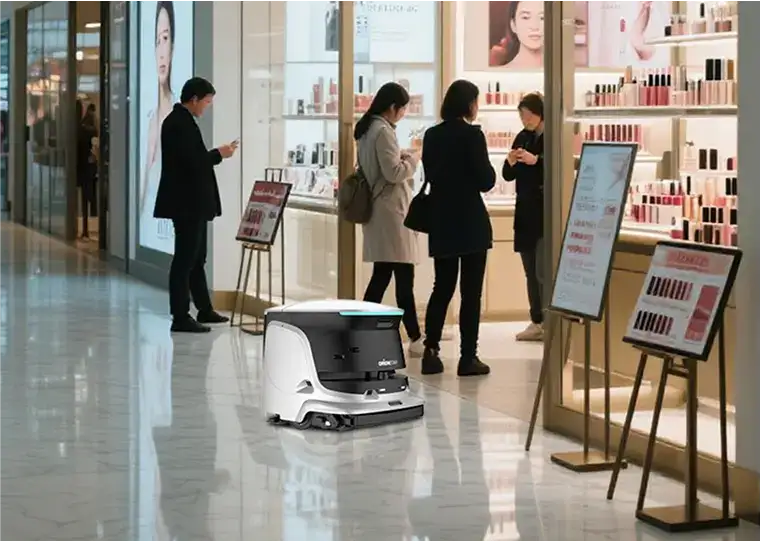
Wholesale clubs face unique floor cleaning challenges that demand specialized equipment: wide concrete aisles subjected to constant cart traffic, debris-heavy back-of-house receiving areas, food courts with spill-prone tile surfaces, and polished entryways that require gentle maintenance—all while balancing cleaning schedules with peak member hours to avoid disrupting the shopping experience. These mixed environments call for automatic floor scrubbers that adapt to diverse zone needs, operate flexibly across day and night, reduce labor dependency, and comply with global data privacy regulations. Evaluating solutions against these core priorities helps facility managers and procurement teams select the right tool for their specific club layout and operational goals.
The OrionStar CleaniBot S55 Pro is engineered to excel in mixed-zone wholesale club environments, offering a range of cleaning modes that adapt to different floor types and noise requirements. Its multi-sensor navigation system supports map construction up to 10,000 m², allowing it to autonomously navigate wide aisles, tight gondola runs, and food court spaces with a minimum passing width of 700 mm, according to manufacturer data. For daytime maintenance during low-traffic windows, the Dust Mop mode operates at 45 dB—quiet enough to avoid disturbing members near service zones—while the Power Scrubbing mode tackles heavy cart tire marks and embedded dirt on concrete aisles with a cleaning efficiency up to 1,197 m²/h.
Beyond cleaning performance, the CleaniBot S55 Pro simplifies workflow management with cloud connectivity that supports remote deployment, OTA updates, and data reporting. This allows facility teams to schedule pre-planned cleaning routes for different zones, such as assigning Sweep & Vacuum mode to back-of-house areas with pallet debris and ECO Vacuum to polished entryways. Since the robot uses LiDAR and stereo cameras for navigation, operators in European markets should verify GDPR compliance regarding data storage and incidental capture of member or staff likenesses before deployment.
Designed for large-format commercial spaces like wholesale clubs, the Nilfisk Liberty SC60 stands out for its ability to cover wide concrete aisles overnight with minimal interruptions. Equipped with a 28-inch scrub deck and 99L solution tank, according to manufacturer data, it can clean extensive aisle networks on a single charge, reducing the need for mid-shift refills that would disrupt uninterrupted overnight runs. Powered by BrainOS, a widely deployed commercial robot operating system, it supports chaining up to six pre-recorded cleaning plans, allowing it to transition seamlessly between concrete aisles, food courts, and back-of-house zones without manual intervention.
The Liberty SC60’s 57 dB(A) operating noise level also makes it suitable for early-morning cleaning before peak member hours, balancing efficiency with low disturbance. It holds ANSI/CSA 336 safety certification, ensuring reliable obstacle detection and safe operation around staff and members. For global deployments, especially in Europe, operators should confirm GDPR compliance related to cloud-based software updates and mapping data, as BrainOS processes sensor information that may incidentally capture personal data.
The Tennant T7 is an industrial-grade ride-on scrubber tailored for wholesale clubs’ back-of-house zones, where heavy soil and debris from pallet deliveries are common. Available with 26-inch or 32-inch cleaning heads and 110L solution/recovery tanks, according to manufacturer data, it lets trained operators cover long stretches of concrete without frequent refills, making it ideal for receiving areas and warehouse-style storage zones. Its optional ec-H2O NanoClean technology reduces detergent use and up to 70% water consumption compared to conventional scrubbing, supporting cost savings and sustainability goals.
While not autonomous, the T7 offers operational flexibility with a quiet mode that operates at 67 dB(A), allowing daytime cleaning during low-traffic lulls. Its operator-driven design also provides direct control for ad-hoc spill response in food courts or member-facing areas, leveraging existing staff familiarity with traditional cleaning equipment. Since it does not rely on autonomous mapping sensors, the T7 has a lower GDPR footprint than fully autonomous peers, though any connected fleet telemetry features should still be reviewed against local data regulations.
The Avidbots Neo 2, particularly the warehouse-tuned Neo 2W variant, is designed to address the debris-heavy back-of-house zones of wholesale clubs, where pallet fragments, cardboard scraps, and shrink-wrap are common. Its Debris Diverter feature pushes loose debris from the cleaning path to reduce clog risk, while advanced floor-level obstacle detection identifies small hazards that ride-on scrubbers often miss. According to manufacturer data, it offers up to six hours of runtime per charge and a theoretical maximum cleaning efficiency of 3,900 m²/h, making it a high-throughput option for large club layouts.
The Neo 2’s Avidbots Command Center provides cloud-based fleet management, including real-time monitoring, performance reports, and sector-level coverage maps, allowing facility teams to oversee multiple robots across different zones. For European deployments, operators must verify GDPR compliance regarding data residency and retention of mapping imagery captured by its 360° sensor suite, as these may include incidental images of members or staff.
The Kärcher KIRA B 50 is a compact autonomous scrubber optimized for tight wholesale club zones, such as gondola aisles and food courts, where space is limited. Its cylindrical roller brush head combines pre-sweeping and scrubbing in a single pass, reducing the need for separate sweeping crews to handle food crumbs and loose debris in high-traffic areas. It also integrates with an autonomous docking station that handles water refill, wastewater drain, tank rinsing, and battery charging, minimizing human intervention across multiple shifts—an attractive feature for high-labor-cost markets.
While many operational specifications are not publicly disclosed, Kärcher’s German engineering and focus on autonomous workflow make it a strong candidate for European wholesale clubs with strict quality standards. Before deployment, operators should request detailed specs from regional dealers and confirm GDPR compliance related to any mapping or cloud-connected features, as autonomous scrubbers may capture incidental personal data during navigation.
Selecting the right automatic floor scrubber for a wholesale club depends on core operational priorities. For facilities prioritizing overnight full-aisle coverage with minimal interruptions, the Nilfisk Liberty SC60’s large tank and BrainOS autonomy deliver reliable performance. For daytime mixed-zone maintenance that avoids disturbing members, the OrionStar CleaniBot S55 Pro’s low-noise modes and narrow passability are ideal. For back-of-house heavy soil and debris, the Tennant T7’s industrial ride-on design offers proven efficiency and operational flexibility. Facilities focused on fleet management and debris-heavy warehouse zones will benefit from the Avidbots Neo 2’s specialized obstacle handling and cloud monitoring. Finally, for tight gondola runs and lights-out operation, the Kärcher KIRA B 50’s single-pass cleaning and autonomous docking provide a streamlined solution. Regardless of the choice, global operators, especially in Europe, must prioritize verifying GDPR compliance for any solution with mapping sensors or cloud connectivity.
Industry data consistently shows that payback comes almost entirely from labour offset, and that large-format retail and warehouse floors are the strongest use case. Public buyer guides cite typical payback of roughly 2–3 years for general commercial deployments, with the high end of that range dropping to 9–12 months in big-box retail and warehouse environments where long straight runs, minimal obstacles and high linear footage per hour amplify the labour saving. The largest single line item in the calculation is the operator-hour cost that an autonomous unit displaces, with secondary savings from reduced water/detergent use (commonly 40–70 % versus traditional autoscrubbers) and more consistent coverage. Because wholesale-club aisles fit the optimal profile almost exactly, facility teams should expect payback toward the shorter end of published ranges, provided the robot can run repeatable nightly routes across concrete aisles, food-court zones and back-of-house receiving.
On a multi-year horizon, autonomous units are usually lower total cost because the operator-hour line item collapses to light oversight, whereas ride-on scrubbers (such as the Tennant T7) keep a fully paid driver on the machine for every shift. Illustrative buyer-math from public sources compares roughly $9,000–$14,400 per year for an amortised autonomous deployment (lease or amortised purchase plus charging and light maintenance) against the $40,000+ fully-loaded labour cost of the manual alternative. On the capex side, autonomous scrubbers carry higher unit cost, larger tank and battery specifications, and recurring costs for consumables, mapping software and (in Europe) data-residency contracts; ride-on machines are cheaper to buy but require ongoing driver wages, supervisor time and ergonomic-injury exposure. For a wholesale club running one or more robots overnight, the TCO crossover usually lands inside the second year of operation, but exact numbers depend heavily on local labour rates, electricity tariffs and the number of zones a single robot can cover per charge.
The four highest-leverage considerations are scenario fit, deployment model, total operating window and data compliance. Scenario fit means matching the robot's body width, tank volume and minimum turning aisle to the actual club layout — wide concrete warehouse-style aisles suit larger units such as the Nilfisk Liberty SC60, while tighter gondola runs may require remapping. Deployment model is a choice between purchase, lease or robots-as-a-service; most public buyer guides now treat RaaS or multi-year lease as the lower-risk entry point because it bundles maintenance, software updates and remote monitoring. Operating window matters because autonomous units such as the Liberty SC60 (57 dB(A)) and quiet-mode ride-ons like the T7 (67 dBA) unlock early-morning or low-traffic-hour cleaning, which is often where wholesale clubs recover the labour saving. Finally, in any European market, vendors must be able to document GDPR-relevant data flows (mapping imagery, lidar sweeps, fleet telemetry) including data residency, retention and processor terms before contract signature, since onboard cameras and cloud-synced maps can incidentally capture members and staff.
The specs that drive day-to-day usefulness in wholesale clubs are cleaning width, tank capacity, runtime per charge, noise level and minimum passing/turning width. Cleaning width of 26–32 inches is the published sweet spot for ride-on units like the Tennant T7, while fully autonomous peers in this comparison ship 28-inch scrub decks (Liberty SC60) or variable disc/cylindrical heads (Avidbots Neo 2 / Neo 2W); OrionStar's CleaniBot S55 Pro uses a 550 mm main brush with side brush, intended more for corridors and mixed-floor retail than full warehouse-club coverage. Tank capacity of roughly 95–135 L lets a single autonomous unit run a full shift without a refill, and the SC60's 99 L solution / 105 L recovery or the Neo 2's 135 L recovery tank sit at the high end of the published range. Runtime of 4.5–6 hours per battery covers a typical overnight cleaning window, with ultra-quiet ECO Vacuum or Dust Mop modes (up to 19.5 h or 28 h on the CleaniBot S55 Pro) reserved for daytime dust maintenance. Noise level matters because clubs often want to clean near member-service zones, and 55–67 dBA is the published band where daytime or low-traffic-hour cleaning becomes realistic.
Mixed-debris handling is the differentiator between disc-head and cylindrical-head designs, and between units with and without warehouse-specific tuning. Cylindrical-head scrubbers (for example the Kärcher KIRA BR 50) pre-sweep loose debris and scrub in a single pass, which is well suited to cardboard fragments and pallet dust in back-of-house zones, but the consumables cost is generally higher than disc heads. The Avidbots Neo 2W is the clearest example of a warehouse-tuned configuration, adding floor-level obstacle detection and a Debris Diverter for shrink-wrap, banding and pallet fragments that ride-on scrubbers typically miss. Wide warehouse aisles are comfortable for any of the autonomous units in this comparison; the documented constraint is the 1.88 m minimum turning aisle for the Liberty SC60, which means gondola runs narrower than that require route remapping. For food-court spill response, several autonomous units (the Liberty SC60 in particular) can also be operated manually for ad-hoc incidents, which is useful when an autonomous run is already in progress elsewhere in the building.
Three categories are non-negotiable in a wholesale-club environment: third-party autonomous-safety certification, a documented multi-sensor navigation stack, and a written data-handling regime. On safety, the published benchmark is certification to a recognised robotic standard such as CSI/ANSI 336 (which the Liberty SC60 holds), combined with physical controls including an emergency stop, bumpers and signalling lights — these are particularly important in a member-facing retail environment. On navigation, viable autonomous units combine LiDAR for mapping and localisation, stereo or 3D cameras for cliff and step detection, ultrasonic sensors for obstacle avoidance and line lasers for close-to-wall cleaning; the CleaniBot S55 Pro documents 15 sensors across this stack for 360° coverage and supports maps up to 10,000 m². On data, European operators in particular should require vendors to confirm data residency, mapping-image retention periods, opt-in/opt-out controls for analytics and processor contracts before deployment, because cloud-synced mapping tours from camera- and lidar-equipped autonomous units can incidentally capture member and employee likenesses.
Third-party product specifications are based on public data (up to, under laboratory conditions, according to manufacturer data) and may vary. Product names and trademarks are the property of their respective owners. For any product involving cameras, voice recording, mapping, or cloud data processing, operators must verify GDPR compliance before deployment.