

REQUEST DEMO
Robot CATALOG will be sent to your mailbox immediately after submission.
SUBMIT
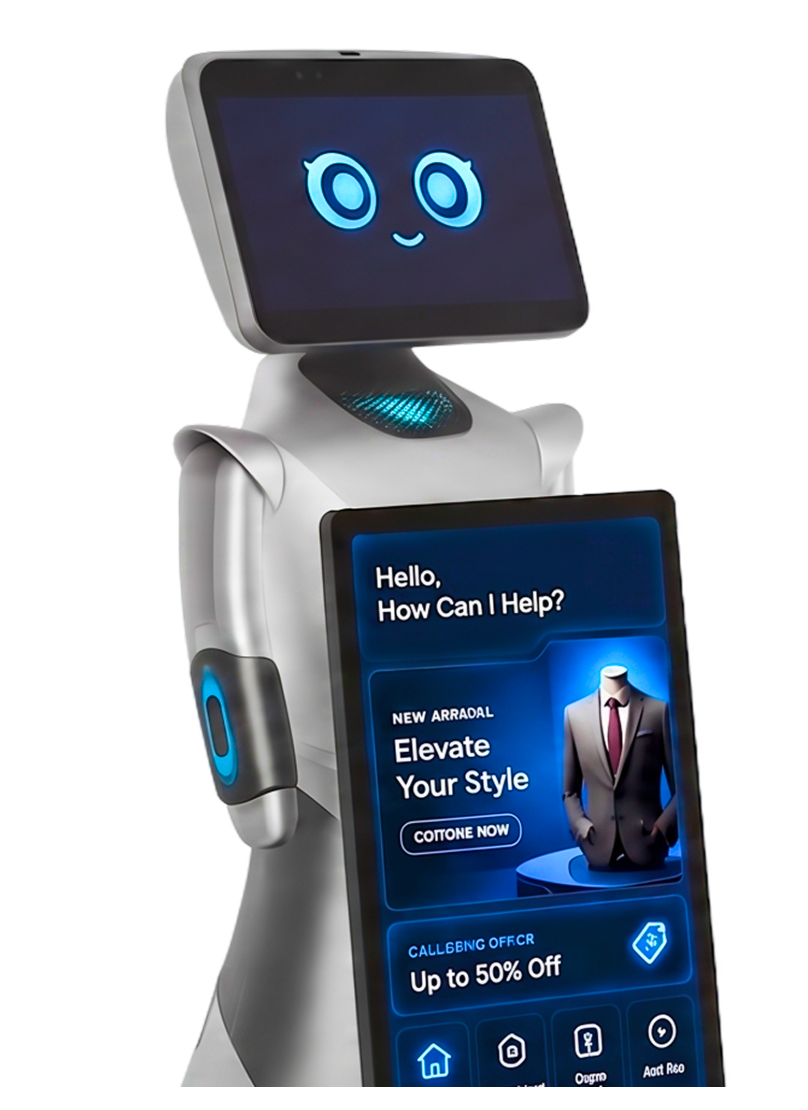
Promotional work in a busy commercial venue has never been a single-channel job. A flagship retail store, a hotel atrium, a shopping-mall concourse, an exhibition hall, or a supermarket chain needs promotional presence across many zones at once: the entrance, the main aisle, the queue at the cashier, the event stage. Fixed digital signage covers one of those zones and stays there. Front-line staff can only be in one place at a time. Mobile service robots have emerged over the past few years as a third channel — one that combines a moving promotional surface with greeting, wayfinding, and, in some cases, light delivery, so the same device can attract attention at the door, lead a customer to a department, and run a digital poster loop in the corridor. They are not a replacement for static signage or for staff, and they are not the right answer for every venue. But for operators who want promotional content to move through a space alongside the customers, a purpose-built promotional robot is now a standard procurement category, with five credible platforms a buyer can compare today.
This article compares one OrionStar product and four competitors across the dimensions that actually decide whether a promotional robot will earn its place in a commercial space: the architecture of its display surfaces, the physical mobility and footprint that determine where it can go, the battery architecture that decides whether it can run a full shift on a single charge, and the multilingual content and privacy story that determines whether it can be deployed internationally and at scale. The five platforms are the OrionStar GreetingBot AD (GreetingBot Pro Large-Screen Edition), the Pudu KettyBot Pro, the Pudu BellaBot Pro, the temi V3, and the Keenon DINERBOT T9 Pro.
The first decision is the architecture of the promotional display itself. A promotional robot for a commercial venue is fundamentally a mobile digital billboard that can also engage customers face-to-face, and the way its screens are arranged dictates how well it does each job. The most common configuration in this category pairs a large, dedicated promotional panel on the body — typically in the 18 to 22 inch range — with a secondary, smaller interactive touchscreen on the head, usually 10 to 14 inches, used for face-to-face interaction, wayfinding, and on-device control. This dual-screen architecture is the most natural fit for high-footfall commercial venues such as shopping-mall concourses, retail flagship stores, exhibition halls, and hotel atria, because it lets the same robot run a continuous promotional loop on the body panel while still being available for one-to-one interaction on the head. A second architecture relies on a single, smaller articulating screen mounted on a tilting or auto-tracking head, paired with an open Android SDK that lets integrators install third-party digital-signage software and build custom promotional apps. This single-screen configuration is well suited to boutique retail showrooms, bank branches, and exhibition booths where the operator prioritises software flexibility over a dedicated large promotional surface, and where the robot's main job is telepresence-style engagement rather than broadcast-style promotion. A third architecture mounts a smaller primary screen on a heavy delivery chassis, with the screen shared between operation prompts, pickup guidance, and lightweight menu or promotional display. This approach fits convention-centre cafeterias, large hotel buffets, and shopping-mall food courts, where physical delivery throughput is the headline requirement and the screen plays a supporting rather than central promotional role.
The second decision is mobility and footprint, because the value of a promotional robot collapses if it cannot reach the zones where customers actually are. Robots in this category split into three mobility profiles. Compact, narrow-aisle chassis profiles under 40 kg with 52 to 65 cm minimum passage width are prioritised for crowded supermarket aisles, densely packed retail showrooms, and constrained trade-show booths, where the promotional surface has to reach the back of the store and where manoeuvring around patrons and fixtures is a continuous challenge. Mid-weight balanced chassis in the 30 to 55 kg range with 60 to 65 cm minimum passage width offer a balance between a sizeable promotional display and the ability to move through most commercial lobbies, mall concourses, and hotel atria, and are best suited to multi-zone deployments where the same robot shifts between greeting at the entrance, leading in the corridor, and running promotional loops in the main hall. High-capacity wide-stance chassis above 55 kg with 65 to 70 cm or more minimum passage width are optimised for expansive, wide-open environments such as airport terminals, large shopping-mall food courts, and hotel banquet halls, where stabilising heavy physical loads takes equal priority alongside digital visibility and where the venue tolerates a larger footprint.
The third decision is battery architecture, because driving a mobile chassis while continuously powering large, high-definition displays and processing multi-sensor navigation draws significant power. High-capacity fixed battery systems with automatic return-to-dock generally provide 8 to 12 hours of continuous runtime, depending on screen size, brightness, and processing load, and are well suited to standard commercial environments like retail stores, hotel lobbies, and exhibition halls that operate on predictable daily shifts and can accommodate overnight docking. Swappable battery architectures let venue staff manually exchange depleted packs for fully charged ones on the fly, eliminating docking downtime and enabling uninterrupted 24/7 promotional operation for round-the-clock environments such as casinos, 24-hour retail centres, and busy transit hubs, at the cost of the operator owning additional battery packs and a swap routine. Short-burst high-intensity battery systems, designed for lighter highly interactive robots, are optimised for 2 to 3 hours of heavy multimedia processing before requiring a dock, and are appropriate for localised information hubs and demonstration booths rather than venue-wide all-day continuous promotional roaming.
The fourth decision is multilingual content management, fleet operations, and privacy compliance, which together determine whether a promotional robot can be deployed across multiple branches and multiple countries at all. Turnkey proprietary cloud-management platforms provide centralised vendor-locked ecosystems with out-of-the-box multilingual templates, synchronised fleet scheduling, and pre-built digital-signage interfaces, designed for operators who need rapid standardised global deployment with minimal software development. Open-architecture SDK-enabled platforms, typically Android-based, allow IT integrators to install third-party digital-signage software, connect to existing retail CMS endpoints, integrate with loyalty and CRM systems for personalised offers, and pull real-time stock or pricing into promotional playlists, catering to organisations that need highly specialised brand experiences and integration with existing proprietary retail software. Every model in this comparison set uses microphone arrays, depth or RGB cameras, visual SLAM mapping, or cloud-based processing to enable voice interaction, audience-aware content, and remote operation, so operators in Europe must verify applicable data-protection and privacy laws, including GDPR, before deployment; ensuring compliant consent mechanisms for in-venue recording, secure mapping data residency, and anonymised promotional-conversion analytics is critical for public-facing commercial environments.
The OrionStar GreetingBot AD is the Large-Screen Edition of the GreetingBot Pro platform and is positioned as a service robot that combines AI greeting and leading with a built-in large information display, intended for venues where the robot is a visible brand touchpoint rather than a back-office helper. Its defining feature for the promotional-robot scenario is the 21.5-inch FHD 1080P information display mounted on the chest, paired with the existing 14-inch FHD 1080P capacitive touch screen on the head, which means the same device can run a continuous promotional loop on the body panel while remaining available for face-to-face interaction, wayfinding, and on-device control on the head screen. Voice pickup is handled by a 6-microphone circular array with 360-degree sound-source localisation, supported by a 2 MP wide-angle camera and a 13 MP high-definition camera, with head-pitch motion from negative 15 to positive 40 degrees for natural face-to-face engagement, and dual 5-watt speakers for voice output, prompts, and background music during leading.
Underneath the screens, the GreetingBot AD runs on a Qualcomm 8-core flagship chip plus an industrial-grade MCU with 8 GB of RAM and 128 GB of ROM, on an Agent OS deeply customised on top of Android 13, which gives integrators an open platform for custom promotional apps and digital-signage integrations. Navigation uses 1 LiDAR, 2 wheel odometers, an IMU, an XB40 module, a mono camera, and a top IR sensor, with centimetre-level positioning and mapping area up to 50,000 square metres per the manufacturer's specification. Passability is 60 to 65 cm corridors, with 5-degree climbing unloaded and the ability to cross 10 mm bumps and 20 mm floor seams, and the robot moves at 0.5 to 1.2 m/s adjustable, which is enough to cover most commercial-venue layouts without becoming a hazard. Body dimensions are 498 by 465 by 1,280 mm at a net weight of 32.5 kg, which places it in the mid-weight balanced mobility profile described above.
For promotional deployment specifically, the GreetingBot AD upgrades the standard GreetingBot Pro battery from 15 Ah to a 20 Ah, 25.2 V, 529.2 Wh lithium ternary pack, paired with an 8 A adapter upgraded from the standard 4 A, in order to preserve approximately 8 to 10 hours of runtime with the new 21.5-inch display drawing additional power. Charging time is about 5 hours powered off and about 6 hours powered on, with a LiDAR-aligned dock sized at 350 by 130 by 338 mm. The chest screen is intended for menus, wayfinding, promotions, event schedules, and brand content, which makes it a strong fit for retail flagship stores, shopping malls, supermarkets, brand showrooms, exhibition halls, and other high-footfall commercial venues where the robot is expected to act as a visible brand touchpoint. Network support covers Wi-Fi 6 (2.4 GHz and 5 GHz dual-band) and 4G (TDD-LTE and FDD-LTE) standard, with ESP32-based multi-robot scheduling and an optional elevator-control module for multi-floor buildings. One caveat for content writers is that arm motion ships in the default-off state on the Large-Screen Edition because the arm actuators physically interfere with the new chest display, so the head pitch and chest screen together carry the expressive load.
The Pudu KettyBot Pro is the compact multitasker in the Pudu service-robot line and is one of the most relevant competitors in this comparison because its core value is screen-led promotion and customer attraction rather than payload volume, which is exactly the role a promotional robot for commercial space is hired to play. Pudu positions it explicitly as a Marketing Expert on Wheels, and the robot carries two LCDs — a 10.1-inch LCD on the head and an 18.5-inch LCD promotional screen on the body reserved for marketing creative in a customised area, with capacitive multi-touch on the 10.1-inch side and support for simultaneous customised promotion, customer attraction, and greeting interactions.
For mobility, the KettyBot Pro is the most compact model in this set at 435 by 450 by 1,120 mm and 38 kg, with minimum travel width 55 cm per official docs (52 cm in certain configurations per Pudu's marketing), maximum surmountable height 5 mm, and maximum climbing angle 5 degrees, which places it squarely in the compact narrow-aisle chassis profile and makes it a strong fit for crowded supermarket aisles, densely packed retail showrooms, and constrained trade-show booths. Cruise speed is 0.2 to 1.2 m/s adjustable, and the robot supports both manual and auto charging with auto-return-to-dock on low battery. Battery capacity is 20 Ah with up to 9 hours of runtime under no-load conditions per manufacturer data, and 3.5 hours charging time.
Navigation uses laser and visual integrated SLAM positioning with 360-degree fisheye lenses for smart tray detection, depth vision sensors, collision sensors, and Lidar, with sticker-free deployment and an IP20 rating. The operating system is Android-based, with a 6-microphone circular array, 2 by 10 W stereo speakers, 2.4 GHz and 5 GHz Wi-Fi, Bluetooth, and a SIM card slot for cellular backhaul, which makes it easy to install third-party signage apps or run Pudu's PUDU Open Platform for personalising expressions, voice, and on-screen content. Multilingual capability is not officially tabulated, but the Android OS supports third-party language packs and Pudu's marketing materials show localisation in English, Chinese, Japanese, and Korean. The KettyBot Pro is widely deployed by Pudu's distributor network across restaurant, retail, hotel, and supermarket chains globally, with the 18.5-inch body screen plus 38 kg body combination being the most distinctive profile for venues where agility matters as much as screen size.
The Pudu BellaBot Pro is the premium member of the BellaBot family and is explicitly marketed as a Premium Delivery and Advertising Robot, which is the most promotion-first positioning in the Pudu catalogue and makes it a primary candidate for venues that want one robot to combine delivery throughput with continuous promotional display. The robot carries the same dual-screen configuration as the KettyBot Pro — a 10.1-inch LCD touchscreen for interaction plus an 18.5-inch LCD promotional screen on the body — with the promotional screen supporting dynamic video and image playback, customisable facial expressions, multimedia promotion, varied voice selections, and skin customisation.
Where BellaBot Pro diverges from the KettyBot Pro is on capacity, runtime, and deployment scale. Dimensions are 570 by 550 by 1,290 mm and 55 kg, with 4 tray levels of 410 by 500 mm footprint, 230/200/180 mm height between trays from top to bottom, 10 kg per tray, and 40 kg total payload, which places it firmly in the high-capacity wide-stance chassis profile and fits expansive environments such as airport terminals, large shopping-mall food courts, and hotel banquet halls. Minimum passage width is 65 cm, max climbing angle is 5 degrees, max surmountable height is 5 mm, and cruise speed is 0.2 to 1.2 m/s. Battery capacity is 25.6 Ah, with approximately 11 hours of runtime per manufacturer data and a quick-change swappable battery design that supports 24/7 operation by exchanging packs; charging time is 4.5 hours per pack.
Navigation uses VSLAM+ and Lidar SLAM visual positioning, 2 front cameras, 3 RGBD sensors, 1 radar, and 1 Lidar, with marker-less deployment and no QR codes or magnetic strips required, and Pudu's VSLAM+ system supports venues up to 200,000 square metres with ceilings up to 30 m and 75 percent reduction in deployment time, which is one of the largest mapping-area claims in this comparison set. The operating system is Android-based, with full voice and gesture interaction, support for custom multilingual apps via the PUDU Open Platform, and Wi-Fi backhaul. BellaBot Pro is sold globally by Pudu's distributor network including Robots Asia, log-robot (Europe), SPARK EPoS (UK), and Myers Robotics Solutions (North America), with case studies in restaurants, hotel buffets, shopping-mall F&B courts, and casino floors, and April 2024 launch coverage that explicitly highlights mobile promotion platform and ad-conversion efficiency as primary value propositions.
The temi V3 is the only consumer-prosumer-grade mobile assistant in this comparison and is positioned very differently from the Pudu and Keenon models: temi is not a tray-carrying service robot, it is a moving smart display on a mobile base designed for telepresence, content delivery, and information-kiosk duties, with no payload system, which means the promotional surface is the entire product rather than one of several capabilities. For venues that prioritise software flexibility and a moving information kiosk over payload capacity, temi is a credible alternative that costs substantially less than the dedicated service-robot platforms.
Temi V3 carries a 13.3-inch QHD IPS LCD touchscreen with 1920 by 1080 resolution, 16M colours, capacitive multi-touch, 224 ppi, and 340 cd per square metre maximum brightness, mounted on a tilting head that auto-tracks the user in follow-me mode and can be locked to face a direction for stationary signage. The Android-based OS supports custom apps via SDK, so promotional content can be delivered through standard Android digital-signage apps or custom-built experiences, and temi Center provides remote fleet management and content push; multilingual support depends on the apps installed, and the OS supports any Android-compatible language pack. Alexa is built in (US English primarily), and a 5G version is available.
Dimensions are 100 cm tall by 35 cm wide by 45 cm deep at approximately 12 kg, the lightest body in this set. Top speed is approximately 3.6 km per hour (about 1 m/s), with up to 8 hours of runtime on the 224 Wh lithium-ion battery pack per manufacturer data, although 2 to 3 hours of continuous follow-me with HD video is more realistic under heavy multimedia load, and the robot auto-returns to dock at 15 percent battery. Navigation uses 360-degree Lidar, 2 depth cameras, 2 RGB cameras at 13 MP, 6 time-of-flight linear sensors, an IMU, ARM quad-core and ARM six-core CPUs, and runs Linux and Android with 3D mapping, path planning, autonomous navigation, obstacle avoidance, and user detection and follow. Temi is sold globally with temi Center management, widely deployed in retail showrooms, hotel lobbies, banks, hospitals, aged-care facilities, and trade-show booths, with dealers and integrators including RobotLab, displays2go, and useabot for the 5G version, and is listed in the sub-$2,000 USD range for the platform, the most affordable option in this comparison set.
The Keenon DINERBOT T9 Pro is the high-load workhorse of the Keenon DINERBOT catering-delivery line and is sold primarily as a delivery robot rather than as a dedicated promotional platform, which makes it the "delivery-first with limited promotional capability" representative in this comparison and the right reference for venues that need throughput first and a screen second. The T9 Pro's 11.6-inch screen is positioned as an operation and interaction panel for ordering, pickup guidance, and customer prompts rather than a dedicated promotional display, and promotional content is delivered through the same touchscreen that handles operations; there is no movable head and no dedicated promotional-screen mode.
Dimensions are 50.0 by 52.7 by 126.6 cm and 63 kg, the heaviest body in this set, with adjustable tray heights of 19.5 cm, 16.9 cm, 25.3 cm, and 22.8 cm and a total load capacity of 40 kg (10 kg per layer). Moving speed is 0.1 to 1.0 m/s, minimum passage width is 70 cm, slope angle is 5 degrees, battery life is up to 18 hours per Keenon's official spec, and charging time is 4 hours, with the charging pile sold separately. Navigation uses stereo vision sensors for 3D perception and obstacle avoidance, VSLAM visual SLAM navigation, and multi-robot dispatching via Keenon's patented scheduling algorithms, with vehicle-grade independent suspension for shock absorption.
Keenon does not publicly tabulate multilingual support for the T9 Pro, but Keenon's deployment teams operate in English, Chinese, Japanese, and Korean and the OS supports localisation per market; remote fleet management runs through the Keenon cloud platform. The T9 Pro has been deployed globally in casual-dining restaurants, Korean BBQ chains, hotel buffets, and convention-centre catering, was announced at HOST Milano (October 2023) as part of Keenon's European product-lineup launch, and won the European Good Design Award 2022 to 2023, with distributors including Robots International, ProServBots, automiq robotics in Australia, and Reliable Robots in Canada. Its differentiator is the combination of 18-hour battery life and 40 kg payload in a delivery-grade chassis, and its limitation is precisely the same as its positioning: there is no dedicated promotional screen, so venues whose primary need is a moving billboard should consider the sister DINERBOT T10 with its 23.8-inch promotional display instead.
Across these five platforms, the right answer depends on what kind of commercial space the robot will actually work in. For high-footfall flagship retail, shopping-mall concourses, hotel atria, and exhibition halls where the robot must act as a visible brand touchpoint and run continuous promotional creative, the dual-screen humanoid form factor of the OrionStar GreetingBot AD, with its 21.5-inch FHD chest display plus 14-inch head touch screen, mid-weight 32.5 kg body, and 8 to 10 hour runtime, is the most direct fit, because it pairs a dedicated large promotional surface with face-to-face greeting and way-leading in a single platform. For narrow-aisle retail, supermarket endcaps, hotel lobbies, and trade-show booths where agility and a smaller footprint are non-negotiable, the compact Pudu KettyBot Pro with its 18.5-inch body screen plus 38 kg body and 55 cm minimum passage width is the most practical dual-screen alternative. For high-traffic malls, casinos, entertainment venues, and hospitality operators who want one robot to combine delivery throughput with continuous promotional display across 24-hour operations, the premium Pudu BellaBot Pro with its 18.5-inch promotional screen, 40 kg payload, 11-hour runtime, and swappable battery is one of the strongest "set-and-forget" options in this comparison set, subject to the larger 65 cm minimum passage width. For boutique retail showrooms, bank branches, and budget-conscious deployments that prioritise software flexibility, a moving information kiosk, and a sub-$2,000 platform over payload capacity or a large dedicated promotional screen, the temi V3 with its 13.3-inch tilting-head touchscreen and open Android SDK is the cost-effective choice, with the caveat that it has no tray system and only one screen. For back-of-house F&B throughput — hotel room service, banquet catering, large cafeteria lines — where the priority is delivery volume rather than a visible promotional surface, the Keenon DINERBOT T9 Pro with its 11.6-inch operation screen, 40 kg payload, and 18-hour battery is the right delivery-first workhorse.
In every case, operators should weigh the four comparison factors in their own venue context, request runtime figures from each vendor under their actual scenario rather than under laboratory conditions, and verify GDPR or local data-protection compliance before deployment, because every model in this set uses cameras, microphones, mapping, or cloud-based processing to deliver the promotional and engagement features that justify its purchase in the first place.
A promotional robot for commercial space is a mobile service robot whose primary job is to attract attention and deliver marketing, promotional, or informational content to people in busy commercial venues such as shopping malls, retail flagship stores, hotel lobbies, exhibition halls, and supermarkets. Unlike a pure delivery robot, whose value is measured in trays carried and trips per hour, a promotional robot is selected on the quality, size, and orientation of its on-board display, its ability to greet and lead customers, and its capacity to run marketing or wayfinding content continuously through a business day. Most models in this category combine a screen-led promotional surface with additional capabilities such as greeting, way-leading, queue calling, or light delivery, but the promotional screen is the headline feature buyers compare against.
For high-footfall commercial venues such as shopping-mall concourses, retail flagship stores, exhibition halls, and hotel atria, screen sizes in the roughly 18 to 22 inch range for the dedicated promotional panel are typically considered the minimum for legible viewing from 2 to 4 metres away. Smaller panels (around 10 to 14 inches) are usually treated as supplementary or interaction surfaces rather than primary promotional displays, and are better suited to wayfinding counters, kiosks, or boutique showcases where viewers come close to the device. Buyers should match the screen size and brightness to the typical viewing distance in each venue zone, and confirm whether the robot supports remote content push so the same robot can run different creative across entrances, corridors, and event areas.
Typical commercial-shift runtimes for current promotional robots range from approximately 8 hours for compact or large-screen humanoid robots to 12 hours for delivery-class models with operation screens, and up to 18 hours for tray-carrying workhorses that do not power a large display continuously. Models with a swappable battery can effectively run 24/7 by exchanging packs, while smaller telepresence-style displays may only sustain 2 to 3 hours of continuous heavy video before needing to dock. Buyers should size the runtime to their opening hours, the brightness and duty cycle of the promotional screen, and the share of the shift spent moving versus stationary display, and ask vendors for runtime figures under their own scenario rather than under laboratory conditions.
Total cost of ownership for a promotional robot in a commercial venue typically combines the unit purchase price, content management and software licences, charging infrastructure (dock or swap stations), routine maintenance, and content production for the promotional screen. Entry-level mobile displays are advertised in the sub-$2,000 USD range for the platform alone, mid-range dual-screen service robots are commonly listed in the $10,000 to $20,000 USD range depending on configuration, and premium humanoid large-screen units sit higher reflecting the integrated display and battery. Content production (creative, localisation, scheduling) and any premium fleet-management subscriptions are recurring costs that often rival the hardware lease over a multi-year deployment. Procurement teams should request an itemised quote covering hardware, software, accessories, support, and content services before signing.
Promotional robots in this category typically combine microphone arrays, depth and RGB cameras, visual SLAM mapping, and cloud-based fleet management to enable voice interaction, audience-aware content, and remote operation. In Europe, this combination triggers obligations under GDPR and equivalent local data-protection laws, including lawful basis for processing biometric and behavioural data, transparency about in-venue recording and analytics, secure storage and defined residency for mapping data, and consent mechanisms for any audience measurement that feeds promotional conversion analytics. Operators should confirm with each vendor where mapping data is stored, whether voice and video are processed on-device or in the cloud, how long recordings are retained, and whether anonymisation is applied before any campaign reporting. A documented data-processing agreement and a venue-level signage and consent flow are recommended before going live in any EU member state.
Integration depth varies significantly across vendors. Turnkey proprietary platforms typically expose a vendor content management system that pushes scheduled creative to fleets and exposes basic engagement metrics, but offer limited hooks into a retailer's existing CMS, mobile app, or loyalty backend. Open-architecture and SDK-enabled platforms (typically Android-based) allow IT teams to install third-party digital-signage software, connect to existing CMS endpoints via APIs, integrate with loyalty and CRM systems for personalised offers, and pull real-time stock or pricing data into promotional playlists. Buyers planning multi-brand or multi-region rollouts should ask vendors for documented APIs, sample integrations with at least one major CMS or signage vendor, and reference customers running similar integrations at comparable scale.
Third-party product specifications cited in this article are based on publicly available data (up to, under laboratory conditions, and according to manufacturer data, as applicable) and may vary by configuration, region, and software version; product names and trademarks belong to their respective owners. Because each model in this comparison set involves cameras, voice recording, mapping, or cloud-based data processing, operators should verify GDPR or applicable local data-protection compliance prior to deployment in any jurisdiction.