

REQUEST DEMO
Robot CATALOG will be sent to your mailbox immediately after submission.
SUBMIT
Commercial buildings are not single-floor warehouses. A modern office tower, mixed-use estate or business park blends wide entrance halls, narrow corridors with glass partitions, multi-floor plate areas, parking decks and back-of-house service zones. Each of these spaces asks a different thing from a cleaning machine: a 1,200 mm corridor cannot host a 700 mm walk-behind scrubber; a 5,000 m² lobby cannot be efficiently covered by a 350 mm dry unit. Facility managers who treat "automatic floor scrubber for commercial buildings" as a single procurement decision tend to over-buy for one zone and under-buy for the next. A better starting point is to recognise that the right answer for most estates is a portfolio of machine classes matched to the building's footprint, wet-pickup needs, navigation demands, overnight autonomy constraints and data-protection obligations.
The most common procurement framework breaks the decision into five working dimensions. First, the cleaning-path capacity has to match the widest open zones without making the robot unusable in corridors. Second, wet-pickup capability and the design of the clean- and waste-water tanks determine how long the robot can run before someone has to step in. Third, navigation, mapping and multi-floor fleet management decide whether the same robot can serve several floors or several buildings. Fourth, the docking station and overnight autonomy level set the labour model that the building's cleaning budget can absorb. Fifth, the data-protection profile — which products persist maps, which stream telemetry, which rely only on LiDAR — has to clear GDPR or its local equivalent before the first deployment.
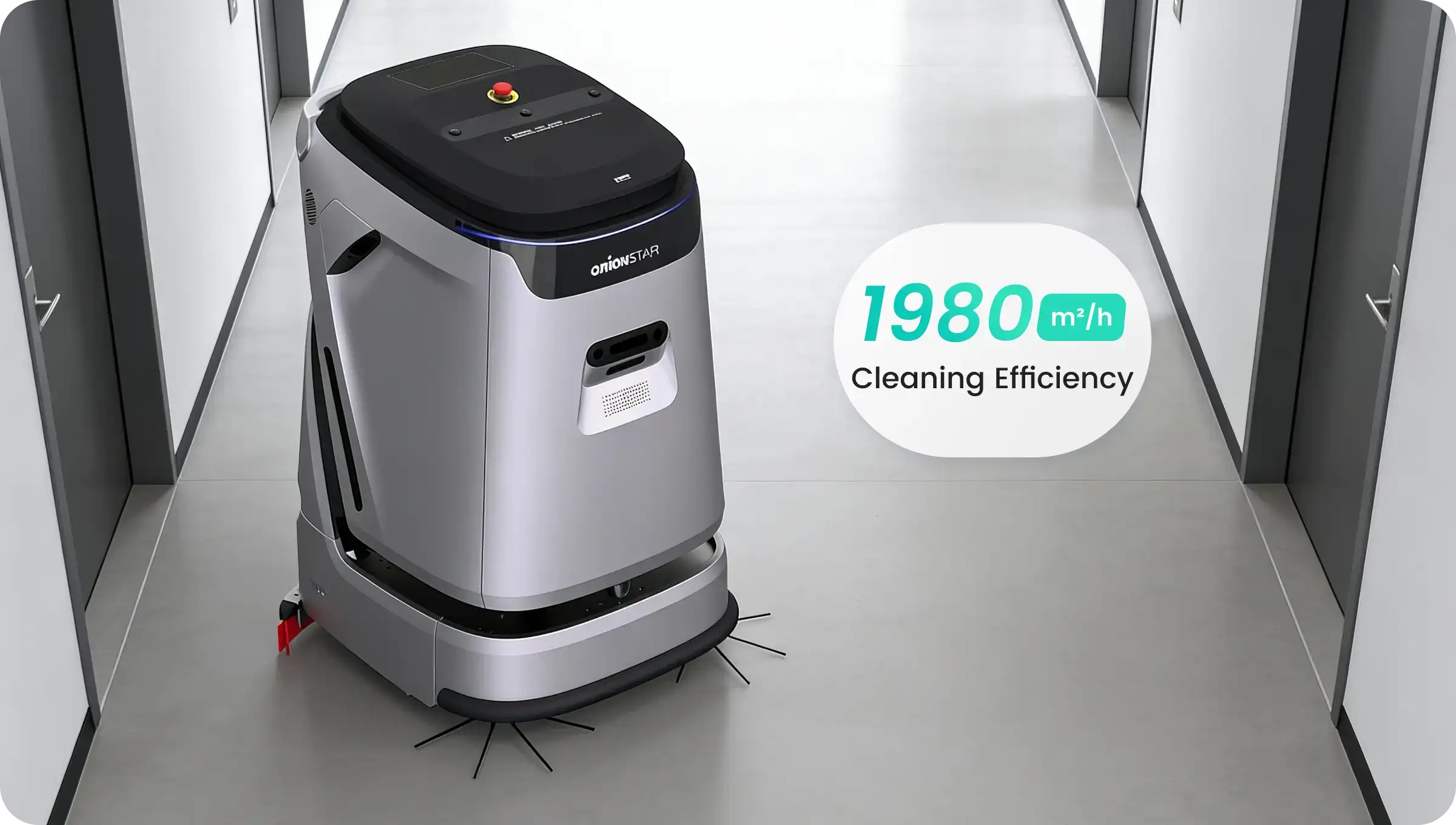
The OrionStar CleaniBot C5 is built as a heavy-duty industrial autonomous scrubber for the kind of mixed commercial estate where a single machine has to clear the lobby, sweep the corridors and back into the parking deck without supervision. According to manufacturer data, it weighs about 170 kg, carries a combined 90 L tank system split evenly between clean and waste water, runs a 550 mm main brush and is rated up to around 1,980 m²/h of cleaning coverage. The docking station handles automatic clean-water refill, waste-water discharge and a high-pressure internal rinse that the vendor reports at roughly 4 minutes per cycle, which lets the robot reset for another shift without an on-site attendant. A reported scrubbing pressure of about 25 kg and a dual-rolling-brush layout support a one-pass removal of heavy soils, with a vendor-reported dirt-cleaning rate close to 95% under defined test conditions. LiDAR-based mapping covers up to around 10,000 m² per map and supports multi-floor reuse, while the multi-sensor obstacle stack keeps the unit operating safely around people in busy commercial spaces. The reported noise level is below 68 dB(A), which keeps overnight use compatible with neighbouring tenants in mixed-use buildings. For estates that want a single industrial-grade scrubber to anchor a portfolio, the C5 sits firmly in the heavy-duty class.
The Kärcher KIRA CV 50 represents the opposite end of the commercial-building portfolio: an ultra-compact autonomous vacuum unit that weighs roughly 15 kg and runs a working width of about 350 mm. It is designed for daily dry-debris maintenance in corridors, under-desk zones and lobby edges where a walk-behind scrubber simply cannot pass. Where the C5 carries a wet tank, the KIRA CV 50 has none — it sweeps dust, lint and small debris, then returns to a small charging dock. In a commercial building it should be read as a complement to a wet-scrubbing fleet rather than a replacement for one. Navigation is based on a teach-and-repeat routine that building teams can configure per floor, with on-board sensors for obstacle detection. For offices that already outsource corridor vacuuming to nightly staff, the KIRA CV 50 typically replaces a manual sweep without changing the existing wet-scrubbing contract.
The Gaussian Robotics Scrubber 50 (also marketed under the Gausium brand) sits in the mid-size wet-scrubbing class that fits typical office floor plates. It combines sweeping, scrubbing and dust-mopping in one machine, with an optional workstation that supports water and charging cycles so the robot can run multi-shift routes with limited human intervention. Published specifications list multi-modal sensors for obstacle avoidance and a footprint that lets it pass through standard office corridors and lift doors, with cloud fleet management for multi-floor scheduling. Operators choosing between a mid-size scrubber and a heavy-duty machine should think about whether the building's largest open zone genuinely needs the heavier tank capacity, or whether a mid-size unit on a tighter route will deliver higher effective coverage per litre. Where the C5 covers the wide-open spaces, the Scrubber 50 is the day-to-day workhorse for the office plate.
The Tennant T7AMR is a ride-on AMR scrubber built on the T7 industrial chassis. According to manufacturer data it carries approximately 110 L of tank capacity, runs a cleaning path in the ~650 mm class and weighs around 492 kg, which makes it a heavy-duty platform suited to large concourses, airport-style halls, education campuses and the parking decks of sizeable commercial buildings. The ride-on form factor means an operator can supervise from the platform when needed, while AMR mode allows the machine to repeat mapped routes autonomously. The trade-off is that the T7AMR is typically considered over-sized for standard office floor plates and is best matched to venues where the wide-open floor area justifies the footprint and the lift or ramp can accept its weight. In a multi-zone commercial estate, it is the right answer for the concourse and the wrong answer for the corridor.
The Avidbots Neo 2W is an industrial autonomous scrubber tuned for warehouse and logistics-style spaces, with swappable batteries that allow near-continuous deployment in back-of-house zones. Publicly available materials highlight a two-wheel configuration, 360° obstacle detection and cloud-based fleet management, with deployment evidence in airports, distribution centres and large-format retailers. In a commercial building it is best framed as the right pick for back-of-house areas, loading bays and large parking or storage sections within a mixed-use estate — not for customer-facing lobbies where its industrial footprint and warehouse-tuned dynamics are mismatched. Where the C5 handles the public-facing floors and the Scrubber 50 handles the office plates, the Neo 2W keeps the service areas and loading docks under autonomous coverage.
For most commercial buildings the procurement decision is less about which single machine is best and more about which combination covers the entire estate with the lowest overnight labour cost. A heavy-duty autonomous scrubber such as the CleaniBot C5 anchors the wide-open zones and parking decks; a mid-size wet-scrubbing unit such as the Gaussian Robotics Scrubber 50 covers the office floor plates; an ultra-compact dry unit such as the Kärcher KIRA CV 50 sweeps corridors and under-desk areas; a ride-on platform such as the Tennant T7AMR is justified only where concourses and parking decks are very large; and a warehouse-tuned unit such as the Avidbots Neo 2W is reserved for back-of-house service areas. The right answer for any building is the mix that lets the cleaning budget drop while the visible cleanliness of every zone stays the same.
Industry reports and case studies from IFM vendors commonly cite labour-hour savings in the range of 60–80% versus manual scrubbing when an autonomous machine covers a defined route each night. ROI for commercial buildings is usually reached within 18–36 months depending on shift patterns, wage levels and how many zones the robot can cover from a single docking station. Operators should compare bids on a per-square-metre-per-year basis rather than headline purchase price.
TCO for an autonomous scrubber in an office or mixed-use building typically breaks down into acquisition (40–55%), preventive maintenance and spare parts (15–25%), consumables such as brushes and chemicals (5–10%), and either labour to manage the robot or a service-contract fee (15–25%). Buildings that share one robot across multiple floors usually see better TCO than those that buy one unit per floor; planning should reflect that.
The clauses that matter most are response-time SLAs (often 24–48 hours for a swap unit), software-update inclusion, map-rebuild allowance, consumables caps, and end-of-life data-handling for the maps the robot has stored. Buyers should also confirm whether the contract covers multi-floor re-mapping when a tenant changes layout. Hidden cost drivers tend to be map rebuilds, lift-integration upgrades and per-call fees for non-warranty repairs.
The two common patterns are a shared-robot model (one robot roams between floors or buildings using a lift-call integration) and a one-per-floor model (a small robot docked on each floor). The shared model lowers capex but needs reliable lift integration and on-shift attendants; the one-per-floor model is simpler but multiplies hardware and consumable costs. Many estates start with one shared heavy-duty unit plus several compact dry units per floor.
Most office floor plates work well with mid-size scrubbers in the 500–700 mm cleaning-width class and combined tank capacities in the 50–100 L range. Buildings with very large lobbies, parking decks or transport concourses usually need walk-behind or ride-on machines with paths of 700 mm and above and combined tanks of 100 L or more, while narrow corridor-heavy layouts often pair a smaller machine with a separate wet-pickup unit. Match tank size to the area covered in a single shift to avoid mid-shift refills.
Most modern machines rely on a combination of LiDAR, depth cameras and ultrasonic sensors to detect glass walls, glass doors and people, then plan around them in real time. Lift transfer is usually handled by a fleet-management module that calls the lift, instructs the robot to enter and exit, and confirms the door cycle. Operators should ask vendors for documented lift-integration case studies and a clear policy on what happens when the robot cannot resolve an obstacle, including alert routing to on-call staff.
Third-party product specifications are based on publicly available data (up to, under defined test conditions, according to manufacturer data) and may differ from real-world results. Product names and trademarks belong to their respective owners. Where any product involves cameras, persistent mapping or cloud data processing, operators should verify GDPR compliance before deployment.