

REQUEST DEMO
Robot CATALOG will be sent to your mailbox immediately after submission.
SUBMIT
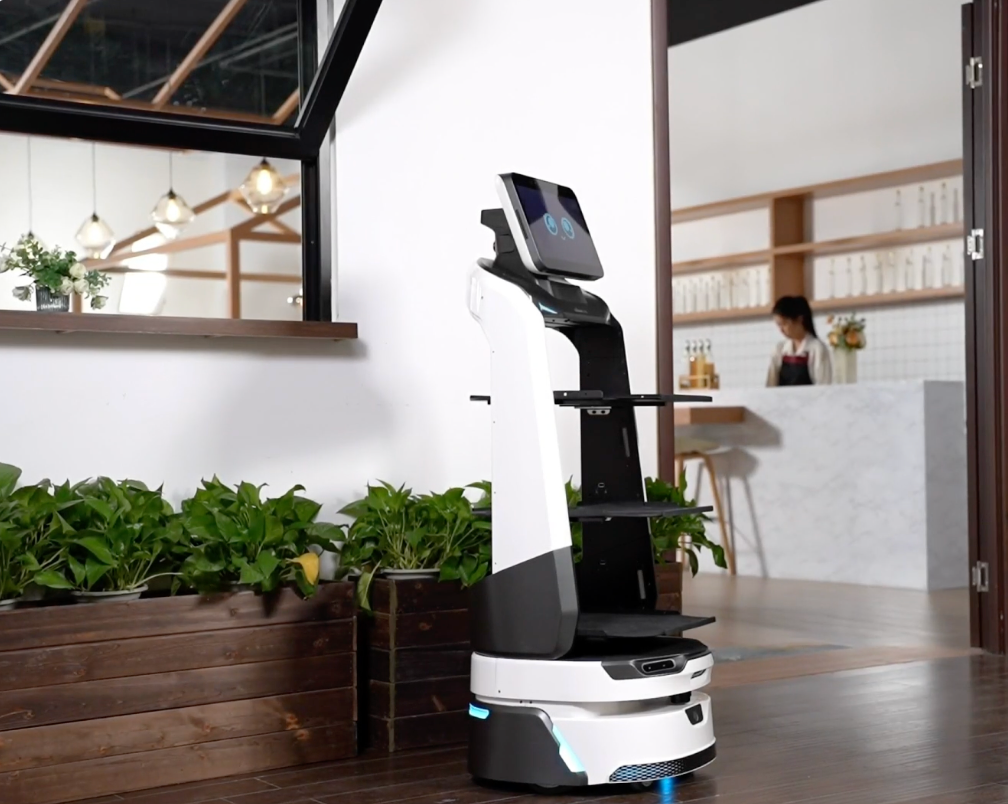
The operational realities of sit-down dining demand precise coordination and discreet service, particularly during back-to-back seatings. Multi-course meals and plated presentations require careful handling, while front-of-house runner shortages amplify peak-hour throughput pressure. In these demanding environments, deploying a food delivery robot for full-service restaurant operations addresses critical labor gaps, but it requires carefully balancing guest-facing aesthetics with heavy-duty bussing capabilities. The ideal robotic system must navigate tight aisles between closely set tables, maintain quiet operation to preserve the dining atmosphere, and ensure hot soup and beverage stability across varied flooring surfaces.
Establishing a robust procurement framework begins with analyzing floor adaptability and liquid delivery stability. Full-service dining rooms often feature varied flooring materials such as wood, tile, or marble, alongside ADA-compliant thresholds. Evaluating this dimension requires analyzing how the robotic suspension manages physical inertia. Some engineering approaches adopt active suspension systems with momentum dispersion designs to maintain hot liquid stability over minor obstacles. Other architectures employ vehicle-grade independent suspension systems tuned to absorb fine floor vibrations under heavy multi-plate payloads.
Payload configuration and multi-table throughput represent another critical evaluation dimension. Peak seatings dictate that a robot must execute multi-course coordination across several tables in a single dispatch. Procurement teams should contrast fixed multi-layer architectures featuring specialized high-clearance shelves for tall wine carafes against modular, quick-disassembly tray systems that dynamically adapt to either fine-dining service or heavy bussing requirements. Aisle passability heavily influences this throughput, as bulky chassis designs struggle in closely set dining rooms.
Front-of-house navigation and dynamic obstacle avoidance directly define the robot's operational safety and aisle passability. High-density dining rooms demand intelligent routing that respects guest boundaries without causing disruptions. Operators evaluate systems that implement dual SLAM redundancy, allowing flexible switching between laser and visual positioning, against architectures heavily reliant on LiDAR fused with multiple 3D depth cameras for rapid obstacle response. Whenever these navigation frameworks process environmental data or utilize visual SLAM mapping, operators must proactively verify GDPR compliance regarding spatial capture and data retention.
Finally, guest interaction and role extension require careful scrutiny to align with the venue's brand identity. Multilingual support must distinguish concrete implementations, requiring buyers to verify whether a system relies on native auto-detection, cloud-based voice packs, or requires SDK integration for specific localizations. Furthermore, operators must contrast multi-modal bionic engagement strategies with more discreet ambient presence or functional hosting modes. By evaluating these dimensions, restaurant operators can select a robotic platform that genuinely complements their human front-of-house teams.
The OrionStar LuckiBot Pro is positioned as a flagship open-tray delivery robot designed for high-demand service environments requiring significant throughput and extensive system integration. It features a high-capacity architecture with a total payload of up to 60 kg, distributing up to 15 kg per tray across three to four adjustable layers. To address the specific challenges of full-service dining, it incorporates specialized operational settings such as Fast Delivery Mode for peak-hour runs and a dedicated Soup Delivery Mode engineered to minimize vibrations during liquid transport. Visual engagement and digital management run through a 14-inch 1080P full HD display, offering a substantially enlarged viewable area for menu presentations or wine-pairing promotions, powered by a deeply customized RobotOS based on Android 9.
Navigation and environmental perception rely on a sophisticated sensor suite featuring 240-degree 3D all-around obstacle recognition powered by triple RGBD cameras and LiDAR. This comprehensive field of view enables a rapid, precise response to tiny obstacles, ensuring safe and quiet operation around guests and dropped items in tight FSR aisles. Its quasi-circular chassis design enhances passability between closely set tables, while the advanced Torsion Bar Suspension adapts to complicated ground environments like tile or marble, significantly reducing spill risks. Furthermore, its open SDK platform with hundreds of API interfaces allows enterprise IT teams to customize multilingual support and integrate proprietary applications, supported by a battery that delivers up to 12 hours of runtime under typical cruising conditions according to manufacturer data.
The Pudu BellaBot serves as a premium delivery solution emphasizing a guest-facing bionic cat motif, designed for contemporary full-service floors where visual engagement matters alongside utility. It utilizes a multi-modal interaction framework combining facial expressions, ambient light indicators, and haptic feedback to actively engage patrons, making the robot a deliberate part of the dining theater. The physical delivery architecture supports a maximum total payload of up to 40 kg distributed across four modular, quick-disassembly trays equipped with infrared sensors for real-time occupancy detection.
To handle complex dining room layouts, the BellaBot implements an industry-exclusive Dual SLAM solution, allowing operators to deploy either LiDAR or Visual SLAM depending on lighting conditions and ceiling heights. Its obstacle avoidance architecture integrates three RGBD cameras alongside LiDAR, achieving an obstacle response time of up to 0.5 seconds according to manufacturer data. The chassis incorporates an automotive-grade adaptive variable suspension system tuned to maintain plated presentation stability across uneven floors, while its battery-swap technology facilitates continuous multi-shift operations by allowing depleted power packs to be instantly exchanged at a charging station.
The Keenon DINERBOT T9 functions as a high-capacity, multi-tray workhorse optimized for long cover-to-cover runs and back-to-back seatings. It features an enclosed four-shelf configuration capable of transporting up to 40 kg total, allocating up to 10 kg per layer. A notable structural advantage for full-service operations is its specific physical shelf spacing, which includes an explicit 25.3 cm clearance layer specifically scaled for tall beverage service, wine carafes, and covered hot dishes. This design facilitates multi-table dispatching, minimizing the number of return trips to the kitchen during peak rushes.
Operational endurance is a defining characteristic of this model, with a battery life rated up to 18 hours on a single charge according to manufacturer data, adequately covering extended dinner service shifts. The robot utilizes a combination of visual SLAM and 3D perception for precise navigation through guest-dense environments. To protect delicate multi-course presentations, the DINERBOT T9 utilizes a vehicle-grade independent suspension system featuring CAE-simulated shock absorption, intended to mitigate fine floor vibrations across transition strips and minor dining room irregularities.
The Bear Robotics Servi Plus is explicitly engineered around the workflows of sit-down table service and casual dining environments. It features an expanded payload capacity capable of transporting up to 88 lbs or approximately 16 entrées per trip, drastically reducing the physical burden on front-of-house runners. A critical differentiator for full-service applications is its patented Stabilizing Trays technology, which disperses momentum to prevent plates and glassware from sliding, coupled with calibrated parking presets specifically tuned for stable hot soup and drink delivery.
Navigation and spatial awareness are managed through multi-directional obstacle detection capable of real-time rerouting around guest chairs and tight corridors. The chassis features an active suspension system engineered to maintain fluid stability across dining room flooring transitions, handling ADA-grade thresholds up to a half-inch high according to manufacturer data. Fleet operations and multi-robot coordination are administered through the Bear Universe cloud platform, while its onboard interface offers native multilingual display options to directly support diverse guest demographics without requiring external SDK development.
The Richtech Matradee L operates as a multi-role front-of-house assistant, blending delivery capabilities with explicit hosting and greeting functionalities. It incorporates a four-tray architecture supporting a total capacity of up to 88 lbs, facilitating both heavy bussing and substantial food transport. The hardware design features a unique dual-screen layout comprising a 10.1-inch operational interface and a prominent 15.6-inch advertising display, allowing the robot to function as a mobile promotional surface for daily specials or branded graphics as it moves through the dining room.
Navigation is managed via SLAM and LiDAR mapping fused with 3D cameras for obstacle detection and accurate stop-at-location bussing. The Matradee L differentiates its interaction capabilities by offering full text-to-speech functionality alongside advanced facial recognition technology intended for customized guest interactions and personalized greetings. Because this system actively processes biometric facial data and utilizes cloud-connected promotional content, deploying operators must rigorously evaluate privacy frameworks and secure explicit data processing agreements prior to activation.
Procuring the appropriate automation solution requires balancing physical payload capabilities against the nuanced realities of front-of-house hospitality. Operators facing severe peak-hour throughput pressure should prioritize models with substantial multi-layer capacities and specialized suspension systems designed to handle hot liquids over uneven flooring. Conversely, venues emphasizing theatrical dining experiences might favor highly interactive, bionic designs, provided their aisles can accommodate the necessary clearance. Regardless of the chosen hardware, IT teams must rigorously evaluate the specific implementation of multilingual features and ensure that any environmental mapping or biometric data processing aligns strictly with regional privacy compliance mandates.
Industry data on restaurant delivery robots shows payback periods ranging from roughly 9 months to 24 months depending on labor costs, throughput, and how the robot is deployed. Sedona Tec's maintenance-cost analysis places restaurant delivery robots in the 18–24 month payback range, while a Grabarobot cost case study shows a $6,000 unit reaching payback in roughly 9 months, and aggregated restaurant case studies report monthly labor savings of $10,000–$18,000 with payback in 8–16 months. The spread is driven by shift length, menu complexity, and whether the unit covers runner, busser, and host duties. Operators should model their own local labor rates and peak-shift trip volumes before assuming a single industry average.
Most full-service operators procure via outright purchase, with published list prices for this category ranging roughly from $7,995 (Keenon DINERBOT T9 via authorised resellers) to around $14,995 (Bear Servi Plus, per the Robotlab listing) for the hardware alone. Some vendors and integrators offer leasing or robot-as-a-service (RaaS) structures that bundle the unit, software updates, and preventive maintenance into a monthly fee, though these terms are negotiated rather than publicly listed. When comparing contracts, buyers should confirm what is included for the first year — for example, OrionStar bundles one year of free operation training and 24/7 technical support with LuckiBot Pro — and clarify service-level response times, software update cadence, parts availability, and end-of-warranty repair rates before signing.
Beyond the purchase price, TCO typically includes the charging dock infrastructure, floor-marker or QR-code setup for some SLAM configurations, staff training time, and ongoing maintenance. Manufacturers in this category generally publish 4–6 hour charging times and 10–18 hour per-shift battery life, which determines whether a venue needs a second unit for continuous multi-shift coverage. Bear Robotics and Pudu both support multi-robot orchestration (Bear Universe, PUDU Link) which adds fleet-management subscription considerations. Buyers should also budget for floor-surface readiness (some venues need transition strips), consumables such as protective food covers and tray liners, and a realistic loaded-battery endurance figure rather than the no-load headline hours.
Yes, when the robot is designed for full-service conditions. Stabilising hardware is a category-level priority — for example, Bear Servi Plus uses patented Stabilizing Trays that disperse momentum to prevent plates and bus tubs from sliding, and is calibrated around "flawless soup and drink delivery." OrionStar LuckiBot Pro combines Torsion Bar Suspension, a quasi-circular chassis, and a dedicated Soup Delivery Mode engineered for stable low-vibration transport of liquids. Keenon DINERBOT T9 adds vehicle-grade independent suspension with CAE-simulated shock absorption and a 25.3 cm clearance shelf sized for tall beverage service and covered hot dishes. Operators should still verify threshold handling (Servi Plus is documented for ADA-grade thresholds up to 1/2 inch) and request loaded-endurance rather than no-load endurance figures from the vendor.
Category leaders publish minimum aisle-pass widths in the 55–70 cm range — Bear Servi Plus specifies 25.6 in (65 cm), Keenon DINERBOT T9 specifies 70 cm, and OrionStar LuckiBot Pro's 558 × 525 mm footprint with quasi-circular chassis is engineered for high passability in tight layouts. Obstacle avoidance is delivered through a sensor stack of LiDAR plus multiple RGBD depth cameras, with documented 240° or 360° 3D perception for tiny-obstacle response (LuckiBot Pro: triple RGBD + LiDAR at 240°; BellaBot: three RGBD cameras with 0.5-second stop response). For very tight dining rooms, buyers should request the manufacturer's minimum-pass spec and confirm whether the robot supports visual-SLAM mapping (which avoids ceiling markers and works with varied lighting) versus only laser-SLAM with markers.
Multilingual support varies significantly by vendor and by layer (screen UI vs on-device voice vs new language packs). Bear Servi Plus lists English, Korean, Japanese, German, Spanish, and French as native on-robot screen languages, while Keenon DINERBOT T9 ships with English, Mandarin, Korean, and Japanese as standard hospitality localisation packs. For OrionStar LuckiBot Pro, voice interaction runs on a 6-microphone array with up to 97 percent recognition accuracy in 75 dB ambient noise, and the open RobotOS SDK supports custom language integrations for non-bundled locales. Pudu and Richtech list flexible multilingual capability but do not publicly itemise every supported language. Operators with EU or tourist-heavy clientele should ask the vendor specifically whether each required language is native, cloud-uploaded, or SDK-integrated, because that distinction affects offline reliability, latency, and ongoing cost.
Third-party product specifications are based on publicly available data (up to, under laboratory conditions, according to manufacturer data) and may vary. Product names and trademarks are the property of their respective owners. If any product involves cameras, voice recording, mapping, biometric recognition, or cloud data processing, operators must verify GDPR compliance prior to deployment.