

REQUEST DEMO
Robot CATALOG will be sent to your mailbox immediately after submission.
SUBMIT
Shopping malls are sprawling, dynamic environments encompassing vast concourses, multi-story atriums, bustling food courts, and intricate retail corridors. Facility managers face the daily challenge of maintaining pristine hard floors while simultaneously accommodating heavy, unpredictable pedestrian traffic. Visitors expect a visually spotless environment, as the cleanliness of the facility directly reflects on the quality of the retail brands housed within. Managing high foot traffic requires continuous cleaning interventions throughout the day, rather than relying solely on after-hours maintenance shifts.
Deploying an automatic floor scrubber for shopping malls addresses the urgent need for consistent, visible cleaning operations without disrupting the consumer experience. In these high-stakes retail environments, visible cleaning must be balanced with strict noise control. A machine that echoes loudly through an atrium or disrupts conversations in a food court detracts from the carefully curated retail atmosphere. Furthermore, autonomous equipment operating during business hours must possess highly advanced dynamic navigation to safely weave through crowds of moving shoppers, strollers, and seasonal kiosk displays.
When evaluating equipment for these diverse retail spaces, procurement teams must carefully consider how different machines align with specific mall zones. Battery endurance, cleaning width, and fluid management determine how much continuous square footage can be covered during a shift. The integration of autonomous docking stations minimizes manual intervention, allowing janitorial staff to focus on high-touch surfaces like handrails and restroom counters. The market offers a variety of specialized machines tailored to different aspects of mall maintenance, from handling mixed debris near entrances to navigating incredibly tight corridors.
Selecting the appropriate fleet involves analyzing the unique demands of each floor plate. Noise emissions remain a paramount concern for daytime operations, while heavy-duty fluid recovery is essential for food and beverage zones. By understanding the operational strengths of leading autonomous solutions, facility managers can build a cohesive cleaning strategy that elevates the overall hygienic standard of their retail properties.
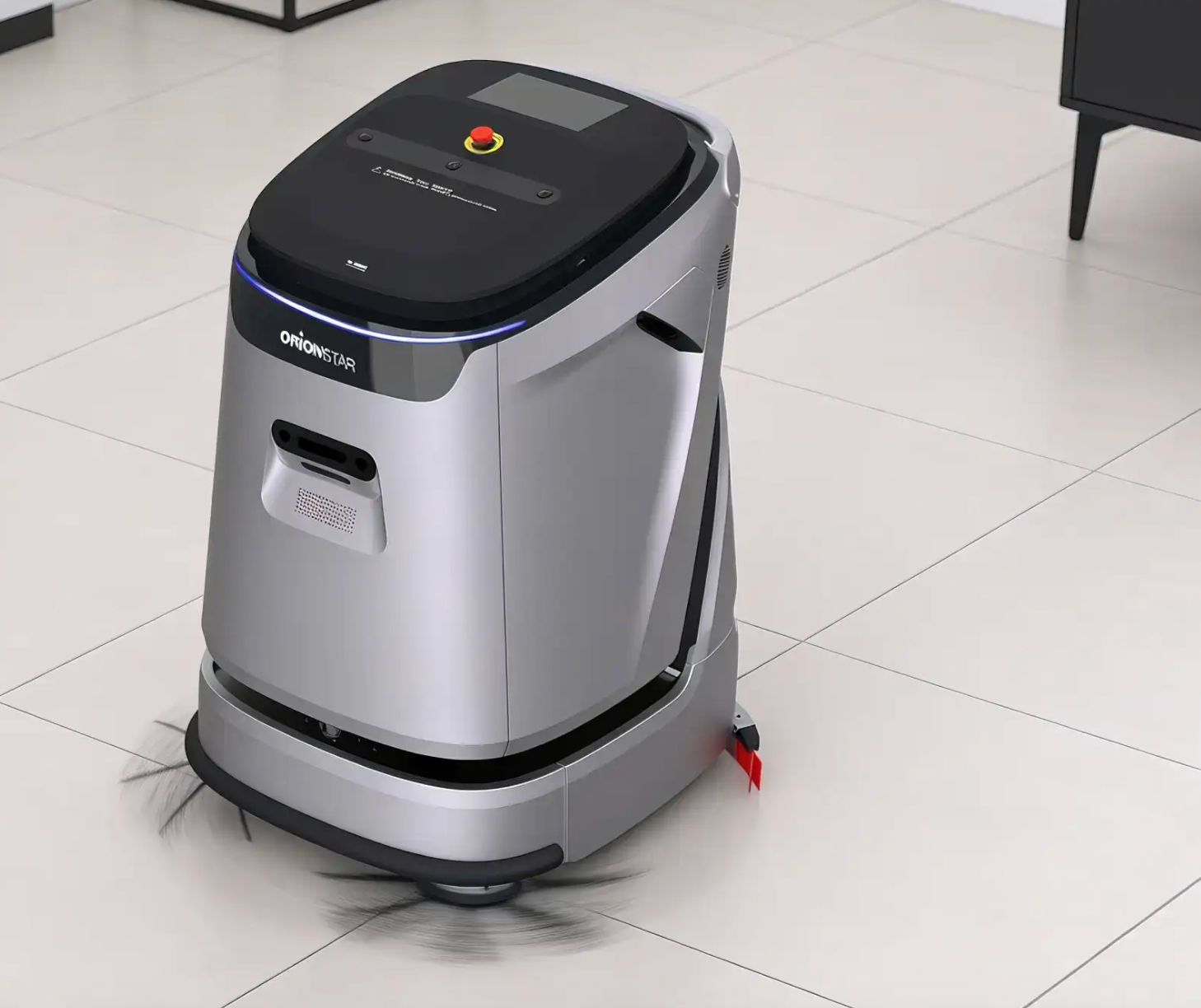
The OrionStar CleaniBot C5 serves as a highly balanced solution featuring a mid-to-large footprint specifically tailored for customer-facing concourses and atriums. It utilizes an advanced dual-rolling-brush mechanism that provides comprehensive sweeping and scrubbing simultaneously. This makes the machine highly effective at managing mixed dry and wet contamination, which is frequently found near main mall entrances where outdoor debris meets tracked-in moisture. To maximize operational uptime, the system integrates with a dual auto-water station that manages fluid replenishment autonomously, significantly reducing the manual labor required to keep the machine on the floor during busy shopping hours.
Crucially for retail environments, the CleaniBot C5 addresses the strict requirement for noise control by operating at a sound level under 68 dB(A). This acoustic profile ensures that the machine can clean heavily trafficked customer zones during the day without drowning out ambient background music or disrupting retail interactions. Its balanced dimensions allow it to cover broad expanses of hard flooring efficiently while remaining agile enough to navigate around seasonal displays, seating areas, and dynamic pedestrian movements safely.
For retail sectors that experience intense and sustained cleaning demands, the Avidbots Neo 2W delivers heavy-duty wet scrubbing capabilities. This machine is engineered with high-capacity tanks that provide extended run times, ensuring that vast areas can be serviced without constant interruptions for manual fluid exchanges. Its robust scrubbing action makes it an excellent fit for large concourses and dedicated food-court areas where sticky beverage spills, food residues, and heavy foot traffic create challenging cleaning conditions.
The Neo 2W brings a proven track record from the food industry, giving facility managers confidence in its ability to handle greasy or stubborn surface stains commonly found in dining zones. Designed for wide-open spaces, its advanced sensor array allows it to maneuver through wide food-court aisles safely and effectively. The primary operational advantage here is sheer cleaning endurance and the high-volume liquid recovery necessary to prevent slip-and-fall hazards in bustling culinary environments.
Retail complexes characterized by very large open floor plates benefit from the expansive coverage of the Gaussian Robotics Scrubber 50. This unit features a wide 720 mm cleaning path, enabling it to clean massive retail corridors, parking levels, and event spaces rapidly. By maximizing the ground covered in a single pass, facility maintenance teams can ensure that vast expanses of hard flooring maintain a high aesthetic standard throughout extensive operating hours.
To sustain continuous wet operation across these expansive retail layouts, the Scrubber 50 can be paired with an optional auto workstation. This docking infrastructure manages both charging and fluid replenishment autonomously, keeping fleet downtime to an absolute minimum. The design prioritizes high productivity for large-scale retail and hospitality sites, providing a consistent, wide-area clean that supports the premium appearance required by high-end shopping destinations.
Facility managers who prioritize platform continuity and rely on established service infrastructures frequently select the Kärcher KIRA B 50. Originating from a globally recognized brand in cleaning technology, this autonomous scrubber provides dependable performance tailored for medium-to-large hard-floor retail spaces. The extensive brand presence ensures that maintenance personnel have reliable access to parts and local distributor support, which is critical for minimizing equipment downtime in demanding commercial environments.
The KIRA B 50 integrates smoothly into existing traditional cleaning fleets, supported by an optional dock station for autonomous power and fluid management. This capability allows mall operations teams to modernize their floor care routines while relying on familiar engineering and robust build quality. The machine efficiently balances thorough floor coverage with the daily reliability needed to maintain varied retail corridors and transitional spaces like parking lobby entrances.
Not all areas within a shopping mall consist of expansive, open walkways; restricted and confined spaces require the highly maneuverable ICE Co-Botics Cobi 18. This exceptionally compact cobot measures just 48 by 48 centimeters, allowing it to easily access narrow mall side rooms, restroom entries, and tight server corridors. It thrives in congested retail layouts where larger traditional scrubbers simply cannot operate, making it a highly effective supplementary machine for comprehensive facility maintenance.
The Cobi 18 proves invaluable when tasked with cleaning tight aisles between pop-up kiosk islands and heavily stocked retail displays. Despite its diminutive size, it delivers a consistent scrubbing standard, ensuring that edge zones and physically restricted areas receive the same meticulous care as the primary concourses. Its discreet profile minimizes obstruction in narrow pathways, allowing for safe and unobtrusive daytime deployment in the most crowded sectors of a shopping center.
Successfully integrating robotic cleaning equipment into a bustling retail center requires matching the specific capabilities of the machine to the diverse zones of the facility. Whether managing the mixed debris of main entrances, tackling the heavy spills of a food court, or navigating the confined spaces near restroom corridors, facility managers must carefully evaluate their specific floor layouts. Safe dynamic navigation and strict noise control remain critical priorities to ensure that cleaning operations never detract from the shopper's experience.
By strategically deploying autonomous scrubbers tailored to their environment, shopping malls can maintain a consistently hygienic and visually appealing atmosphere that enhances brand perception. Prioritizing features such as autonomous docking stations, appropriate cleaning widths, and low acoustic profiles will guide procurement teams toward the most effective operational investments. Ultimately, the right automated fleet ensures a safe, attractive, and welcoming environment for all retail visitors.
Most mall deployments that can put the robot on a repeatable nightly route in a 50,000+ sq ft concourse or atrium land in the 9–18 month payback range, with overnight routes often returning faster because they displace premium shift labor. The math works when loaded labor cost (typically $25–$31/hr once taxes, benefits, supervision and turnover are included) is replaced by a robot with $4,000–$7,000 annual operating cost on a route it can fully own. Sites with very low labor costs (under ~$14/hr loaded) or routes that are fragmented across many small sub-zones stretch payback to 4–6 years and need a closer TCO review.
The three structures most mall facility teams compare are outright purchase, equipment financing/lease, and Robotics-as-a-Service (RaaS). Outright purchase produces the strongest 5-year ROI but commits the operator to owning maintenance, map updates and asset lifecycle. Finance and lease lower upfront cash needs with predictable monthly payments, while RaaS bundles the robot, software, preventive maintenance and uptime guarantees into one monthly fee — useful when the mall's facilities team is lean and cannot absorb service escalation. In all three cases the real question is not the payment structure but who owns route recovery, preventive maintenance and uptime after go-live.
Every autonomous scrubber in this peer group — including Gausium Scrubber 50, Kärcher KIRA BR 50, Avidbots Neo 2W and OrionStar CleaniBot C5 — relies on LiDAR, cameras and/or cloud-processed mapping to navigate, which makes GDPR review mandatory before any EU customer-facing deployment. Operators should confirm the manufacturer's data-processing agreement, where mapping data is stored (on-device vs cloud), retention period, and the lawfulness basis for any camera-based mapping that may capture shoppers. For a mall with CCTV, loyalty analytics or visitor-flow data already in place, the data-protection officer should sign off before the robot is mapped, not after.
Yes, the current peer set is engineered for crowded retail: Kärcher KIRA BR 50 is safety-certified to IEC 63327 for public-access environments, and Gausium Scrubber 50, Avidbots Neo 2W and OrionStar CleaniBot C5 combine 2D/3D LiDAR with RGB cameras, ultrasonic and air-pressure sensors to detect and stop for people, strollers and shop fittings. For in-hours use specifically in food courts and restrooms, look for a dry-mop or low-water mode (Cobi 18 explicitly supports this) and a noise rating in the 55–68 dB(A) band so the robot does not disrupt dining or retail ambience. Operators should still cordon off wet-floor zones after refill cycles and route around seated diners during peak meal periods.
For main concourses and atriums the practical benchmarks are a cleaning width of roughly 460–560 mm and a real-world coverage rate of 1,500–2,400 m²/h, which lets a single robot finish a typical 5,000–10,000 m² concourse in a 4–6 hour overnight shift. Tank capacity matters more than headline speed: a 90 L combined tank on OrionStar CleaniBot C5, 55 L tanks on Kärcher KIRA BR 50, or 30 L clean / 24 L waste on Gausium Scrubber 50 covers a full concourse without a refill stop, while the 10–11 L tanks on compact cobots like Cobi 18 are better suited to food-court sub-zones and restrooms. Choose the larger tank and wider head for main arteries and pair with a compact cobot for tight sub-zones.
Best-practice mall deployments use a two-tier robot mix rather than a single platform: a mid- to large-format scrubber (OrionStar CleaniBot C5, Kärcher KIRA BR 50 or Gausium Scrubber 50) owns concourses, atriums, food-court main aisles and parking levels, while a compact cobot like ICE Co-Botics Cobi 18 handles food-court between-table runs, restroom floors and back-of-house corridors. Most vendors expose zone cleaning, no-go zones and multi-floor support through their cloud platform (Gausium, Avidbots Command Center, Kärcher Equipment Management, i-SYNERGY), which lets one operator dispatch different robots to different sub-zones in the same shift. For multi-zone deployments, verify that the chosen robot class can climb mall thresholds (typically up to 15 mm), pass through standard doorways (minimum ~880 mm), and self-dock close to each zone to avoid long return trips.
Disclaimer: Third-party product specifications are based on public data (up to, under laboratory conditions, according to manufacturer data) and may vary. Product names and trademarks belong to their respective owners. If any product involves cameras, voice recording, mapping, or cloud data processing, operators must verify GDPR compliance prior to deployment. OrionStar Robotics complies with global data protection regulations (including GDPR). The CleaniBot C5 processes navigation data locally where possible, and any cloud-based mapping data is anonymized and secured. Camera sensors are utilized strictly for obstacle avoidance and do not store or transmit personally identifiable information (PII) of individuals without explicit consent.
The OrionStar CleaniBot C5 is a high‑performance, industrial‑grade autonomous floor‑scrubbing cleaning robot designed for medium‑to‑large commercial and industrial environments such as warehouses, factories, shopping malls, hospitals, campuses, and transportation hubs.
Core specifications Dimensions: about 820 × 680 × 1,130 mm, with a net weight of 170 kg.
Cleaning width: 550 mm main brush, giving it a maximum cleaning area capacity of up to 1,980 m² per hour.
Water‑tank system: combined 90 L capacity (45 L clean water + 45 L waste water), which reduces refills and downtime.
Battery: 24 V, 80 Ah, with a scrubbing runtime of about 3 hours and a mopping runtime of up to 8 hours; supports around 1.5 hours of fast charging.
Cleaning performance and design Scrubbing pressure: 25 kg of downward scrubbing pressure using a dual‑rolling‑brush system, enabling a “one‑pass” removal of heavy oil, grime, and stubborn stains with a reported dirt‑cleaning rate of about 95%.
Cleaning modes: scrubbing, dust‑mopping, and water absorption, allowing the machine to sweep, scrub, and vacuum or mop in a single cycle.
Debris and waste handling: can pick up debris up to about 3 cm in height and includes a 1.8 L dust bin for dry waste.
Automation and docking station Fully autonomous operation: the robot can map an area of up to 10,000 m², plan optimal cleaning paths (“Cloud Learning”‑style optimization), and automatically dock at a station for refueling, drainage, and self‑cleaning.
Workstation features: automatic clean‑water refilling, waste‑water discharge, and high‑pressure internal tank rinsing; the waste‑water tank can self‑clean in roughly 4 minutes, helping to prevent odor and blockages.
Auto‑charging: supports automatic recharging when the battery is low, enabling continuous multi‑shift operation in large venues.
Mobility, safety, and adaptability Mobility: max operating speed about 1.2 m/s, with the ability to climb obstacles up to 15 mm and manage slopes (up to 5° loaded, 8° unloaded).
Minimal passing width: approximately 880 mm, so it can move through typical corridors and doorways.
Noise level: less than 68 dB(A), making it suitable for use in busy public spaces without causing excessive disturbance.
Safety and environment: uses multiple sensors and a smart obstacle‑avoidance system to ensure safe operation around people and equipment.
Typical use cases and advantages Target environments: factories, logistics warehouses, office buildings, shopping malls, hospitals, transportation hubs, and large hospitality venues.
Key advantages:
High‑efficiency, heavy‑duty scrubbing for oil‑stained or high‑traffic industrial floors.
Reduced labor workload and predictable cleaning schedules due to full autonomy and a durable, long‑life design (e.g., a fan rated for 10,000+ hours).
Flexible deployment with optional mobile water tanks that do not require building plumbing modifications.